Lots of lovely patches for your Valentine’s Day delight. Get ’em as soon as you can…
from Naked Security https://ift.tt/Ee1jCsY
via IFTTT

Lots of lovely patches for your Valentine’s Day delight. Get ’em as soon as you can…
from Naked Security https://ift.tt/Ee1jCsY
via IFTTT
Microsoft is sending the world a whole bunch of love today, in the form of patches to plug dozens of security holes in its Windows operating systems and other software. This year’s special Valentine’s Day Patch Tuesday includes fixes for a whopping three different “zero-day” vulnerabilities that are already being used in active attacks.

Microsoft’s security advisories are somewhat sparse with details about the zero-day bugs. Redmond flags CVE-2023-23376 as an “Important” elevation of privilege vulnerability in the Windows Common Log File System Driver, which is present in Windows 10 and 11 systems, as well as many server versions of Windows.
“Sadly, there’s just a little solid information about this privilege escalation,” said Dustin Childs, head of threat awareness at Trend Micro’s Zero Day Initiative. “Microsoft does note that the vulnerability would allow an attacker to exploit code as SYSTEM, which would allow them to completely take over a target. This is likely being chained with a remote code execution bug to spread malware or ransomware. Considering this was discovered by Microsoft’s Threat Intelligence Center, it could mean it was used by advanced threat actors. Either way, make sure you test and roll these fixes quickly.”
The zero-day CVE-2023-21715 is a weakness in Microsoft Office that Redmond describes as a “security feature bypass vulnerability.”
“Microsoft lists this as under active exploit, but they offer no info on how widespread these exploits may be,” Childs said. “Based on the write-up, it sounds more like a privilege escalation than a security feature bypass, but regardless, active attacks in a common enterprise application shouldn’t be ignored. It’s always alarming when a security feature is not just bypassed but exploited. Let’s hope the fix comprehensively addresses the problem.”
The third zero-day flaw already seeing exploitation is CVE-2023-21823, which is another elevation of privilege weakness — this one in the Microsoft Windows Graphic component. Researchers at cybersecurity forensics firm Mandiant were credited with reporting the bug.
Kevin Breen, director of cyber threat research at Immersive Labs, pointed out that the security bulletin for CVE-2023-21823 specifically calls out OneNote as being a vulnerable component for the vulnerability.
“In recent weeks, we have seen an increase in the use of OneNote files as part of targeted malware campaigns,” Breen said. “Patches for this are delivered via the app stores and not through the typical formats, so it’s important to double check your organization’s policies.”
Microsoft fixed another Office vulnerability in CVE-2023-21716, which is a Microsoft Word bug that can lead to remote code execution — even if a booby-trapped Word document is merely viewed in the preview pane of Microsoft Outlook. This security hole has a CVSS (severity) score of 9.8 out of a possible 10.
Microsoft also has more valentines for organizations that rely on Microsoft Exchange Server to handle email. Redmond patched three Exchange Server flaws (CVE-2023-21706, CVE-2023-21707, and CVE-2023-21529), all of which Microsoft says are remote code execution flaws that are likely to be exploited.
Microsoft said authentication is required to exploit these bugs, but then again threat groups that attack Exchange vulnerabilities also tend to phish targets for their Exchange credentials.
Microsoft isn’t alone in dropping fixes for scary, ill-described zero-day flaws. Apple on Feb. 13 released an update for iOS that resolves a zero-day vulnerability in Webkit, Apple’s open source browser engine. Johannes Ullrich at the SANS Internet Storm Center notes that in addition to the WebKit problem, Apple fixed a privilege escalation issue. Both flaws are fixed in iOS 16.3.1.
“This privilege escalation issue could be used to escape the browser sandbox and gain full system access after executing code via the WebKit vulnerability,” Ullrich warned.
On a lighter note (hopefully), Microsoft drove the final nail in the coffin for Internet Explorer 11 (IE11). According to Redmond, the out-of-support IE11 desktop application was permanently disabled on certain versions of Windows 10 on February 14, 2023 through a Microsoft Edge update.
“All remaining consumer and commercial devices that were not already redirected from IE11 to Microsoft Edge were redirected with the Microsoft Edge update. Users will be unable to reverse the change,” Microsoft explained. “Additionally, redirection from IE11 to Microsoft Edge will be included as part of all future Microsoft Edge updates. IE11 visual references, such as the IE11 icons on the Start Menu and taskbar, will be removed by the June 2023 Windows security update (“B” release) scheduled for June 13, 2023.”
For a more granular rundown on the updates released today, see the SANS Internet Storm Center roundup. If today’s updates cause any stability or usability issues in Windows, AskWoody.com will likely have the lowdown on that.
Please consider backing up your data and/or imaging your system before applying any updates. And feel free to sound off in the comments if you experience any problems as a result of these patches.
from Krebs on Security https://ift.tt/obHJCeD
via IFTTT
Everyone update now! Except for those who don’t need to! Or who need to but will only get updates later on, though Apple isn’t saying yet!
from Naked Security https://ift.tt/RXdSwuE
via IFTTT
Small and medium-sized businesses have good reason to be concerned about the loss of data and financial impacts
The post Confident cybersecurity means fewer headaches for SMBs appeared first on WeLiveSecurity
from WeLiveSecurity https://ift.tt/W0PSVDa
via IFTTT
Conditional code considered cryptographically contraindicated.
from Naked Security https://ift.tt/Bd4O1mt
via IFTTT
What is behind the drop in ransomware and what should still be done for containing the ransomware scourge?
The post Key findings from the latest ESET Threat Report – Week in security with Tony Anscombe appeared first on WeLiveSecurity
from WeLiveSecurity https://ift.tt/FvoCUbq
via IFTTT
Reddit is suggesting 3 tips as a follow-up to this breach. We agree with 2 of them but not with the 3rd…
from Naked Security https://ift.tt/uaj6WiF
via IFTTT
Your smart speaker is designed to listen, but could it be eavesdropping too?
The post Alexa, who else is listening? appeared first on WeLiveSecurity
from WeLiveSecurity https://ift.tt/1fJPUsE
via IFTTT
Authorities in the United States and United Kingdom today levied financial sanctions against seven men accused of operating “Trickbot,” a cybercrime-as-a-service platform based in Russia that has enabled countless ransomware attacks and bank account takeovers since its debut in 2016. The U.S. Department of the Treasury says the Trickbot group is associated with Russian intelligence services, and that this alliance led to the targeting of many U.S. companies and government entities.
Initially a stealthy trojan horse program delivered via email and used to steal passwords, Trickbot evolved into “a highly modular malware suite that provides the Trickbot Group with the ability to conduct a variety of illegal cyber activities, including ransomware attacks,” the Treasury Department said.
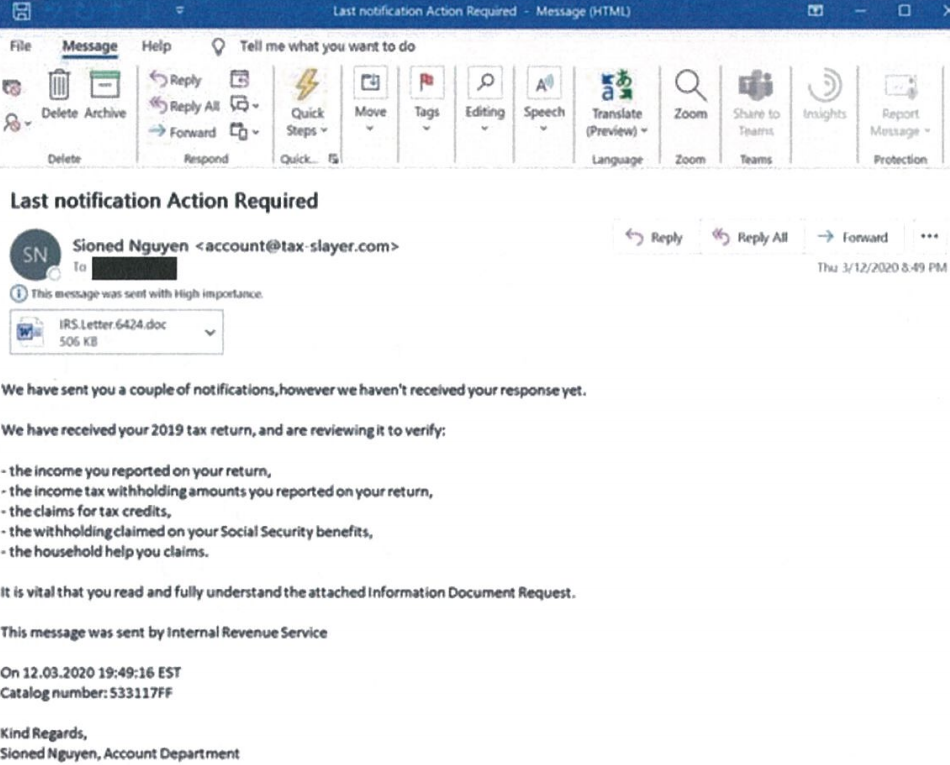
A spam email from 2020 containing a Trickbot-infected attachment. Image: Microsoft.
“During the height of the COVID-19 pandemic in 2020, Trickbot targeted hospitals and healthcare centers, launching a wave of ransomware attacks against hospitals across the United States,” the sanctions notice continued. “In one of these attacks, the Trickbot Group deployed ransomware against three Minnesota medical facilities, disrupting their computer networks and telephones, and causing a diversion of ambulances. Members of the Trickbot Group publicly gloated over the ease of targeting the medical facilities and the speed with which the ransoms were paid to the group.”
Only one of the men sanctioned today is known to have been criminally charged in connection with hacking activity. According to the Treasury Department, the alleged senior leader of the Trickbot group is 34-year-old Russian national Vitaly “Bentley” Kovalev.
A New Jersey grand jury indicted Kovalev in 2012 after an investigation by the U.S. Secret Service determined that he ran a massive “money mule” scheme, which used phony job offers to trick people into laundering money stolen from hacked small to mid-sized businesses in the United States. The 2012 indictment against Kovalev relates to cybercrimes he allegedly perpetrated prior to the creation of Trickbot.
In 2015, Kovalev reportedly began filming a movie in Russia about cybercrime called “Botnet.” According to a 2016 story from Forbes.ru, Botnet’s opening scene was to depict the plight of Christina Svechinskaya, a Russian student arrested by FBI agents in September 2010.

Christina Svechinskaya, a money mule hired by Bentley who was arrested by the FBI in 2010.
Svechinskaya was one of Bentley’s money mules, most of whom were young Russian students on summer travel visas in the United States. She was among 37 alleged mules charged with aiding an international cybercrime operation — basically, setting up phony corporate bank accounts for the sole purpose of laundering stolen funds.
Although she possessed no real hacking skills, Svechinskaya’s mugshot and social media photos went viral online and she was quickly dubbed “the world’s sexiest computer hacker” by the tabloids.
Kovalev’s Botnet film project was disrupted after Russian authorities raided the film production company’s offices as part of a cybercrime investigation. In February 2016, Reuters reported that the raid was connected to a crackdown on “Dyre,” a sophisticated trojan that U.S. federal investigators say was the precursor to the Trickbot malware. The Forbes.ru article cited sources close to the investigation who said the film studio was operating as a money-laundering front for the cybercrooks behind Dyre.
But shifting political winds in Russia would soon bring high treason charges against three of the Russian cybercrime investigators tied to the investigation into the film studio. In a major shakeup in 2017, the Kremlin levied treason charges against Sergey Mikhaylov, then deputy chief of Russia’s top anti-cybercrime unit.
Also charged with treason was Ruslan Stoyanov, then a senior employee at Russian security firm Kaspersky Lab [the Forbes.ru report from 2016 said investigators from Mikhaylov’s unit and Kaspersky Lab were present at the film company raid].
Russian media outlets have speculated that the men were accused of treason for helping American cybercrime investigators pursue top Russian hackers. However, the charges against both men were classified and have never been officially revealed. After their brief, closed trial, both men were convicted of treason. Mikhaylov was given a 22 year prison sentence; Stoyanov was sentenced to 14 years in prison.
In September 2021, the Kremlin issued treason charges against Ilya Sachkov, formerly head of the cybersecurity firm Group-IB. According to Reuters, Sachkov and his company were hired by the film studio “to advise the Botnet director and writers on the finer points of cybercrime.” Sachkov remains imprisoned in Russia pending his treason trial.
Trickbot was heavily used by Conti and Ryuk, two of Russia’s most ruthless and successful ransomware groups. Blockchain analysis firm Chainalysis estimates that in 2021 alone, Conti extorted more than USD $100 million from its hacking victims; Chainalysis estimates Ryuk extorted more than USD $150 million from its ransomware victims.
The U.S. cybersecurity firm CrowdStrike has long tracked the activities of Trickbot, Ryuk and Conti under the same moniker — “Wizard Spider” — which CrowdStrike describes as “a Russia-nexus cybercriminal group behind the core development and distribution of a sophisticated arsenal of criminal tools, that allow them to run multiple different types of operations.”
“CrowdStrike Intelligence has observed WIZARD SPIDER targeting multiple countries and industries such as academia, energy, financial services, government, and more,” said Adam Meyers, head of intelligence at CrowdStrike.
This is not the U.S. government’s first swipe at the Trickbot group. In early October 2020, KrebsOnSecurity broke the news that someone had launched a series of coordinated attacks designed to disrupt the Trickbot botnet. A week later, The Washington Post ran a story saying the attack on Trickbot was the work of U.S. Cyber Command, a branch of the Department of Defense headed by the director of the U.S. National Security Agency (NSA).
Days after Russia invaded Ukraine in February 2022, a Ukrainian researcher leaked several years of internal chat logs from the Conti ransomware gang. Those candid conversations offer a fascinating view into the challenges of running a sprawling criminal enterprise with more than 100 salaried employees. They also showed that Conti enjoyed protection from prosecution by Russian authorities, as long as the hacker group took care not to target Russian organizations.
In addition, the leaked Conti chats confirmed there was considerable overlap in the operation and leadership of Conti, Trickbot and Ryuk.
CrowdStrike’s Meyers said while Wizard Spider operations have significantly reduced following the demise of Conti in June 2022, today’s sanctions will likely cause temporary disruptions for the cybercriminal group while they look for ways to circumvent the financial restrictions — which make it illegal to transact with or hold the assets of sanctioned persons or entities.
“Often, when cybercriminal groups are disrupted, they will go dark for a time only to rebrand under a new name,” Meyers said.
The prosecution of Kovalev and six other men named in today’s sanctions is being handled by the U.S. Attorney’s Office in New Jersey. A copy of the now-unsealed 2012 indictment of Kovalev is here (PDF).
from Krebs on Security https://ift.tt/T9Eptfc
via IFTTT
Latest epsiode. Listen now!
from Naked Security https://ift.tt/FaJy0Is
via IFTTT
 Pacosite's Blog