Today, Microsoft is officially pulling the plug on its support for Windows 7. What’s your plan?
The post Windows 7 end of life: Time to move on appeared first on WeLiveSecurity
from WeLiveSecurity https://ift.tt/2srt0Jo
via IFTTT

Today, Microsoft is officially pulling the plug on its support for Windows 7. What’s your plan?
The post Windows 7 end of life: Time to move on appeared first on WeLiveSecurity
from WeLiveSecurity https://ift.tt/2srt0Jo
via IFTTT
Sources tell KrebsOnSecurity that Microsoft Corp. is slated to release a software update on Tuesday to fix an extraordinarily serious security vulnerability in a core cryptographic component present in all versions of Windows. Those sources say Microsoft has quietly shipped a patch for the bug to branches of the U.S. military and to other high-value customers/targets that manage key Internet infrastructure, and that those organizations have been asked to sign agreements preventing them from disclosing details of the flaw prior to Jan. 14, the first Patch Tuesday of 2020.
According to sources, the vulnerability in question resides in a Windows component known as crypt32.dll, a Windows module that Microsoft says handles “certificate and cryptographic messaging functions in the CryptoAPI.” The Microsoft CryptoAPI provides services that enables developers to secure Windows-based applications using cryptography, and includes functionality for encrypting and decrypting data using digital certificates.
A critical vulnerability in this Windows component could have wide-ranging security implications for a number of important Windows functions, including authentication on Windows desktops and servers, the protection of sensitive data handled by Microsoft’s Internet Explorer/Edge browsers, as well as a number of third-party applications and tools.
Equally concerning, a flaw in crypt32.dll might also be abused to spoof the digital signature tied to a specific piece of software. Such a weakness could be exploited by attackers to make malware appear to be a benign program that was produced and signed by a legitimate software company.
This component was introduced into Windows more than 20 years ago — back in Windows NT 4.0. Consequently, all versions of Windows are likely affected (including Windows XP, which is no longer being supported with patches from Microsoft).
Microsoft has not yet responded to requests for comment. However, KrebsOnSecurity has heard rumblings from several sources over the past 48 hours that this Patch Tuesday (tomorrow) will include a doozy of an update that will need to be addressed immediately by all organizations running Windows.
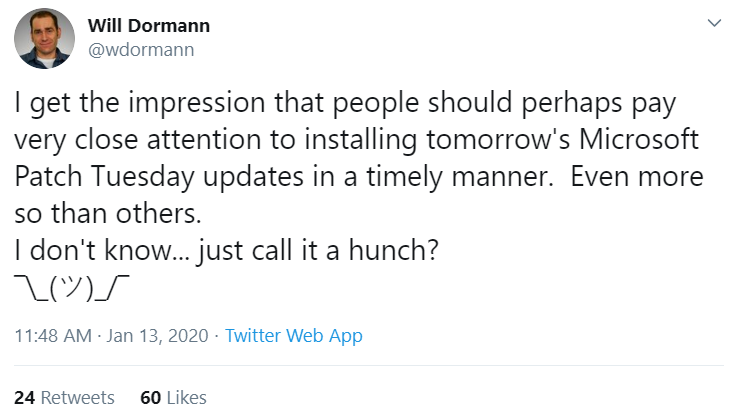
Will Dormann, a security researcher who authors many of the vulnerability reports for the CERT Coordination Center (CERT-CC), tweeted today that “people should perhaps pay very close attention to installing tomorrow’s Microsoft Patch Tuesday updates in a timely manner. Even more so than others. I don’t know…just call it a hunch?” Dormann declined to elaborate on that teaser.
It could be that the timing and topic here (cryptography) is nothing more than a coincidence, but KrebsOnSecurity today received a heads up from the U.S. National Security Agency (NSA) stating that NSA’s Director of Cybersecurity Anne Neuberger is slated to host a call on Jan. 14 with the news media that “will provide advanced notification of a current NSA cybersecurity issue.”
The NSA’s public affairs folks did not respond to requests for more information on the nature or purpose of the discussion. The invitation from the agency said only that the call “reflects NSA’s efforts to enhance dialogue with industry partners regarding its work in the cybersecurity domain.”
Stay tuned for tomorrow’s coverage of Patch Tuesday and possibly more information on this particular vulnerability.
from Krebs on Security https://ift.tt/2t5z9vd
via IFTTT
The attack may have compromised donors’ payment information.
from Dark Reading: https://ift.tt/2FMDxC4
via IFTTT
Organizations need to apply mitigations for vulnerability in Citrix Application Delivery Controller and Citrix Gateway ASAP, security researchers say.
from Dark Reading: https://ift.tt/2tUA9SU
via IFTTT
If you can answer these six questions, you’ll be off to a great start.
from Dark Reading: https://ift.tt/2tUJRVd
via IFTTT
Windows 7 and Server 2008 will continue to work after Jan. 14, 2020, but will no longer receive security updates.
from Dark Reading: https://ift.tt/35Q67gr
via IFTTT
Wondering how this guy could be so clumsy? So is he.
from Dark Reading: https://ift.tt/2smLsTt
via IFTTT
When it comes to protection against this insidious type of scam, the telcos’ authentication procedures leave a lot be desired, a study finds
The post 5 major US wireless carriers vulnerable to SIM swapping attacks appeared first on WeLiveSecurity
from WeLiveSecurity https://ift.tt/35RebgC
via IFTTT
Anyone searching for a primer on how to spot clever phishing links need look no further than those targeting customers of Apple, whose brand by many measures remains among the most-targeted. Past stories here have examined how scammers working with organized gangs try to phish iCloud credentials from Apple customers who have a mobile device that is lost or stolen. Today’s piece looks at the well-crafted links used in some of these lures.
KrebsOnSecurity heard from a reader in South Africa who recently received a text message stating his lost iPhone X had been found. The message addressed him by name and said he could view the location of his wayward device by visiting the link https://maps-icloud%5B.%5Dcom — which is most definitely not a legitimate Apple or iCloud link and is one of countless spoofing Apple’s “Find My” service for locating lost Apple devices.
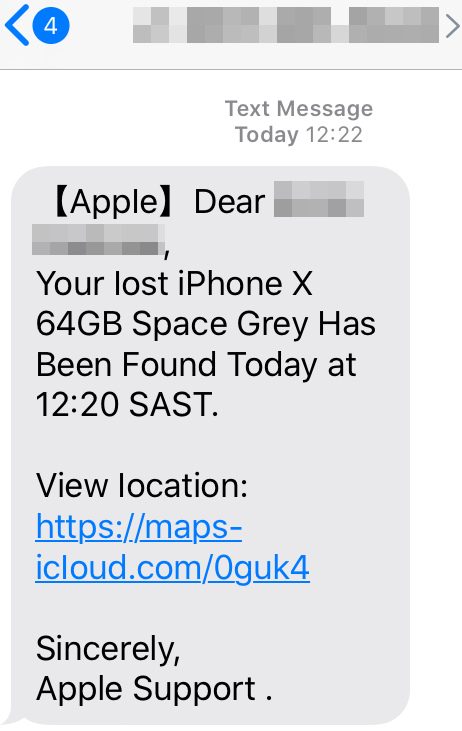
While maps-icloud[.]com is not a particularly convincing phishing domain, a review of the Russian server where that domain is hosted reveals a slew of far more persuasive links spoofing Apple’s brand. Almost all of these include encryption certificates (start with “https://) and begin with the subdomains “apple.” or “icloud.” followed by a domain name starting with “com-“.
Here are just a few examples (the phishing links in this post have been hobbled with brackets to keep them from being clickable):
apple.com-support[.]id
apple.com-findlocation[.]id
apple.com-sign[.]in
apple.com-isupport[.]in
icloud.com-site-log[.]in
Savvy readers here no doubt already know this, but to find the true domain referenced in a link, look to the right of “http(s)://” until you encounter the first forward slash (/). The domain directly to the left of that first slash is the true destination; anything that precedes the second dot to the left of that first slash is a subdomain and should be ignored for the purposes of determining the true domain name.
For instance, in the case of the imaginary link below, example.com is the true destination, not apple.com:
Of course, any domain can be used as a redirect to any other domain. Case in point: Targets of the phishing domains above who are undecided on whether the link refers to a legitimate Apple site might seek to load the base domain into a Web browser (minus the customization in the remainder of the link after the first forward slash). To assuage such concerns, the phishers in this case will forward anyone visiting those base domains to Apple’s legitimate iCloud login page (icloud.com).
The best advice to sidestep phishing scams is to avoid clicking on links that arrive unbidden in emails, text messages and other mediums. Most phishing scams invoke a temporal element that warns of dire consequences should you fail to respond or act quickly. If you’re unsure whether the message is legitimate, take a deep breath and visit the site or service in question manually — ideally, using a browser bookmark so as to avoid potential typosquatting sites.
from Krebs on Security https://ift.tt/3a8Jh6K
via IFTTT
The Manor Independent School District is investigating a phishing email scam that led to three separate fraudulent transactions.
from Dark Reading: https://ift.tt/3a2oUbw
via IFTTT

