Sería una especia de copia digital de una persona que se quiera recrear
from Tendencias – Digital Trends Español https://ift.tt/3pWLA4d
via IFTTT

Sería una especia de copia digital de una persona que se quiera recrear
from Tendencias – Digital Trends Español https://ift.tt/3pWLA4d
via IFTTT
In October 2020, KrebsOnSecurity looked at how a web of sites connected to conspiracy theory movements QAnon and 8chan were being kept online by DDoS-Guard, a dodgy Russian firm that also hosts the official site for the terrorist group Hamas. New research shows DDoS-Guard relies on data centers provided by a U.S.-based publicly traded company, which experts say could be exposed to civil and criminal liabilities as a result of DDoS-Guard’s business with Hamas.
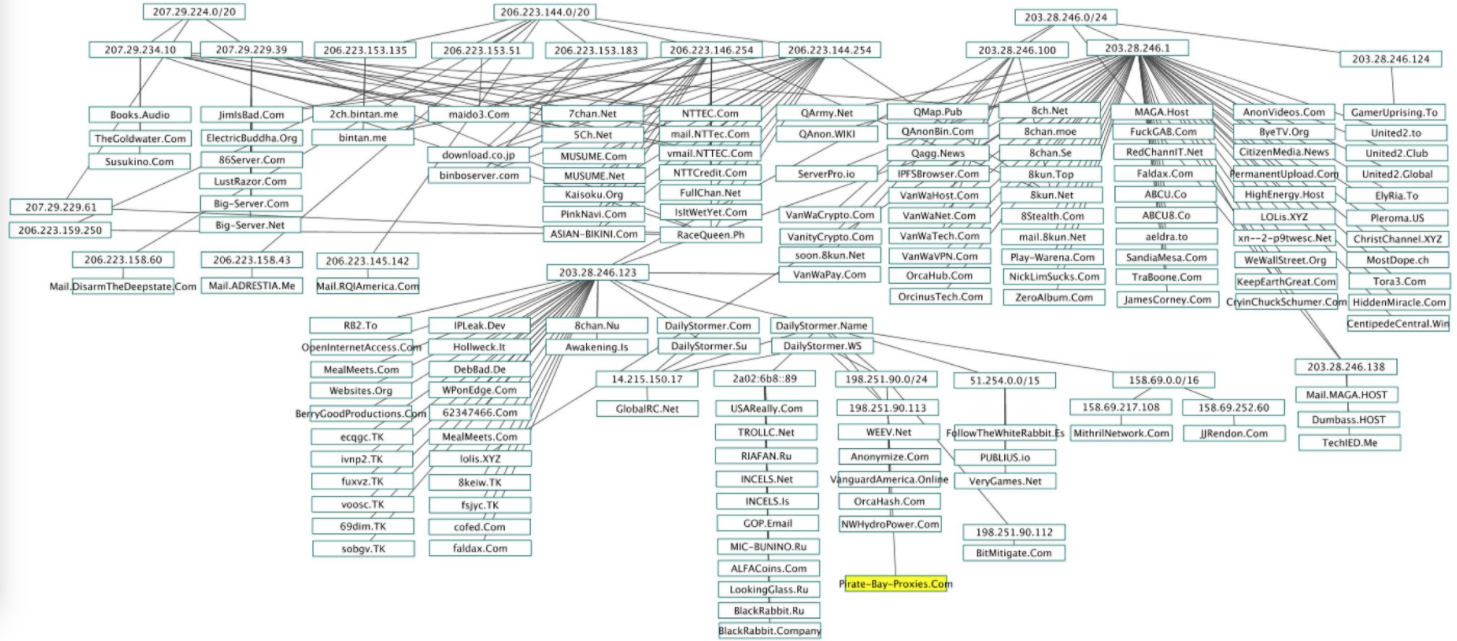
Many of the IP address ranges in in this map of QAnon and 8Chan-related sites — are assigned to VanwaTech. Source: twitter.com/Redrum_of_Crows
Last year’s story examined how a phone call to Oregon-based CNServers was all it took to briefly sideline multiple websites related to 8chan/8kun — a controversial online image board linked to several mass shootings — and QAnon, the far-right conspiracy theory which holds that a cabal of Satanic pedophiles is running a global child sex-trafficking ring and plotting against President Donald Trump.
From that piece:
A large number of 8kun and QAnon-related sites (see map above) are connected to the Web via a single Internet provider in Vancouver, Wash. called VanwaTech (a.k.a. “OrcaTech“). Previous appeals to VanwaTech to disconnect these sites have fallen on deaf ears, as the company’s owner Nick Lim reportedly has been working with 8kun’s administrators to keep the sites online in the name of protecting free speech.
After that story, CNServers and a U.K.-based hosting firm called SpartanHost both cut ties with VanwaTech. Following a brief disconnection, the sites came back online with the help of DDoS-Guard, an Internet company based in St. Petersburg, Russia. DDoS-Guard is now VanwaTech’s sole connection to the larger Internet.
A review of the several thousand websites hosted by DDoS-Guard is revelatory, as it includes a vast number of phishing sites and domains tied to cybercrime services or forums online.
Replying to requests for comment from a CBSNews reporter following up on my Oct. 2020 story, DDoS-Guard issued a statement saying, “We observe network neutrality and are convinced that any activity not prohibited by law in our country has the right to exist.”
But experts say DDoS-Guard’s business arrangement with a Denver-based publicly traded data center firm could create legal headaches for the latter thanks to the Russian company’s support of Hamas.
In a press release issued in late 2019, DDoS-Guard said its services rely in part on a traffic-scrubbing facility in Los Angeles owned by CoreSite [NYSE:COR], a real estate investment trust which invests in “carrier-neutral data centers and provides colocation and peering services.”
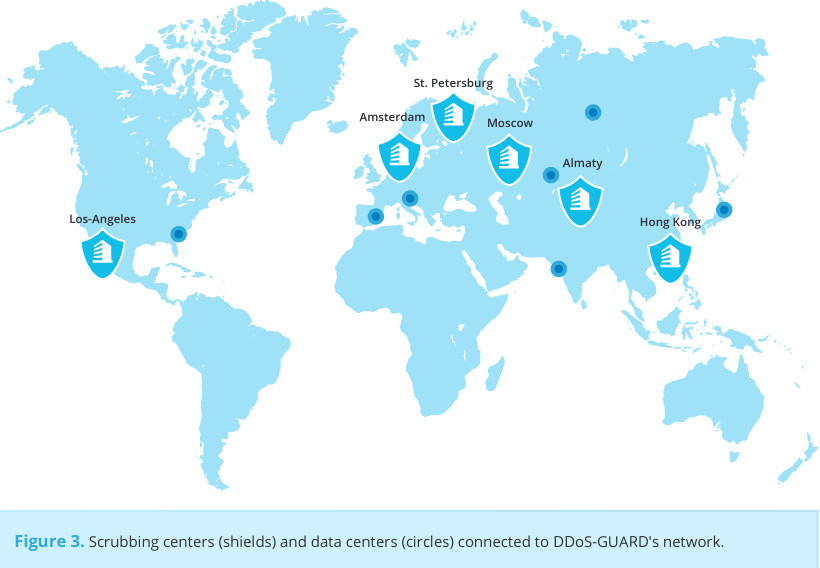
This facilities map published by DDoS-Guard suggests the company’s network actually has at least two points of presence in the United States.
Hamas has long been named by the U.S. Treasury and State departments as a Specially Designated Global Terrorist (SDGT) organization. Under such a designation, any U.S. person or organization that provides money, goods or services to an SDGT entity could face civil and/or criminal prosecution and hefty fines ranging from $250,000 to $1 million per violation.
Sean Buckley, a former Justice Department prosecutor with the law firm Kobre & Kim, said U.S. persons and companies within the United States “are prohibited from any transaction or dealing in property or interests in property blocked pursuant to an entity’s designation as a SDGT, including but not limited to the making or receiving of any contribution of funds, goods, or services to or for the benefit of individuals or entities so designated.”
CoreSite did not respond to multiple requests for comment. But Buckley said companies can incur fines and prosecution for violating SDGT sanctions even when they don’t know that they are doing so.
In 2019, for example, a U.S. based cosmetics company was fined $1 million after investigators determined its eyelash kits were sourcing materials from North Korea, even though the supplier in that case told the cosmetics firm the materials had come from China.
“U.S. persons or companies found to willfully violate these regulations can be subject to criminal penalties under the International Emergency Economic Powers Act,” Buckley said. “However, even in the case that they are unaware they’re violating these regulations, or if the transaction isn’t directly with the sanctioned entity, these companies still run a risk of facing substantial civil and monetary penalties by the Department of Treasury’s Office of Foreign Asset Control if the sanctioned entity stands to benefit from such a transaction.”
DDoS-Guard said its partnership with CoreSite will help its stable of websites load more quickly and reliably for people visiting them from the United States. It is possible that when and if CoreSite decides it’s too risky to continue doing business with DDoS-Guard, sites like those affiliated with Hamas, QAnon and 8Chan may become more difficult to reach.
Meanwhile, DDoS-Guard customer VanwaTech continues to host a slew of sites promoting the conspiracy theory that the U.S. 2020 presidential election was stolen from President Donald Trump via widespread voting fraud and hacked voting machines, including maga[.]host, donaldsarmy[.]us, and donaldwon[.]com.
These sites are being used to help coordinate a protest rally in Washington, D.C. on January 6, 2021, the same day the U.S. Congress is slated to count electoral votes certified by the Electoral College, which in December elected Joseph R. Biden as the 46th president of The United States.
In a tweet late last year, President Trump urged his supporters to attend the Jan. 6 protest, saying the event “will be wild.”
8chan, which has rebranded as 8kun, has been linked to white supremacism, neo-Nazism, antisemitism, multiple mass shootings, and child pornography. The FBI in 2019 identified QAnon as a potential domestic terror threat, noting that some of its followers have been linked to violent incidents motivated by fringe beliefs.
from Krebs on Security https://ift.tt/3om18hA
via IFTTT

La aplicación de salud de Samsung se prepara para arrancar el año empujando uno de los propósitos más habituales: hacer ejercicio. ¿Y qué mejor manera para estimularlo que compitiendo entre amigos? Pues la aplicación se prepara para llenar uno de los huecos que faltaban: retar hasta a nueve personas en competiciones en grupo.
De entre todas las aplicaciones para registrar el ejercicio que existen hay un tipo de apps que suelen ofrecer gran cantidad de funciones sin hacer uso de anuncios y suscripciones: las aplicaciones de marca. Por ejemplo, Google Fit es una gran opción, también Xiaomi Mi Fit o Huawei Salud. Y Samsung Health es uno de los pilares de la experiencia deportiva en dispositivos Samsung que también puede instalarse en otros móviles. Esta ubicuidad favorece la nueva opción que llega este enero: Samsung por fin integra las competiciones con varios amigos.
Repasamos algunos de los gadgets más raros que se han visto en la CES
from Tendencias – Digital Trends Español https://ift.tt/3bnOb3d
via IFTTT
El atacante tendría más datos de otras instituciones bancarias mexicanas
from Tendencias – Digital Trends Español https://ift.tt/2MB5e7r
via IFTTT
Te presentamos los mejores audífonos para correr y disfrutar de tu música favorita al mismo tiempo.
from Tendencias – Digital Trends Español https://ift.tt/3ksEuBN
via IFTTT
Creo que a estas alturas, y menos en un blog como este, no hay nadie que no sepa que hay compañías que respetan poco o nada nuestra privacidad. Las más importantes son Facebook y Google, ambas compañías cuya fuente de ingresos más importante es la publicidad. Para poder ofrecernos anuncios personalizados, necesitan nuestra información, y lo saben prácticamente todo de nosotros. Compañías como Firefox o Apple quieren que esto cambie, pero, lógicamente no todos piensan lo mismo.
Este nuevo episodio sobre la privacidad empezó en septiembre. Apple lanzaba iOS 14, y una de sus novedades era una función que informaba a los usuarios sobre los datos que recopilaba cualquier app. Facebook se quejó de esto desde antes del lanzamiento de la versión estable de iOS 14, motivo por el cual la compañía de Cupertino retrasó la llegada de esta función a iOS 14.3. Mark Zuckerberg también llenó los periódicos de publicidad atacando a Apple asegurando de que esto sería malo para las pymes, pero Tim Cook y su equipo han seguido adelante con su plan: la función de privacidad ya está disponible.
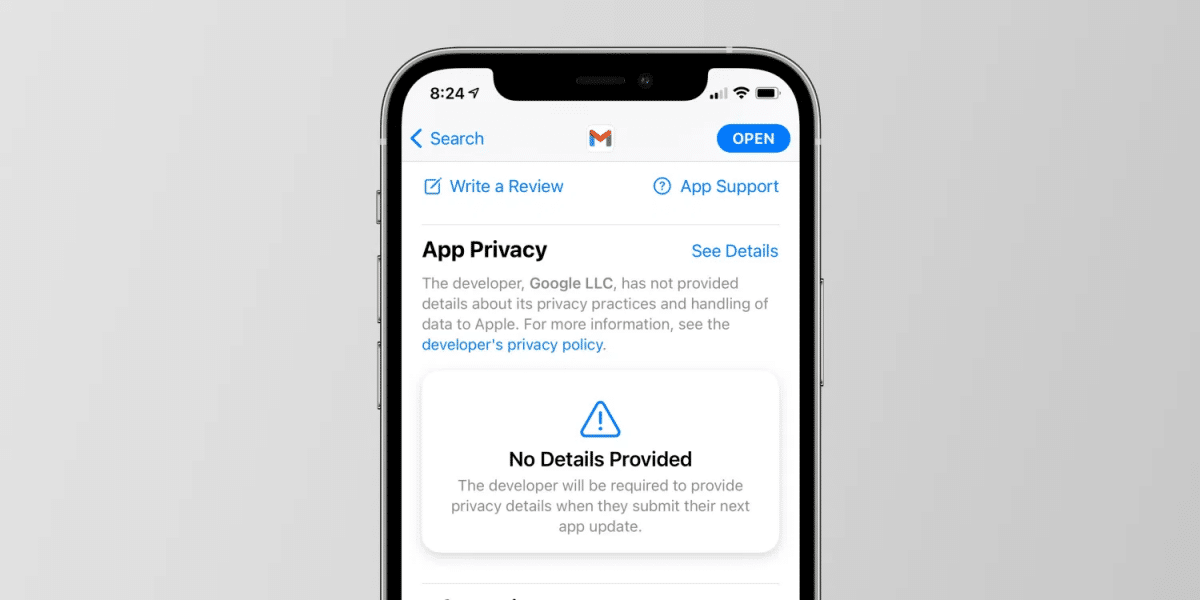
Ahora, cualquier desarrollador que quiera entregar una app al App Store de iOS debe aportar una nueva información, concretamente qué datos recoge del usuario que instale y ejecute dicha app. Tal y como informa Fast Company (vía 9to5mac, de donde también hemos cogido la imagen), Google actualizó sus apps el día 7 de diciembre, un día antes de que Apple obligara a los desarrolladores a añadir esta información a sus apps. Ahora mismo, si entramos al apartado de la nueva función de iOS 14.3, sólo vemos un mensaje que reza «No se han proporcionado detalles».
Cualquier usuario escéptico, como yo mismo, puede pensar que aún no ha pasado un mes desde la última actualización y que esto podría no significar nada, pero es que las apps de Android sí han subido actualizaciones, varias, de hecho, lo que hace pensar que, sencillamente, Google no quiere ser transparente. La otra posibilidad es que la compañía esté reescribiendo sus apps para que no recojan tanta información, ya que, de ser mucho lo que nos «roban», sólo obtendrían mala publicidad.
Ahora quedan por ver dos cosas: cuándo actualiza sus apps para iOS Google y qué pone en este apartado de privacidad. Personalmente, tengo ganas de que llegue ese momento, y probablemente alguno termine buscando alternativas a sus apps y servicios.
from Linux Adictos https://ift.tt/2KVvCsl
via IFTTT
Proposition 24 will change Californians’ rights and business’s responsibilities regarding consumer data protection.
from Dark Reading: https://ift.tt/3pX9k8p
via IFTTT
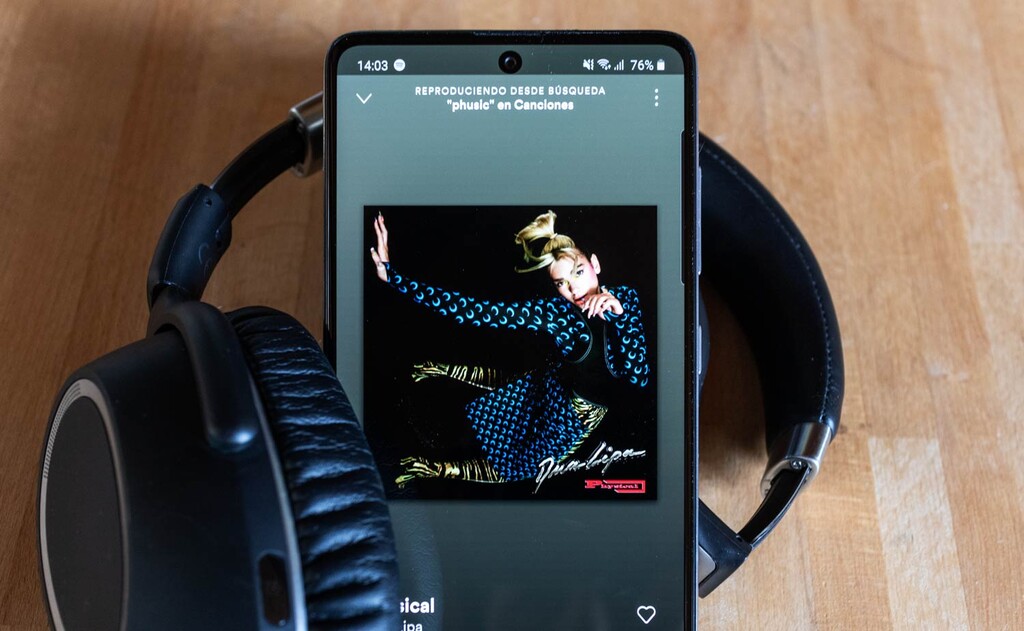
El salto de volumen al apretar los botones del teléfono puede ser excesivo, sobre todo si el entorno es silencioso y sólo se busca un poco más de potencia. Los Samsung Galaxy no permiten la personalización directa de los niveles, pero sí hay una app con la que puede realizarse dicha personalización: Sound Assistant. Te explicamos cómo funciona.
Escuchar música con los auriculares es algo habitual en un móvil ya que éste permite reproducir un ingente catálogo musical, todo dependerá de a qué servicios te suscribas o qué canciones subas al dispositivo. Ahora bien: ¿te has encontrado con que el salto del volumen no se adapta a tus gustos? Seguro que te habrá pasado: vas a subir dicho volumen porque te gusta una canción y el audio pasa a sonar muy fuerte. O al contrario, quizá termine sonando demasiado bajo con sólo un toque. Pues bien: los Samsung Galaxy tienen una sencilla solución.
If snooping and falsifying web traffic is so easy when plain old HTTP is used, why do we still have HTTP at all?
from Naked Security https://ift.tt/2JOX9Lm
via IFTTT
 Pacosite's Blog