Whether you’re new to home schooling or an old hand, it’s worth taking a moment to ensure you’re doing it securely.
from Naked Security https://ift.tt/3i7V89E
via IFTTT

Whether you’re new to home schooling or an old hand, it’s worth taking a moment to ensure you’re doing it securely.
from Naked Security https://ift.tt/3i7V89E
via IFTTT
Data is an organization’s most valuable asset, so a data-centric approach would provide the best value for organizations, now and in the future.
from Dark Reading: https://ift.tt/3i7Jf3J
via IFTTT
Erlang Cookie – Remote Code Execution
from Exploit-DB.com RSS Feed https://ift.tt/2N0nNSK
via IFTTT
ESET researchers uncover attacks targeting Colombian government institutions and private companies, especially from the energy and metallurgical industries
The post Operation Spalax: Targeted malware attacks in Colombia appeared first on WeLiveSecurity
from WeLiveSecurity https://ift.tt/38DdVXa
via IFTTT
Microsoft today released updates to plug more than 80 security holes in its Windows operating systems and other software, including one that is actively being exploited and another which was disclosed prior to today. Ten of the flaws earned Microsoft’s most-dire “critical” rating, meaning they could be exploited by malware or miscreants to seize remote control over unpatched systems with little or no interaction from Windows users.
Most concerning of this month’s batch is probably a critical bug (CVE-2021-1647) in Microsoft’s default anti-malware suite — Windows Defender — that is seeing active exploitation. Microsoft recently stopped providing a great deal of detail in their vulnerability advisories, so it’s not entirely clear how this is being exploited.
But Kevin Breen, director of research at Immersive Labs, says depending on the vector the flaw could be trivial to exploit.
“It could be as simple as sending a file,” he said. “The user doesn’t need to interact with anything, as Defender will access it as soon as it is placed on the system.”
Fortunately, this bug is probably already patched by Microsoft on end-user systems, as the company continuously updates Defender outside of the normal monthly patch cycle.
Breen called attention to another critical vulnerability this month — CVE-2020-1660 — which is a remote code execution flaw in nearly every version of Windows that earned a CVSS score of 8.8 (10 is the most dangerous).
“They classify this vulnerability as ‘low’ in complexity, meaning an attack could be easy to reproduce,” Breen said. “However, they also note that it’s ‘less likely’ to be exploited, which seems counterintuitive. Without full context of this vulnerability, we have to rely on Microsoft to make the decision for us.”
CVE-2020-1660 is actually just one of five bugs in a core Microsoft service called Remote Procedure Call (RPC), which is responsible for a lot of heavy lifting in Windows. Some of the more memorable computer worms of the last decade spread automatically by exploiting RPC vulnerabilities.
Allan Liska, senior security architect at Recorded Future, said while it is concerning that so many vulnerabilities around the same component were released simultaneously, two previous vulnerabilities in RPC — CVE-2019-1409 and CVE-2018-8514 — were not widely exploited.
The remaining 70 or so flaws patched this month earned Microsoft’s less-dire “important” ratings, which is not to say they’re much less of a security concern. Case in point: CVE-2021-1709, which is an “elevation of privilege” flaw in Windows 8 through 10 and Windows Server 2008 through 2019.
“Unfortunately, this type of vulnerability is often quickly exploited by attackers,” Liska said. “For example, CVE-2019-1458 was announced on December 10th of 2019, and by December 19th an attacker was seen selling an exploit for the vulnerability on underground markets. So, while CVE-2021-1709 is only rated as [an information exposure flaw] by Microsoft it should be prioritized for patching.”
Trend Micro’s ZDI Initiative pointed out another flaw marked “important” — CVE-2021-1648, an elevation of privilege bug in Windows 8, 10 and some Windows Server 2012 and 2019 that was publicly disclosed by ZDI prior to today.
“It was also discovered by Google likely because this patch corrects a bug introduced by a previous patch,” ZDI’s Dustin Childs said. “The previous CVE was being exploited in the wild, so it’s within reason to think this CVE will be actively exploited as well.”
Separately, Adobe released security updates to tackle at least eight vulnerabilities across a range of products, including Adobe Photoshop and Illustrator. There are no Flash Player updates because Adobe retired the browser plugin in December (hallelujah!), and Microsoft’s update cycle from last month removed the program from Microsoft’s browsers.
Windows 10 users should be aware that the operating system will download updates and install them all at once on its own schedule, closing out active programs and rebooting the system. If you wish to ensure Windows has been set to pause updating so you have ample opportunity to back up your files and/or system, see this guide.
Please back up your system before applying any of these updates. Windows 10 even has some built-in tools to help you do that, either on a per-file/folder basis or by making a complete and bootable copy of your hard drive all at once. You never know when a patch roll-up will bork your system or possibly damage important files. For those seeking more flexible and full-featured backup options (including incremental backups), Acronis and Macrium are two that I’ve used previously and are worth a look.
That said, there don’t appear to be any major issues cropping up yet with this month’s update batch. But before you apply updates consider paying a visit to AskWoody.com, which usually has the skinny on any reports about problematic patches.
As always, if you experience glitches or issues installing any of these patches this month, please consider leaving a comment about it below; there’s a better-than-even chance other readers have experienced the same and may chime in here with some helpful tips.
from Krebs on Security https://ift.tt/3nEsP3U
via IFTTT
Phishing is when an attacker attempts to fool you into clicking on a malicious link or opening an attachment in an email. Be suspicious of any email or online message that creates a strong sense of urgency, has bad spelling or addresses you as "Dear Customer."
from SANS Institute Security Awareness Tip of the Day https://ift.tt/2Jz32Hp
via IFTTT
Security researchers have disclosed a vulnerability they exploited to access more than 100,000 private employee records.
from Dark Reading: https://ift.tt/3oH2pQh
via IFTTT
A third piece of malware is uncovered, but there’s still plenty of unknowns about the epic attacks purportedly out of Russia.
from Dark Reading: https://ift.tt/38DkIjZ
via IFTTT
Microsoft patched 83 bugs, including a Microsoft Defender zero-day and one publicly known elevation of privilege flaw.
from Dark Reading: https://ift.tt/3bw5JKf
via IFTTT
New research into the malware that set the stage for the megabreach at IT vendor SolarWinds shows the perpetrators spent months inside the company’s software development labs honing their attack before inserting malicious code into updates that SolarWinds then shipped to thousands of customers. More worrisome, the research suggests the insidious methods used by the intruders to subvert the company’s software development pipeline could be repurposed against many other major software providers.
In a blog post published Jan. 11, SolarWinds said the attackers first compromised its development environment on Sept. 4, 2019. Soon after, the attackers began testing code designed to surreptitiously inject backdoors into Orion, a suite of tools used by many Fortune 500 firms and a broad swath of the federal government to manage their internal networks.
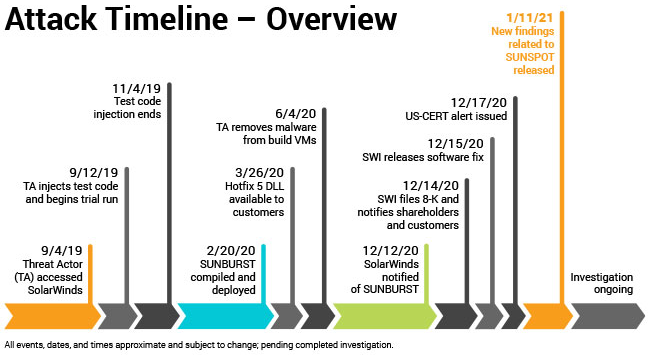
Image: SolarWinds.
According to SolarWinds and a technical analysis from CrowdStrike, the intruders were trying to work out whether their “Sunspot” malware — designed specifically for use in undermining SolarWinds’ software development process — could successfully insert their malicious “Sunburst” backdoor into Orion products without tripping any alarms or alerting Orion developers.
In October 2019, SolarWinds pushed an update to their Orion customers that contained the modified test code. By February 2020, the intruders had used Sunspot to inject the Sunburst backdoor into the Orion source code, which was then digitally signed by the company and propagated to customers via SolarWinds’ software update process.
Crowdstrike said Sunspot was written to be able to detect when it was installed on a SolarWinds developer system, and to lie in wait until specific Orion source code files were accessed by developers. This allowed the intruders to “replace source code files during the build process, before compilation,” Crowdstrike wrote.
The attackers also included safeguards to prevent the backdoor code lines from appearing in Orion software build logs, and checks to ensure that such tampering wouldn’t cause build errors.
“The design of SUNSPOT suggests [the malware] developers invested a lot of effort to ensure the code was properly inserted and remained undetected, and prioritized operational security to avoid revealing their presence in the build environment to SolarWinds developers,” CrowdStrike wrote.
A third malware strain — dubbed “Teardrop” by FireEye, the company that first disclosed the SolarWinds attack in December — was installed via the backdoored Orion updates on networks that the SolarWinds attackers wanted to plunder more deeply.
So far, the Teardrop malware has been found on several government networks, including the Commerce, Energy and Treasury departments, the Department of Justice and the Administrative Office of the U.S. Courts.
SolarWinds emphasized that while the Sunspot code was specifically designed to compromise the integrity of its software development process, that same process is likely common across the software industry.
“Our concern is that right now similar processes may exist in software development environments at other companies throughout the world,” said SolarWinds CEO Sudhakar Ramakrishna. “The severity and complexity of this attack has taught us that more effectively combatting similar attacks in the future will require an industry-wide approach as well as public-private partnerships that leverage the skills, insight, knowledge, and resources of all constituents.”
from Krebs on Security https://ift.tt/3i5sO81
via IFTTT

