Absent from privacy policies, the tracking came to light after a breach with Air Canada’s mobile app, then password slurping from Mixpanel.
from Naked Security http://bit.ly/2SiuRf3
via IFTTT

Absent from privacy policies, the tracking came to light after a breach with Air Canada’s mobile app, then password slurping from Mixpanel.
from Naked Security http://bit.ly/2SiuRf3
via IFTTT
A highly targeted, malware-laced phishing campaign landed in the inboxes of multiple credit unions last week. The missives are raising eyebrows because they were sent only to specific anti-money laundering contacts at credit unions, and many credit union sources say they suspect the non-public data may have been somehow obtained from the National Credit Union Administration (NCUA), an independent federal agency that insures deposits at federally insured credit unions.
The USA Patriot Act, passed in the wake of the terror attacks of Sept 11, 2001, requires all financial institutions to appoint at least two Bank Secrecy Act (BSA) contacts responsible for reporting suspicious financial transactions that may be associated with money laundering. U.S. credit unions are required to register these BSA officers with the NCUA.
On the morning of Wednesday, Jan. 30, BSA officers at credit unions across the nation began receiving emails spoofed to make it look like they were sent by BSA officers at other credit unions. The missives addressed each contact by name, claimed that a suspicious transfer from one of the recipient credit union’s customers was put on hold for suspected money laundering, and encouraged recipients to open an attached PDF to review the suspect transaction.
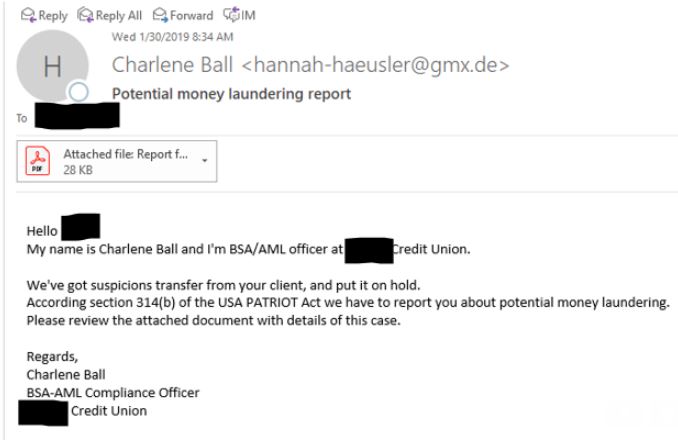
One of the many variations on the malware-laced targeted phishing email sent to dozens of credit unions across the nation last week.
The phishing emails contained grammatical errors and were sent from email addresses not tied to the purported sending credit union. It is not clear if any of the BSA officers who received the messages actually clicked on the attachment, although one credit union source reported speaking with a colleague who feared a BSA contact at their institution may have fallen for the ruse.
One source at an association that works with multiple credit unions who spoke with KrebsOnSecurity on condition of anonymity said many credit unions are having trouble imagining another source for the recipient list other than the NCUA.
“I tried to think of any public ways that the scammers might have received a list of BSA officers, but sites like LinkedIn require contact through the site itself,” the source said. “CUNA [the Credit Union National Association] has BSA certification schools, but they certify state examiners and trade association staff (like me), so non-credit union employees that utilize the school should have received these emails if the list came from them. As far as we know, only credit union BSA officers have received the emails. I haven’t seen anyone who received the email say they were not a BSA officer yet.”
“Wonder where they got the list of BSA contacts at all of our credit unions,” said another credit union source. “They sent it to our BSA officer, and [omitted] said they sent it to her BSA officers.” A BSA officer at a different credit union said their IT department had traced the source of the message they received back to Ukraine.
The NCUA has not responded to multiple requests for comment since Monday. The agency’s instructions for mandatory BSA reporting (PDF) state that the NCUA will not release BSA contact information to the public. Officials with CUNA also did not respond to requests for comment.
A notice posted by the U.S. Treasury Department’s Financial Crimes Enforcement Network (FinCEN) said the bureau was aware of the phishing campaign, and was urging financial institutions to disregard the missives.
The latest scam comes amid a significant rise in successful phishing attacks, according to a non-public alert sent in late January by the U.S. Secret Service to financial institutions nationwide. “The Secret Service is observing a noticeable increase in successful large-scale phishing attacks targeting unsuspecting victims across industry,” the alert warns.
The Secret Service alert reminds readers that we in the United States are entering tax season, which typically brings a large spike in scams designed to siphon personal and financial data. It also includes some helpful reminders, including:
-Never click on links embedded in emails or open any attachments from unknown or suspect fraudulent email accounts.
-Always independently verify any requested information originates from a legitimate source.
-Visit Web sites by entering the domain name yourself (for sensitive sites, preferably by using a bookmark you created previously).
-If you are contacted via phone, hang up, look up the number for the institution at that institution’s Web site, and call back. Do not give out information in an unsolicited phone call.
from Krebs on Security http://bit.ly/2ROkquN
via IFTTT
For the second time in a year, illegal child abuse images have been spotted inside a blockchain. According to a post by web blockchain payments system Money Button, on 30 January its service was abused to place “illegal content” inside the Bitcoin Satoshi Vision (BSV) ledger, a recent cryptocurrency hard fork from Bitcoin Cash [BCH]. […]
from Naked Security http://bit.ly/2tdf6ra
via IFTTT
ESET researchers publish their latest findings on a modular Trojan called DanaBot and on a cryptocurrency stealer that takes the form of clipper malware on Google Play.
The post Week in security with Tony Anscombe appeared first on WeLiveSecurity
from WeLiveSecurity http://bit.ly/2SjPfwF
via IFTTT
A university employee accidentally emailed a spreadsheet containing personal information on every one of the college’s 4,557 students.
from Naked Security http://bit.ly/2GfFhG4
via IFTTT
Cryptocurrency stealers that replace a wallet address in the clipboard are no longer limited to Windows or shady Android app stores
The post First clipper malware discovered on Google Play appeared first on WeLiveSecurity
from WeLiveSecurity http://bit.ly/2I1I8El
via IFTTT
Waze users are helping intoxicated drivers to evade checkpoints and could thus be “engaging in criminal conduct,” say police.
from Naked Security http://bit.ly/2RKJZgg
via IFTTT
So much for creating a three-headed Cerberus marketing-happy chat dog! Also, we’ll soon see the who-what-huh? behind the ads we’re shown.
from Naked Security http://bit.ly/2RQc3yI
via IFTTT
Vulnerable plugin for a remote management tool gave attackers a way to encrypt systems belonging to all customers of a US-based MSP.
from Dark Reading: https://ubm.io/2Dgjiei
via IFTTT
The purchase will add WebRoot’s cloud-based security to the cloud-based data backup and recovery platform of Carbonite.
from Dark Reading: https://ubm.io/2TDn6NA
via IFTTT

