Annual Protest Raises $250K to Cure Krebs

For the second year in a row, denizens of a large German-language online forum have donated more than USD $250,000 to cancer research organizations in protest of a story KrebsOnSecurity published in 2018 that unmasked the creators of Coinhive, a now-defunct cryptocurrency mining service that was massively abused by cybercriminals. Krebs is translated as “cancer” in German.
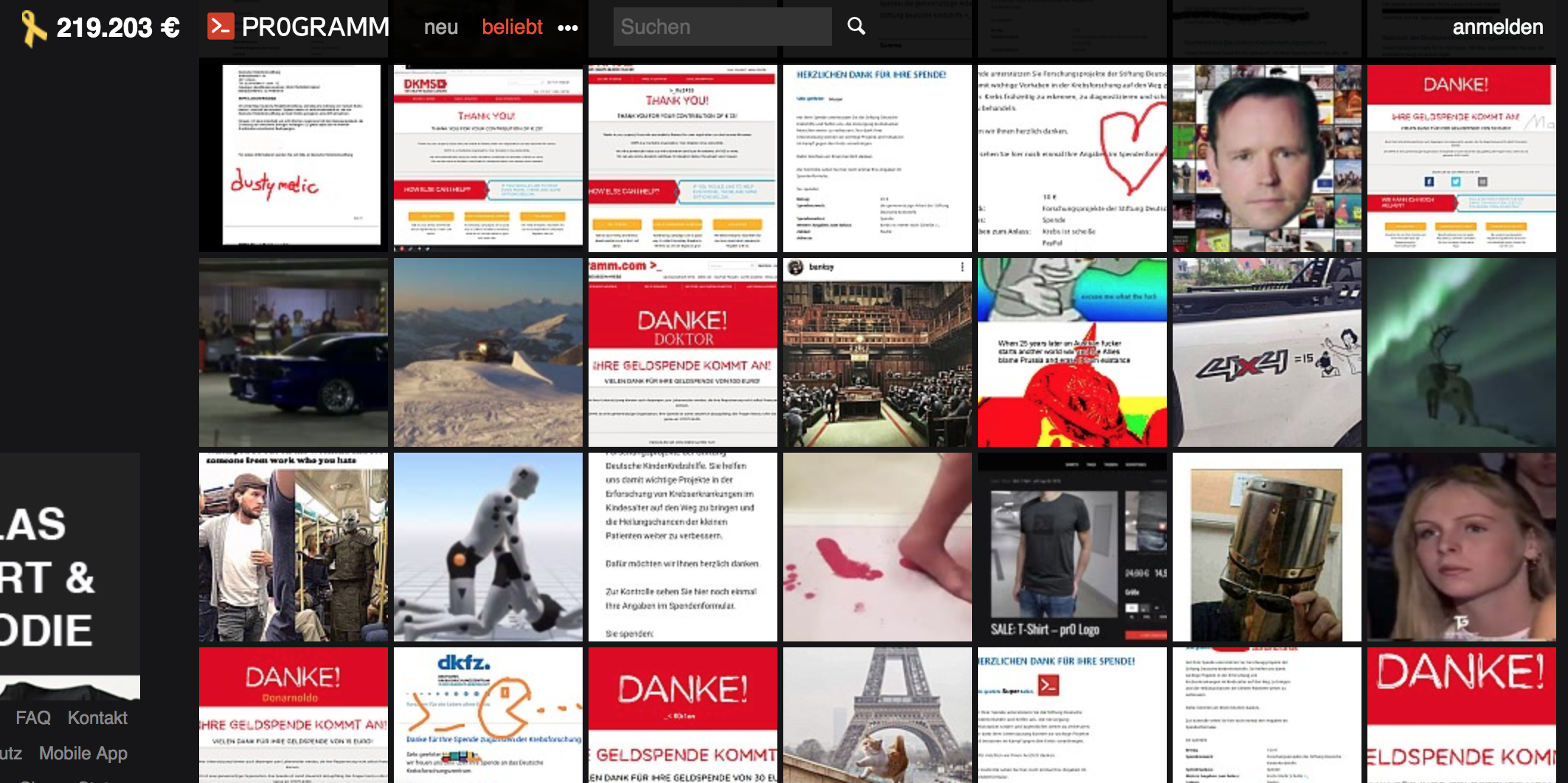
Images posted to the decidedly not-safe-for-work German-language image forum pr0gramm[.]com. Members have posted thousands of thank you receipts from cancer research organizations that benefited from their fight cancer/krebs campaign.

On March 26, 2018, KrebsOnSecurity published Who and What is Coinhive, which showed the founder of Coinhive was the co-creator of the German image hosting and discussion forum pr0gramm[dot]com (not safe for work).  I undertook the research because Coinhive’s code at the time was found on tens of thousands of hacked Web sites, and Coinhive seemed uninterested in curbing widespread abuse of its platform.

Pr0gramm’s top members accused KrebsOnSecurity of violating their privacy, even though all of the research published about them was publicly available online. In protest, the forum’s leaders urged members to donate money to medical research in a bid to find a cure for Krebs (i.e. “cancer”).

All told, thousands of Pr0gramm’s members donated more than USD $250,000 to cancer cure efforts within days of that March 2018 story. This week, the Pr0gramm administrators rallied members to commemorate that successful fundraiser with yet another.

“As announced there will be a donation marathon at anniversary day of Krebsaction,” Pr0gramm’s administrators announced. “Today, March 27th, we’re firing the starting shot for the marathon. Please tag your donation bills properly if they shall be accounted. The official tag is ‘krebsspende.’

According to a running tally on Pr0gramm’s site, this year’s campaign has raised 252,000 euros for cancer research so far, or about USD $284,000. That brings the total that Pr0gramm members have donated to cancer research to more than a half-million dollars.

As a bonus, Coinhive announced last month that it was shutting down, citing a perfect storm of negative circumstances. Coinhive had made structural changes to its systems following my 2018 story so that it would no longer profit from accounts used on hacked Web sites. Perhaps more importantly, the value of the cryptocurrency Coinhive’s code helped to mine dropped precipitously over the past year.

from Krebs on Security https://ift.tt/2OAujMC
via IFTTT
Man Behind Fatal ‘Swatting’ Gets 20 Years

Tyler Barriss, a 26-year-old California man who admitted making a phony emergency call to police in late 2017 that led to the shooting death of an innocent Kansas resident, has been sentenced to 20 years in federal prison.

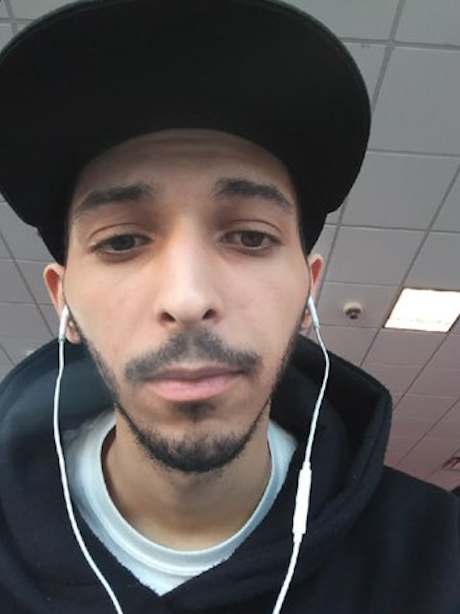
Tyler Barriss, in an undated selfie.

Barriss has admitted to his role in the Kansas man’s death, as well as to dozens of other non-fatal “swatting” attacks. These dangerous hoaxes involve making false claims to emergency responders about phony hostage situations or bomb threats, with the intention of prompting a heavily-armed police response to the location of the claimed incident.

On Dec. 28, 2017, Barriss placed a call from California to police in Wichita, Kan., claiming that he was a local resident who’d just shot his father and was holding other family members hostage.

When Wichita officers responded to the address given by the caller — 1033 W. McCormick — they shot and killed 28-year-old Andrew Finch, a father of two who had done nothing wrong.

Barriss admitted setting that fatal swatting in motion after getting in the middle of a dispute between two Call of Duty online gamers, 18-year-old Casey Viner from Ohio and Shane Gaskill, 20, from Wichita. Viner and Gaskill are awaiting their own trials in connection with Finch’s death.

Barriss pleaded guilty to making hoax bomb threats in phone calls to the headquarters of the FBI and the Federal Communications Commission in Washington, D.C. He also made bomb threat and swatting calls from Los Angeles to emergency numbers in Ohio, New Hampshire, Nevada, Massachusetts, Illinois, Utah, Virginia, Texas, Arizona, Missouri, Maine, Pennsylvania, New Mexico, New York, Michigan, Florida and Canada.

“I hope that this prosecution and lengthy sentence sends a strong message that will put an end to the juvenile and reckless practice of ‘swatting’ within the gaming community, as well as in any other context,” said Kansas U.S. Attorney Stephen McAllister said in a written statement. “Swatting is just a terrible idea. I also hope that today’s result helps bring some peace to the Finch family and some closure to the Wichita community.”

Many readers have commented here that the officer who fired the shot which killed Andrew Finch should also face prosecution. However, the district attorney for the county that encompasses Wichita decided in April 2018 that the officer will not face charges, and will not be named because he isn’t being charged with a crime.

As the victim of a swatting attack in 2013 and two other attempted swattings, I’m glad to finally see a swatting prosecution that may actually serve as a deterrent to this idiotic and extremely dangerous crime going forward.

But as I’ve observed in previous stories about swatting attacks, it would also be nice if more police forces around the country received additional training on exercising restraint in the use of deadly force, particularly in responding to hostage or bomb threat scenarios that have hallmarks of a swatting hoax.

For example, perpetrators of swatting often call non-emergency numbers at state and local police departments to carry out their crimes precisely because they are not local to the region and cannot reach the target’s police department by calling 911. This is exactly what Tyler Barriss did in the Wichita case and others. Swatters also often use text-to-speech (TTY) services for the hearing impaired to relay hoax swat calls, as was the case with my 2013 swatting.

from Krebs on Security https://ift.tt/2uAjbWY
via IFTTT

A Month After 2 Million Customer Cards Sold Online, Buca di Beppo Parent Admits Breach

On Feb. 21, 2019, KrebsOnSecurity contacted Italian restaurant chain Buca di Beppo after discovering strong evidence that two million credit and debit card numbers belonging to the company’s customers were being sold in the cybercrime underground. Today, Buca’s parent firm announced it had remediated a 10-month breach of its payment systems at dozens of restaurants, including some locations of its other brands such as Earl of Sandwich and Planet Hollywood.

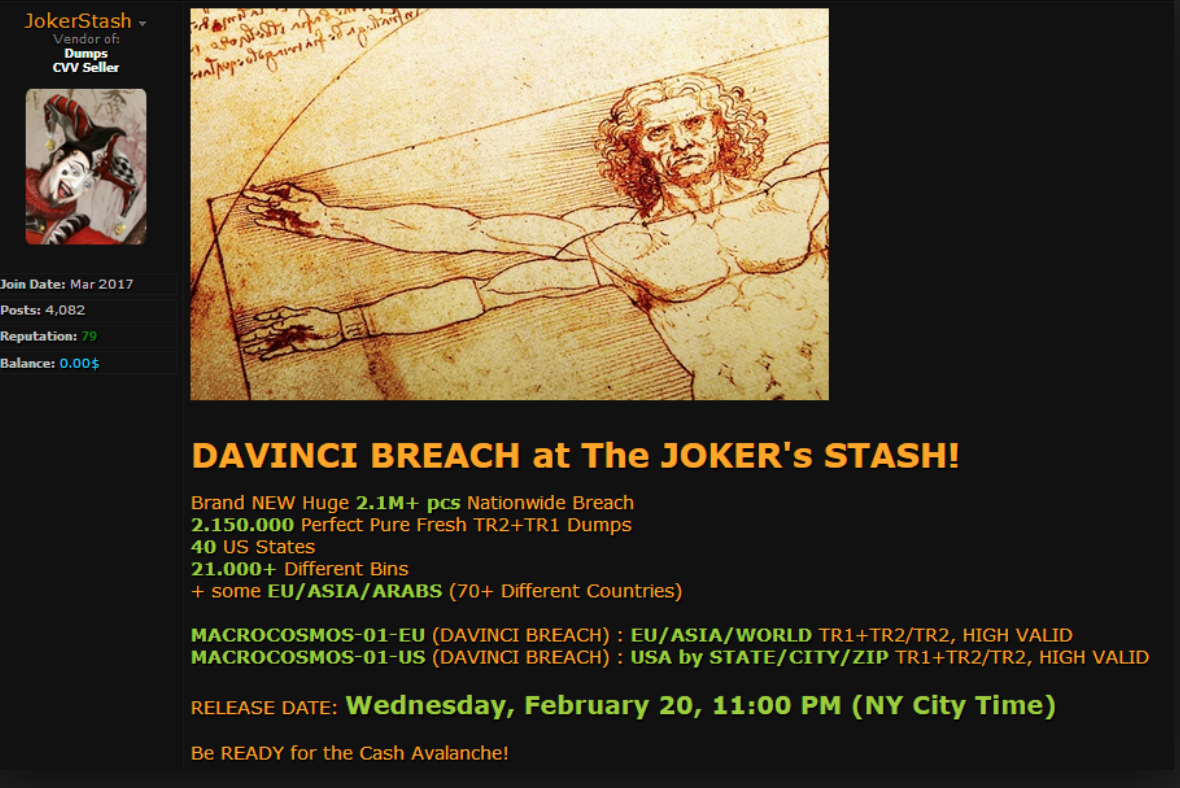
Some 2.1 million+ credit and debit card accounts stolen from dozens of Earl Enterprises restaurant locations went up for sale on a popular carding forum on Feb. 20, 2019.

In a statement posted to its Web site today, Orlando, Fla. based hospitality firm Earl Enterprises said a data breach involving malware installed on its point-of-sale systems allowed cyber thieves to steal card details from customers between May 23, 2018 and March 18, 2019.

Earl Enterprises did not respond to requests for specifics about how many customers total may have been impacted by the 10-month breach. The company’s statement directs concerned customers to an online tool that allows one to look up breached locations by city and state.

According to an analysis of that page, it appears the breach impacts virtually all 67 Buca di Beppo locations in the United States; a handful out of the total 31 Earl of Sandwich locations; and Planet Hollywood locations in Las Vegas, New York City and Orlando. Also impacted were Tequila Taqueria in Las Vegas; Chicken Guy! in Disney Springs, Fla.; and Mixology in Los Angeles.

KrebsOnsecurity contacted the executive team at Buca di Beppo in late February after determining most of this restaurant’s locations were likely involved a data breach that first surfaced on Joker’s Stash, an underground shop that sells huge new batches of freshly-stolen credit and debit cards on a regular basis.

Joker’s Stash typically organizes different batches of stolen cards around a codename tied to a specific merchant breach. This naming convention allows criminals who purchased cards from a specific batch and found success using those cards fraudulently to buy from the same batch again when future cards stolen from the same breached merchant are posted for sale.

While a given batch’s nickname usually has little relation to the breached merchant, Joker’s Stash does offer a number of search options for customers that can sometimes be used to trace a large batch of stolen cards back to a specific merchant.

This is especially true if the victim merchant has a number of store locations in multiple smaller U.S. towns. That’s because while Joker’s Stash makes its stolen cards searchable via a variety of qualities — the card-issuing bank or expiration date, for example — perhaps the most useful in this case is the city or ZIP code tied to each card.

As with a number of other carding sites, Joker’s Stash indexes cards by the city and/or ZIP code of the store from which the card was stolen (not the ZIP code of the affected cardholders).

On Feb. 20, Joker’s Stash moved a new batch of some 2.15 million stolen cards that it dubbed the “Davinci Breach.” An analysis of the cities and towns listed among the Davinci cards for sale included a number of hacked store locations that were not in major cities, such as Burnsville, Minn., Levonia, Mich., Midvale, Utah, Norwood, Ohio, and Wheeling, Ill.

Earl Enterprises said in its statement the malicious software installed at affected stores captured payment card data, which could have included credit and debit card numbers, expiration dates and, in some cases, cardholder names. The company says online orders were not affected.

Malicious hackers typically steal card data from organizations by hacking into point-of-sale systems remotely and seeding those systems with malicious software that can copy account data stored on a card’s magnetic stripe. Thieves can use that data to clone the cards and then use the counterfeits to buy high-priced merchandise from electronics stores and big box retailers.

Cardholders are not responsible for fraudulent charges, but your bank isn’t always going to detect card fraud. That’s why it’s important to regularly review your monthly statements and quickly report any unauthorized charges.

from Krebs on Security https://ift.tt/2WqIPt8
via IFTTT