After a poke from the UK’s watchdog, the companies promised to beef up filters to strain out those who write, buy and sell fluffy nonsense.
from Naked Security https://ift.tt/2NsDAar
via IFTTT

After a poke from the UK’s watchdog, the companies promised to beef up filters to strain out those who write, buy and sell fluffy nonsense.
from Naked Security https://ift.tt/2NsDAar
via IFTTT
Electric utilities continue to be a target of nation-state attackers, even before the latest tensions between Iran and the United States, says a critical-infrastructure security firm.
from Dark Reading: https://ift.tt/2NdBw5X
via IFTTT
Researchers found unremovable malware preinstalled in the Unimax U686CL, a budget Android device sold by Assurance Wireless.
from Dark Reading: https://ift.tt/2FAm6V5
via IFTTT
‘Systemic failures’ found in the retailer’s management and protection of customer data
Dixons Carphone has been hit with the maximum possible fine after the tills in its shops were compromised by a cyber-attack that affected at least 14 million people.
The retailer discovered the massive data breach last summer and a subsequent investigation by the Information Commissioner’s Office (ICO) found the attacker had installed malicious software on 5,390 tills in branches of its Currys PC World and Dixons Travel chains.
from Data and computer security | The Guardian https://ift.tt/2tFkfvr
via IFTTT
Crooks have stolen tens of millions of dollars and other valuable commodities from thousands of consumers via “SIM swapping,” a particularly invasive form of fraud that involves tricking a target’s mobile carrier into transferring someone’s wireless service to a device they control. But the U.S. Federal Communications Commission (FCC), the entity responsible for overseeing wireless industry practices, has so far remained largely silent on the matter. Now, a cadre of Senate lawmakers is demanding to know what, if anything, the agency might be doing to track and combat SIM swapping.
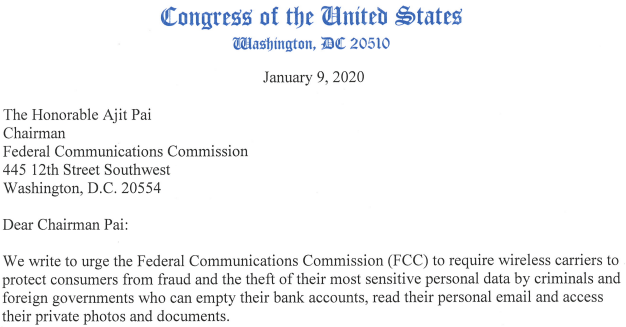
On Thursday, a half-dozen Democrats in the Senate sent a letter to FCC Chairman Ajit Pai, asking the agency to require the carriers to offer more protections for consumers against unauthorized SIM swaps.
“Consumers have no choice but to rely on phone companies to protect them against SIM swaps — and they need to be able to count on the FCC to hold mobile carriers accountable when they fail to sure their systems and thus harm consumers,” reads the letter, signed by Sens. Ron Wyden (OR), Ted Lieu (CA), Sherrod Brown (OH), Anna Eshoo (CA), Edward Markey (MA) and Yvette Clarke (NY).
SIM swapping is an insidious form of mobile phone fraud that is often used to steal large amounts of cryptocurrencies and other items of value from victims. All too frequently, the scam involves bribing or tricking employees at mobile phone stores into seizing control of the target’s phone number and diverting all texts and phone calls to the attacker’s mobile device.
Once in control of the stolen phone number, the attacker can then reset the password for any online account that allows password resets and/or two-factor verification requests via text messages or automated phone calls (i.e. most online services, including many of the mobile carrier Web sites).
From there, the scammers can pivot in a variety of directions, including: Plundering the victim’s financial accounts; hacking their identities on social media platforms; viewing the victim’s email and call history; and abusing that access to harass and scam their friends and family.
The lawmakers asked the FCC to divulge whether it tracks consumer complaints about fraudulent SIM swapping and number “port-outs,” which involve moving the victim’s phone number to another carrier. The senators demanded to know whether the commission offers any guidance for consumers or carriers on this important issue, and if the FCC has initiated any investigations or taken enforcement actions against carriers that failed to secure customer accounts.
The letter also requires the FCC to respond as to whether there is anything in federal regulations that prevents mobile carriers from sharing with banks information about the most recent SIM swap date of a customer as a way to flag potentially suspicious login attempts — a method already used by financial institutions in other countries, including Australia, the United Kingdom and several nations in Africa.
“Some carriers, both in the U.S. and abroad, have adopted policies that better protect consumers from SIM swaps, such as allowing customers to add optional security protections to their account that prevent SIM swaps unless the customer visits a store and shows ID,” the letter continues. “Unfortunately, implementation of these additional security measures by wireless carriers in the U.S. is still spotty and consumers are not likely to find out about the availability of these obscure, optional security features until it is too late.”
The FCC did not immediately respond to requests for comment.
Legitimate SIM swaps are a common request for all carriers, and they usually happen when a customer has lost their mobile phone or when they need to upgrade to a newer model that requires a different-sized SIM card (the small, removable smart chip that ties the customer’s device to their phone number).
But unauthorized SIM swaps enable even low-skilled thieves to quickly turn a victim’s life upside down and wrest control over a great deal of their online identities and finances. What’s more, the security options available to wireless customers concerned about SIM swapping — such as personal identification number (PIN) codes — are largely ineffective against crooked or clueless mobile phone store employees.
A successful SIM swap may allow tormentors to access a victim’s email inbox even after the target has changed his or her password. For example, some email services allow customers to reset their passwords just by providing a piece of information that would likely only be known to the legitimate account holder, such as the month and year the account was created, or the name of a custom folder or label in the account previously created by the user.
One technique used by SIM swappers to regain access to hacked inboxes is to jot down this information once a SIM swap affords them the ability to reset the account’s password. Alternatively, SIM swappers have been known to create their own folders or labels in the hacked account to facilitate backdoor access later on.
A number of young men have recently been criminally charged with using SIM swapping to steal accounts and cryptocurrencies like Bitcoin from victims. This week, a court in New York unsealed a grand jury indictment against 22-year-old alleged serial SIM swapper Nicholas Truglia, who stands accused of using the technique to siphon $24 million worth of cryptocurrencies from blockchain investor Michael Terpin.
But experts say the few arrests that have been made in conjunction with SIM swapping attacks have pushed many involved in this crime to enlist help from co-conspirators who are minors and thus largely outside the reach of federal prosecutors.
For his part, Terpin sent an open letter to FCC commissioners in October 2019, urging them to mandate that wireless carriers provide a way for customers to truly lock down their accounts against SIM swapping, even if that means requiring an in-person visit to a store or conversation with the carrier’s fraud department.
In an interview with KrebsOnSecurity, Terpin said the FCC has so far abdicated its responsibility over the carriers on this matter.
“It took them a long time to get around to taking robocalls seriously, but those scams rarely cost people millions of dollars,” Terpin said. “Imagine going into a bank and you don’t remember your PIN and the teller says, ‘Oh, that’s okay I can look it up for you.’ The fact that a $9-an-hour mobile store employee can see your high security password or PIN is shocking.”
“The carriers should also have to inform every single current and future customer that there is this high security option available,” Terpin continued. “That would stop a lot of this fraud and would take away the ability of these ne’er-do-well 19-year-old store employees who get bribed into helping out with the scam.”
Want to read more about SIM swapping? Check out Busting SIM Swappers and SIM Swap Myths, or view the entire catalog of stories on the topic here.
from Krebs on Security https://ift.tt/37RpjeU
via IFTTT
PowerTrick is sort of a custom-version of PowerShell Empire and can be used to download additional malware, SentinelOne says.
from Dark Reading: https://ift.tt/36Qb9dO
via IFTTT
Users of AWS Aurora, DocumentDB, and RDS databases must download and install a fresh certificate and rotate the certificate authority.
from Dark Reading: https://ift.tt/36C39Ny
via IFTTT
Open source platforms such as the Malware Information Sharing Platform are well positioned to drive a community-based approach to intelligence sharing.
from Dark Reading: https://ift.tt/2tIsRS9
via IFTTT
It’s hard to protect what you don’t know is there. These free tools can help you understand just what it is that you need to protect — and need to protect yourself from.
from Dark Reading: https://ift.tt/2sPTxAl
via IFTTT
Industrial control systems vendor plans to acquire Avnet Data Security, which provides penetration testing, assessments, training, and managed network and security services for the ICS sector.
from Dark Reading: https://ift.tt/305mwfv
via IFTTT

