Did Mom’s special holiday sneak up on you, too? Don’t sweat it.
from Gear Latest https://ift.tt/ZELBn91
via IFTTT

Did Mom’s special holiday sneak up on you, too? Don’t sweat it.
from Gear Latest https://ift.tt/ZELBn91
via IFTTT
En Veracruz hoy la condición actual es Partly Cloudy y una temperatura de 27C.

La máxima temperatura será de 33C y la mínima de 26C.
Durante el día la condición se pronostica como Partly Cloudy

Sunrise May 5, 2022 at 06:54AM
Sunset May 5, 2022 at 07:48PM
Viento con dirección Southeast y velocidad de 8 Km/h
With a high of 91F and a low of 79F.
via IFTTT
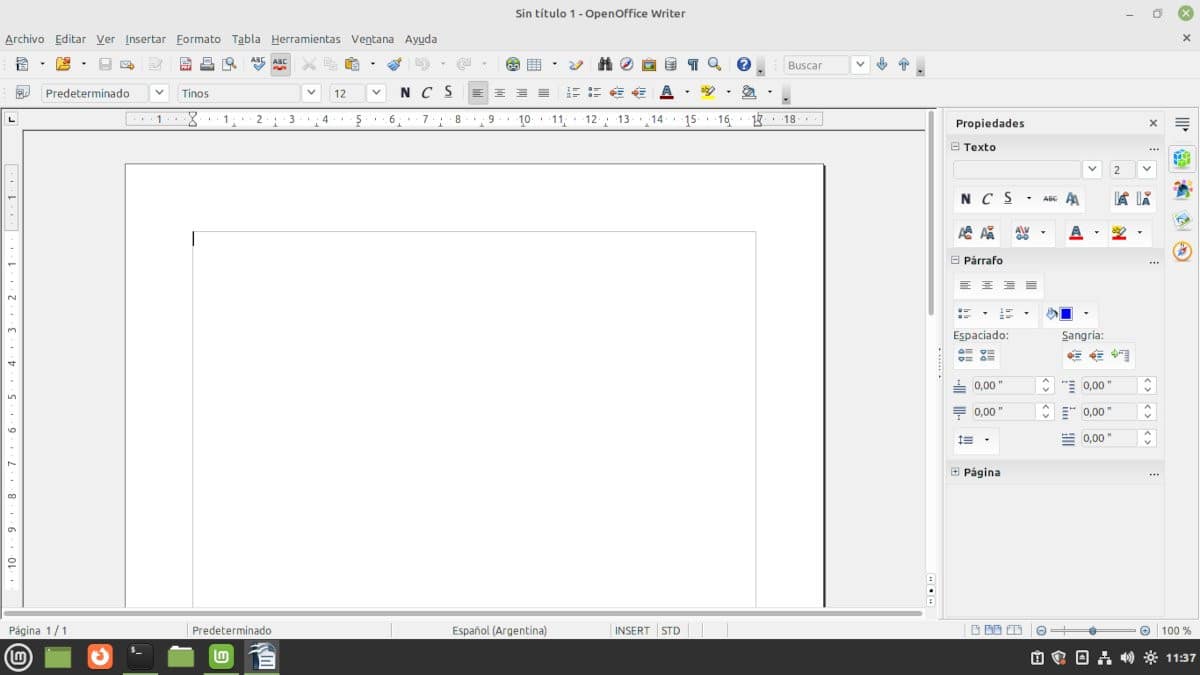
OpenOffice Writer tiene una interfaz de usuario más sencilla.
(adsbygoogle = window.adsbygoogle || []).push({});
Sin que nadie entienda demasiado bien por qué se toma la molestia, el proyecto Apache OpenOffice se complace en anunciar el lanzamiento de Apache OpenOffice 4.1.12. Según se informó, esta versión está dedicada a Jörg Schmidt, al que definieron como un valioso colaborador que falleció repentinamente el año pasado.
En este caso se trata de una versión de mantenimiento y, según las notas de lanzamiento incorpora mejoras.
(adsbygoogle = window.adsbygoogle || []).push({});
Voy a dejar mi opinión de lado hasta el final y reproducir las notas de lanzamiento para que ustedes saquen sus propias conclusiones. Como siempre, tienen el formulario de comentarios para decir lo que quieran.
Wakefield, DE – 04 de mayo de 2022 – Apache OpenOffice, una suite de productividad de documentos de oficina líder y de código abierto líder, anunció hoy Apache OpenOffice 4.1.12, como siempre disponible en 41 idiomas para Windows, macOS y Linux.
Veamos las notas de lanzamiento:
Apache OpenOffice 4.1.12 es una versión de mantenimiento que incorpora otras correcciones de errores y pequeñas mejoras. Se recomienda a todos los usuarios de Apache OpenOffice 4.1.11 o anteriores que se actualicen.
(adsbygoogle = window.adsbygoogle || []).push({});
Para usuarios de macOS:
La utilidad Gatekeeper de macOS podría identificar a Apache OpenOffice como software malicioso. Esto puede solucionarse de dos formas:
Para usuarios de Windows
Que algo se pueda hacer no implica que debe hacerse. A esta altura, tanto LibreOffice como las opciones privativas o Google Docs y la versión online de Microsoft Office, superan hace rato las prestaciones de Apache OpenOffice. Nadie sabe demasiado bien lo que pasó al interior del proyecto cuando Oracle compró Sun, pero debe haber sido lo suficientemente grave porque, el encono parece ser el único sustento de un proyecto que atrasa por lo menos diez años.
(adsbygoogle = window.adsbygoogle || []).push({});
No me opongo (Al contario, me encantaría) una suite ofimática de código abierto que le compitiera de igual a igual a LibreOffice. Pero, que fuera algo al estilo de Brave contra Firefox. Es decir, desde una base de código y una perspectiva diferente.
Lamentablemente, los recursos dedicados a los proyectos de código abierto comunitario tienen un límite y, estoy seguro que enfocándose en otra cosa. los participantes en OpenOffice podrían hacer aportes valiosos.
from Linux Adictos https://ift.tt/bPv7xCM
via IFTTT
Here’s what you should know about some of the nastiest mobile malware – from malicious software that takes phones and data hostage to RATs that allow hackers to control devices remotely
The post 3 most dangerous types of Android malware appeared first on WeLiveSecurity
from WeLiveSecurity https://ift.tt/ZkYU90y
via IFTTT
Here’s what you should know about some of the nastiest mobile malware – from malicious software that takes phones and data hostage to RATs that allow hackers to control devices remotely
The post 3 most dangerous types of Android malware appeared first on WeLiveSecurity
from WeLiveSecurity https://ift.tt/ZkYU90y
via IFTTT
Yes, passwords are going away. No, it won’t happen tomorrow. So it’s still worth knowing the basics of picking proper passwords.
from Naked Security https://ift.tt/em29wA8
via IFTTT
All active GitHub users who contribute code will be required to enable at least one form of two-factor authentication by the end of 2023.
from Dark Reading https://ift.tt/cYjGKqT
via IFTTT
I heard that bananas are radioactive. If they are radioactive, then they radiate energy. How many bananas would you need to power a house?
Kang JI
Bananas are radioactive. But don't worry, it's fine.

Bananas are radioactive because they contain potassium, some of which is the radioactive isotope potassium-40. The factoid about banana radioactivity was popularized by nuclear engineers trying to reassure people[1] that small doses of radiation are normal and not necessarily dangerous. Of course, this kind of thing can backfire.

Thanks to their use as a radiation dose comparison, bananas now have a reputation as an especially radioactive food, but they're really not. The CRC Handbook of Radiation Measurement and Protection, the source of the original data behind the banana factoid, lists lots of other foods with more potassium-40 than bananas, including coconuts, peanuts, and sweet potatoes. A large cheese pizza might be three times more radioactive than a banana,[2] and your own body emits a lot more radiation than either.

Potassium-40 decays slowly, with individual atoms sitting around for millions or billions of years before quantum randomness finally triggers them decay. Imagine you're an atom of potassium; every second you roll 21 dice. If they all come up 6s, you decay.

There are gazillions[3] of atoms of potassium-40 in a banana. In any given second, 10 or 15 of them make that all-sixes roll, spit out a high-energy particle, and become stable calcium or argon.

That high-energy particle released by the expiring potassium atom[4] will promptly bonk[5] into other atoms, leaving everything vibrating with extra heat energy. In theory, you could use this heat energy to do work—that's how the Mars rovers Curiosity and Opportunity are powered.
The Mars rovers use plutonium, which decays millions of times per second, releasing a lot of power. By comparison, the 15 decays per second from one banana work out to a couple of picowatts of power, roughly the power consumption of a single human cell. Even if you captured that decay energy with perfect efficiency, powering a house would require about 300 quadrillion[6] bananas, which would form a heap large enough to bury most of the skyscrapers in the NYC metro area.[7]

The potassium-40 in bananas is a terrible source of energy. But that's okay, because you know what's a great energy source? The banana itself! A banana contains about 100 calories of food energy, and if you incinerate whole bananas as fuel, it would only take about 10 bunches per day to keep your house running.

Unfortunately for New York City, which we buried in bananas a moment ago while trying to make the radiation idea work (sorry!), radioactivity vs chemical energy isn't an either/or thing. If you piled up a lot of bananas, they would start to release that chemical energy, one way or another. The sun-baked banana pile would start to rot. The heat from the bananas decomposing in the atmosphere would immediately swamp the heat from radioactivity. The sun-dried bananas would dry, crack, and eventually burn.

Decomposition by anaerobic bacteria deep in the pile would produce various gases, including highly flammable methane. As they bubbled up to the surface of the burning banana swamp, they could ignite; gas buildup from food waste is a major industrial explosion hazard.

So don't worry about the radioactivity in bananas. It's the rest of the banana that's the real threat. But if you're willing to risk the danger, you could power a lot more than just your house. With just a modest weekly supply of bananas—enough to cover Liberty Island in NYC…

…you could power the entire city.

[1] After nuclear engineering, this is the main pastime of nuclear engineers.
[2] Google has a handy tool for looking up the amount of potassium in foods, which even lets you select specific pizza brands. But for some reason, if you select Pizza Hut Pepperoni Pizza, your only serving size options are either "1 slice" or "40 pizzas." Nothing in between.
[3] There are about 800,000,000,000,000,000 of them, which is probably quadrillions or quintillions or something, but life is too short to sit around counting zeros and then looking up the Latin prefixes for big numbers.
[4] RIP
[5] The technical term is THUNK.
[6] Fine, I looked it up this time.
[7] It's 300 quadrillion bananas, Michael—what can it cost, 3 quintillion dollars?
from what if? https://ift.tt/cib24fl
via IFTTT
Operation CuckooBees uncovered the state-sponsored group’s sophisticated new tactics in a years-long campaign that hit more than 30 tech and manufacturing companies.
from Dark Reading https://ift.tt/NX0RehU
via IFTTT
Microsoft’s stand-alone version of Defender for SMBs promises to help SecOps teams automate detection, response, and recovery.
from Dark Reading https://ift.tt/iqa2Twn
via IFTTT
 Pacosite's Blog