A thriving painter’s enviable life begins to fray at the edges when a bright young woman she once befriended resurfaces as a shell of her former self.
from New On Netflix USA https://ift.tt/3oUJMvf
via IFTTT

A thriving painter’s enviable life begins to fray at the edges when a bright young woman she once befriended resurfaces as a shell of her former self.
from New On Netflix USA https://ift.tt/3oUJMvf
via IFTTT
A recent phishing campaign targeting Coinbase users shows thieves are getting cleverer about phishing one-time passwords (OTPs) needed to complete the login process. It also shows that phishers are attempting to sign up for new Coinbase accounts by the millions as part of an effort to identify email addresses that are already associated with active accounts.
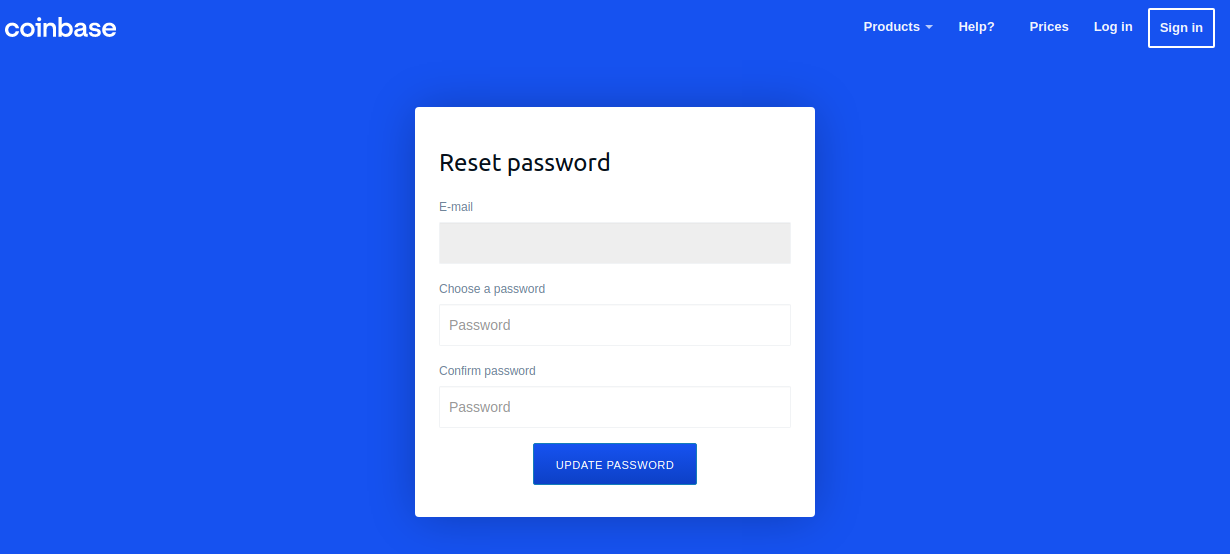
A Google-translated version of the now-defunct Coinbase phishing site, coinbase.com.password-reset[.]com
Coinbase is the world’s second-largest cryptocurrency exchange, with roughly 68 million users from over 100 countries. The now-defunct phishing domain at issue — coinbase.com.password-reset[.]com — was targeting Italian Coinbase users (the site’s default language was Italian). And it was fairly successful, according to Alex Holden, founder of Milwaukee-based cybersecurity firm Hold Security.
Holden’s team managed to peer inside some poorly hidden file directories associated with that phishing site, including its administration page. That panel, pictured in the redacted screenshot below, indicated the phishing attacks netted at least 870 sets of credentials before the site was taken offline.
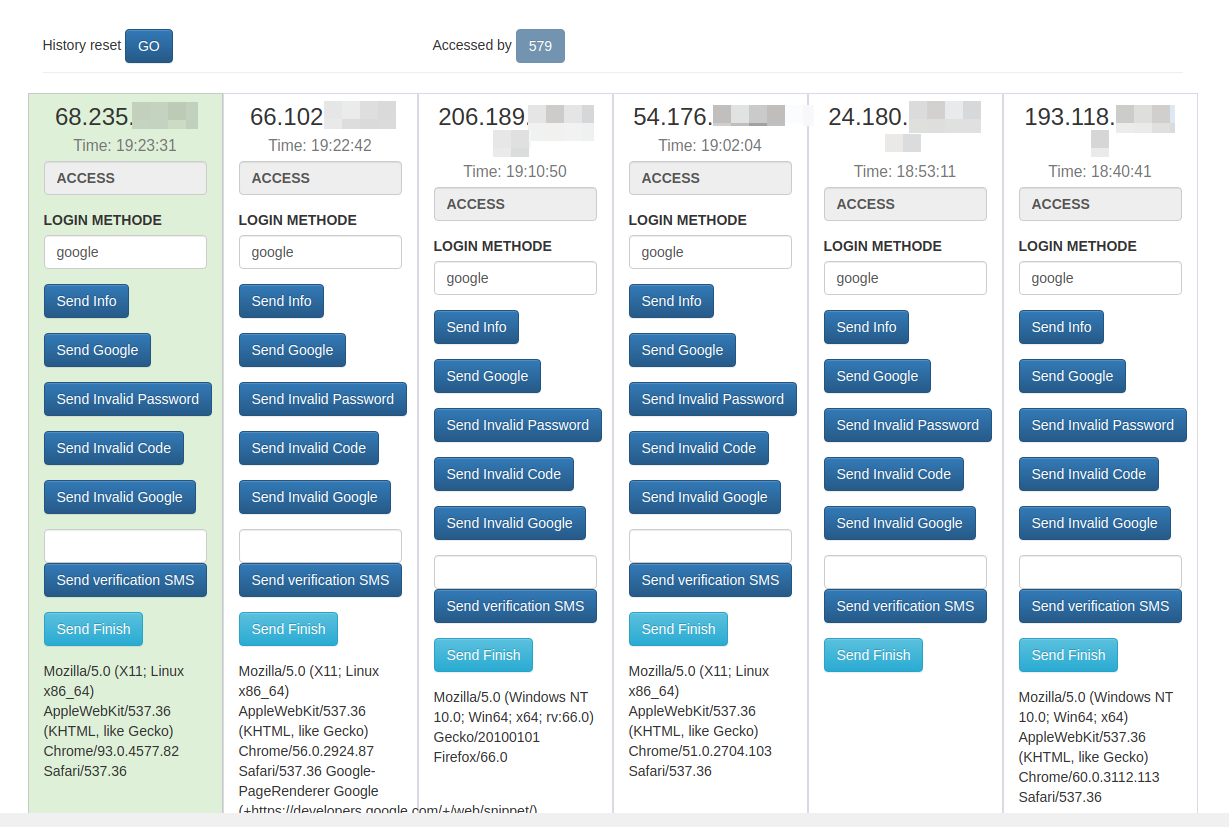
The Coinbase phishing panel.
Holden said each time a new victim submitted credentials at the Coinbase phishing site, the administrative panel would make a loud “ding” — presumably to alert whoever was at the keyboard on the other end of this phishing scam that they had a live one on the hook.
In each case, the phishers manually would push a button that caused the phishing site to ask visitors for more information, such as the one-time password from their mobile app.
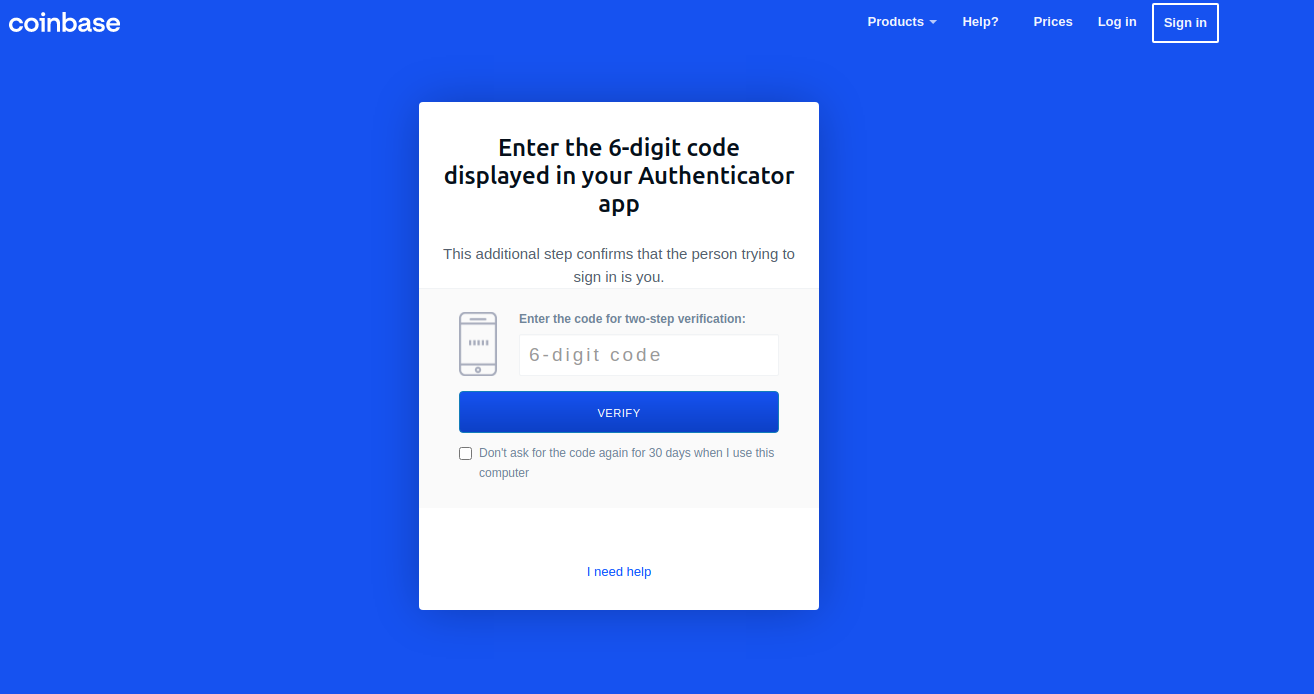
“These guys have real-time capabilities of soliciting any input from the victim they need to get into their Coinbase account,” Holden said.
Pressing the “Send Info” button prompted visitors to supply additional personal information, including their name, date of birth, and street address. Armed with the target’s mobile number, they could also click “Send verification SMS” with a text message prompting them to text back a one-time code.
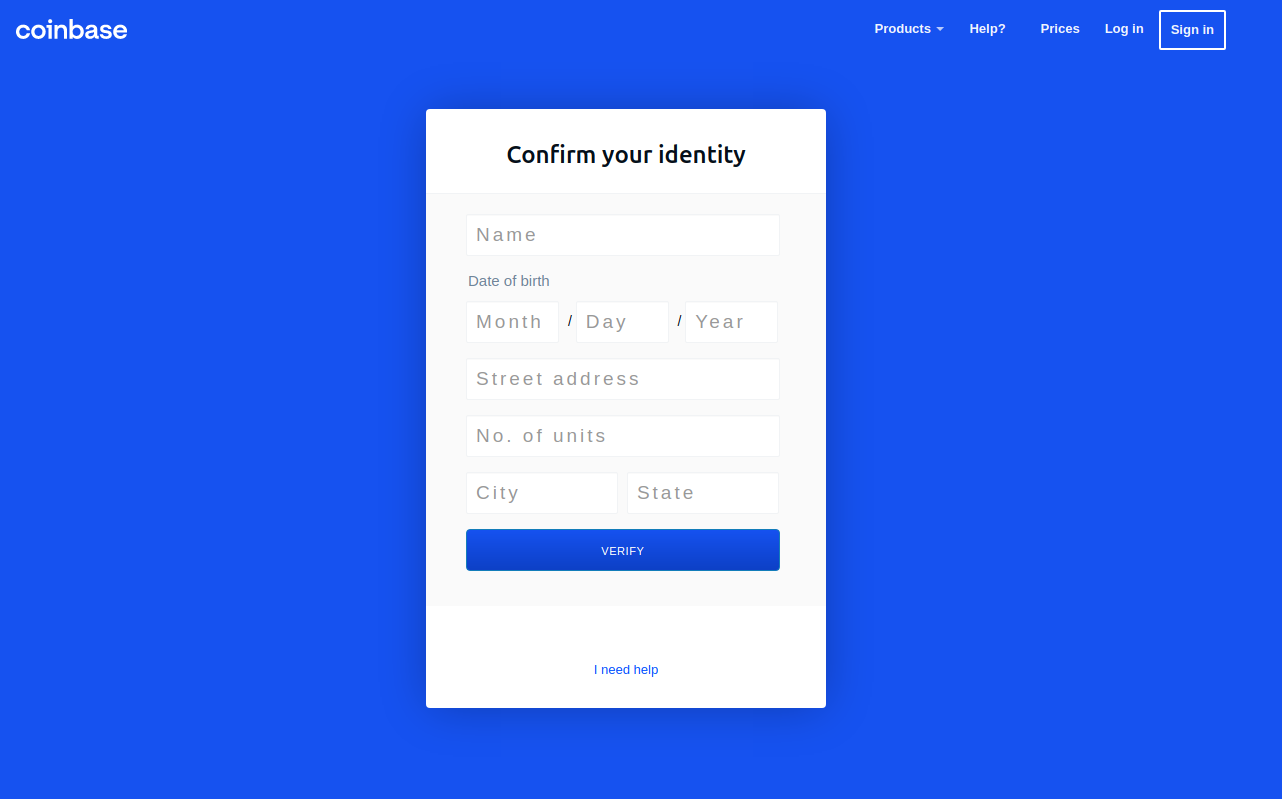
Holden said the phishing group appears to have identified Italian Coinbase users by attempting to sign up new accounts under the email addresses of more than 2.5 million Italians. His team also managed to recover the username and password data that victims submitted to the site, and virtually all of the submitted email addresses ended in “.it”.
But the phishers in this case likely weren’t interested in registering any accounts. Rather, the bad guys understood that any attempts to sign up using an email address tied to an existing Coinbase account would fail. After doing that several million times, the phishers would then take the email addresses that failed new account signups and target them with Coinbase-themed phishing emails.
Holden’s data shows this phishing gang conducted hundreds of thousands of halfhearted account signup attempts daily. For example, on Oct. 10 the scammers checked more than 216,000 email addresses against Coinbase’s systems. The following day, they attempted to register 174,000 new Coinbase accounts.
In an emailed statement shared with KrebsOnSecurity, Coinbase said it takes “extensive security measures to ensure our platform and customer accounts remain as safe as possible.” Here’s the rest of their statement:
“Like all major online platforms, Coinbase sees attempted automated attacks performed on a regular basis. Coinbase is able to automatically neutralize the overwhelming majority of these attacks, using a mixture of in-house machine learning models and partnerships with industry-leading bot detection and abuse prevention vendors. We continuously tune these models to block new techniques as we discover them. Coinbase’s Threat Intelligence and Trust & Safety teams also work to monitor new automated abuse techniques, develop and apply mitigations, and aggressively pursue takedowns against malicious infrastructure. We recognize that attackers (and attack techniques) will continue to evolve, which is why we take a multi-layered approach to combating automated abuse.”
Last month, Coinbase disclosed that malicious hackers stole cryptocurrency from 6,000 customers after using a vulnerability to bypass the company’s SMS multi-factor authentication security feature.
“To conduct the attack, Coinbase says the attackers needed to know the customer’s email address, password, and phone number associated with their Coinbase account and have access to the victim’s email account,” Bleeping Computer’s Lawrence Abrams wrote. “While it is unknown how the threat actors gained access to this information, Coinbase believes it was through phishing campaigns targeting Coinbase customers to steal account credentials, which have become common.”
This phishing scheme is another example of how crooks are coming up with increasingly ingenious methods for circumventing popular multi-factor authentication options, such as one-time passwords. Last month, KrebsOnSecurity highlighted research into several new services based on Telegram-based bots that make it relatively easy for crooks to phish OTPs from targets using automated phone calls and text messages.These OTP phishing services all assume the customer already has the target’s login credentials through some means — such as through a phishing site like the one examined in this story.
Savvy readers here no doubt already know this, but to find the true domain referenced in a link, look to the right of “http(s)://” until you encounter the first slash (/). The domain directly to the left of that first slash is the true destination; anything that precedes the second dot to the left of that first slash is a subdomain and should be ignored for the purposes of determining the true domain name.
In the phishing domain at issue here — coinbase.com.password-reset[.]com — password-reset[.]com is the destination domain, and the “coinbase.com” is just an arbitrary subdomain of password-reset[.]com. However, when viewed in a mobile device, many visitors to such a domain may only see the subdomain portion of the URL in their mobile browser’s address bar.
The best advice to sidestep phishing scams is to avoid clicking on links that arrive unbidden in emails, text messages or other media. Most phishing scams invoke a temporal element that warns of dire consequences should you fail to respond or act quickly. If you’re unsure whether the message is legitimate, take a deep breath and visit the site or service in question manually — ideally, using a browser bookmark so as to avoid potential typosquatting sites.
Also, never provide any information in response to an unsolicited phone call. It doesn’t matter who claims to be calling: If you didn’t initiate the contact, hang up. Don’t put them on hold while you call your bank; the scammers can get around that, too. Just hang up. Then you can call your bank or wherever else you need.
By the way, when was the last time you reviewed your multi-factor settings and options at the various websites entrusted with your most precious personal and financial information? It might be worth paying a visit to 2fa.directory (formerly twofactorauth[.]org) for a checkup.
from Krebs on Security https://ift.tt/3BCDmEE
via IFTTT

The group, which conducts espionage and sows disinformation, is larger than previously thought and has shifted tactics.
from Dark Reading https://ift.tt/3oZXUU6
via IFTTT
These weatherproof devices can keep a watchful eye on your property and let you get on with life.
from Gear Latest https://ift.tt/3DDniTz
via IFTTT

OnePlus amplía su catálogo de móviles con un nuevo aspirante a teléfono con mejor relación calidad precio: el OnePlus 9RT ya es oficial en China. Con un procesador potente, grandes capacidades fotográficas, con el mejor diseño de OnePlus y con ColorOS 12 como capa de software.
La gama OnePlus 9 ha conquistado 2021 con su gran calidad y potentes prestaciones. El fabricante ya avisó de que no renovaría la familia en la segunda mitad de año, al menos internacionalmente. Aun así, no confirmó que dejase de actualizar el OnePlus 9R, una variedad que se quedó en territorio asiático. Tras las numerosas filtraciones y anuncios esa actualización ya es oficial.
We’ve tested all the top slates, from Apple’s iPads to Android and Windows devices.
from Gear Latest https://ift.tt/2HZTGCA
via IFTTT

(adsbygoogle = window.adsbygoogle || []).push({});
La fiebre de la convergencia y esas luchas entre Canonical y Microsoft por llegar antes, entre otras compañías, parece que se quedó atrás. Sin embargo, Google está haciendo esfuerzos para avanzar hacia su convergencia en el sistema operativo Android para dispositivos móviles, pero en este caso hacia la convergencia con la rama general del kernel Linux.
Google está buscando una manera de facilitar el mantenimiento de Android, y para ello el gigante del motor de búsquedas lleva años trabajando para ajustar el kernel de Android a la rama oficial de Linux, haciendo que se instalen drivers de terceros a través de un mecanismo llamado Project Treble, que fue presentado por primera vez en 2017.
(adsbygoogle = window.adsbygoogle || []).push({});
Dicho de otra forma, Google quiere que el kernel de Android sea el kernel Linux genérico para todos los dispositivos. Y parece ser que en la versión Android 12 se produciría un avance importante en este sentido, según el ingeniero de software Todd Kjos de esta compañía. Él ha presentado un informe sobre ello en la Linux Plumbers Conference en el que se dice que esa versión accederá a la rama principal del kernel Linux suministrando a los usuarios finales una Generic Kernel Image (GKI).
Recuerda que ahora Android no tiene un kernel genérico de Linux, sino que se trata de una bifurcación de la rama vainilla. Google hizo cambios específicos en el núcleo del sistema operativo dirigidos al ámbito de los dispositivos móviles, creando un kernel específico para Android que fuese común. Después, algunos fabricantes de SoCs, como Qualcomm, Samsung, o MediaTek, bifurcaron este kernel común de Google para crear sus núcleos específicos optimizados para sus chips. Ahora, con estos avances, todo esto podría cambiar, y tener un nuevo núcleo convergente donde todos los que necesiten agregar módulos o controladores o firmware al kernel Linux de Android, lo puedan hacer, pero sin modificaciones respecto al kernel que sale de la kernel.org.
from Linux Adictos https://ift.tt/30gXQVr
via IFTTT
Two childhood friends — one now a movie star, one a barber — meet for the first time in years during a film shoot in their hometown.
from New On Netflix USA https://ift.tt/3v7gD0U
via IFTTT
A landowner and his worker fall for the same woman, setting the stage for a love triangle, a murder plot and a resurgence of secrets from the past.
from New On Netflix USA https://ift.tt/2YIQbz5
via IFTTT
 Pacosite's Blog