OpenSIS 8.0 ‘modname’ – Directory/Path Traversal
from Exploit-DB.com RSS Feed https://ift.tt/3gZGjqu
via IFTTT

OpenSIS 8.0 ‘modname’ – Directory/Path Traversal
from Exploit-DB.com RSS Feed https://ift.tt/3gZGjqu
via IFTTT
Remote Mouse 4.002 – Unquoted Service Path
from Exploit-DB.com RSS Feed https://ift.tt/2WOS3EO
via IFTTT

Xiaomi acaba de presentar una nueva variante del Xiaomi Redmi 10 y el sucesor del Xiaomi Redmi 9 Prime del año pasado: un Xiaomi Redmi 10 Prime cuya principal novedad pasa por incluir una enorme batería de 6.000 mAh de capacidad.
El apellido Prime llega con un incremento en la capacidad de la batería, unos gramos de más y algo más de grosor que el modelo estándar, pero por lo demás tenemos el mismo móvil de gama media con Helio G88 con pantalla a 90 Hz y cámara cuádruple de 50 megapíxeles.

Ha pasado ya un año desde que Qualcomm lanzó oficialmente sus últimos procesadores para wearables, los Wear 4100 y Wear 4100+. Aunque no ha sido hasta hace apenas unos días que se estrenaban por primera vez en el Fossil Gen 6, parece claro que Qualcomm ya está preparando su sucesor, el posible Snapdragon Wear 5100.
Este procesador para relojes inteligentes lleva filtrándose tímidamente en las últimas semanas, aunque sin muchos detalles concretos. Ahora, WinFuture ha recogido algunos detalles al respecto que, desgraciadamente, apuntan a una renovación moderada, donde se mantendría la misma estructura de la generación anterior, con núcleos Cortex A53.
Dubbed Safety Mode, the feature will temporarily block authors of offensive tweets from being able to contact or follow users.
The post Twitter introduces new feature to automatically block abusive behavior appeared first on WeLiveSecurity
from WeLiveSecurity https://ift.tt/3jDOHNT
via IFTTT

(adsbygoogle = window.adsbygoogle || []).push({});
Hace tiempo, reproducir contenido protegido en una Raspberry Pi era de todo menos sencillo. Yo lo conseguí y compartí de dos maneras distintas, una en la que había que descargar el software para Chrome OS y otra a través de un contenedor que, bueno, sólo diremos que funciona(ba). Ninguno de esos dos métodos era oficial ni se acercaba a serlo, como sí lo es ahora. El problema es que desde hace poco no va bien.
Y es que Raspberry Pi OS es un sistema soso que por lo menos a mí no me gusta tanto como Manjaro ARM, pero es el oficial. Después de un tiempo he vuelto a buscar información sobre el contenido DRM en la famosa placa de la frambuesa y he dado con la noticia de que ya hace tiempo que está disponible. Y lo mejor, en los repositorios oficiales del sistema operativo. Pero lo malo es que, justo entre ayer y hoy, los usuarios han empezado a experimentar fallos.
(adsbygoogle = window.adsbygoogle || []).push({});
Originalmente, este artículo iba a ser sobre que todo era de color de rosa y felicidad, que ya podíamos reproducir Netflix, Spotify o Amazon Prime Video en la Raspberry Pi, pero probándolo yo mismo he visto, primero, que no funciona, y segundo, que es reciente, de horas en algunos casos. Resulta que Google acaba de actualizar Widevine y ha dejado «colgado» al paquete que funciona la placa simple. Pero la opción existe, y se espera que en días todo vuelva a la normalidad. Por lo tanto, dejo las instrucciones para habilitar el soporte para un futuro que esperemos sea a corto plazo.
Antes que nada, se comenta que merece la pena hacerlo en una instalación limpia, por lo menos si ya habíamos estado toqueteando con las opciones que funcionaban en el pasado. El paquete, libwidevinecdm0, está disponible en los repositorios oficiales, y en teoría debe funcionar en versiones más antiguas de la placa simple, pero el rendimiento no es el mejor de todos si no se usa una de las más nuevas.
Así, conseguir la compatibilidad en Chromium, el navegador que hay instalado por defecto en el sistema operativo oficial, es tan sencillo como actualizar los repositorios, el sistema operativo e instalar el paquete con estos tres comandos:
(adsbygoogle = window.adsbygoogle || []).push({});
sudo apt update
sudo apt full-upgrade
sudo apt install libwidevinecdm0
Como esta vez no hemos hecho nada extraño, lo único que queda tras la instalación del paquete es reiniciar el navegador, casi tan sencillo como activar la casilla para habilitar el soporte para DRM en Firefox.
Para mí, un ligero overclock y hacer funcionar un par de cosas que necesitaba lo ha cambiado todo, y os digo con total sinceridad que he vuelto al sistema oficial de la Pi. Crucemos los dedos y esperemos que arreglen el soporte para Widevine pronto.
from Linux Adictos https://ift.tt/3kRUgaW
via IFTTT

Ya faltan pocas semanas para el lanzamiento de Android 12, cuya versión final se espera que llegue a los primeros dispositivos el próximo mes de octubre, a las cuatro semanas de lanzar Google la última beta, con lo que las desarrolladoras ya está preparando sus aplicaciones para exprimir lo antes posibles las novedades de esta gran actualización.
Y una de las principales novedades, la que el usuario notará nada más actualizar sus móviles, es su gran rediseño con ‘Material You’. La renovada interfaz de Android ahora será dinámica, adaptando los colores de la interfaz a nuestro fondo de pantalla.
Con el lanzamiento del nuevo Samsung Galaxy Watch 4 basado en Wear OS 3, Google y Samsung quieren darle un buen impulso a su nueva plataforma unificada, para ver si con todos sus socios consiguen que los relojes inteligentes basados en este sistema operativo lideren las ventas.
Cuando Samsung presentó su Galaxy Watch 4, Google hizo un repaso de algunas de las novedades de Wear OS 3 que se iban a encontrar sus clientes, anunciando rediseños y nuevas aplicaciones como YouTube Music que llegaban a la nueva versión de su sistema operativo, pero por suerte** algunas de estas mejoras están llegando también a Wear OS 2.0**.

Mientras que YouTube Music y el nuevo Google Maps son exclusivos para Wear OS 3 (Android 11+) vemos como el rediseño de Mensajes de Google está llegando ya también a Wear OS 2.0 (Android 7+).
Con el lanzamiento de Wear OS 3, Google se ha puesto las pilas para renovar todas sus aplicaciones, que en el caso de Wear OS llevaba años prácticamente abandonada, sin recibir importantes novedades.
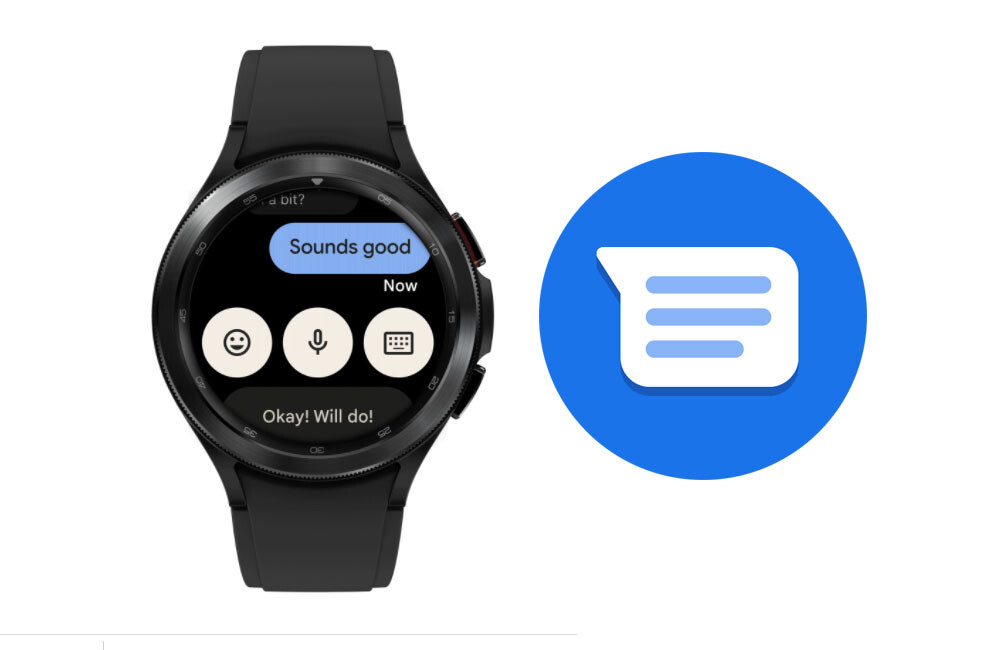
Ahora en su nueva actualización, la aplicación de Mensajes de Google para Wear OS renueva por completo su interfaz, añadiendo el diseño Material Design de Android 12, lo que se traduce en un diseño donde predominan las curvas.
{“videoId”:”x7zpyou”,”autoplay”:true,”title”:”COMPARATIVA de SMARTWATCH ¿Cuál es EL MEJOR RELOJ INTELIGENTE ?”}
En esta nueva versión deja al lado su color azul de fondo para apostar por un tema oscuro, con fondo negro y colores grises para sus botones y para los bocadillos de las conversaciones. Así la aplicación será mucho más amigable con la pantalla OLED de los relojes y con la batería.
Con la nueva versión de Mensajes de Google para Wear OS nos permite chatear con nuestros contactos directamente desde el reloj. Su nueva interfaz hace más fácil enviar emojis, usar el dictado de voz, activar el teclado o usar las respuestas inteligentes. Mensajes de Google para Wear OS no solo mostrará los mensajes de texto sino que también podremos ver en pantalla las fotos que nos envían.
Vía | 9to5Google
En Xataka Android | Cómo acelerar tu reloj Wear OS reduciendo sus animaciones
–
La noticia
Mensajes de Google para Wear OS se actualiza lanzando su rediseño a más relojes: estas son sus novedades
fue publicada originalmente en
Xataka Android
por
Cosmos
.
from Xataka Android https://ift.tt/3zFeZoL
via IFTTT
Some of the most successful and lucrative online scams employ a “low-and-slow” approach — avoiding detection or interference from researchers and law enforcement agencies by stealing small bits of cash from many people over an extended period. Here’s the story of a cybercrime group that compromises up to 100,000 email inboxes per day, and apparently does little else with this access except siphon gift card and customer loyalty program data that can be resold online.

The data in this story come from a trusted source in the security industry who has visibility into a “proxy” network of hacked machines that fraudsters in just about every corner of the Internet are using to anonymize their malicious Web traffic. For the past three years, the source — we’ll call him “Bill” to preserve his requested anonymity — has been watching one group of threat actors that is mass-testing millions of usernames and passwords against the world’s major email providers each day.
Bill said he’s not sure where the passwords are coming from, but he assumes they are tied to various databases for compromised websites that get posted to password cracking and hacking forums on a regular basis. Bill said this criminal group averages between five and ten million email authentication attempts daily, and comes away with anywhere from 50,000 to 100,000 of working inbox credentials.
In about half the cases the credentials are being checked via “IMAP,” which is an email standard used by email software clients like Mozilla’s Thunderbird and Microsoft Outlook. With his visibility into the proxy network, Bill can see whether or not an authentication attempt succeeds based on the network response from the email provider (e.g. mail server responds “OK” = successful access).
You might think that whoever is behind such a sprawling crime machine would use their access to blast out spam, or conduct targeted phishing attacks against each victim’s contacts. But based on interactions that Bill has had with several large email providers so far, this crime gang merely uses custom, automated scripts that periodically log in and search each inbox for digital items of value that can easily be resold.
And they seem particularly focused on stealing gift card data.
“Sometimes they’ll log in as much as two to three times a week for months at a time,” Bill said. “These guys are looking for low-hanging fruit — basically cash in your inbox. Whether it’s related to hotel or airline rewards or just Amazon gift cards, after they successfully log in to the account their scripts start pilfering inboxes looking for things that could be of value.”
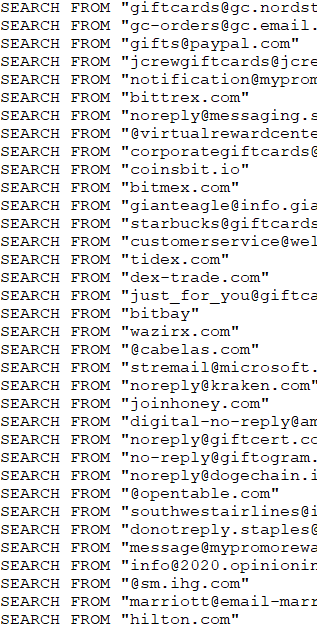
A sample of some of the most frequent search queries made in a single day by the gift card gang against more than 50,000 hacked inboxes.
According to Bill, the fraudsters aren’t downloading all of their victims’ emails: That would quickly add up to a monstrous amount of data. Rather, they’re using automated systems to log in to each inbox and search for a variety of domains and other terms related to companies that maintain loyalty and points programs, and/or issue gift cards and handle their fulfillment.
Why go after hotel or airline rewards? Because these accounts can all be cleaned out and deposited onto a gift card number that can be resold quickly online for 80 percent of its value.
“These guys want that hard digital asset — the cash that is sitting there in your inbox,” Bill said. “You literally just pull cash out of peoples’ inboxes, and then you have all these secondary markets where you can sell this stuff.”
Bill’s data also shows that this gang is so aggressively going after gift card data that it will routinely seek new gift card benefits on behalf victims, when that option is available. For example, many companies now offer employees a “wellness benefit” if they can demonstrate they’re keeping up with some kind of healthy new habit, such as daily gym visits, yoga, or quitting smoking.
Bill said these crooks have figured out a way to tap into those benefits as well.
“A number of health insurance companies have wellness programs to encourage employees to exercise more, where if you sign up and pledge to 30 push-ups a day for the next few months or something you’ll get five wellness points towards a $10 Starbucks gift card, which requires 1000 wellness points,” Bill explained. “They’re actually automating the process of replying saying you completed this activity so they can bump up your point balance and get your gift card.”
How do the compromised email credentials break down in terms of ISPs and email providers? There are victims on nearly all major email networks, but Bill said several large Internet service providers (ISPs) in Germany and France are heavily represented in the compromised email account data.
“With some of these international email providers we’re seeing something like 25,000 to 50,000 email accounts a day get hacked,” Bill said. “I don’t know why they’re getting popped so heavily.”
That may sound like a lot of hacked inboxes, but Bill said some of the bigger ISPs represented in his data have tens or hundreds of millions of customers.
Measuring which ISPs and email providers have the biggest numbers of compromised customers is not so simple in many cases, nor is identifying companies with employees whose email accounts have been hacked.
This kind of mapping is often more difficult than it used to be because so many organizations have now outsourced their email to cloud services like Gmail and Microsoft Office365 — where users can access their email, files and chat records all in one place.
“It’s a little complicated with Office 365 because it’s one thing to say okay how many Hotmail connections are you seeing per day in all this credential-stuffing activity, and you can see the testing against Hotmail’s site,” Bill said. “But with the IMAP traffic we’re looking at, the usernames being logged into are any of the million or so domains hosted on Office365, many of which will tell you very little about the victim organization itself.”
On top of that, it’s also difficult to know how much activity you’re not seeing.
Looking at the small set of Internet address blocks he knows are associated with Microsoft 365 email infrastructure, Bill examined the IMAP traffic flowing from this group to those blocks. Bill said that in the first week of April 2021, he identified 15,000 compromised Office365 accounts being accessed by this group, spread over 6,500 different organizations that use Office365.
“So I’m seeing this traffic to just like 10 net blocks tied to Microsoft, which means I’m only looking at maybe 25 percent of Microsoft’s infrastructure,” Bill explained. “And with our puny visibility into probably less than one percent of overall password stuffing traffic aimed at Microsoft, we’re seeing 600 Office accounts being breached a day. So if I’m only seeing one percent, that means we’re likely talking about tens of thousands of Office365 accounts compromised daily worldwide.”

In a December 2020 blog post about how Microsoft is moving away from passwords to more robust authentication approaches, the software giant said an average of one in every 250 corporate accounts is compromised each month. As of last year, Microsoft had nearly 240 million active users, according to this analysis.
“To me, this is an important story because for years people have been like, yeah we know email isn’t very secure, but this generic statement doesn’t have any teeth to it,” Bill said. “I don’t feel like anyone has been able to call attention to the numbers that show why email is so insecure.”
Bill says that in general companies have a great many more tools available for securing and analyzing employee email traffic when that access is funneled through a Web page or VPN, versus when that access happens via IMAP.
“It’s just more difficult to get through the Web interface because on a website you have a plethora of advanced authentication controls at your fingertips, including things like device fingerprinting, scanning for http header anomalies, and so on,” Bill said. “But what are the detection signatures you have available for detecting malicious logins via IMAP?”
Microsoft declined to comment specifically on Bill’s research, but said customers can block the overwhelming majority of account takeover efforts by enabling multi-factor authentication.
“For context, our research indicates that multi-factor authentication prevents more than 99.9% of account compromises,” reads a statement from Microsoft. “Moreover, for enterprise customers, innovations like Security Defaults, which disables basic authentication and requires users to enroll a second factor, have already significantly decreased the proportion of compromised accounts. In addition, for consumer accounts, adding a second authentication factor is required on all accounts.”
Bill said he’s frustrated by having such visibility into this credential testing botnet while being unable to do much about it. He’s shared his data with some of the bigger ISPs in Europe, but says months later he’s still seeing those same inboxes being accessed by the gift card gang.
The problem, Bill says, is that many large ISPs lack any sort of baseline knowledge of or useful data about customers who access their email via IMAP. That is, they lack any sort of instrumentation to be able to tell the difference between legitimate and suspicious logins for their customers who read their messages using an email client.
“My guess is in a lot of cases the IMAP servers by default aren’t logging every search request, so [the ISP] can’t go back and see this happening,” Bill said.
Confounding the challenge, there isn’t much of an upside for ISPs interested in voluntarily monitoring their IMAP traffic for hacked accounts.
“Let’s say you’re an ISP that does have the instrumentation to find this activity and you’ve just identified 10,000 of your customers who are hacked. But you also know they are accessing their email exclusively through an email client. What do you do? You can’t flag their account for a password reset, because there’s no mechanism in the email client to affect a password change.”
Which means those 10,000 customers are then going to start receiving error messages whenever they try to access their email.
“Those customers are likely going to get super pissed off and call up the ISP mad as hell,” Bill said. “And that customer service person is then going to have to spend a bunch of time explaining how to use the webmail service. As a result, very few ISPs are going to do anything about this.”
It’s not often KrebsOnSecurity has occasion to publish so-called “indicators of compromise” (IoC)s, but hopefully some ISPs may find the information here useful. This group automates the searching of inboxes for specific domains and trademarks associated with gift card activity and other accounts with stored electronic value, such as rewards points and mileage programs.
This file includes the top inbox search terms used in a single 24 hour period by the gift card gang. The numbers on the left in the spreadsheet represent the number of times during that 24 hour period where the gift card gang ran a search for that term in a compromised inbox.
Some of the search terms are focused on specific brands — such as Amazon gift cards or Hilton Honors points; others are for major gift card networks like CashStar, which issues cards that are white-labeled by dozens of brands like Target and Nordstrom. Inboxes hacked by this gang will likely be searched on many of these terms over the span of just a few days.
from Krebs on Security https://ift.tt/3mXwmxC
via IFTTT
The alarm system that can be turned off with your email address.
from Naked Security https://ift.tt/3jKkZXX
via IFTTT

 Pacosite's Blog