Online Traffic Offense Management System 1.0 – ‘id’ SQL Injection (Authenticated)
from Exploit-DB.com RSS Feed https://ift.tt/3mhQU3r
via IFTTT

Online Traffic Offense Management System 1.0 – ‘id’ SQL Injection (Authenticated)
from Exploit-DB.com RSS Feed https://ift.tt/3mhQU3r
via IFTTT
New scam spreads to Australia from Europe, targeting thousands of Android users
Thousands of Australians have been hit by a new scam text message known as Flubot, which aims to install malware on their phones.
Flubot is a type of malware targeting Android users, but iPhone users can also receive the messages. It tells the receiver they missed a call or have a new voicemail, providing a fake link to listen.
Related: Password of three random words better than complex variation, experts say
Related: How NSO became the company whose software can spy on the world
from Data and computer security | The Guardian https://ift.tt/2W37z08
via IFTTT
Ransomware payments may have greater implications than you thought – and not just for the company that gave in to the attackers’ demands
The post Are you, the customer, the one paying the ransomware demand? appeared first on WeLiveSecurity
from WeLiveSecurity https://ift.tt/3z25zDf
via IFTTT
Companies you do business with should never ask for your account information, credit card numbers or password in an email. If you have any questions about an email you receive that supposedly came from your financial institution or service provider, find their number on their website and call them.
from SANS Institute Security Awareness Tip of the Day https://ift.tt/2PfvSED
via IFTTT
Criminal hackers will try almost anything to get inside a profitable enterprise and secure a million-dollar payday from a ransomware infection. Apparently now that includes emailing employees directly and asking them to unleash the malware inside their employer’s network in exchange for a percentage of any ransom amount paid by the victim company.
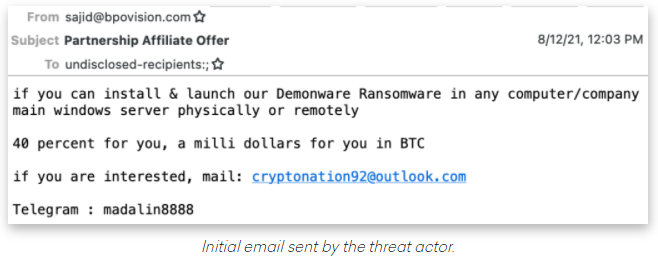
Image: Abnormal Security.
Crane Hassold, director of threat intelligence at Abnormal Security, described what happened after he adopted a fake persona and responded to the proposal in the screenshot above. It offered to pay him 40 percent of a million-dollar ransom demand if he agreed to launch their malware inside his employer’s network.
This particular scammer was fairly chatty, and over the course of five days it emerged that Hassold’s correspondent was forced to change up his initial approach in planning to deploy the DemonWare ransomware strain, which is freely available on GitHub.
“According to this actor, he had originally intended to send his targets—all senior-level executives—phishing emails to compromise their accounts, but after that was unsuccessful, he pivoted to this ransomware pretext,” Hassold wrote.
Abnormal Security documented how it tied the email back to a young man in Nigeria who acknowledged he was trying to save up money to help fund a new social network he is building called Sociogram.
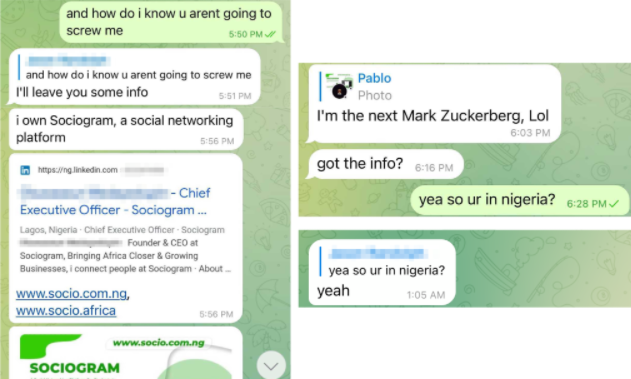
Image: Abnormal Security.
This attacker’s approach may seem fairly amateur, but it would be a mistake to dismiss the threat from West African cybercriminals dabbling in ransomware. While multi-million dollar ransomware payments are hogging the headlines, by far the biggest financial losses tied to cybercrime each year stem from so-called Business Email Compromise (BEC) or CEO Scams, in which crooks mainly based in Africa and Southeast Asia will spoof communications from executives at the target firm in a bid to initiate unauthorized international wire transfers.
According to the latest figures (PDF) released by the FBI Internet Crime Complaint Center (IC3), the reported losses from BEC scams continue to dwarf other cybercrime loss categories, increasing to $1.86 billion in 2020.
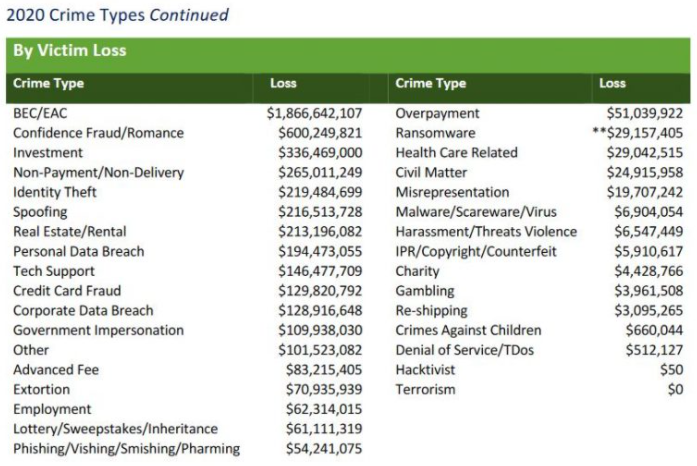
Image: FBI
“Knowing the actor is Nigerian really brings the entire story full circle and provides some notable context to the tactics used in the initial email we identified,” Hassold wrote. “For decades, West African scammers, primarily located in Nigeria, have perfected the use of social engineering in cybercrime activity.”
“While the most common cyber attack we see from Nigerian actors (and most damaging attack globally) is business email compromise (BEC), it makes sense that a Nigerian actor would fall back on using similar social engineering techniques, even when attempting to successfully deploy a more technically sophisticated attack like ransomware,” Hassold concluded.
Cybercriminals trolling for disgruntled employees is hardly a new development. Big companies have long been worried about the very real threat of disgruntled employees creating identities on darknet sites and then offering to trash their employer’s network for a fee (for more on that, see my 2016 story, Rise of the Darknet Stokes Fear of the Insider).
Indeed, perhaps this enterprising Nigerian scammer is just keeping up with current trends. Several established ransomware affiliate gangs that have recently rebranded under new banners seem to have done away with the affiliate model in favor of just buying illicit access to corporate networks.
For example, the Lockbit 2.0 ransomware-as-a-service gang actually includes a solicitation for insiders in the desktop wallpaper left behind on systems encrypted with the malware.
“Would you like to earn millions of dollars? Our company acquires access to networks of various companies, as well as insider information that can help you steal the most valuable data of any company,” LockBit’s unusual ad reads. “You can provide us accounting data for the access to any company, for example, login and password to RDP, VPN, corporate email, etc. Open our letter at your email. Launch the provided virus on any computer in your company. Companies pay us the foreclosure for the decryption of files and prevention of data leak.”
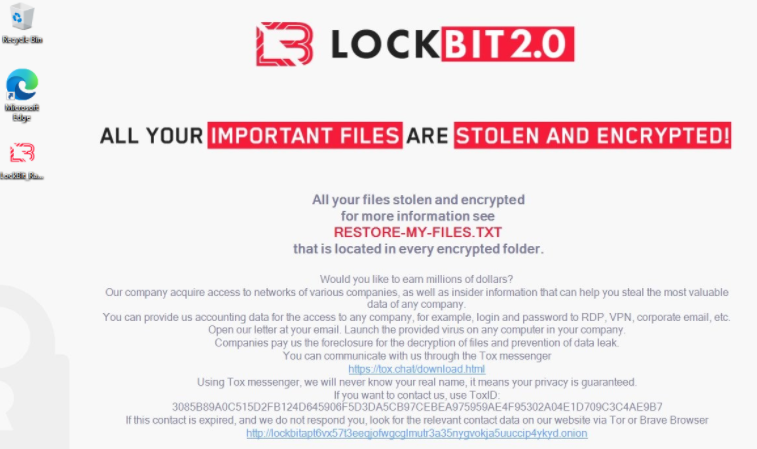
Image: Sophos.
Likewise, the newly formed DarkMatter ransomware gang kicked off its presence on the cybercrime forums with the unassuming thread, “Buying/monetizing your access to corporate networks.” The rest of the post reads:
We are looking for access to corporate networks in the following countries:
– the USA
– Canada
– Australia
– the UKAll lines of business except for:
– Healthcare
– Government entities.Requirements:
– Revenue according to ZoomInfo: over 100 million.
– Number of hosts: 500 to 15,000.
– We do not accept networks that anybody else has already tried to work on.Two options of cooperation:
– We buy networks: 3 to 100k.
– We monetize them (subject to negotiation on a case-by-case basis).How we work:
You select an option of cooperation. -> You provide access to the network. -> We check it. -> We take it or not (depending on whether it meets the requirements).
from Krebs on Security https://ift.tt/3j6MP0d
via IFTTT
Lastest episode – listen, laugh and learn! This week, Chester Wisniewski joins us on the show.
from Naked Security https://ift.tt/3815cgk
via IFTTT
Charity Management System CMS 1.0 – Multiple Vulnerabilities
from Exploit-DB.com RSS Feed https://ift.tt/3gfuXhK
via IFTTT
Fraudsters impersonate vaccine manufacturers and authorities overseeing vaccine distribution efforts, INTERPOL warns
The post Health authorities in 40 countries targeted by COVID‑19 vaccine scammers appeared first on WeLiveSecurity
from WeLiveSecurity https://ift.tt/3k400OG
via IFTTT

T-Mobile warned Monday that a data breach has exposed the names, date of birth, Social Security number and driver’s license/ID information of more than 40 million current, former or prospective customers. The acknowledgment came less than 48 hours after millions of the stolen T-Mobile customer records went up for sale in the cybercrime underground.
On Monday evening, T-Mobile said a “highly sophisticated” attack against its network led to the breach of data on millions of customers.
“Our preliminary analysis is that approximately 7.8 million current T-Mobile postpaid customer accounts’ information appears to be contained in the stolen files, as well as just over 40 million records of former or prospective customers who had previously applied for credit with T-Mobile,” the company wrote in a blog post. “Importantly, no phone numbers, account numbers, PINs, passwords, or financial information were compromised in any of these files of customers or prospective customers.”
Nevertheless, T-Mobile is urging all T-Mobile postpaid customers to proactively change their account PINs by going online into their T-Mobile account or calling customer care at 611. “This precaution is despite the fact that we have no knowledge that any postpaid account PINs were compromised,” the advisory reads.
It is not clear how many people total may be impacted by this breach. T-Mobile hasn’t yet responded to requests for clarification regarding how many of the 7.8 million current customers may also have been affected by the credit application breach.
The intrusion first came to light on Twitter when the account @und0xxed started tweeting the details, and someone on a cybercrime forum began selling what they claimed were more than 100 million freshly hacked records from T-Mobile. The hackers claimed one of those databases held the name, date of birth, SSN, drivers license information, plaintext security PIN, address and phone number of 36 million T-Mobile customers in the United States — all going back to the mid-1990s.
T-Mobile said it was also able to confirm approximately 850,000 active T-Mobile prepaid customer names, phone numbers and account PINs were also exposed.
“We have already proactively reset ALL of the PINs on these accounts to help protect these customers, and we will be notifying accordingly right away. No Metro by T-Mobile, former Sprint prepaid, or Boost customers had their names or PINs exposed,” T-Mobile said. “We have also confirmed that there was some additional information from inactive prepaid accounts accessed through prepaid billing files. No customer financial information, credit card information, debit or other payment information or SSN was in this inactive file.”
T-Mobile said it would pay for two years of identity theft protection services for any affected customers, and that it was offering “an extra step to protect your mobile account with our Account Takeover Protection capabilities for postpaid customers, which makes it harder for customer accounts to be fraudulently ported out and stolen.” Why it wouldn’t make that extra protection standard for all accounts all the time is not entirely clear.
This stolen data is being actively sold, but if the past is any teacher much of it will wind up posted online soon. It is interesting that T-Mobile is saying no phone numbers were exposed in the 40 million records of former or prospective customers who applied for credit with T-Mobile; Some of the data and screenshots shared by the hackers certainly seem to suggest otherwise. Regardless, it is a safe bet that scammers will use some of this information to target T-Mobile users with phishing messages, account takeovers and harassment.
Data stolen and exposed in this breach may also be used for identity theft. Credit monitoring and ID theft protection services can help you recover from having your identity stolen, but most will do nothing to stop the ID theft from happening. If you want the maximum control over who should be able to view your credit or grant new lines of credit in your name, then a security freeze is your best option.
If you’re a current T-Mobile customer, by all means change your account PIN as instructed. But regardless of which mobile provider you patronize, consider removing your phone number from as many online accounts as you can. Many online services require you to provide a phone number upon registering an account, but in many cases that number can be removed from your profile afterwards.
Why do I suggest this? Many online services allow users to reset their passwords just by clicking a link sent via SMS, and this unfortunately widespread practice has turned mobile phone numbers into de facto identity documents. Which means losing control over your phone number thanks to an unauthorized SIM swap or mobile number port-out, divorce, job termination or financial crisis can be devastating.
from Krebs on Security https://ift.tt/3y1unKm
via IFTTT
crossfire-server 1.9.0 – ‘SetUp()’ Remote Buffer Overflow
from Exploit-DB.com RSS Feed https://ift.tt/2XGeVal
via IFTTT

