The deployment of 5G networks will bring new use cases and revenue opportunities, mobile providers say, but security will be essential.
from Dark Reading: https://ubm.io/2Vjs3ju
via IFTTT

The deployment of 5G networks will bring new use cases and revenue opportunities, mobile providers say, but security will be essential.
from Dark Reading: https://ubm.io/2Vjs3ju
via IFTTT
A completely trusted stack lets the enterprise be confident that apps and data are treated and protected wherever they are.
from Dark Reading: https://ubm.io/2WwHvFG
via IFTTT
A Mozilla bug has made everyone’s Firefox addons ‘untrustworthy’ – including turning off the important NoScript security feature in Tor.
from Naked Security http://bit.ly/2Wss2WS
via IFTTT
Despite privacy scandals, Facebook is more profitable than ever – journalists must use the tools of tech to understand why
A dark shadow looms over our networked world. It’s called the “privacy paradox”. The main commercial engine of this world involves erosion of, and intrusions upon, our privacy. Whenever researchers, opinion pollsters and other busybodies ask people if they value their privacy, they invariably respond with a resounding “yes”. The paradox arises from the fact that they nevertheless continue to use the services that undermine their beloved privacy.
If you want confirmation, then look no further than Facebook. In privacy-scandal terms, 2018 was an annus horribilis for the company. Yet the results show that by almost every measure that matters to Wall Street, it has had a bumper year. The number of daily active users everywhere is up; average revenue per user is up 19% on last year, while overall revenue for the last quarter of 2018 is 30.4% up on the same quarter in 2017. In privacy terms, the company should be a pariah. At least some of its users must be aware of this. But it apparently makes no difference to their behaviour.
Related: Secretive hard-Brexit Facebook campaign got 1m responses
from Data and computer security | The Guardian http://bit.ly/2UYqfre
via IFTTT
Arrests in Germany, Brazil and US relate to sale of drugs, stolen data and malicious software
German police have shut down one of the world’s largest illegal online markets in the so-called dark web and arrested the three men allegedly running it, prosecutors said on Friday.
The “Wall Street Market” (WSM) site enabled trade in cocaine, heroin, cannabis and amphetamines as well as stolen data, fake documents and malicious software.
Related: Dark web blamed for rise in drugs sent by post from Netherlands
from Data and computer security | The Guardian http://bit.ly/2vKKn65
via IFTTT
Europol-led international law enforcement operation led to takedown of world’s second-largest digital underground marketplace.
from Dark Reading: https://ubm.io/2LloViE
via IFTTT
from Dark Reading: https://ubm.io/2GVNYDr
via IFTTT
Belgian coder Bernard Fabrot just finished a 3.5-year computational marathon, solving a fascinating cryptopuzzle set at MIT back in 1999.
from Naked Security http://bit.ly/2H0tv1l
via IFTTT
Federal investigators in the United States, Germany and the Netherlands announced today the arrest and charging of three German nationals and a Brazilian man as the alleged masterminds behind the Wall Street Market (WSM), one of the world’s largest dark web bazaars that allowed vendors to sell illegal drugs, counterfeit goods and malware. Now, at least one former WSM administrator is reportedly trying to extort money from WSM vendors and buyers (supposedly including Yours Truly) — in exchange for not publishing details of the transactions.
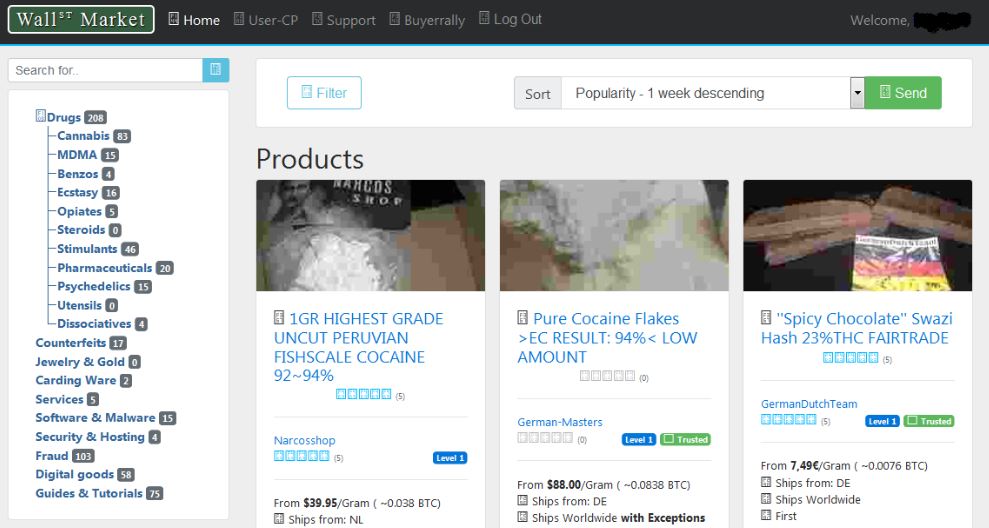
The now-defunct Wall Street Market (WSM). Image: Dark Web Reviews.
A complaint filed Wednesday in Los Angeles alleges that the three defendants, who currently are in custody in Germany, were the administrators of WSM, a sophisticated online marketplace available in six languages that allowed approximately 5,400 vendors to sell illegal goods to about 1.15 million customers around the world.
“Like other dark web marketplaces previously shut down by authorities – Silk Road and AlphaBay, for example – WSM functioned like a conventional e-commerce website, but it was a hidden service located beyond the reach of traditional internet browsers, accessible only through the use of networks designed to conceal user identities, such as the Tor network,” reads a Justice Department release issued Friday morning.
The complaint alleges that for nearly three years, WSM was operated on the dark web by three men who engineered an “exit scam” last month, absconding with all of the virtual currency held in marketplace escrow and user accounts. Prosecutors say they believe approximately $11 million worth of virtual currencies was then diverted into the three men’s own accounts.
The defendants charged in the United States and arrested Germany on April 23 and 24 include 23-year-old resident of Kleve, Germany; a 31-year-old resident of Wurzburg, Germany; and a 29-year-old resident of Stuttgart, Germany. The complaint charges the men with two felony counts – conspiracy to launder monetary instruments, and distribution and conspiracy to distribute controlled substances. These three defendants also face charges in Germany.
Signs of the dark market seizure first appeared Thursday when WSM’s site was replaced by a banner saying it had been seized by the German Federal Criminal Police Office (BKA).
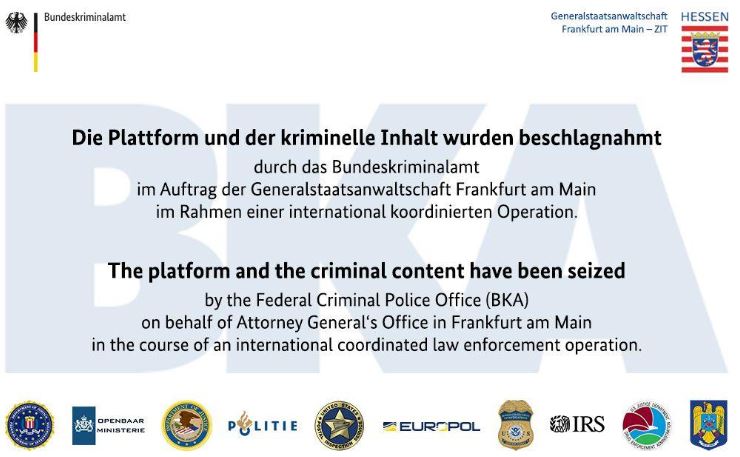
The seizure message that replaced the homepage of the Wall Street Market on on May 2.
Writing for ZDNet’s Zero Day blog, Catalin Cimpanu noted that “in this midst of all of this, one of the site’s moderators –named Med3l1n— began blackmailing WSM vendors and buyers, asking for 0.05 Bitcoin (~$280), and threatening to disclose to law enforcement the details of WSM vendors and buyers who made the mistake of sharing various details in support requests in an unencrypted form.
In a direct message sent to my Twitter account this morning, a Twitter user named @FerucciFrances who claimed to be part of the exit scam demanded 0.05 bitcoin (~$286) to keep quiet about a transaction or transactions allegedly made in my name on the dark web market.
“Make it public and things gonna be worse,” the message warned. “Investigations goes further once the whole site was crawled and saved and if you pay, include the order id on the dispute message so you can be removed. You know what I am talking about krebs.”
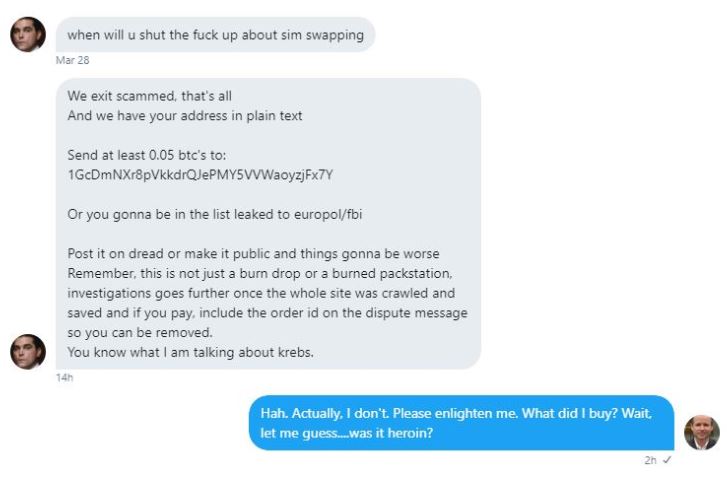
A direct message from someone trying to extort money from me.
I did have at least one user account on WSM, although I don’t recall ever communicating on the forum with any other users, and I certainly never purchased or sold anything there. Like most other accounts on dark web shops and forums, it was created merely for lurking. I asked @FerucciFrances to supply more evidence of my alleged wrongdoing, but he has not yet responded.
The Justice Department said the MED3LIN moniker belongs to a fourth defendant linked to Wall Street Market — Marcos Paulo De Oliveira-Annibale, 29, of Sao Paulo, Brazil — who was charged Thursday in a criminal complaint filed in the U.S. District Court in Sacramento, California.
Oliviera-Annibale also faces federal drug distribution and money laundering charges for allegedly acting as a moderator on WSM, who, according to the charges, mediated disputes between vendors and their customers, and acted as a public relations representative for WSM by promoting it on various sites.
Prosecutors say they connected MED3LIN to his offline identity thanks to photos and other clues he left behind online years ago, suggesting once again that many alleged cybercriminals are not terribly good at airgapping their online and offline selves.
“We are on the hunt for even the tiniest of breadcrumbs to identify criminals on the dark web,” said McGregor W. Scott, United States Attorney for the Eastern District of California. “The prosecution of these defendants shows that even the smallest mistake will allow us to figure out a cybercriminal’s true identity. As with defendant Marcos Annibale, forum posts and pictures of him online from years ago allowed us to connect the dots between him and his online persona ‘Med3l1n.’ No matter where they live, we will investigative and prosecute criminals who create, maintain, and promote dark web marketplaces to sell illegal drugs and other contraband.”
A copy of the Justice Department’s criminal complaint in the case is here (PDF).
from Krebs on Security http://bit.ly/2H1V0Yr
via IFTTT

