Belgian coder Bernard Fabrot just finished a 3.5-year computational marathon, solving a fascinating cryptopuzzle set at MIT back in 1999.
from Naked Security http://bit.ly/2H0tv1l
via IFTTT

Belgian coder Bernard Fabrot just finished a 3.5-year computational marathon, solving a fascinating cryptopuzzle set at MIT back in 1999.
from Naked Security http://bit.ly/2H0tv1l
via IFTTT
Federal investigators in the United States, Germany and the Netherlands announced today the arrest and charging of three German nationals and a Brazilian man as the alleged masterminds behind the Wall Street Market (WSM), one of the world’s largest dark web bazaars that allowed vendors to sell illegal drugs, counterfeit goods and malware. Now, at least one former WSM administrator is reportedly trying to extort money from WSM vendors and buyers (supposedly including Yours Truly) — in exchange for not publishing details of the transactions.
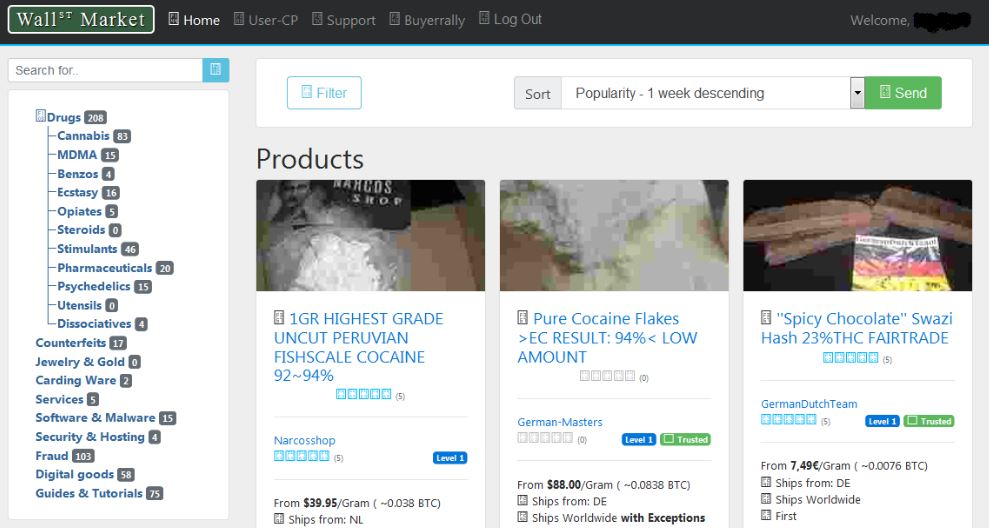
The now-defunct Wall Street Market (WSM). Image: Dark Web Reviews.
A complaint filed Wednesday in Los Angeles alleges that the three defendants, who currently are in custody in Germany, were the administrators of WSM, a sophisticated online marketplace available in six languages that allowed approximately 5,400 vendors to sell illegal goods to about 1.15 million customers around the world.
“Like other dark web marketplaces previously shut down by authorities – Silk Road and AlphaBay, for example – WSM functioned like a conventional e-commerce website, but it was a hidden service located beyond the reach of traditional internet browsers, accessible only through the use of networks designed to conceal user identities, such as the Tor network,” reads a Justice Department release issued Friday morning.
The complaint alleges that for nearly three years, WSM was operated on the dark web by three men who engineered an “exit scam” last month, absconding with all of the virtual currency held in marketplace escrow and user accounts. Prosecutors say they believe approximately $11 million worth of virtual currencies was then diverted into the three men’s own accounts.
The defendants charged in the United States and arrested Germany on April 23 and 24 include 23-year-old resident of Kleve, Germany; a 31-year-old resident of Wurzburg, Germany; and a 29-year-old resident of Stuttgart, Germany. The complaint charges the men with two felony counts – conspiracy to launder monetary instruments, and distribution and conspiracy to distribute controlled substances. These three defendants also face charges in Germany.
Signs of the dark market seizure first appeared Thursday when WSM’s site was replaced by a banner saying it had been seized by the German Federal Criminal Police Office (BKA).
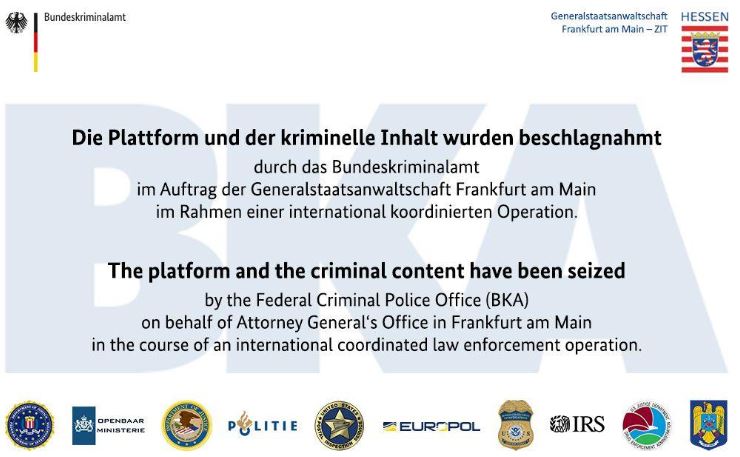
The seizure message that replaced the homepage of the Wall Street Market on on May 2.
Writing for ZDNet’s Zero Day blog, Catalin Cimpanu noted that “in this midst of all of this, one of the site’s moderators –named Med3l1n— began blackmailing WSM vendors and buyers, asking for 0.05 Bitcoin (~$280), and threatening to disclose to law enforcement the details of WSM vendors and buyers who made the mistake of sharing various details in support requests in an unencrypted form.
In a direct message sent to my Twitter account this morning, a Twitter user named @FerucciFrances who claimed to be part of the exit scam demanded 0.05 bitcoin (~$286) to keep quiet about a transaction or transactions allegedly made in my name on the dark web market.
“Make it public and things gonna be worse,” the message warned. “Investigations goes further once the whole site was crawled and saved and if you pay, include the order id on the dispute message so you can be removed. You know what I am talking about krebs.”
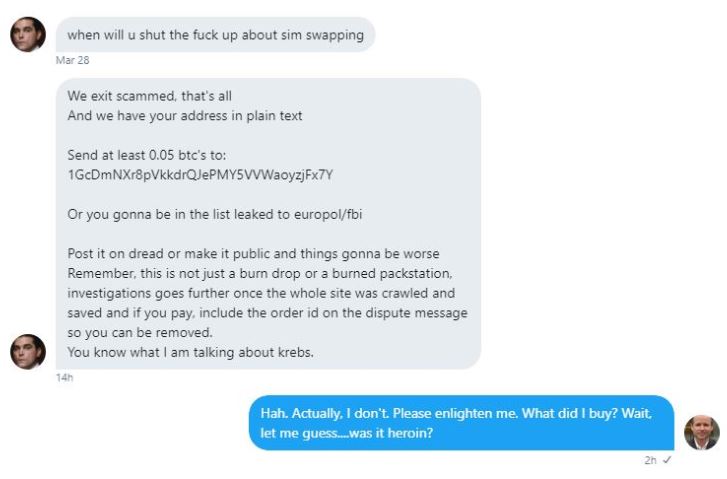
A direct message from someone trying to extort money from me.
I did have at least one user account on WSM, although I don’t recall ever communicating on the forum with any other users, and I certainly never purchased or sold anything there. Like most other accounts on dark web shops and forums, it was created merely for lurking. I asked @FerucciFrances to supply more evidence of my alleged wrongdoing, but he has not yet responded.
The Justice Department said the MED3LIN moniker belongs to a fourth defendant linked to Wall Street Market — Marcos Paulo De Oliveira-Annibale, 29, of Sao Paulo, Brazil — who was charged Thursday in a criminal complaint filed in the U.S. District Court in Sacramento, California.
Oliviera-Annibale also faces federal drug distribution and money laundering charges for allegedly acting as a moderator on WSM, who, according to the charges, mediated disputes between vendors and their customers, and acted as a public relations representative for WSM by promoting it on various sites.
Prosecutors say they connected MED3LIN to his offline identity thanks to photos and other clues he left behind online years ago, suggesting once again that many alleged cybercriminals are not terribly good at airgapping their online and offline selves.
“We are on the hunt for even the tiniest of breadcrumbs to identify criminals on the dark web,” said McGregor W. Scott, United States Attorney for the Eastern District of California. “The prosecution of these defendants shows that even the smallest mistake will allow us to figure out a cybercriminal’s true identity. As with defendant Marcos Annibale, forum posts and pictures of him online from years ago allowed us to connect the dots between him and his online persona ‘Med3l1n.’ No matter where they live, we will investigative and prosecute criminals who create, maintain, and promote dark web marketplaces to sell illegal drugs and other contraband.”
A copy of the Justice Department’s criminal complaint in the case is here (PDF).
from Krebs on Security http://bit.ly/2H1V0Yr
via IFTTT
The EO outlines a ‘rotational assignment program’ intended to help security practitioners develop their skills.
from Dark Reading: https://ubm.io/2YaxWN3
via IFTTT
Enterprise cloud security is making real progress, but emerging technologies call for security teams to keep up the pace.
from Dark Reading: https://ubm.io/2LoautW
via IFTTT
A Pennsylvania credit union is suing financial industry technology giant Fiserv, alleging that “baffling” security vulnerabilities in the company’s software are “wreaking havoc” on its customers. The credit union said the investigation that fueled the lawsuit was prompted by a 2018 KrebsOnSecurity report about glaring security weaknesses in a Fiserv platform that exposed personal and financial details of customers across hundreds of bank Web sites.

Brookfield, Wisc.-based Fiserv [NASDAQ:FISV] is a Fortune 500 company with 24,000 employees and $5.8 billion in earnings last year. Its account and transaction processing systems power the Web sites for hundreds of financial institutions — mostly small community banks and credit unions.
In August 2018, in response to inquiries by KrebsOnSecurity, Fiserv fixed a pervasive security and privacy hole in its online banking platform. The authentication weakness allowed bank customers to view account data for other customers, including account number, balance, phone numbers and email addresses.
In late April 2019, Fiserv was sued by Bessemer System Federal Credit Union, a comparatively tiny financial institution with just $38 million in assets. Bessemer said it was moved by that story to launch its own investigation into Fiserv’s systems, and it found a startlingly similar flaw: Firsev’s platform would let anyone reset the online banking password for a customer just by knowing their account number and the last four digits of their Social Security number.
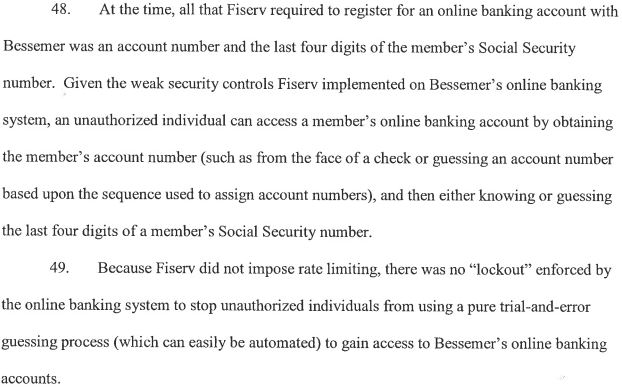
Bessemer claims Fiserv’s systems let anyone reset a customer’s online banking password just by knowing their SSN and account number.
Recall that in my Aug 2018 report, Fiserv’s systems were exposing online banking account numbers for its customers. Thus, an attacker would only need to know a target’s SSN to reset that customer’s password, according to Bessemer. And that information is for sale in multiple places online and in the cybercrime underground for a few bucks per person.
Bessemer further alleges Fiserv’s systems had no checks in place to prevent automated attacks that might let thieves rapidly guess the last four digits of the customer’s SSN — such as limiting the number of times a user can submit a login request, or imposing a waiting period after a certain number of failed login attempts.
The lawsuit says the fix Fiserv scrambled to put in place after Bessemer complained was “pitifully deficient and ineffective:”
“Fiserv attempted to fortify Bessemer’s online banking website by requiring users registering for an account to supply a member’s house number. This was ineffective because residential street addresses can be readily found on the internet and through other public sources. Moreover, this information can be guessed through a trial-and-error process. Most alarmingly, this security control was purely illusory. Because some servers were not enforcing this security check, it could be readily bypassed.”
Bessemer says instead of fixing these security problems and providing the requested assurances that information was being adequately safeguarded, Fiserv issued it a “notice of claims,” alleging the credit union’s security review of its own online banking system gave rise to civil and criminal claims.
The credit union says Fiserv demanded it not disclose information relating to the security review to any third parties, “including Fiserv’s other clients (who presumably were affected with the same security problems at their financial institutions) as well as media sources.”
Fiserv did not immediately respond to requests for comment. But Fiserv spokesperson Ann Cave was quoted in several publications saying, “We believe the allegations have no merit and will respond to the claims as part of the legal process.”
Charles Nerko, the attorney representing Bessemer in the lawsuit, said to protect the credit union’s members, the credit union is replacing its core processing vendor, although Nerko would not specify where the credit union might be taking its business.
According to FedFis.com, Fiserv is by far the top bank core processor, with more than 37 percent market share. And it’s poised to soon get much bigger.
In January 2019, Fiserv announced it was acquiring payment processing giant First Data in a $22 billion all-stock deal. The deal is expected to close in the second half of 2019, pending an antitrust review by the U.S. Justice Department.
That merger, should it go through, may not bode well for Fiserv’s customers, argues Paul Schaus of American Banker.
“Banks should take this trend as a warning sign,” Schaus wrote. “Rather than delivering new innovations that banks and their customers crave, legacy vendors are looking to remain relevant by acquiring existing products and services that expand their portfolios into new areas of financial services. As emerging technologies grow more critical to everyday business, these legacy vendors, which banks have deep longstanding relationships with, likely won’t be on the leading edge in every product or channel. Instead, financial institutions will need to seek out newer vendors that have deeper commitments and focus in cutting-edge technologies that will drive industry change.”
from Krebs on Security http://bit.ly/2J0Zl0e
via IFTTT
Well-crafted narratives can help you win over users in the battle to develop a sustainable cybersecurity culture.
from Dark Reading: https://ubm.io/2GUeiO5
via IFTTT
ESET researchers document how cybercriminals abused the advertising network of Russia’s leading search engine for malicious campaigns targeting accountants
The post Week in security with Tony Anscombe appeared first on WeLiveSecurity
from WeLiveSecurity http://bit.ly/2DGeaB9
via IFTTT
When it comes to an easy life, the criminals behind the fearful Anubis banking malware have become big fans of Twitter and, increasingly, the secure messaging of Telegram.
from Naked Security http://bit.ly/2VJf6Ps
via IFTTT
A reflection on whether this approach to addressing IoT security challenges can ‘deliver the goods’ and how consumer awareness can help in the grand scheme of things
The post The UK plans to legislate to secure IoT, but is it really the answer? appeared first on WeLiveSecurity
from WeLiveSecurity http://bit.ly/2JdfwH0
via IFTTT
Crooks have developed “ingenious” new ways to drain user accounts and wallets, CipherTrace says, prodding regulators into action.
from Naked Security http://bit.ly/2Y97aEJ
via IFTTT

