
FEMA IT Specialist Charged in ID Theft, Tax Refund Fraud Conspiracy

An information technology specialist at the Federal Emergency Management Agency (FEMA) was arrested this week on suspicion of hacking into the human resource databases of University of Pittsburgh Medical Center (UPMC) in 2014, stealing personal data on more than 65,000 UPMC employees, and selling the data on the dark web.

On June 16, authorities in Michigan arrested 29-year-old Justin Sean Johnson in connection with a 43-count indictment on charges of conspiracy, wire fraud and aggravated identity theft.

Federal prosecutors in Pittsburgh allege that in 2013 and 2014 Johnson hacked into the Oracle PeopleSoft databases for UPMC, a $21 billion nonprofit health enterprise that includes more than 40 hospitals.

According to the indictment, Johnson stole employee information on all 65,000 then current and former employees, including their names, dates of birth, Social Security numbers, and salaries.

The stolen data also included federal form W-2 data that contained income tax and withholding information, records that prosecutors say Johnson sold on dark web marketplaces to identity thieves engaged in tax refund fraud and other financial crimes. The fraudulent tax refund claims made in the names of UPMC identity theft victims caused the IRS to issue $1.7 million in phony refunds in 2014.

Johnson could not be reached for comment. At a court hearing in Pittsburgh this week, a judge ordered the defendant to be detained pending trial. Johnson’s attorney declined to comment on the charges.

Prosecutors allege Johnson’s intrusion into UPMC was not an isolated occurrence, and that for several years after the UPMC hack he sold personally identifiable information (PII) to buyers on dark web forums.

“The information was sold by Johnson on dark web forums for use by conspirators, who promptly filed hundreds of false form 1040 tax returns in 2014 using UPMC employee PII,” reads a statement from U.S. Attorney Scott Brady. “These false 1040 filings claimed hundreds of thousands of dollars of false tax refunds, which they converted into Amazon.com gift cards, which were then used to purchase Amazon merchandise which was shipped to Venezuela.”

The indictment says Johnson used the hacker aliases “DS and “TDS” to market the stolen records to identity thieves on the Evolution and AlphaBay dark web marketplaces. However, archived copies of the now-defunct dark web forums indicate those aliases are merely abbreviations that stand for “DearthStar” and “TheDearthStar,” respectively.

“You can expect good things come tax time as I will have lots of profiles with verified prior year AGIs to make your refund filing 10x easier,” TheDearthStar advertised in an August 2015 message to AlphaBay members.

In some cases, it appears these DearthStar identities were actively involved in not just selling PII and tax refund fraud, but also stealing directly from corporate payrolls.

In an Aug. 2015 post to AlphaBay titled “I’d like to stage a heist but…,” TheDearthStar solicited people to help him cash out access he had to the payroll systems of several different companies:

“… I have nowhere to send the money. I’d like to leverage the access I have to payroll systems of a few companies and swipe a chunk of their payroll. Ideally, I’d like to find somebody who has a network of trusted individuals who can receive ACH deposits.”

When another AlphaBay member asks how much he can get, TheDearthStar responds, “Depends on how many people end up having their payroll records ‘adjusted.’ Could be $1,000 could be $100,000.”

2014 and 2015 were particularly bad years for tax refund fraud, a form of identity theft which cost taxpayers and the U.S. Treasury billions of dollars. In April 2014, KrebsOnSecurity wrote about a spike in tax refund fraud perpetrated against medical professionals that caused many to speculate that one or more major healthcare providers had been hacked.

A follow-up story that same month examined the work of a cybercrime gang that was hacking into HR departments at healthcare organizations across the country and filing fraudulent tax refund requests with the IRS on employees of those victim firms.

The Justice Department’s indictment quotes from Johnson’s online resume as stating that he is proficient at installing and administering Oracle PeopleSoft systems. A LinkedIn resume for a Justin Johnson from Detroit says the same, and that for the past five months he has served as an information technology specialist at FEMA. A Facebook profile with the same photo belongs to a Justin S. Johnson from Detroit.

Johnson’s resume also says he was self-employed for seven years as a “cyber security researcher / bug bounty hunter” who was ranked in the top 1,000 by reputation on Hacker One, a program that rewards security researchers who find and report vulnerabilities in software and web applications.

from Krebs on Security https://ift.tt/2Ye5egY
via IFTTT
FEMA IT Specialist Charged in ID Theft, Tax Refund Fraud Conspiracy

An information technology specialist at the Federal Emergency Management Agency (FEMA) was arrested this week on suspicion of hacking into the human resource databases of University of Pittsburgh Medical Center (UPMC) in 2014, stealing personal data on more than 65,000 UPMC employees, and selling the data on the dark web.

On June 16, authorities in Michigan arrested 29-year-old Justin Sean Johnson in connection with a 43-count indictment on charges of conspiracy, wire fraud and aggravated identity theft.

Federal prosecutors in Pittsburgh allege that in 2013 and 2014 Johnson hacked into the Oracle PeopleSoft databases for UPMC, a $21 billion nonprofit health enterprise that includes more than 40 hospitals.

According to the indictment, Johnson stole employee information on all 65,000 then current and former employees, including their names, dates of birth, Social Security numbers, and salaries.

The stolen data also included federal form W-2 data that contained income tax and withholding information, records that prosecutors say Johnson sold on dark web marketplaces to identity thieves engaged in tax refund fraud and other financial crimes. The fraudulent tax refund claims made in the names of UPMC identity theft victims caused the IRS to issue $1.7 million in phony refunds in 2014.

Johnson could not be reached for comment. At a court hearing in Pittsburgh this week, a judge ordered the defendant to be detained pending trial. Johnson’s attorney declined to comment on the charges.

Prosecutors allege Johnson’s intrusion into UPMC was not an isolated occurrence, and that for several years after the UPMC hack he sold personally identifiable information (PII) to buyers on dark web forums.

“The information was sold by Johnson on dark web forums for use by conspirators, who promptly filed hundreds of false form 1040 tax returns in 2014 using UPMC employee PII,” reads a statement from U.S. Attorney Scott Brady. “These false 1040 filings claimed hundreds of thousands of dollars of false tax refunds, which they converted into Amazon.com gift cards, which were then used to purchase Amazon merchandise which was shipped to Venezuela.”

The indictment says Johnson used the hacker aliases “DS and “TDS” to market the stolen records to identity thieves on the Evolution and AlphaBay dark web marketplaces. However, archived copies of the now-defunct dark web forums indicate those aliases are merely abbreviations that stand for “DearthStar” and “TheDearthStar,” respectively.

“You can expect good things come tax time as I will have lots of profiles with verified prior year AGIs to make your refund filing 10x easier,” TheDearthStar advertised in an August 2015 message to AlphaBay members.

In some cases, it appears these DearthStar identities were actively involved in not just selling PII and tax refund fraud, but also stealing directly from corporate payrolls.

In an Aug. 2015 post to AlphaBay titled “I’d like to stage a heist but…,” TheDearthStar solicited people to help him cash out access he had to the payroll systems of several different companies:

“… I have nowhere to send the money. I’d like to leverage the access I have to payroll systems of a few companies and swipe a chunk of their payroll. Ideally, I’d like to find somebody who has a network of trusted individuals who can receive ACH deposits.”

When another AlphaBay member asks how much he can get, TheDearthStar responds, “Depends on how many people end up having their payroll records ‘adjusted.’ Could be $1,000 could be $100,000.”

2014 and 2015 were particularly bad years for tax refund fraud, a form of identity theft which cost taxpayers and the U.S. Treasury billions of dollars. In April 2014, KrebsOnSecurity wrote about a spike in tax refund fraud perpetrated against medical professionals that caused many to speculate that one or more major healthcare providers had been hacked.

A follow-up story that same month examined the work of a cybercrime gang that was hacking into HR departments at healthcare organizations across the country and filing fraudulent tax refund requests with the IRS on employees of those victim firms.

The Justice Department’s indictment quotes from Johnson’s online resume as stating that he is proficient at installing and administering Oracle PeopleSoft systems. A LinkedIn resume for a Justin Johnson from Detroit says the same, and that for the past five months he has served as an information technology specialist at FEMA. A Facebook profile with the same photo belongs to a Justin S. Johnson from Detroit.

Johnson’s resume also says he was self-employed for seven years as a “cyber security researcher / bug bounty hunter” who was ranked in the top 1,000 by reputation on Hacker One, a program that rewards security researchers who find and report vulnerabilities in software and web applications.

from Krebs on Security https://ift.tt/2Ye5egY
via IFTTT
When Security Takes a Backseat to Productivity

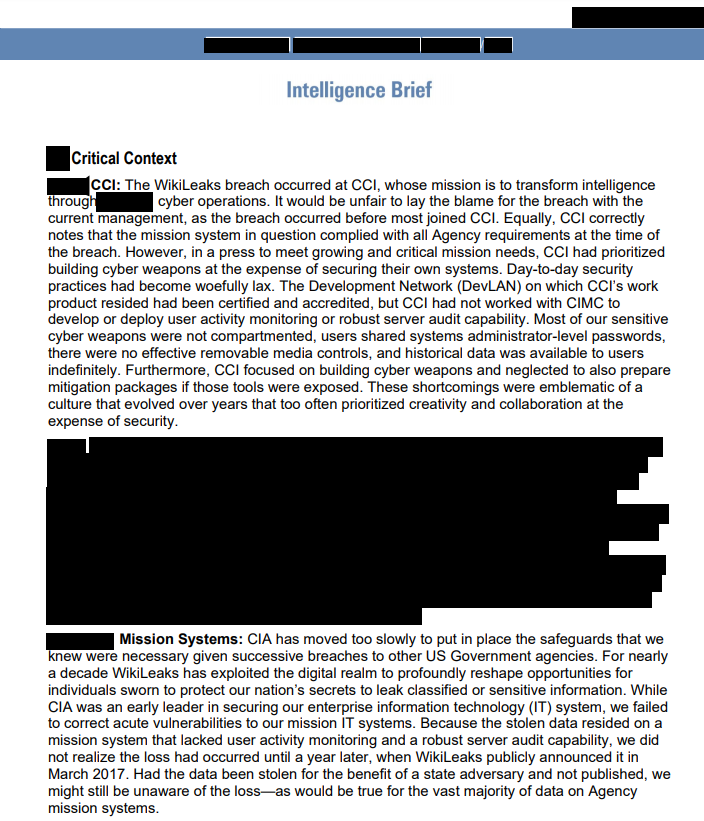
“We must care as much about securing our systems as we care about running them if we are to make the necessary revolutionary change.” -CIA’s Wikileaks Task Force.

So ends a key section of a report the U.S. Central Intelligence Agency produced in the wake of a mammoth data breach in 2016 that led to Wikileaks publishing thousands of classified documents stolen from the agency’s offensive cyber operations division. The analysis highlights a shocking series of security failures at one of the world’s most secretive organizations, but the underlying weaknesses that gave rise to the breach also unfortunately are all too common in many organizations today.

The CIA produced the report in October 2017, roughly seven months after Wikileaks began publishing Vault 7 — reams of classified data detailing the CIA’s capabilities to perform electronic surveillance and cyber warfare. But the report’s contents remained shrouded from public view until earlier this week, when heavily redacted portions of it were included in a letter by Sen. Ron Wyden (D-Ore.) to the Director of National Intelligence.

The CIA acknowledged its security processes were so “woefully lax” that the agency probably would never have known about the data theft had Wikileaks not published the stolen documents online. What kind of security failures created an environment that allegedly allowed a former CIA employee to exfiltrate so much sensitive data? Here are a few, in no particular order:

  • Failing to rapidly detect security incidents.
  • Failing to act on warning signs about potentially risky employees.
  • Moving too slowly to enact key security safeguards.
  • A lack of user activity monitoring or robust server audit capability.
  • No effective removable media controls.
  • No single person empowered to ensure IT systems are built and maintained securely throughout their lifecycle.
  • Historical data available to all users indefinitely.

Substitute the phrase “cyber weapons” with “productivity” or just “IT systems” in the CIA’s report and you might be reading the post-mortem produced by a security firm hired to help a company recover from a highly damaging data breach.

A redacted portion of the CIA’s report on the Wikileaks breach.

DIVIDED WE STAND, UNITED WE FALL

A key phrase in the CIA’s report references deficiencies in “compartmentalizing” cybersecurity risk. At a high level (not necessarily specific to the CIA), compartmentalizing IT environments involves important concepts such as:

  • Segmenting one’s network so that malware infections or breaches in one part of the network can’t spill over into other areas.
  • Not allowing multiple users to share administrative-level passwords
  • Developing baselines for user and network activity so that deviations from the norm stand out more prominently.
  • Continuously inventorying, auditing, logging and monitoring all devices and user accounts connected to the organization’s IT network.

“The Agency for years has developed and operated IT mission systems outside the purview and governance of enterprise IT, citing the need for mission functionality and speed,” the CIA observed. “While often fulfilling a valid purpose, this ‘shadow IT’ exemplifies a broader cultural issue that separates enterprise IT from mission IT, has allowed mission system owners to determine how or if they will police themselves.”

All organizations experience intrusions, security failures and oversights of key weaknesses. In large enough enterprises, these failures likely happen multiple times each day. But by far the biggest factor that allows small intrusions to morph into a full-on data breach is a lack of ability to quickly detect and respond to security incidents.

Also, because employees tend to be the most abundant security weakness in any organization, instituting some kind of continuing security awareness training for all employees is a good idea. Some security experts I know and respect dismiss security awareness programs as a waste of time and money, observing that no matter how much training a company does, there will always be some percentage of users who will click on anything.

That may or may not be accurate, but even if it is, at least the organization then has a much better idea which employees probably need more granular security controls (i.e. more compartmentalizing) to keep them from becoming a serious security liability.

Sen. Wyden’s letter (PDF), first reported on by The Washington Post, is worth reading because it points to a series of continuing security weaknesses at the CIA, many of which have already been addressed by other federal agencies, including multi-factor authentication for domain names and access to classified/sensitive systems, and anti-spam protections like DMARC.

from Krebs on Security https://ift.tt/2Y91CwL
via IFTTT