Unmasking MirrorFace: Operation LiberalFace targeting Japanese political entities

ESET researchers discovered a spearphishing campaign targeting Japanese political entities a few weeks before the House of Councillors elections, and in the process uncovered a previously undescribed MirrorFace credential stealer

The post Unmasking MirrorFace: Operation LiberalFace targeting Japanese political entities appeared first on WeLiveSecurity

from WeLiveSecurity https://ift.tt/nONvD3J
via IFTTT

Log4 sigue siendo un problema, a un año de su descubrimiento 

log4j

Log4Shell es uno de los que aparecerán en las filtraciones de datos durante la próxima década

Esta semana marca el primer aniversario del descubrimiento de la vulnerabilidad Log4j/Log4Shell que afecta a la biblioteca de registro de Java. Y es que a pesar de ya haber pasado un año desde el incidente el número de descargas de versiones vulnerables de Log4j sigue siendo elevado, pues se ha calculado alrededor del 30-40% de todas las descargas son para la versión expuesta.

Como se informó recientemente, muchas organizaciones siguen siendo vulnerables a pesar de que las versiones parcheadas pronto estuvieron disponibles.

Para quienes desconocen de la vulnerabilidad, deben saber que es notable porque el ataque se puede llevar a cabo en aplicaciones Java que registran valores obtenidos de fuentes externas, por ejemplo, al mostrar valores problemáticos en mensajes de error.

La vulnerabilidad de Log4j fue una llamada de atención para todas las organizaciones y fue un momento que a muchos profesionales de la seguridad les gustaría olvidar. Sin embargo, con el uso generalizado de Log4j y una red cada vez mayor de servidores internos y de terceros para parchear, la vulnerabilidad se sentirá durante mucho tiempo.

Se observa que casi todos los proyectos que utilizan frameworks como Apache Struts, Apache Solr, Apache Druid o Apache Flink se ven afectados, incluidos Steam, Apple iCloud, clientes y servidores de Minecraft.

Sonatype ha producido un centro de recursos para mostrar el estado actual de la vulnerabilidad, así como una herramienta para ayudar a las empresas a escanear su código fuente abierto para ver si está afectado.

El tablero muestra el porcentaje de descargas de Log4j que siguen siendo vulnerables (actualmente alrededor del 34 % desde diciembre pasado). También muestra las partes del mundo que han visto el porcentaje más alto de descargas vulnerables.

Brian Fox, CTO de Sonatype, dice:

Log4j fue un claro recordatorio de la importancia crítica de asegurar la cadena de suministro de software. Se utilizó en prácticamente todas las aplicaciones modernas y afectó a los servicios de organizaciones de todo el mundo. Un año después del incidente de Log4Shell, la situación sigue siendo sombría. Según nuestros datos, el 30-40% de todas las descargas de Log4j son para la versión vulnerable, aunque se lanzó un parche dentro de las 24 horas posteriores a la revelación prematura de la vulnerabilidad.

Ademas de ello, añade que es:

Imperativo que las organizaciones reconozcan que la mayoría de los riesgos del código abierto recaen en los consumidores, quienes deben adoptar las mejores prácticas en lugar de culpar al código defectuoso. Log4j no es un incidente aislado: el 96% de las descargas de componentes de código abierto vulnerables tenían una versión parcheada.

Las organizaciones necesitan una mejor visibilidad de cada componente utilizado en sus cadenas de suministro de software. Esta es la razón por la cual las soluciones de análisis de composición de software de calidad son tan importantes hoy en día, ya que el mundo contempla la utilidad de los SBOM en el futuro.

La política de software del Reino Unido y Europa debería exigir a los consumidores comerciales de software libre que puedan llevar a cabo el equivalente a un retiro específico, tal como esperamos los fabricantes de bienes físicos como la industria automotriz. La visibilidad general otorgará beneficios adicionales a las organizaciones, como la capacidad de tomar decisiones en él.

A medida que avanzamos quedó claro que los hackers continuarían explotando la vulnerabilidad. En febrero, los hackers patrocinados por el estado iraní utilizaron la falla para ingresar a una red del gobierno de EE. UU., extraer criptomonedas ilegalmente, robar credenciales y cambiar contraseñas. Luego, en octubre, un grupo asociado con el gobierno chino utilizó la vulnerabilidad para lanzar ataques contra varios objetivos, incluido un país del Medio Oriente y un fabricante de productos electrónicos.

La vulnerabilidad Log4j continúa afectando a las empresas en la actualidad. Ocupa constantemente el primer o segundo lugar en los informes de amenazas de diferentes consultoras de ciberseguridad, lo que afecta al 41 % de las organizaciones en todo el mundo a partir de octubre de 2022.

from Linux Adictos https://ift.tt/WrDvElf
via IFTTT

Six Charged in Mass Takedown of DDoS-for-Hire Sites

The U.S. Department of Justice (DOJ) today seized four-dozen domains that sold “booter” or “stresser” services — businesses that make it easy and cheap for even non-technical users to launch powerful Distributed Denial of Service (DDoS) attacks designed knock targets offline. The DOJ also charged six U.S. men with computer crimes related to their alleged ownership of the popular DDoS-for-hire services.
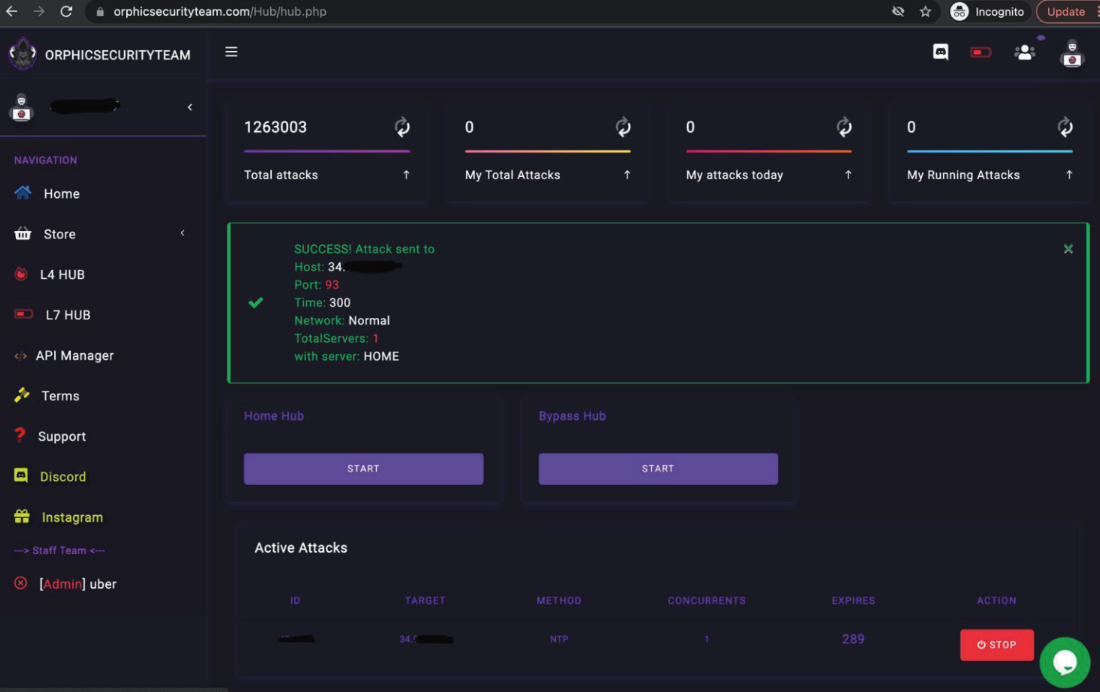
The booter service OrphicSecurityTeam[.]com was one of the 48 DDoS-for-hire domains seized by the Justice Department this week.

The DOJ said the 48 domains it seized helped paying customers launch millions of digital sieges capable of knocking Web sites and even entire network providers offline.

Booter services are advertised through a variety of methods, including Dark Web forums, chat platforms and even youtube.com. They accept payment via PayPal, Google Wallet, and/or cryptocurrencies, and subscriptions can range in price from just a few dollars to several hundred per month. The services are generally priced according to the volume of traffic to be hurled at the target, the duration of each attack, and the number of concurrent attacks allowed.

Prosecutors in Los Angeles say the booter sites supremesecurityteam[.]com and royalstresser[.]com were the brainchild of Jeremiah Sam Evans Miller, a.k.a. “John the Dev,” a 23-year-old from San Antonio, Texas. Miller was charged this week with conspiracy and violations of the Computer Fraud and Abuse Act (CFAA). The complaint against Miller alleges Royalstresser launched nearly 200,000 DDoS attacks between November 2021 and February 2022.

Defendant Angel Manuel Colon Jr., a.k.a Anonghost720 and Anonghost1337, is a 37-year-old from Belleview, Fla. Colon is suspected of running the booter service securityteam[.]io. He was also charged with conspiracy and CFAA violations. The feds say the SecurityTeam stresser service conducted 1.3 million attacks between 2018 and 2022, and attracted some 50,000 registered users.

Charged with conspiracy were Corey Anthony Palmer, 22, of Lauderhill, Fla, for his alleged ownership of booter[.]sx; and Shamar Shattock, 19, of Margate, Fla., for allegedly operating the booter service astrostress[.]com, which had more than 30,000 users and blasted out some 700,000 attacks.

Two other alleged booter site operators were charged in Alaska. John M. Dobbs, 32, of Honolulu, HI is charged with aiding and abetting violations of the CFAA related to the operation of IPStresser[.]com, which he allegedly operated for nearly 13 years until last month. During that time, IPstresser launched approximately 30 million DDoS attacks and garnered more than two million registered users.

Joshua Laing, 32, of Liverpool, NY, also was charged with CFAA infractions tied to his alleged ownership of the booter service TrueSecurityServices[.]io, which prosecutors say had 18,000 users and conducted over 1.2 million attacks between 2018 and 2022.

Purveyors of stressers and booters claim they are not responsible for how customers use their services, and that they aren’t breaking the law because — like most security tools — stresser services can be used for good or bad purposes. For example, all of the above-mentioned booter sites contained wordy “terms of use” agreements that required customers to agree they will only stress-test their own networks — and that they won’t use the service to attack others.

But the DOJ says these disclaimers usually ignore the fact that most booter services are heavily reliant on constantly scanning the Internet to commandeer misconfigured devices that are critical for maximizing the size and impact of DDoS attacks.

“None of these sites ever required the FBI to confirm that it owned, operated, or had any property right to the computer that the FBI attacked during its testing (as would be appropriate if the attacks were for a legitimate or authorized purpose),” reads an affidavit (PDF) filed by Elliott Peterson, a special agent in the FBI’s Anchorage field office.

“Additionally, analysis of data related to the FBI-initiated attacks revealed that the attacks launched by the SUBJECT DOMAINS involved the extensive misuse of third-party services,” Peterson continued. “Specifically, all of the tested services offered ‘amplification’ attacks, where the attack traffic is amplified through unwitting third-party servers in order to increase the overall attack size, and to shift the financial burden of generating and transmitting all of that data away from the booter site administrator(s) and onto third parties.”

According to U.S. federal prosecutors, the use of booter and stresser services to conduct attacks is punishable under both wire fraud laws and the Computer Fraud and Abuse Act (18 U.S.C. § 1030), and may result in arrest and prosecution, the seizure of computers or other electronics, as well as prison sentences and a penalty or fine.

The charges unsealed today stemmed from investigations launched by the FBI’s field offices in Los Angeles and Alaska, which spent months purchasing and testing attack services offered by the booter sites.

A similar investigation initiating from the FBI’s Alaska field office in 2018 culminated in a takedown and arrest operation that targeted 15 DDoS-for-hire sites, as well as three booter store defendants who later pleaded guilty.

The Justice Department says its trying to impress upon people that even buying attacks from DDoS-for-hire services can land Internet users in legal jeopardy.

“Whether a criminal launches an attack independently or pays a skilled contractor to carry one out, the FBI will work with victims and use the considerable tools at our disposal to identify the person or group responsible,” said Donald Alway, the assistant director in charge of the FBI’s Los Angeles field office.

The United Kingdom, which has been battling its fair share of domestic booter bosses, in 2020 started running online ads aimed at young people who search the Web for booter services.

And in Europe, prosecutors have even gone after booter customers.

Here is the full list of booter site domains seized (or in the process of being seized) by the DOJ:

api-sky[.]xyz
astrostress[.]com
blackstresser[.]net
booter[.]sx
booter[.]vip
bootyou[.]net
brrsecurity[.]org
buuter[.]cc
cyberstress[.]us
defconpro[.]net
dragonstresser[.]com
dreams-stresser[.]io
exotic-booter[.]com
freestresser[.]so
instant-stresser[.]com
ipstress[.]org
ipstress[.]vip
ipstresser[.]com
ipstresser[.]us
ipstresser[.]wtf
ipstresser[.]xyz
kraysec[.]com
mcstorm[.]io
nightmarestresser[.]com
orphicsecurityteam[.]com
ovhstresser[.]com
quantum-stresser[.]net
redstresser[.]cc
royalstresser[.]com
securityteam[.]io
shock-stresser[.]com
silentstress[.]net
stresser[.]app
stresser[.]best
stresser[.]gg
stresser[.]is
stresser[.]net/stresser[.]org
stresser[.]one
stresser[.]shop
stresser[.]so
stresser[.]top
stresserai[.]com
sunstresser[.]com
supremesecurityteam[.]com
truesecurityservices[.]io
vdos-s[.]co
zerostresser[.]com

from Krebs on Security https://ift.tt/iT4Z2Ec
via IFTTT

Firefox 109 «tomará prestado» el botón de Chrome que esconde las extensiones

Firefox 109

Hace algo más de 24 horas desde que Mozilla hizo oficial el lanzamiento de Firefox 108. Entre sus novedades, quizá lo más destacado fue el soporte para WebMIDI, pero hay que reconocer que no fue uno de los lanzamientos más emocionantes que se recuerdan. Tras el lanzamiento de una nueva versión estable, la compañía pone a disposición de cualquier interesado dos tres versiones más: la Beta, la Dev, que es muy parecida a la primera, y la Nightly. En enero lanzarán Firefox 109, y ya se conocen algunas novedades de esa versión.

Actualmente en el canal Beta, Firefox 109 incluirá un botón en donde se esconderán las extensiones. Esto es algo que hace mucho que está disponible en Chrome/Chromium, y su finalidad es esconder todas las extensiones para que sólo aparezcan cuando nosotros queramos. Claro está, es posible dejar visibles algunas extensiones, pero hay muchas que no necesitamos tener siempre en la barra ocupando espacio.

Firefox 109 llegará el 10 de enero

En la captura se puede ver cómo están ahora las extensiones y cómo estarán muy pronto. La ventana verde (arriba) es de Firefox 108, y, sin ser mi navegador por defecto, tengo hasta 5 iconos ocupando espacio. La ventana roja es de Firefox 110, actualmente en al canal Nightly, pero podemos ver lo mismo si descargamos Firefox Beta, un icono con forma de pieza de puzzle que muestra todas las extensiones que no hayamos dejado a la vista a propósito.

Esta novedad del botón está publicada en el mismo punto en el que hay publicada otra que, desde mi punto de vista, no tiene nada que ver: se activará la versión 3 del manifiesto (MV3), pero dejando claro que MV2 sigue estando soportada y activada. Para completar la lista de mejoras que de momento nos pueden adelantar, dicen que las versiones de Firefox en español de España (es-ES) y español de Argentina (es-AR) vienen ahora con un diccionario integrado que puede usarse con el corrector ortográfico de Firefox.

Firefox 109 llegará ya en 2023, concretamente el 10 de enero, y se esperan más novedades además de estas dos.

from Linux Adictos https://ift.tt/VOBfKvY
via IFTTT

Microsoft Patch Tuesday, December 2022 Edition

Microsoft has released its final monthly batch of security updates for 2022, fixing more than four dozen security holes in its various Windows operating systems and related software. The most pressing patches include a zero-day in a Windows feature that tries to flag malicious files from the Web, a critical bug in PowerShell, and a dangerous flaw in Windows 11 systems that was detailed publicly prior to this week’s Patch Tuesday.

The security updates include patches for Azure, Microsoft Edge, Office, SharePoint Server, SysInternals, and the .NET framework. Six of the update bundles earned Microsoft’s most dire “critical” rating, meaning they fix vulnerabilities that malware or malcontents can use to remotely commandeer an unpatched Windows system — with little to no interaction on the part of the user.

The bug already seeing exploitation is CVE-2022-44698, which allows attackers to bypass the Windows SmartScreen security feature. The vulnerability allows attackers to craft documents that won’t get tagged with Microsoft’s “Mark of the Web,” despite being downloaded from untrusted sites.

“This means no Protected View for Microsoft Office documents, making it easier to get users to do sketchy things like execute malicious macros,
said Greg Wiseman, product manager at security firm Rapid7. This is the second Mark of the Web flaw Microsoft has patched in as many months; both were first publicly detailed over the past two months on Twitter by security researcher Will Dormann.

Publicly disclosed (but not actively exploited for now) is CVE-2022-44710, which is an elevation of privilege flaw in the DirectX graphics component of Windows 11.

Another notable critical bug is CVE-2022-41076, a remote code execution flaw in PowerShell — a key component of Windows that makes it easier to automate system tasks and configurations.

Kevin Breen at Immersive Labs said while Microsoft doesn’t share much detail about CVE-2022-41076 apart from the designation ‘Exploitation More Likely,’ they also note that successful exploitation requires an attacker to take additional actions to prepare the target environment.

“What actions are required is not clear; however, we do know that exploitation requires an authenticated user level of access,” Breen said. “This combination suggests that the exploit requires a social engineering element, and would likely be seen in initial infections using attacks like MalDocs or LNK files.”

Speaking of malicious documents, Trend Micro’s Zero Day Initiative highlights CVE-2022-44713, a spoofing vulnerability in Outlook for Mac.

“We don’t often highlight spoofing bugs, but anytime you’re dealing with a spoofing bug in an e-mail client, you should take notice,” ZDI’s Dustin Childs wrote. “This vulnerability could allow an attacker to appear as a trusted user when they should not be. Now combine this with the SmartScreen Mark of the Web bypass and it’s not hard to come up with a scenario where you receive an e-mail that appears to be from your boss with an attachment entitled “Executive_Compensation.xlsx”. There aren’t many who wouldn’t open that file in that scenario.”

Microsoft also released guidance on reports that certain software drivers certified by Microsoft’s Windows Hardware Developer Program were being used maliciously in post-exploitation activity.

Three different companies reported evidence that malicious hackers were using these signed malicious driver files to lay the groundwork for ransomware deployment inside victim organizations. One of those companies, Sophos, published a blog post Tuesday detailing how the activity was tied to the Russian ransomware group Cuba, which has extorted an estimated $60 million from victims since 2019.

Of course, not all scary and pressing security threats are Microsoft-based. Also on Tuesday, Apple released a bevy of security updates to iOS, iPadOS, macOS, tvOS and Safari, including  a patch for a newly discovered zero-day vulnerability that could lead to remote code execution.

Anyone responsible for maintaining Fortinet or Citrix remote access products probably needs to update, as both are dealing with active attacks on just-patched flaws.

For a closer look at the patches released by Microsoft today (indexed by severity and other metrics) check out the always-useful Patch Tuesday roundup from the SANS Internet Storm Center. And it’s not a bad idea to hold off updating for a few days until Microsoft works out any kinks in the updates: AskWoody.com usually has the lowdown on any patches that may be causing problems for Windows users.

As always, please consider backing up your system or at least your important documents and data before applying system updates. And if you run into any problems with these updates, please drop a note about it here in the comments.

from Krebs on Security https://ift.tt/t1BGnYd
via IFTTT