Conti Ransom Gang Starts Selling Access to Victims

The Conti ransomware affiliate program appears to have altered its business plan recently. Organizations infected with Conti’s malware who refuse to negotiate a ransom payment are added to Conti’s victim shaming blog, where confidential files stolen from victims may be published or sold. But sometime over the past 48 hours, the cybercriminal syndicate updated its victim shaming blog to indicate that it is now selling access to many of the organizations it has hacked.
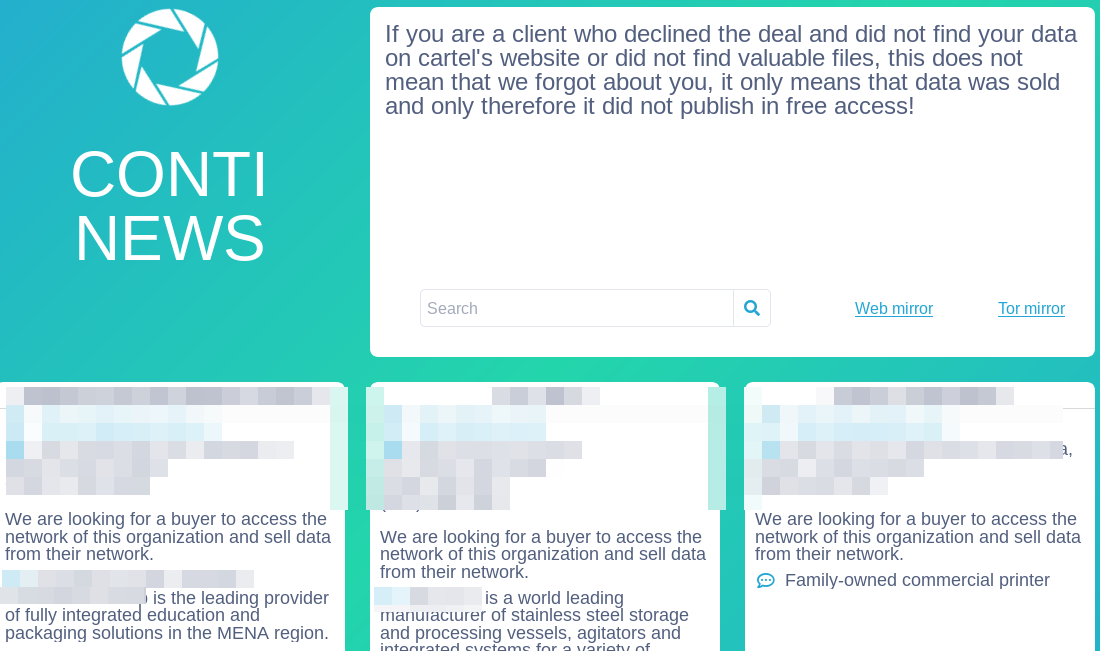
A redacted screenshot of the Conti News victim shaming blog.

“We are looking for a buyer to access the network of this organization and sell data from their network,” reads the confusingly worded message inserted into multiple recent victim listings on Conti’s shaming blog.

It’s unclear what prompted the changes, or what Conti hopes to gain from the move. It’s also not obvious why they would advertise having hacked into companies if they plan on selling that access to extract sensitive data going forward. Conti did not respond to requests for comment.

“I wonder if they are about to close down their operation and want to sell data or access from an in-progress breach before they do,” said Fabian Wosar, chief technology officer at computer security firm Emsisoft. “But it’s somewhat stupid to do it that way as you will alert the companies that they have a breach going on.”

The unexplained shift comes as policymakers in the United States and Europe are moving forward on efforts to disrupt some of the top ransomware gangs. Reuters recently reported that the U.S. government was behind an ongoing hacking operation that penetrated the computer systems of REvil, a ransomware affiliate group that experts say is about as aggressive and ruthless as Conti in dealing with victims. What’s more, REvil was among the first ransomware groups to start selling its victims’ data.

REvil’s darknet victim shaming site remains offline. In response, a representative for the Conti gang posted a long screed on Oct. 22 to a Russian language hacking forum denouncing the attack on REvil as the “unilateral, extraterritorial, and bandit-mugging behavior of the United States in world affairs.”

“Is there a law, even an American one, even a local one in any county of any of the 50 states, that legitimize such indiscriminate offensive action?” reads the Conti diatribe. “Is server hacking suddenly legal in the United States or in any of the US jurisdictions? Suppose there is such an outrageous law that allows you to hack servers in a foreign country. How legal is this from the point of view of the country whose servers were attacked? Infrastructure is not flying there in space or floating in neutral waters. It is a part of someone’s sovereignty.”

Conti’s apparent new direction may be little more than another ploy to bring victim companies to the negotiating table, as in “pay up or someone will pay for your data or long-term misery if you don’t.”

Or maybe something just got lost in the translation from Russian (Conti’s blog is published in English). But by shifting from the deployment of ransomware malware toward the sale of stolen data and network access, Conti could be aligning its operations with many competing ransomware affiliate programs that have recently focused on extorting companies in exchange for a promise not to publish or sell stolen data.

However, as Digital Shadows points out in a recent ransomware roundup, many ransomware groups are finding it difficult to manage data-leak sites, or hosting stolen data on the dark web for download.

After all, when it takes weeks to download one victim’s data via Tor — if indeed the download succeeds at all — the threat of leaking sensitive data as a negotiation tactic loses some of its menace. It’s also a crappy user experience. This has resulted in some ransomware groups exposing data using public file-sharing websites, which are faster and more reliable but can be taken down through legal means quite quickly.

Data leak sites also can offer investigators a potential way to infiltrate ransomware gangs, as evidenced by the recent reported compromise of the REvil gang by U.S. authorities.

“On 17 Oct 2021, a representative of the REvil ransomware gang took it to a Russian-speaking criminal forum to reveal that their data-leak sites had been ‘hijacked’,” Digital Shadows’ Ivan Righi wrote. “The REvil member explained that an unknown individual accessed the hidden services of REvil’s website’s landing page and blog using the same key owned by the developers. The user believed that the ransomware gang’s servers had been compromised and the individual responsible for the compromise was ‘looking for’ him.”

A recent report by Mandiant revealed that FIN12 — the group believed to be responsible for both Conti and the Ryuk ransomware operation — has managed to conduct ransomware attacks in less than 3 days, compared to more than 12 days for attacks involving data exfiltration.

Seen through those figures, perhaps Conti is merely seeking to outsource more of the data exfiltration side of the business (for a fee, of course) so that it can focus on the less time-intensive but equally profitable racket of deploying ransomware.

“As Q4 comes near, it will be interesting to see if issues relating to managing data leak sites will discourage new ransomware groups [from pursuing] the path of data-leak sites, or what creative solutions they will create to work around these issues,” Righi concluded. “The Ryuk ransomware group has proven itself to remain effective and a top player in the ransomware threat landscape without the need for a data-leak site. In fact, Ryuk has thrived by not needing a data leak site and data exfiltration.”

from Krebs on Security https://ift.tt/3ChB4eh
via IFTTT

Ransomware attacks in UK have doubled in a year, says GCHQ boss

Jeremy Fleming says ransomware is proliferating as it is ‘largely uncontested’ and highly profitable

The head of the UK spy agency GCHQ has disclosed that the number of ransomware attacks on British institutions has doubled in the past year.

Jeremy Fleming, the director of GCHQ, said locking files and data on a user’s computer and demanding payment for their release had become increasingly popular among criminals because it was “largely uncontested” and highly profitable.

Continue reading…

from Data and computer security | The Guardian https://ift.tt/3jAMbYu
via IFTTT

Huawei Watch Fit Mini, híbrido entre reloj y pulsera de actividad con especial énfasis en el diseño

Huawei Watch Fit Mini, híbrido entre reloj y pulsera de actividad con especial énfasis en el diseño

El catálogo de dispositivos de muñeca aumenta en Huawei Alemania anticipando una distribución europea: la pulsera Huawei Watch Fit Mini ya puede adquirirse en aquel país. Elegante, con gran pantalla rectangular, perfecta para medir el ejercicio y otros parámetros de salud, como la calidad del sueño.

La diferencia entre los relojes inteligentes y las pulseras de actividad es cada vez más difusa, al menos vistas desde el exterior: las segundas se van pareciendo cade vez más a los primeros. Eso sí, las pulseras acostumbran a incluir menos características técnicas; como el GPS, que suele quedarse para los relojes. Es el caso de la nueva Huawei Watch Fit Mini: de diseño atractivo, sus características son más que suficiente para acompañar el uso del teléfono.


Continue reading

Listen up 3 – CYBERSECURITY FIRST! Cyberinsurance, help or hindrance?

This is the third in our collection of Naked Security Podcast minisodes for Week 4 of Cybersecurity Awareness month. This time, we talk to Dr Jason Nurse, Associate Professor in Cybersecurity at the University of Kent, about the controversial topic of cyberinsurance. Cyberinsurers often get criticised for “caving in” to ransomware criminals, but in an […]

from Naked Security https://ift.tt/3meQqe9
via IFTTT

Oppo A56 5G: nuevo modelo para la gama media con 5G, doble cámara y una gran batería

Oppo A56 5G: nuevo modelo para la gama media con 5G, doble cámara y una gran batería

Oppo tiene un nuevo teléfono integrando su catálogo. Se trata del Oppo A56 5G, un modelo que ha sido presentado en China y que viene a relevar al Oppo A55 5G, un modelo con el que comparte buena parte de las especificaciones a pesar de la evolución en la gama.

De hecho en el Oppo A56 5G la marca se ha centrado sobre todo en el apartado fotográfico, en el que han cambiado el módulo de cámaras pasando de tres a dos y al añadir nuevos colores para el acabado que hacen que el Oppo A56 5G puede comprarse en tonos negros, morados y azules. Continue reading

Kodi 19.3 llega antes de lo esperado para corregir fallos presentes en la versión anterior

Kodi 19.3

Justo ayer estropeé el Kodi de mi Raspberry Pi y tuve que empezar de cero. Tras iniciarlo, el famoso «Media Center» me dijo que estaba disponible la v19.2 del mismo, pero yo no podía instalar esa versión porque la que hay en los repositorios oficiales sigue siendo la v18.7. A eso se referirán sus desarrolladores cuando, en la nota del lanzamiento de Kodi 19.3, dijeron que muchos aún estarían esperando la anterior versión de punto y ya han lanzado la siguiente.

Kodi 19.3 es la tercera actualización de mantenimiento de Matrix, y no incluye nuevas funciones. Si se ha lanzado tan pronto es porque han querido pulir un poco las cosas, y que muchos aún no estemos usando la versión anterior ha tenido algo que ver en que hayan lanzado Kodi 19.3, para que los que aún no estuviéramos en esa entrega no tuviéramos que sufrir los problemas que contenía.

Novedades más destacadas de Kodi 19.3

  • Tuvieron algunos problemas para publicar la versión de Xbox debido a algunos requisitos específicos de la plataforma necesarios para la reproducción 4k/HEVC. Ya deberían haber cubierto estos requisitos a satisfacción de Microsoft, y finalmente ha llegado a la Tienda Windows.
  • También había y han solucionado un problema con un certificado caducado para la versión 18.9 en Xbox, lo que hacía que la versión quedara fuera de esa plataforma para nuevas instalaciones.
  • Hubo un problema de audio Atmos durante mucho tiempo en todas las plataformas que soportan TrueHD passthrough. Ya está solucionado.
  • Solucionada una regresión en la versión 19.2 que rompía Airplay.
  • Un par de correcciones relacionadas con los juegos, en particular una corrección del mando y algunos problemas de sombreado en Retroplayer.
  • Corregido un error que afectaba a las miniaturas de los episodios vistos cuando se ocultaban los spoilers de los episodios.
  • Se ha mejorado mucho los metadatos mostrados en las tiendas de aplicaciones de Linux.

Kodi 19.3 ha sido anunciado hoy, por lo que ya está disponible para su descarga. Por lo menos así es para los que descarguen el software desde su página o repositorio oficial. A Linux llegará de la mano de Flathub en las próximas horas. Si, como yo, tenéis una Raspberry Pi con el sistema operativo oficial, bueno, tocará seguir esperando.

from Linux Adictos https://ift.tt/3nlBudo
via IFTTT

Xiaomi 11 Lite 5G NE, análisis: un peso pluma que esconde más potencia de lo que parece

Xiaomi 11 Lite 5G NE, análisis: un peso pluma que esconde más potencia de lo que parece

En abril de este mismo año analizábamos el Xiaomi Mi 11 Lite 5G, un gama media que ahora cuenta con un hermano gemelo, el Xiaomi 11 Lite 5G NE. Las siglas corresponden a ‘New Edition’, aunque no todos los cambios que han llegado suponen un salto adelante. Aquí estamos ante una versión con distinto procesador, colores y memorias base.

Pasa por nuestra mesa de análisis el Xiaomi 11 Lite 5G NE, un gama media con características interesantes que pretende hacerse un hueco en un territorio donde sus propios hermanos son sus mayores enemigos.


Continue reading