Attackers target companies’ container supply chain, driving a sixfold increase in a year, aiming to steal processing time for cryptomining and compromise cloud infrastructure.
from Dark Reading: https://ift.tt/3wPTPTi
via IFTTT

Attackers target companies’ container supply chain, driving a sixfold increase in a year, aiming to steal processing time for cryptomining and compromise cloud infrastructure.
from Dark Reading: https://ift.tt/3wPTPTi
via IFTTT

El sucesor de Hangouts sigue recibiendo importantes novedades. Tras el lanzamiento oficial de su integración con Gmail la semana pasada, ahora vemos como Google Chat mejora su buscador.
El buscador de Google Chat era muy básico, se limitaba a una barra de búsqueda para buscar en chats y contactos, pero no permitía filtrar los resultados hasta hoy.
Reproductive Biology Associates says the data of 38,000 patients may have been compromised in the April cyberattack.
from Dark Reading: https://ift.tt/3wOrj4q
via IFTTT
PAHO Director says “spirit of unity” has allowed the Americas to grapple with the worst health crisis in 100 years
Cristina Mitchell
21 Jun 2021
from PAHO/WHO | Pan American Health Organization https://ift.tt/3gKWf05
via IFTTT
Te presentamos los mejores dispositivos de streaming que existen. El Amazon Fire TV Cube es nuestro favorito.
from Digital Trends Español https://ift.tt/2hxExxf
via IFTTT
The school district has spent seven months and a reported $8.1 million recovering from the November attack.
from Dark Reading: https://ift.tt/3zLHb9J
via IFTTT
La compañía incursiona en el mundo de los NFT, particularmente su línea de juguetes Hot Wheels.
from Digital Trends Español https://ift.tt/3wLuf1V
via IFTTT
Seeking some safe fun in the sun? Head outside with deals on speakers, luggage, and more.
from Gear Latest https://ift.tt/3iYEv2I
via IFTTT
Amid multiple recent reports of hackers breaking into and tampering with drinking water treatment systems comes a new industry survey with some sobering findings: A majority of the 52,000 separate drinking water systems in the United States still haven’t inventoried some or any of their information technology systems — a basic first step in protecting networks from cyberattacks.
The Water Information Sharing and Analysis Center (WaterISAC) — an industry group that tries to facilitate information sharing and the adoption of best practices among utilities in the water sector — surveyed roughly 600 employees of water and wastewater treatment facilities nationwide, and found 37.9 percent of utilities have identified all IT-networked assets, with an additional 21.7 percent working toward that goal.
The ISAC found when it comes to IT systems tied to “operational technology” (OT) — systems responsible for monitoring and controlling the industrial operation of these utilities and their safety features — just 30.5 percent had identified all OT-networked assets, with an additional 22.5 percent working to do so.
“Identifying IT and OT assets is a critical first step in improving cybersecurity,” the report concluded. “An organization cannot protect what it cannot see.”
It’s also hard to see threats you’re not looking for: 67.9 percent of water systems reported no IT security incidents in the last 12 months, a somewhat unlikely scenario.
Michael Arceneaux, managing director of the WaterISAC, said the survey shows much room for improvement and a need for support and resources.
“Threats are increasing, and the sector, EPA, CISA and USDA need to collaborate to help utilities prevent and recover from compromises,” Arceneaux said on Twitter.
While documenting each device that needs protection is a necessary first step, a number of recent cyberattacks on water treatment systems have been blamed on a failure to properly secure water treatment employee accounts that can be used for remote access.
In April, federal prosecutors unsealed an indictment against a 22-year-old from Kansas who’s accused of hacking into a public water system in 2019. The defendant in that case is a former employee of the water district he allegedly hacked.
In February, we learned that someone hacked into the water treatment plan in Oldsmar, Fla. and briefly increased the amount of sodium hydroxide (a.k.a. lye used to control acidity in the water) to 100 times the normal level. That incident stemmed from stolen or leaked employee credentials for TeamViewer, a popular program that lets users remotely control their computers.
In January, a hacker tried to poison a water treatment plant that served parts of the San Francisco Bay Area, reports Kevin Collier for NBCNews. The hacker in that case also had the username and password for a former employee’s TeamViewer account.
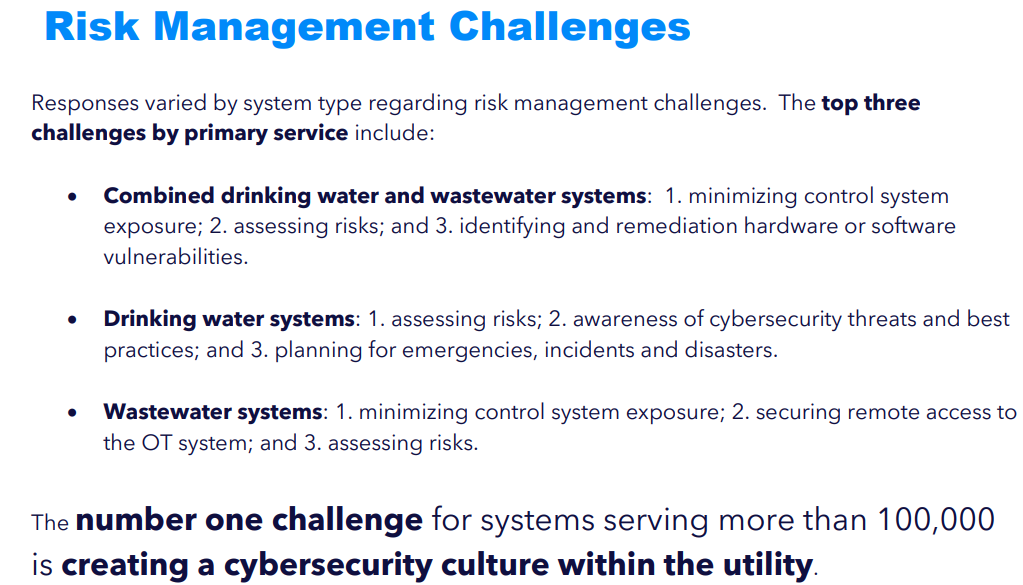
Image: WaterISAC.
Andrew Hildick-Smith is a consultant who served more than 15 years managing remote access systems for the Massachusetts Water Resources Authority. He said the percentage of companies that reported already having inventoried all of their IT systems or being in the process of doing so is roughly equal to the number of larger water utilities (greater than 100,000 customers) that recently had to certify to the Environmental Protection Agency (EPA) that they are compliant with the Water Infrastructure Act of 2018.
The water act gives utilities serving between 3,300 and 50,000 residents until the end of this month to complete a cybersecurity risk and resiliency assessment.
But Hildick-Smith said the vast majority of the nation’s water utilities — tens of thousands of them — serve fewer than 3,300 residents, and those utilities currently do not have to report to the EPA about their cybersecurity practices (or the lack thereof).
“A large number of utilities — probably close to 40,000 of them — are small enough that they haven’t been asked to do anything,” he said. “But some of those utilities are kind of doing cybersecurity based on self motivation rather than any requirement.”
According to the WaterISAC, a great many of the nation’s water utilities are subject to economic disadvantages typical of rural and urban communities.
“Others do not have access to a cybersecurity workforce,” the report explains. “Operating in the background is that these utilities are struggling to maintain and replace infrastructure, maintain revenues while addressing issues of affordability, and comply with safe and clean water regulations.”
The report makes the case for federal funding of state and local systems to provide cybersecurity training, tools and services for those in charge of maintaining IT systems, noting that 38 percent of water systems allocate less than 1 percent of their annual budgets to cybersecurity.
As the recent hacking incidents above can attest, enabling some form of multi-factor authentication for remote access can blunt many of these attacks.
However, the sharing of remote access credentials among water sector employees may be a contributing factor in these recent incidents, since organizations that let multiple employees use the same account also are less likely to have any form of multi-factor enabled.
A copy of the Water ISAC report is available here (PDF).
from Krebs on Security https://ift.tt/35I6cVO
via IFTTT

Hace dos semanas Google anunció que el próximo 23 de junio llegará Stadia a los dispositivos con Android TV y Google TV como el nuevo Chromecast. Eso significa que faltan dos días para poder jugar a la plataforma de streaming de videojuegos de Google en los televisores sin tener que depender el Chromecast Ultra, que hasta hoy es el único dispositivo para televisores compatible.
Pues bien, Google no se ha querido esperar al miércoles para lanzar la aplicación Stadia para Android TV, la cual ya puedes descargar en cualquier televisor con Android TV y Google TV.
 Pacosite's Blog