No cabe duda viendo los últimos Google I/O y todos los movimientos del gigante californiano, que Google Assistant es ya su servicio estrella con la inteligencia artificial por bandera y buscando ya protagonizar también nuestra experiencia en Android cambiando para siempre la interacción con nuestros dispositivos. Con Google asignando cada vez más recursos, Assistant sigue creciendo en funcionalidades con un CES 2020 muy interesante donde ya vimos funcionalidad de lectura
Por fin ha llegado el momento que muchos esperaban antes de dar la bienvenida al fin de semana: un viernes más, los desarrolladores de apps para Android nos ofrecen la posibilidad de conseguir aplicaciones y juegos de pago con grandes descuentos, que en algunos casos suponen hasta el 100% del precio original. En la selección de ofertas de hoy, destacan aplicaciones como Ai Gallery, Lunescopia o AmoledWalls Pro en el
Si has visto o leído las noticias en los últimos días, habrás podido comprobar que hay un nombre que resuena con fuerza: coronavirus. Este virus se ha cobrado ya decenas de vidas en China, obligando al país a decretar la mayor cuarentena de su historia, cerrando incluso las ciudades de Wuhan -donde se inició- y Huanggang para evitar su propagación. Pese a estas medidas, medios como La Vanguardia informan de
Si buscas nuevas apps y juegos para probar este fin de semana, has llegado al lugar adecuado. Como hemos hecho los viernes de cada semana durante los últimos meses, una vez más vamos en busca de las mejores novedades que han aterrizado en Google Play en los últimos días. Cada semana, seleccionaremos las tres mejores aplicaciones nuevas, y los tres juegos recién llegados más entretenidos o que más nos hayan
Si buscas nuevas apps y juegos para probar este fin de semana, has llegado al lugar adecuado. Como hemos hecho los viernes de cada semana durante los últimos meses, una vez más vamos en busca de las mejores novedades que han aterrizado en Google Play en los últimos días. Cada semana, seleccionaremos las tres mejores aplicaciones nuevas, y los tres juegos recién llegados más entretenidos o que más nos hayan
Si buscas nuevas apps y juegos para probar este fin de semana, has llegado al lugar adecuado. Como hemos hecho los viernes de cada semana durante los últimos meses, una vez más vamos en busca de las mejores novedades que han aterrizado en Google Play en los últimos días. Cada semana, seleccionaremos las tres mejores aplicaciones nuevas, y los tres juegos recién llegados más entretenidos o que más nos hayan
China se encuentra ahora mismo asolada por un virus que, por el momento, ha matado a 17 personas y ha obligado al gobierno a cerrar dos ciudades para evitar la propagación del mismo a otros núcleos urbanos, y a su vez, más víctimas mortales. El Coronavirus, que es el nombre que ha recibido, está causando graves problemas en el país asiático, y está afectando a todos los ámbitos del país,
If you’re running a business online, few things can be as disruptive or destructive to your brand as someone stealing your company’s domain name and doing whatever they wish with it. Even so, most major Web site owners aren’t taking full advantage of the security tools available to protect their domains from being hijacked. Here’s the story of one recent victim who was doing almost everything possible to avoid such a situation and still had a key domain stolen by scammers.
On December 23, 2019, unknown attackers began contacting customer support people at OpenProvider, a popular domain name registrar based in The Netherlands. The scammers told the customer representatives they had just purchased from the original owner the domain e-hawk.net — which is part of a service that helps Web sites detect and block fraud — and that they were having trouble transferring the domain from OpenProvider to a different registrar.
The real owner of e-hawk.net is Raymond Dijkxhoorn, a security expert and entrepreneur who has spent much of his career making life harder for cybercrooks and spammers. Dijkxhoorn and E-HAWK’s CEO Peter Cholnoky had already protected their domain with a “registrar lock,” a service that requires the registrar to confirm any requested changes with the domain owner via whatever communications method is specified by the registrant.
In the case of e-hawk.net, however, the scammers managed to trick an OpenProvider customer service rep into transferring the domain to another registrar with a fairly lame social engineering ruse — and without triggering any verification to the real owners of the domain.
Specifically, the thieves contacted OpenProvider via WhatsApp, said they were now the rightful owners of the domain, and shared a short screen grab video showing the registrar’s automated system blocking the domain transfer (see video below).
“The support agent helpfully tried to verify if what the [scammers] were saying was true, and said, ‘Let’s see if we can move e-hawk.net from here to check if that works’,” Dijkxhoorn said. “But a registrar should not act on instructions coming from a random email address or other account that is not even connected to the domain in question.”
Dijkxhoorn shared records obtained from OpenProvider showing that on Dec. 23, 2019, the e-hawk.net domain was transferred to a reseller account within OpenProvider. Just three days later, that reseller account moved e-hawk.net to another registrar — Public Domain Registry (PDR).
“Due to the previously silent move to another reseller account within OpenProvider, we were not notified by the registrar about any changes,” Dijkxhoorn said. “This fraudulent move was possible due to successful social engineering towards the OpenProvider support team. We have now learned that after the move to the other OpenProvider account, the fraudsters could silently remove the registrar lock and move the domain to PDR.”
REGISTRY LOCK
Dijkxhoorn said one security precaution his company had not taken with their domain prior to the fraudulent transfer was a “registry lock,” a more stringent, manual (and sometimes offline) process that effectively neutralizes any attempts by fraudsters to social engineer your domain registrar.
With a registry lock in place, your registrar cannot move your domain to another registrar on its own. Doing so requires manual contact verification by the appropriate domain registry, such as Verisign — which is the authoritative registry for all domains ending in .com, .net, .name, .cc, .tv, .edu, .gov and .jobs. Other registries handle locks for specific top-level or country-code domains, including Nominet (for .co.uk or .uk domains), EURID (for .eu domains), CNNIC for (for .cn) domains, and so on.
According to data provided by digital brand protection firm CSC, while domains created in the top three most registered top-level domains (.com, .jp and .cn) are eligible for registry locks, just 22 percent of domain names tracked in Forbes’ list of the World’s Largest Public Companies have secured registry locks.
Unfortunately, not all registrars support registry locks (a list of top-level domains that do allow registry locks is here, courtesy of CSC). But as we’ll see in a moment, there are other security precautions that can and do help if your domain somehow ends up getting hijacked.
Dijkxhoorn said his company first learned of the domain theft on Jan. 13, 2020, which was the date the fraudsters got around to changing the domain name system (DNS) settings for e-hawk.net. That alert was triggered by systems E-HAWK had previously built in-house that continually monitor their stable of domains for any DNS changes.
By the way, this continuous monitoring of one’s DNS settings is a powerful approach to help blunt attacks on your domains and DNS infrastructure. Anyone curious about why this might be a good approach should have a look at this deep-dive from 2019 on “DNSpionage,” the name given to the exploits of an Iranian group that has successfully stolen countless passwords and VPN credentials from major companies via DNS-based attacks.
DNSSEC
Shortly after pointing e-hawk.net’s DNS settings to a server they controlled, the attackers were able to obtain at least one encryption certificate for the domain, which could have allowed them to intercept and read encrypted Web and email communications tied to e-hawk.net.
But that effort failed because E-HAWK’s owners also had enabled DNSSEC for their domains (a.k.a. “DNS Security Extensions”), which protects applications from using forged or manipulated DNS data by requiring that all DNS queries for a given domain or set of domains be digitally signed.
With DNSSEC properly enabled, if a name server determines that the address record for a given domain has not been modified in transit, it resolves the domain and lets the user visit the site. If, however, that record has been modified in some way or doesn’t match the domain requested, the name server blocks the user from reaching the fraudulent address.
While fraudsters who have hijacked your domain and/or co-opted access to your domain registrar can and usually will try to remove any DNSSEC records associated with the hijacked domain, it generally takes a few days for these updated records to be noticed and obeyed by the rest of the Internet.
As a result, having DNSSEC enabled for its domains bought E-HAWK an additional 48 hours or so with which to regain control over its domain before any encrypted traffic to and from e-hawk.net could have been intercepted.
In the end, E-HAWK was able to wrest back its hijacked domain in less than 48 hours, but only because its owners are on a first-name basis with many of the companies that manage the Internet’s global domain name system. Perhaps more importantly, they happened to know key people at PDR — the registrar to which the thieves moved the stolen domain.
Dijkxhoorn said without that industry access, E-HAWK probably would still be waiting to re-assume control over its domain.
“This process is normally not that quick,” he said, noting that most domains can’t be moved for at least 60 days after a successful transfer to another registrar.
In an interview with KrebsOnSecurity, OpenProvider CEO and FounderArno Vis said said OpenProvider is reviewing its procedures and building systems to prevent support employees from overriding security checks that come with a registrar lock.
“We are building an extra layer of approval for things that support engineers shouldn’t be doing in the first place,” Vis said. “As far as I know, this is the first time something like this has happened to us.”
As in this case, crooks who specialize in stealing domains often pounce during holidays, when many registrars are short on well-trained staff. But Vis said the attack against E-HAWK targeted the company’s most senior support engineer.
“This is why social engineering is such a tricky thing, because in the end you still have a person who has to make a decision about something and in some cases they don’t make the right decision,” he said.
WHAT CAN YOU DO?
To recap, for maximum security on your domains, consider adopting some or all of the following best practices:
-Use registration features like Registry Lock that can help protect domain names records from being changed. Note that this may increase the amount of time it takes going forward to make key changes to the locked domain (such as DNS changes).
-Use DNSSEC (both signing zones and validating responses).
-Use access control lists for applications, Internet traffic and monitoring.
-Use 2-factor authentication, and require it to be used by all relevant users and subcontractors.
-In cases where passwords are used, pick unique passwords and consider password managers.
-Review the security of existing accounts with registrars and other providers, and make sure you have multiple notifications in place when and if a domain you own is about to expire.
-Monitor the issuance of new SSL certificates for your domains by monitoring, for example, Certificate Transparency Logs.
Hace unos días, y por casualidad, descubrí un programa llamado Mockuuups Studio. Este programa lo puedes usar de forma totalmente gratis, con varias composiciones gratis, aunque también puedes pagar por tener algo más completo que lo que ofrece la base. Dicho esto, tengo que decir que lo puedes instalar desde el centro de Software de Ubuntu, o encontrarlo en otras tiendas de apps diferentes.
Si no lo localizas en tu distro lo puedes descargar desde su web oficial. En esta misma página encontrarás los paquetes necesarios para instalarlo en GNU/Linux, pero también está disponible para Windows y para macOS. En el caso del paquete para Linux, se trata de un paquete universal Snap, por lo que puedes instalarlo de un modo muy sencillo. Sea cual sea la plataforma desde la que lo estés usando, y de cómo lo instales, ahora te comento por qué me ha resultado interesante…
Si te estás preguntando qué es un mockup, o mock-up, o maqueta, es un diseño o modelo a escala o a tamaño real de un dispositivo usado para las presentaciones, demostraciones, reviews, promociones, y con otros muchos objetivos. Este tipo de composiciones quedan muy bien y seguro que lo has visto en multitud de sitios por la red. Pues bien, ahora ya sabes cómo puedes crearlas con Mockuuups Studio de forma super sencilla…
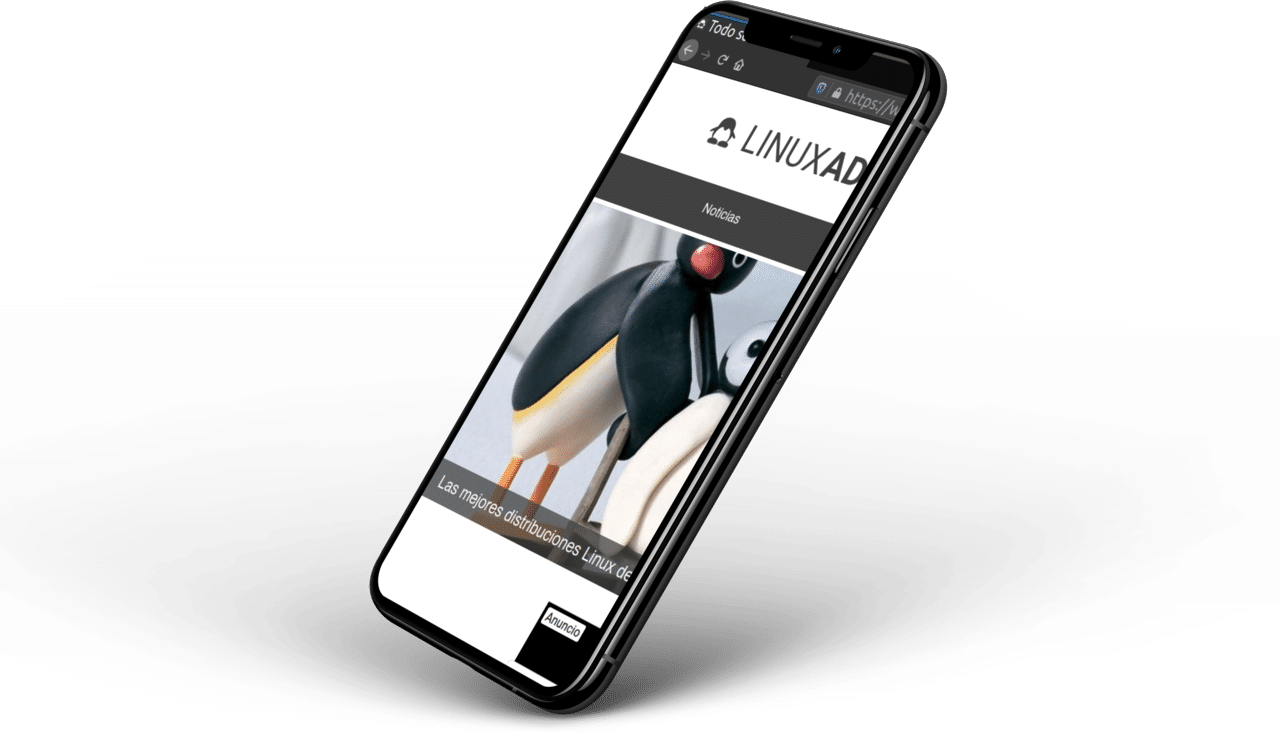
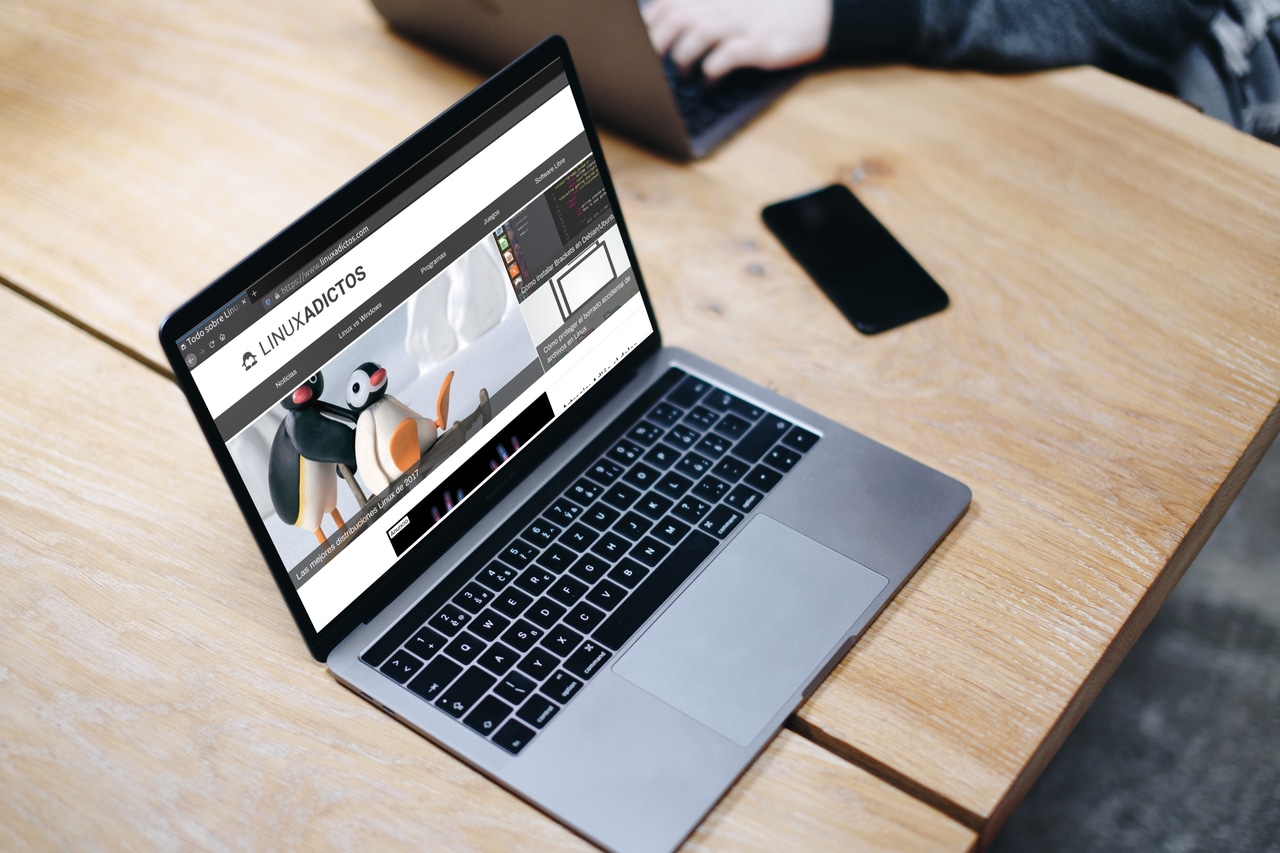
Muchos diseñadores usan este tipo de composiciones, y para que puedas ver más demostraciones, he creado algunos ejemplos para que los puedas ver. He capturado la página de LxA y la he usado como fondo para Mockuuups Studio. Luego he seleccionado algunos de los diseños gratuitos para que puedas ver el resultado… ¡Espero que te guste el resultado y te resulte práctico para tus objetivos!
Acerca de Mockuuups Studio
Desgraciadamente Mockuuups Studio es software propietario, y como he comentado, tiene algunas limitaciones en lo que puedes hacer si no pagas. Pero para muchas tareas sencillas puede ser una gran ayuda que te hará las composiciones de una forma muy rápida y sencilla. Sin que tengas que usar otros programas más complejos y hacerlo de una forma más manual.
Con Mockuuups Studio puedes generar mockups de productos en cuestión de segundos. Es ideal para tus blogs, tus presentaciones, o para cualquier trabajo en el que quieras mostrar algo más profesional. Entre su lista de dispositivos disponibles se encuentran una gran variedad, como ordenadores Dell, smartphones varios, iPad, iPhone, productos de Samsung, y un largo etc. No todos están disponibles sin pagar.
En su pantalla principal puedes seleccionar el que más te guste, pulsas sobre él y luego te permite importar un fondo de pantalla, logo o cualquier imagen. Entonces el propio programa se encargará de ponerlo de fondo en la pantalla del dispositivo que hayas elegido. Así de sencillo. Si te gusta el resultado, puedes descargar el resultado como una imagen .png o .jpg para usarlo en tus trabajos.
Las vistas previas se muestran muy rápidamente, no tarda apenas nada en crearlo y tampoco en descargar el resultado que te guste. Además, puedes ir pasando slides para ver cómo quedaría el resultado en otros dispositivos disponibles, sin que tengas que importar la imagen en cada uno de ellos.
La biblioteca de dispositivos tiene unas 500 imágenes de gran calidad y desde varios ángulos y dispositivos. Por eso no necesitarás buscar en Google para tus composiciones. Además, se puede aumentar si lo deseas. Por supuesto todo está bien organizado, con un buscador y filtros para mostrar solo lo que quieras en cada momento.
Por último, debes saber que es compatible con archivos de Figma y tambiénd e Photoshop, por si quieres usar este tipo de ficheros en tus composiciones. Y por supuesto, acepta imágenes de tipo JPEG y PNG.




 Pacosite's Blog