
By DAISUKE WAKABAYASHI and KATIE BENNER
The internet giant paid Mr. Rubin $90 million and praised him, while keeping silent about a misconduct claim.
Published: October 24, 2018 at 07:00PM
from NYT Technology https://ift.tt/2D3XYLf
via IFTTT

By DAISUKE WAKABAYASHI and KATIE BENNER
The internet giant paid Mr. Rubin $90 million and praised him, while keeping silent about a misconduct claim.
Published: October 24, 2018 at 07:00PM
from NYT Technology https://ift.tt/2D3XYLf
via IFTTT
Federal investigators on Friday arrested a Virginia man accused of being part of a neo-Nazi group that targeted hundreds of people in “swatting” attacks, wherein fake bomb threats, hostage situations and other violent scenarios were phoned in to police as part of a scheme to trick them into visiting potentially deadly force on a target’s address.
In July 2018, KrebsOnSecurity published the story Neo-Nazi Swatters Target Dozens of Journalists, which detailed the activities of a loose-knit group of individuals who had targeted hundreds of individuals for swatting attacks, including federal judges, corporate executives and almost three-dozen journalists (myself included).
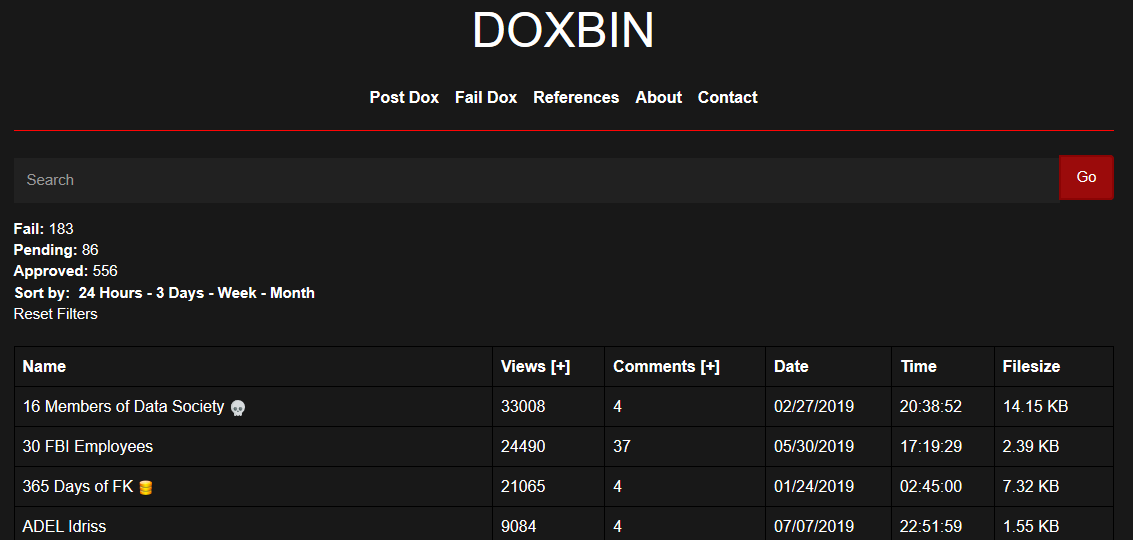
A portion of the Doxbin, as it existed in late 2019.
An FBI affidavit unsealed this week identifies one member of the group as John William Kirby Kelley. According to the affidavit, Kelley was instrumental in setting up and maintaining the Internet Relay Chat (IRC) channel called “Deadnet” that was used by he and other co-conspirators to plan, carry out and document their swatting attacks.
Prior to his recent expulsion on drug charges, Kelley was a student studying cybersecurity at Old Dominion University in Norfolk, Va. Interestingly, investigators allege it was Kelley’s decision to swat his own school in late November 2018 that got him caught. Using the handle “Carl,” Kelley allegedly explained to fellow Deadnet members he hoped the swatting would get him out of having to go to class.
The FBI says Kelley used virtual private networking (VPN) services to hide his true Internet location and various voice-over-IP (VoIP) services to conduct the swatting calls. In the ODU incident, investigators say Kelley told ODU police that someone was armed with an AR-15 rifle and had placed multiple pipe bombs within the campus buildings.
Later that day, Kelley allegedly called ODU police again but forgot to obscure his real phone number on campus, and quickly apologized for making an accidental phone call. When authorities determined that the voice on the second call matched that from the bomb threat earlier in the day, they visited and interviewed the young man.
Investigators say Kelley admitted to participating in swatting calls previously, and consented to a search of his dorm room, wherein they found two phones, a laptop and various electronic storage devices.
The affidavit says one of the thumbs drive included multiple documents that logged statements made on the Deadnet IRC channel, which chronicled “countless examples of swatting activity over an extended period of time.” Those included videos Kelley allegedly recorded of his computer screen which showed live news footage of police responding to swatting attacks while he and other Deadnet members discussed the incidents in real-time on their IRC forum.
The FBI believes Kelley also was linked to a bomb threat incident in November 2018 at the predominantly African American Alfred Baptist Church in Old Town Alexandria, an incident that led to the church being evacuated during evening worship services while authorities swept the building for explosives.
The FBI affidavit was based in part on interviews with an unnamed co-conspirator, who told investigators that he and the others on Deadnet IRC are white supremacists and sympathetic to the neo-Nazi movement.
“The group’s neo-Nazi ideology is apparent in the racial tones throughout the conversation logs,” the affidavit reads. “Kelley and other co-conspirators are affiliated with or have expressed sympathy for Atomwafen Division,” an extremist group whose members are suspected of having committed multiple murders in the U.S. since 2017.
Investigators say on one of Kelley’s phones they found a photo of he and others in tactical gear holding automatic weapons next to pictures of Atomwaffen recruitment material and the neo-Nazi publication Siege.
As I reported last summer, several Deadnet members maintained a site on the Dark Web called the “Doxbin,” which listed the names, addresses, phone number and often known IP addresses, Social Security numbers, dates of birth and other sensitive information on hundreds of people — and in some cases the personal information of the target’s friends and family. After those indexed on the Doxbin were successfully swatted, a blue gun icon would be added next to the person’s name.
One of the core members of the group on Deadnet — an individual who used the nickname “Chanz,” among others — stated that he was responsible for maintaining SiegeCulture, a white supremacist Web site that glorifies the writings of neo-Nazi James Mason (whose various books call on followers to start a violent race war in the United States).
Deadnet chat logs obtained by KrebsOnSecurity show that another key swatting suspect on Deadnet who used the handle “Zheme” told other IRC members in March 2019 that one of his friends had recently been raided by federal investigators for allegedly having connections to the person responsible for the mass shooting in October 2018 at the Tree of Life Jewish synagogue in Pittsburgh.
At one point last year, Zheme also reminded denizens of Deadnet about a court hearing in the murder trial of Sam Woodward, an alleged Atomwaffen member who’s been charged with killing a 19-year-old gay Jewish college student.
As reported by this author last year, Deadnet members targeted dozens of journalists whose writings they considered threatening to their worldviews. Indeed, one of the targets successfully swatted by Deadnet members was Pulitzer prize winning columnist Leonard G. Pitts Jr., whose personal information as listed on the Doxbin was annotated with a blue gun icon and the label “anti-white race/politics writer.”
In another Deadnet chat log seen by this author, Chanz admits to calling in a bomb threat at the UCLA campus following a speech by Milo Yiannopoulos. Chanz bragged that he did it to frame feminists at the school for acts of terrorism.
On a personal note, I sincerely hope this arrest is just the first of many to come for those involved in swatting attacks related to Deadnet and the Doxbin. KrebsOnSecurity has obtained information indicating that several members of my family also have been targeted for harassment and swatting by this group.
Finally, it’s important to note that while many people may assume that murders and mass shootings targeting people because of their race, gender, sexual preference or religion are carried out by so-called “lone wolf” assailants, the swatting videos created and shared by Deadnet members are essentially propaganda that hate groups can use to recruit new members to their cause.
The Washington Post reports that Kelley had his first appearance in federal court in Alexandria on Friday.
“His public defender did not comment on the allegations but said his client has ‘very limited funds,’” The Post’s courts reporter Rachel Weiner wrote.
The charge against Kelley of conspiracy to make threats carries up to five years in prison. The affidavit in Kelley’s arrest is available here (PDF).
from Krebs on Security https://ift.tt/2QIPHlJ
via IFTTT
Nos movemos en un momento clave en la industria smartphone y teníamos que aprovecharlo. El ejercicio 2020 arranca ya sus motores, el CES de Las Vegas cierra las persianas y toda la maquinaria mediática apunta ya al Unpacked de Samsung, así que es hora de echarle ese vistazo en profundidad que nos faltaba a un Samsung Galaxy Fold todavía smartphone estrella en el catálogo surcoreano, a la espera de más
Entra en Andro4all para leer el artículo completo
Puedes unirte a nosotros en Twitter, Facebook o en Google+
¡Suscríbete a nuestro canal de YouTube!
Publicado recientemente en Andro4all
La entrada Samsung Galaxy Fold, análisis y opinión: el móvil más caro y diferente nos muestra un futuro lleno de luces y (algunas) sombras se publicó primero en Andro4all.
from Andro4all https://ift.tt/35DUPLX
via IFTTT
Citrix Application Delivery Controller and Citrix Gateway – Remote Code Execution
from Exploit-DB.com RSS Feed https://ift.tt/30fA48j
via IFTTT
Citrix Application Delivery Controller and Citrix Gateway – Remote Code Execution (PoC)
from Exploit-DB.com RSS Feed https://ift.tt/35Ias4U
via IFTTT

By KEVIN ROOSE
By opting not to change the company’s political advertising rules, Mark Zuckerberg has ensured another election shaped by the social network.
Published: January 9, 2020 at 06:00PM
from NYT Technology https://ift.tt/2uFeiiN
via IFTTT
Tinfoil Security’s dynamic application and API security testing capabilities will be added to Synopsys Software Integrity Group.
from Dark Reading: https://ift.tt/2R40hTg
via IFTTT
La nueva versión del proyecto DXVK 1.5.1 está disponible ya para su descarga y actualización. Y es que en esta nueva versión se han implementado algunas mejoras para solucionar problemas con algunos juegos. De los cuales se benefician GTA V, Halo entre otro más.
Para quienes aún desconocen de DXVK, deben saber que es una de las herramientas incluidas en la función Steam Play de Steam. Es una herramienta fantástica que puede convertir las llamadas gráficas de Microsoft DirectX 11 y DirectX 10 a Vulkan, la API de gráficos de código abierto que es compatible con Linux. Para utilizar DXVK, además de Wine y Vulkan, obviamente se necesita una GPU compatible con Vulkan.
(adsbygoogle = window.adsbygoogle || []).push({});
Si bien DXVK aun que se usa principalmente en Steam Play, no es el único lugar donde los usuarios de Linux pueden aprovechar esta fantástica tecnología. También aporta la implementación D3D11 basada en Vulkan para Linux y Wine, en lo que respecta al rendimiento y la optimización cuando se ejecutan juegos de Direct3D 11 en Wine puesto que también brindan soporte para Direct3D9.
En esta nueva entrega del proyecto DXVK, podremos encontrar que dentro de los principales cambios anunciados se menciona la optimización general del rendimiento de Direct3D 9, junto con una implementación mejorada de desplazamiento de profundidad en Direct3D 9, con la cual se eliminaron los problemas de renderizado con Pixel Shader 1.x., como la falta de sombras y calcomanías en muchos juegos.
También se destaca el ajuste al número de subprocesos utilizados para la complicación de pipeline para tratar con los sistemas “comunes” de 6 y 8 núcleos de hoy en día, al tiempo que permite que las CPU más nuevas con más de 12 subprocesos utilicen más durante la fase de compilación.
(adsbygoogle = window.adsbygoogle || []).push({});
También se corrigió un error que causaba un bloqueo debido a la división por cero al iniciar algunos juegos basados en Direct3D 9.
De los problemas resueltos que se mencionan en el anuncio de esta nueva versión, los juegos beneficiados fueron GTA V en el cual se corrigió una regresión que causaría un rendimiento extremadamente pobre al habilitar Vsync en modo de pantalla completa.
De los demás títulos podremos encontrar las mejoras para: Halo CE, Need For Speed: Carbon, Risen 2, Sims 4, Trackmania Forever y Vampire The Masquerade: Bloodlines.
Y también se destaca el trabajo de configuración dxvk.hud el cual se ha restaurado y debido a la supervisión, se eliminó en la rama 1.5.
Finalmente si quieres conocer más al respecto sobre los detalles del lanzamiento de DXVK 1.5.1 puedes hacerlo a través del anuncio de lanzamiento en GitHub en el siguiente enlace.

DXVK requiere de la última versión estable de Wine para ejecutarse. Por lo que, si no cuentas con este instalado. Ahora solo tendremos que descargar el último paquete estable de DXVK, este lo encontramos en el siguiente enlace.
wget https://github.com/doitsujin/dxvk/releases/download/v1.5/dxvk-1.5.tar.gz
Después de haber realizado la descarga ahora vamos a descomprimir el paquete recién obtenido, esto lo pueden hacer con desde su entorno de escritorio o desde la misma terminal ejecutando en el siguiente comando:
tar -xzvf dxvk-1.5.tar.gz
Después accedemos a la carpeta con:
cd dxvk-1.5
Y ejecutamos el comando sh para ejecutar el script de instalación:
sudo sh setup-dxvk.sh install
setup-dxvk.sh install --without-dxgi
Cuando se instale DXVK en un prefijo de Wine. La ventaja es que se puede usar Wine vkd3d para juegos D3D12 y DXVK para juegos D3D11.
Además, la nueva secuencia de comandos le permite instalar la dll como enlaces simbólicos, lo que facilita la actualización de DXVK para obtener más prefijos de Wine (puede hacerlo a través del comando –symlink).
Como verán la carpeta de DXVK contiene otras dos dll para 32 y 64 bits estas las vamos a colocar de acuerdo a las siguientes rutas.
En donde “usuario” lo remplazas por el nombre de usuario que utilizas en tu distribución de Linux.
Para 64 bits las colocamos en:
~/.wine/drive_c/windows/system32/
O
/home/”usuario”/.wine/drive_c/windows/system32/
Y para 32 bits en:
~/.wine/drive_c/windows/syswow64
O
/home/”usuario”/.wine/drive_c/windows/system32/
from Linux Adictos https://ift.tt/2FFnKEO
via IFTTT

By DAISUKE WAKABAYASHI
David Drummond, who played a key role for the company since it was founded, was being investigated for relationships with several women at the company.
Published: January 9, 2020 at 06:00PM
from NYT Technology https://ift.tt/30aISMw
via IFTTT

Recientemente se dio a conocer la noticia de la liberación de la nueva actualización de OpenWrt 19.07 en la cual se añaden nuevas características de las que destaca el soporte para el nuevo protocolo WPA3 asi como soporte para nuevos dispositivos.
Para quienes desconocen de OpenWrt deben saber que este es un firmware basado en una distribución de Linux que es utilizada en dispositivos tales como routers personales. El desarrollo de OpenWrt fue impulsado inicialmente gracias a la licencia GPL, que obligaba a todos aquellos fabricantes que modificaban y mejoraban el código, a liberar este y contribuir cada vez más al proyecto en general.
(adsbygoogle = window.adsbygoogle || []).push({});
Poco a poco el software ha ido creciendo y se encuentran características implementadas que no tienen muchos otros fabricantes de dispositivos comerciales para el sector no profesional, tales como QoS, VPN y otras características que dotan a OpenWrt de un dispositivo realmente potente y versátil, apto para utilizar los hardware donde corre OpenWrt no solo para utilizarlos como routers, sino como servidores de archivo, nodos P2P, servidores de WEBcams, firewall o puertas de acceso VPN.
OpenWrt admite muchas plataformas y arquitecturas diferentes y tiene un sistema de compilación que facilita conveniente la compilación cruzada, que incluye varios componentes en ello, lo que facilita la creación de firmware o imagen de disco preparada y adaptada para tareas específicas con el conjunto deseado de paquetes preinstalados.
Desde la versión anterior de 18.06.0 ha habido 3954 confirmaciones y el soporte de hardware se ha expandido a todas las plataformas compatibles que ahora en esta nueva versión de OpenWrt 19.07 se ha suministrado una versión del kernel de Linux 4.14.162.
(adsbygoogle = window.adsbygoogle || []).push({});
Además de ello, una de las características principales de este lanzamiento es que se agregó el soporte para la tecnología de seguridad inalámbrica WPA3, que proporciona protección contra ataques de adivinación de contraseña ya que no permitirá adivinar la contraseña en modo fuera de línea y se utiliza el protocolo de autenticación SAE.
De manera predeterminada el soporte WPA3 aún no está habilitado y requiere la instalación de paquetes adicionales los cuales son hostapd-openssl o hostapd-wolfssl para crear un punto de acceso y wpa-supplicant-openssl o wpad-openssl para trabajar en modo cliente.
Por otro lado, podremos encontrar que la interfaz web de LuCI se ha convertido en representación del lado del cliente, lo que permite ahorrar recursos en el servidor y aumentar la productividad debido a algunas operaciones realizadas por el navegador (código JavaScript) y no por los scripts de firmware de Lua.
Sin embargo, no todas las aplicaciones LuCI están adaptadas para esta función y en caso de problemas, se recomienda usar el paquete luci-compat.
En cuanto al soporte con esta nueva versión se descontinuó el soporte para las siguientes plataformas :adm5120, adm8668, ar7, au1000, ixp4xx, mcs814x, omap24xx, ppc40x, ppc44x. También se presentó el soporte inicial para la nueva plataforma ath79 que reemplaza a ar71xx y presenta el uso de Device Tree.
Y que tambien se puede usar ath79 y ar71xx en la rama OpenWRT 19.07, pero en una de las próximas versiones, se suspenderá el soporte para ar71xx, mientras que para Ath79 se proporciona soporte para aproximadamente 200 dispositivos basados en procesadores MIPS 24K.
Por supuesto, también hay nuevas versiones de muchos paquetes, tales como, hostapd 2.9, dnsmasq 2.80, dropbear 2019.78, busybox 1.30.1, gcc 7.5.0
Finalmente, otro de los cambios que se destacan en el anuncio es que se han agregado herramientas para verificar las copias de seguridad y actualizar los indicadores de capacidad a Sysupgrade.
De las correcciones realizadas, se destaca el trabajo en el manejo de la red, la configuración inalámbrica y tambien en el cliente y servidor DHCPv6, asi como tambien en el administrador de procesos, el bus de mensajes del sistema, el servidor web incorporado y la biblioteca de administración de configuración.
Si quieres conocer más al respecto sobre los detalles de esta nueva liberación del firmware OpenWrt 19.07 puedes consultar la información en el siguiente enlace.
Las compilaciones de esta nueva versión están preparadas para 37 plataformas diferentes, de las cuales se pueden obtener los paquetes de actualización desde el siguiente enlace.
from Linux Adictos https://ift.tt/2sda15b
via IFTTT
 Pacosite's Blog