La NSA libero el código de Ghidra un framework de ingeniería inversa

Ghidra es uno de los muchos proyectos de software de código abierto desarrollados dentro de la Agencia de Seguridad Nacional (NSA) de los Estados Unidos de America (USA). Cabe destacar que, en junio de 2017 la NSA ha proporcionado una lista de herramientas que ha desarrollado y que ahora están disponibles públicamente a través de Open Source como parte de su Programa de Transferencia de Tecnología (TTP).

Ghidra es un framework de ingeniería inversa desarrollado por la División de Investigación de la NSA para la Misión de Ciberseguridad de la NSA. Facilita el análisis de códigos maliciosos y malware, como virus y permite a los profesionales comprender mejor las posibles vulnerabilidades de sus redes y sistemas.

Características de Ghidra

Entre las características clave de Ghidra, encontramos

  • Una herramienta que viene con un conjunto de herramientas de análisis de software para analizar el código compilado en varias plataformas, incluyendo Windows, macOS y Linux.
  • Un marco cuyas capacidades incluyen desmontaje, ensamblaje, descompilación, representación gráfica y scripting, y cientos de otras características
  • Una herramienta que admite una amplia variedad de conjuntos de instrucciones de procesador y formatos ejecutables y se puede ejecutar en modo interactivo y automatizado.
  • La capacidad de los usuarios para desarrollar sus propios componentes y / o secuencias de comandos de Ghidra utilizando la API expuesta.

El programa incluye una amplia gama de tecnologías patentadas en múltiples áreas tecnológicas, de las cuales se pueden destacar las siguientes.

Apache Acumulo

Proporciona un almacenamiento y recuperación de datos sólido y escalable. Agrega control de acceso basado en celdas y un mecanismo de programación del lado del servidor que puede modificar pares clave / valor en diferentes puntos del proceso de administración de datos.

CASA (Certificate Authority Situational Awareness)

Revela certificados no válidos de autoridades de certificados confiables en sistemas Windows. CASA está disponible como una aplicación Splunk.

JAVA PATHFINDER MANGO (JPF-MANGO)

Herramienta de análisis de código estático basada en métodos formales. Es parte del proyecto Java PathFinder de Ames de la NASA, para verificar los binarios ejecutables de Java (código de bytes).

APACHE NIFI

Automatiza el flujo de datos entre sistemas. NiFi implementa conceptos de programación basados en flujo y resuelve problemas comunes de flujo de datos que enfrentan las empresas.

Algunas de las capacidades y objetivos de alto nivel de Apache NiFi incluyen:

  • una interfaz de usuario basada en la web que proporciona una experiencia perfecta entre diseño, control, retroalimentación y seguimiento
  • Software altamente configurable: por ejemplo, es posible aplicar una prioridad dinámica o modificar el flujo en tiempo de ejecución
  • La fuente de los datos: la herramienta ofrece la posibilidad de seguir el flujo de datos desde el principio hasta el final
  • Diseñado para expansión: con esta herramienta podrás crear tus propios procesadores y más
  • Seguridad: envía SSL, SSH, HTTPS, contenido cifrado y así sucesivamente. También cuenta con una autorización para múltiples inquilinos, así como una administración de políticas / autorización interna.

OPENATTESTATION

Verifica la integridad del sistema al establecer una medida básica del Módulo de plataforma confiable (TPM) de un sistema y controla los cambios en esa medición. Inicialmente, basado en el software NSA Host Integrity en el inicio (HIS).

Las características principales incluyen:

  • Soporte para los principales sistemas operativos de host de Linux
  • Esquemas de reporte basados en PCR y las reglas de política.
  • API de consulta basada en RESTful
  • La implementación del portal web / interfaz gráfica de referencia.
  • La comparación de datos históricos de PCR;.
  • Gestión de listas blancas
  • control de acceso flexible al servidor de atestación
  • Tomcat 2-way SSL / TLS es compatible con las API de consulta
  • Informes SAML.

¿Cómo tener Ghidra en Linux?

Ghidra cuenta con una página web oficial en donde podrás encontrar ayuda disponible para los desarrolladores que quieran usarla, sabrás más sobre cómo instalarlo, usarlo, etc.

La NSA también se tomó la molestia de proporcionar un FAQ que se mejorará en función de las preguntas que puedan hacer los desarrolladores en la comunidad.

El enlace donde podrás consultar esto y descargar este framework es este. 

El artículo La NSA libero el código de Ghidra un framework de ingeniería inversa ha sido originalmente publicado en Linux Adictos.

from Linux Adictos https://ift.tt/2Cdvb4K
via IFTTT

Este es el Huawei Watch GT Active, la respuesta de Huawei al Samsung Galaxy Watch Active

Junto a los Galaxy S10 y S10, Samsung anunciaba una nueva edición de su reloj inteligente basado en su plataforma propia, el Galaxy Watch, enfocado a aquellos usuarios que valoran por encima de todo las capacidades de este tipo de wearables en lo que a detección y monitorización de actividad física se refiere. Ahora, Huawei pretende seguir estos mismos pasos. Según afirma el reconocido leaker Roland Quandt a través de

Entra en Andro4all para leer el artículo completo

Puedes unirte a nosotros en Twitter, Facebook o en Google+

¡Suscríbete a nuestro canal de YouTube!

Publicado recientemente en Andro4all

from Andro4all https://ift.tt/2H6Rb5F
via IFTTT

El VP de Oppo filtra a su próximo buque insignia, con Snapdragon 855 y su propio zoom híbrido 10X

Que la propia Oppo quiere calentar el ambiente de cara a la llegada de su próximo smartphone tope de gama no es ningún secreto, y es que de hecho ellos mismos están siendo los mayores filtradores sus próximos lanzamientos habiendo enseñado de forma prematura a los Oppo F11 Pro, su nueva gama media, a la espera ya de su primer smartphone con conectividad 5G del que se ha habla hace

Entra en Andro4all para leer el artículo completo

Puedes unirte a nosotros en Twitter, Facebook o en Google+

¡Suscríbete a nuestro canal de YouTube!

Publicado recientemente en Andro4all

from Andro4all https://ift.tt/2HnqWY2
via IFTTT

¡Llévate un Huawei Mate 20 Pro totalmente gratis!

Huawei es una compañía que ha mejorado notablemente con el paso de los años, y esto le ha servido para consolidarse como uno de los mayores vendedores a nivel mundial, una posición a la que cuesta llegar, y que también cuesta mantener con el paso del tiempo. Lo que está claro es que la firma china cuenta con un gran número de seguidores, y ahora, gracias a una plataforma creada,

Entra en Andro4all para leer el artículo completo

Puedes unirte a nosotros en Twitter, Facebook o en Google+

¡Suscríbete a nuestro canal de YouTube!

Publicado recientemente en Andro4all

from Andro4all https://ift.tt/2EVIqZS
via IFTTT

MyEquifax.com Bypasses Credit Freeze PIN

Most people who have frozen their credit files with Equifax have been issued a numeric Personal Identification Number (PIN) which is supposed to be required before a freeze can be lifted or thawed. Unfortunately, if you don’t already have an account at the credit bureau’s new myEquifax portal, it may be simple for identity thieves to lift an existing credit freeze at Equifax and bypass the PIN armed with little more than your, name, Social Security number and birthday.

Consumers in every U.S. state can now freeze their credit files for free with Equifax and two other major bureaus (Trans Union and Experian). A freeze makes it much harder for identity thieves to open new lines of credit in your name.

In the wake of Equifax’s epic 2017 data breach impacting some 148 million Americans, many people did freeze their credit files at the big three in response. But Equifax has changed a few things since then.

Seeking to manage my own credit freeze at equifax.com as I’d done in years past, I was steered toward creating an account at myequifax.com, which I was shocked to find I did previously possess.

Getting an account at myequifax.com was easy. In fact, it was too easy. The portal asked me for an email address and suggested a longish, randomized password, which I accepted. I chose an old email address that I knew wasn’t directly tied to my real-life identity.

The next page asked me enter my SSN and date of birth, and to share a phone number (sharing was optional, so I didn’t). SSN and DOB data is widely available for sale in the cybercrime underground on almost all U.S. citizens. This has been the reality for years, and was so well before Equifax announced its big 2017 breach.

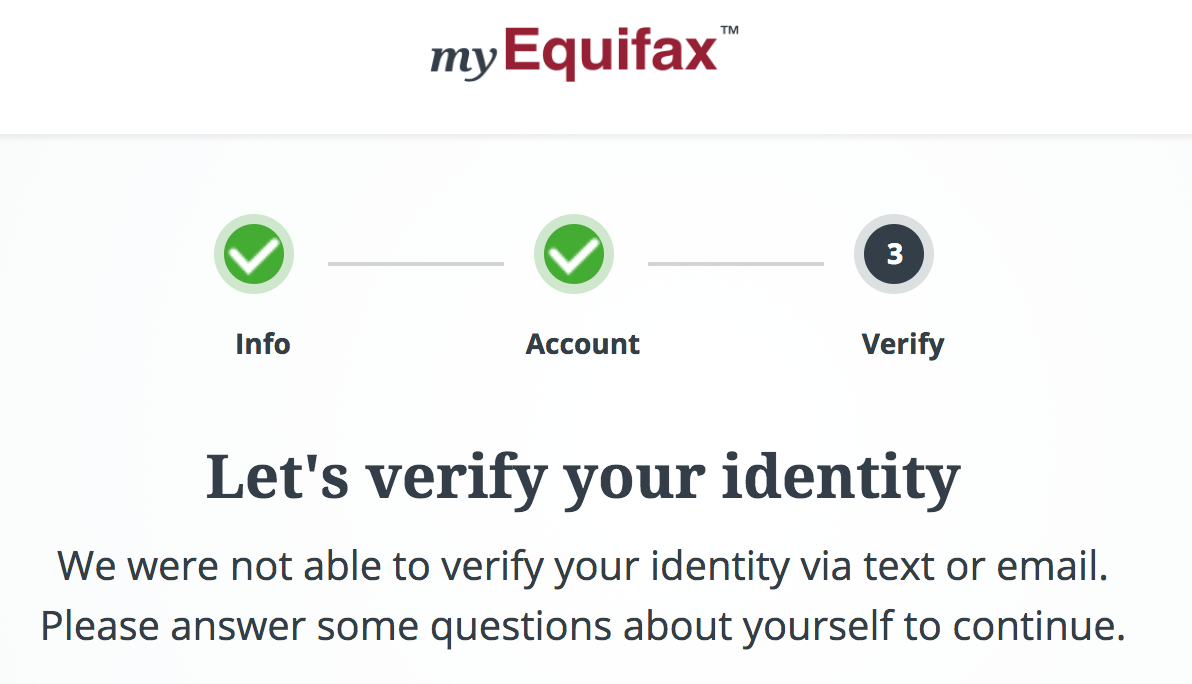
myEquifax said it couldn’t verify that my email address belonged to the Brian Krebs at that SSN and DOB. It then asked a series of four security questions — so-called “knowledge-based authentication” or KBA questions designed to see if I can about my recent financial history.

In general, the data being asked about in these KBA quizzes is culled from public records, meaning that this information likely is publicly available in some form — either digitally or in-person. Indeed, I have long assailed the KBA industry as creating a false sense of security that is easily bypassed by fraudsters.

One potential problem with relying on KBA questions to authenticate consumers online is that so much of the information needed to successfully guess the answers to those multiple-choice questions is now indexed or exposed by search engines, social networks and third-party services online — both criminal and commercial.

The first three multiple-guess questions myEquifax asked were about loans or debts that I have never owed. Thus, the answer to the first three KBA questions asked was, “none of the above.” The final question asked for the name of our last mortgage company. Again, information that is not hard to find.

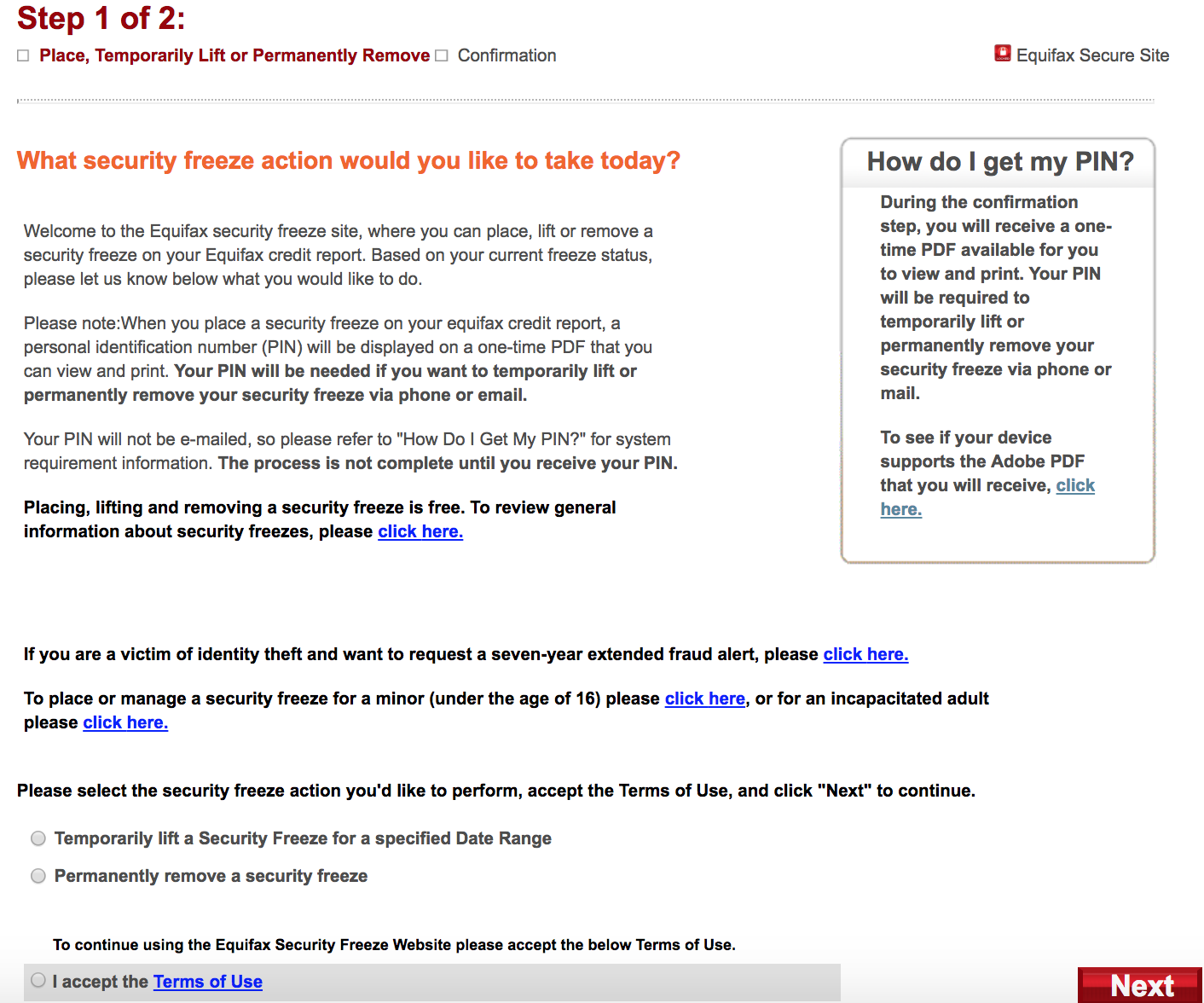
Satisfied with my answers, Equifax informed me that yes indeed I was Brian Krebs and that I could now manage my existing freeze with the company. After requesting a thaw, I was brought to a vintage Equifax page that looked nothing like myEquifax’s sunnier new online plumage.

Equifax’s site says it will require users requesting changes to an existing credit freeze to have access to their freeze PIN and be ready to supply it. But Equifax never actually asks for the PIN.

This page informed me that if I previously secured a freeze of my credit file with Equifax and been given a PIN needed to undo that status in any way, that I should be ready to provide said information if I was requesting changes via phone or email. 

In other words, credit freezes and thaws requested via myExquifax don’t require users to supply any pre-existing PIN.

Fine, I said. Let’s do this.

myEquifax then asked for the date range requested to thaw my credit freeze. Submit.

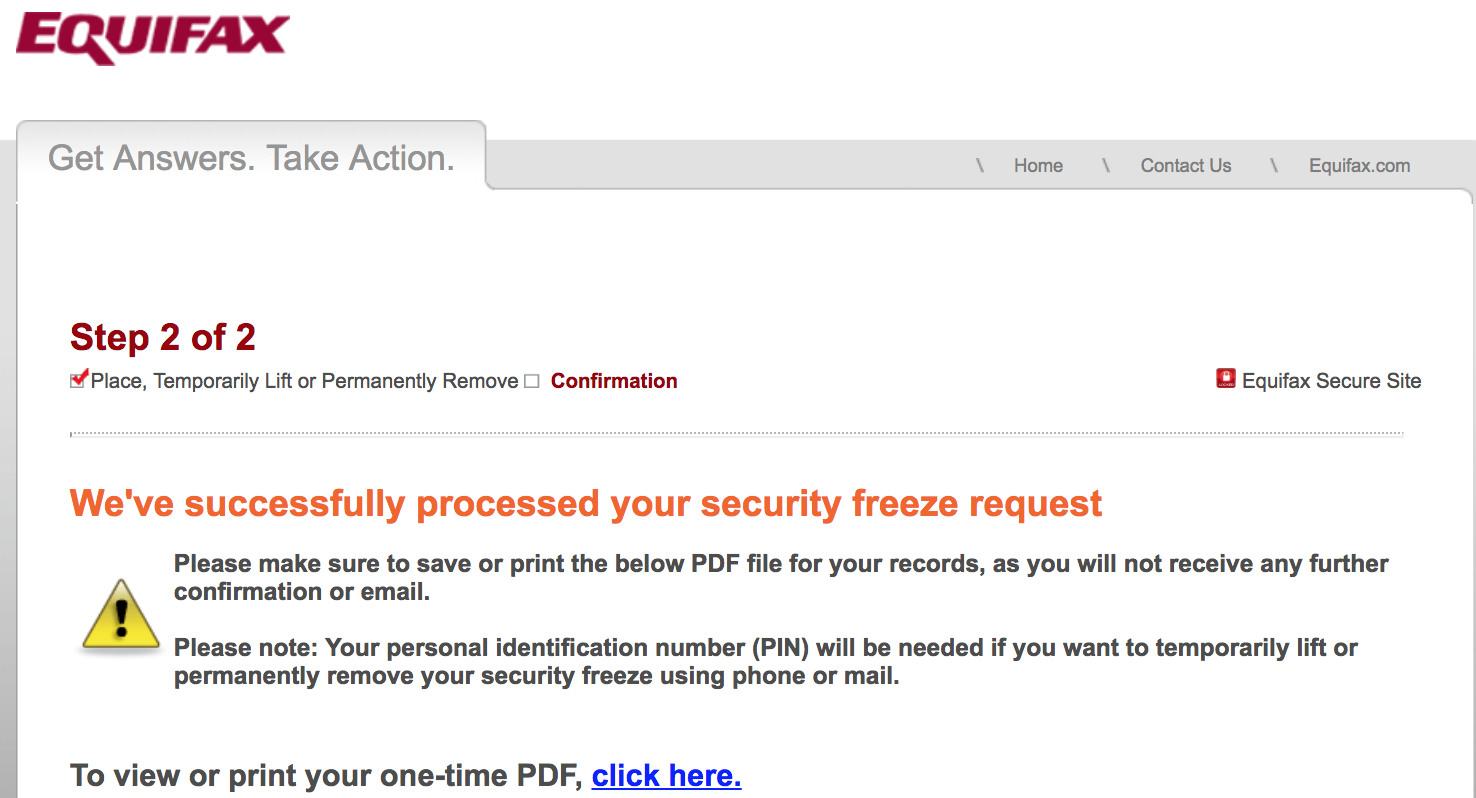
“We’ve successfully processed your security freeze request!,” the site declared.

This also was exclaimed in an email to the random old address I’d used at myEquifax, although the site never once made any attempt to validate that I had access to this inbox, something that could be done by simply sending a confirmation link that needs to be clicked to activate the account.

In addition, I noticed Equifax added my old mobile number to my account, even though I never supplied this information and was not using this phone when I created the myEquifax account.

Successfully unfreezing (temporarily thawing) my credit freeze did not require me to ever supply my previously-issued freeze PIN from Equifax. Anyone who knew the vaguest and most knowable details about me could have done the same.

myEquifax.com does not currently seek to verify the account by requesting confirmation via a phone call or text to the phone number associated with the account (also, recall that even providing a phone number was optional).

Happily, I did discover then when I used a different computer and Internet address to try to open up another account under my name, date of birth and SSN, it informed me that a profile already existed for this information. This suggests that signing up at myEquifax is probably a good idea, given that the alternative is more risky.

It was way too easy to create my account, but I’m not saying everyone will be able to create one online. In testing with several readers over the past 24 hours, myEquifax seems to be returning a lot more error pages at the KBA stage of the process now, prompting people to try again later or make a request via email or phone.

Equifax spokesperson Nancy Bistritz-Balkan said not requiring a PIN for people with existing freezes was by design.

“With myEquifax, we created an online experience that enables consumers to securely and conveniently manage security freezes and fraud alerts,” Bistritz-Balkan said..

“We deployed an experience that embraces both security standards (using a multi-factor and layered approach to verify the consumer’s identity) and reflects specific consumer feedback on managing security freezes and fraud alerts online without the use of a PIN,” she continued. “The account set-up process, which involves the creation of a username and password, relies on both user inputs and other factors to securely establish, verify, and authenticate that the consumer’s identity is connected to the consumer every time.”

I asked Bistritz-Balkan what else besides a username and a password the company may have meant by “multi-factor;” I’m still waiting for clarification. But I did not experience anything like multi-factor in setting up or logging into my myEquifax account.

This may by closer to Equifax’s idea of multi-factor: The company told me that if I still really wanted to use my freeze PIN, I could always call their 800 number (800-349-9960) or make the request via mail. Nevermind that if I’m a bad guy looking to hack others, I’m definitely going to be using the myEquifax Web site — not the options that make me have to supply a PIN.

Virtually the entire United States population in 2017 became eligible for free credit monitoring from Equifax following its 2017 breach. Credit monitoring can be useful for recovering from identity theft, but consumers should not expect these services to block new account fraud; the most they will likely do in this case is alert you after ID thieves have already opened new accounts in your name.

A credit freeze does not impact your ability to use any existing financial accounts you may have, including bank and credit/debit accounts. Nor will it protect you from fraud on those existing accounts. It is mainly a way to minimize the risk that someone may be able to create new accounts in your name.

If you haven’t done so lately, it might a good time to order a free copy of your credit report from annualcreditreport.com. This service entitles each consumer one free copy of their credit report annual from each of the three credit bureaus — either all at once or spread out over the year.

Additional reading:

Credit Freezes are Free: Let the Ice Age Begin

Plant Your Flag, Mark Your Territory

Experian Site Can Give Anyone Your Freeze PIN

Survey: Americans Spent $1.4B on Credit Freeze Fees in Wake of Equifax Breach

Equifax Breach Fallout: Your Salary History

Data Broker Giants Hacked by ID Theft Service

Experian Sold Access to ID Theft Service

from Krebs on Security https://ift.tt/2CdspN8
via IFTTT