Feds Charge Three in Mass Seizure of Attack-for-hire Services

Authorities in the United States this week brought criminal hacking charges against three men as part of an unprecedented, international takedown targeting 15 different “booter” or “stresser” sites — attack-for-hire services that helped paying customers launch tens of thousands of digital sieges capable of knocking Web sites and entire network providers offline.
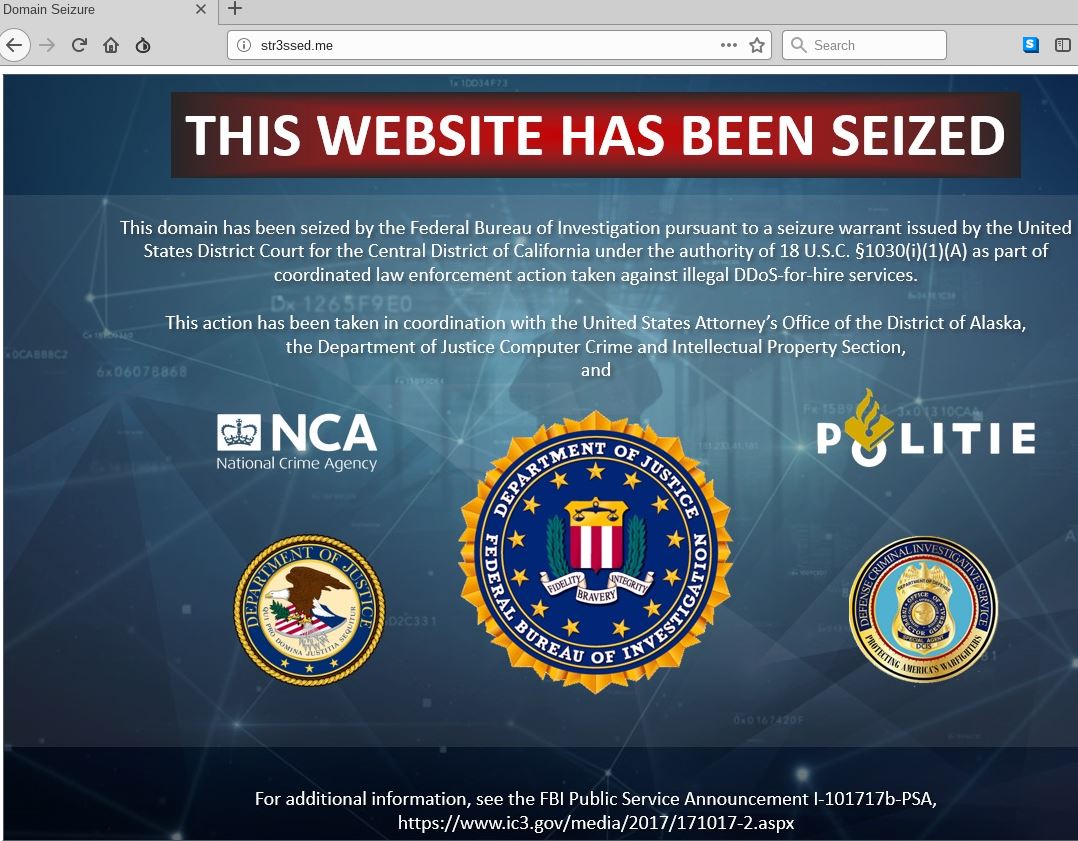
The seizure notice appearing on the homepage this week of more than a dozen popular “booter” or “stresser” DDoS-for-hire Web sites.

As of Thursday morning, a seizure notice featuring the seals of the U.S. Justice Department, FBI and other law enforcement agencies appeared on the booter sites, including:

anonsecurityteam[.]com
booter[.]ninja
bullstresser[.]net
critical-boot[.]com
defcon[.]pro
defianceprotocol[.]com
downthem[.]org
layer7-stresser[.]xyz
netstress[.]org
quantumnstress[.]net
ragebooter[.]com
request[.]rip
str3ssed[.]me
torsecurityteam[.]org
vbooter[.]org

Booter sites are dangerous because they help lower the barriers to cybercrime, allowing even complete novices to launch sophisticated and crippling attacks with the click of a button.

Cameron Schroeder, assistant U.S. attorney for the Central District of California, called this week’s action the largest simultaneous seizure of booter service domains ever.

“This is the biggest action U.S. law enforcement has taken against booter services, and we’re doing this in cooperation with a large number of industry and foreign law enforcement partners,” Schroeder said.

Booter services are typically advertised through variety of methods, including Dark Web forums, chat platforms and even youtube.com. They accept payment via PayPal, Google Wallet, and/or cryptocurrencies, and subscriptions can range in price from just a few dollars to several hundred per month. The services are priced according to the volume of traffic to be hurled at the target, the duration of each attack, and the number of concurrent attacks allowed.

Purveyors of stressers and booters claim they are not responsible for how customers use their services, and that they aren’t breaking the law because — like most security tools — stresser services can be used for good or bad purposes. For example, all of the above-mentioned booter sites contained wordy “terms of use” agreements that required customers to agree they will only stress-test their own networks — and that they won’t use the service to attack others.

But experts say today’s announcement shreds that virtual fig leaf, and marks several important strategic shifts in how authorities intend to prosecute booter service operators going forward.

“This action is predicated on the fact that running a booter service itself is illegal,” said Allison Nixon, director of security research at Flashpoint, a security firm based in New York City. “That’s a slightly different legal argument that has been made in the past against other booter owners.”

For one thing, the booter services targeted in this takedown advertised the ability to “resolve” or determine the true Internet address of a target. This is especially useful for customers seeking to harm targets whose real address is hidden behind mitigation services like Cloudflare (ironically, the same provider used by most of these booter services to withstand attacks by competing booter services).

Some resolvers also allowed customers to determine the Internet address of a target using nothing more than the target’s Skype username.

“You don’t need to use a Skype resolver just to attack yourself,” assistant U.S. Attorney Schroeder said. “Clearly, the people running these booter services know their services are being used not by people targeting their own infrastructure, and have built in capabilities that specifically allow customers to attack others.”

Another important distinction between this week’s coordinated action and past booter site takedowns was that the government actually tested each service it dismantled to validate claims about attack firepower and to learn more about how each service conducted assaults.

In a complaint unsealed today, the Justice Department said that although FBI agents identified at least 60 different booter services operating between June and December 2018, they discovered not all were fully operational and capable of launching attacks. Hence, the 15 services seized this week represent those that the government was able to use to conduct successful, high-volume attacks against their own test sites.

“This is intended to send a very clear message to all booter operators that they’re not going to be allowed to operate openly anymore,” Nixon said. “The message is that if you’re running a DDoS-for-hire service that can attack an Internet address in such a way that the FBI can purchase an attack against their own test servers, you’re probably going to get in trouble.”

DOWN THEM ALL

Charged in a Los Angeles federal court this week were the alleged operators of “Downthem” — a booter service the government says helped some 2,000 customers launch debilitating digital assaults at more than 200,000 targets, including many government, banking, university and gaming Web sites.

Prosecutors say that in addition to running and marketing Downthem, defendants Matthew Gatrel and Juan Martinez sold huge, continuously updated lists of Internet addresses tied to devices that could be used by other booter services to make attacks far more powerful and effective.
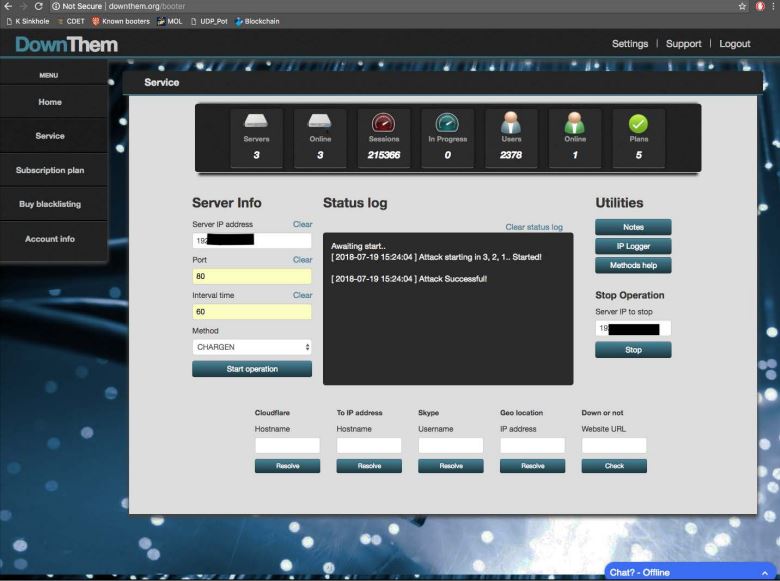
The user interface for Downthem[.]org, one of 15 booter sites seized by the feds today.

Booter and stresser services let customers pick from among a variety of attack methods, but almost universally the most powerful of these methods involves what’s known as a “reflective amplification attack.” In such assaults, the perpetrators leverage unmanaged Domain Name Servers (DNS) or other devices on the Web to create huge traffic floods.

Ideally, DNS servers only provide services to machines within a trusted domain — such as translating an Internet address from a series of numbers into a domain name, like example.com. But DNS reflection attacks rely on consumer and business routers and other devices equipped with DNS servers that are (mis)configured to accept queries from anywhere on the Web.

Attackers can send spoofed DNS queries to these DNS servers, forging the request so that it appears to come from the target’s network. That way, when the DNS servers respond, they reply to the spoofed (target) address.

The bad guys also can amplify a reflective attack by crafting DNS queries so that the responses are much bigger than the requests. For example, an attacker could compose a DNS request of less than 100 bytes, prompting a response that is 60-70 times as large. This “amplification” effect is especially pronounced if the perpetrators query dozens of DNS servers with these spoofed requests simultaneously.

The government alleges that Gatrel and Martinez constantly scanned the Internet for these misconfigured devices, and then sold lists of Internet addresses tied to these devices to other booter service operators.

Schroeder said the government is arguing that the use of these third-party servers in reflective amplification attacks can be prosecuted under existing wire fraud and computer trespass laws.

“Certainly [booter service operators] don’t have permission from all of those other devices owners to use the devices and their bandwidth to direct these attacks,” she said. “We look at it as a wire fraud violation because essentially they’re stealing property from upstream providers and using their resources to conduct these attacks. There are also multiple ways we can show this is pretty clearly not lawful under the Computer Fraud and Abuse Act.”

Prosecutors further allege Gatrel resold his booter services to other booter operators, including Quantum Stresser — one of the 15 services seized by the government this week. The alleged operator of that service, Pennsylvania resident David Bukoski, was charged in the District of Alaska this week for aiding and abetting computer intrusions.

Investigators say Bukoski’s booter service was among the longest running services targeted by the FBI, operating since at least 2012. An indictment against Bukoski unsealed this week maintains Quantum Stresser had over 80,000 customer subscriptions, and that during 2018 the service was used to conduct over 50,000 actual or attempted attacks targeting people and networks worldwide.

According to the government, the use of booter and stresser services to conduct attacks is punishable under both wire fraud laws and the Computer Fraud and Abuse Act (18 U.S.C. § 1030), and may result in arrest and prosecution; seizure of computers or other electronics; significant prison sentences; a penalty or fine.

Schroeder said the government understands this week’s takedowns aren’t going to solve the booter problem once and for all, and that other booter services will likely spring up in the wake of those dismantled this week. But she said the arrests and seizures have helped built a template that the government can use in tandem with its industry partners to shorten the lifespan of new booter services and to bring those responsible to justice.

“We certainly don’t expect this problem to go away after this,” Schroeder said. But this is an attempt to build a strategic approach to this problem, to look at it in a more systemic way and deal with it on a much larger scale.”

from Krebs on Security https://ift.tt/2POVjXD
via IFTTT
Desarrolladores de FreeBSD pretenden migrar ZFS a ZoL “ZFS on Linux”

Hace pocos días los desarrolladores a cargo del proyecto FreeBSD presentaron un plan de traducción para el sistema de archivos ZFS utilizado en el proyecto de implementación para el proyecto “ZFS on Linux” (ZoL), que está desarrollando el port ZFS para Linux.

El motivo de la migración es el estancamiento de la base de código ZFS del proyecto Illumos (fork de OpenSolaris), que anteriormente se usaba como base para transferir los cambios relacionados con ZFS a FreeBSD.

Sobre ZFS

ZFS es un sistema de archivos y administrador de volúmenes desarrollado originalmente por Sun Microsystems para su sistema operativo Solaris. El significado original era ‘Zettabyte File System’, pero ahora es un acrónimo recursivo.

ZFS destaca por su gran capacidad, integración de los conceptos anteriormente separados de sistema de ficheros y administrador de volúmenes en un solo producto, nueva estructura sobre el disco, sistemas de archivos ligeros y una administración de espacios de almacenamiento sencilla.

Hasta hace poco, la mayor parte del desarrollo relacionado con ZFS fue producido por el proyecto “ZFS on Linux” y la empresa Delphix.

La compañía desarrolla el sistema operativo Delphix DelphixOS (fork de Illumos) el cual proporcionó previamente el apoyo de ZFS en el código base Illumos.

El desarrollo de ZFS se migrara a Linux

Hace algunos meses (a principios de año), Delphix anunció la transición a la implementación de “ZFS on Linux”, que finalmente concentró en un solo lugar toda la actividad relacionada con ZFS.

De los proyectos ZFS en desarrollo y acompañados, solo queda “ZFS on Linux”, que ahora puede considerarse la implementación principal de OpenZFS .

Dado que la implementación de ZFS por Illumos ya se está quedando significativamente por detrás de “ZFS on Linux” en términos de funcionalidad.

Los desarrolladores de FreeBSD se han dado cuenta de que la comunidad de FreeBSD no tiene la fuerza suficiente para mantener y desarrollar la base de código existente por sí misma.

Si continúa utilizando Illumos, la brecha de funcionalidad solo aumentará y la transferencia de parches requerirá cada vez más recursos.

En lugar de tratar de aferrarse a Illumos, el equipo de soporte de ZFS en FreeBSD decidió aceptar “ZFS on Linux” como el principal proyecto de desarrollo de ZFS, dirigir los recursos existentes para aumentar la portabilidad de su código y utilizar su base de código como la base de la implementación de ZFS para FreeBSD.

El soporte de FreeBSD se integrará directamente en el código “ZFS on Linux” y se desarrollará principalmente en los repositorios de este proyecto (el tema del desarrollo conjunto en un solo repositorio ya se acordó con Brian Behlendorf, líder del proyecto ZFS en Linux).

¿Por qué Linux y no continuar en FreeBSD?

En la actualidad, un prototipo del port “ZFS on Linux” para FreeBSD ya se ha preparado para su revisión.

Para integrarlo en el código base de FreeBSD, queda por agregar varias características nuevas al marco de opencrypto.

Para combinar el port con la base de código principal “ZFS on Linux”, deben agregar el soporte para FreeBSD al sistema de integración continua, asegurarse de que el código pase todas las pruebas y realizar pruebas de calidad adicionales.

La sustitución de la implementación de ZFS en el código base de FreeBSD está programada para el 15 de abril, si han pasado dos meses desde que se estabilizó el port (de lo contrario, se cambiará el plazo).

En el futuro, durante tres meses, las versiones antiguas y nuevas de ZFS coexistirán, después de lo cual se eliminará el antiguo código ZFS basado en Illumos.

De la nueva funcionalidad que está disponible en el port de ZoL para FreeBSD, pero no en la implementación de Illumos ZFS, se observa el modo multihost ( MMP , protección multimodificador), sistema avanzado de cuotas, cifrado de conjuntos de datos, selección separada de clases de asignación de bloques. clases).

El uso de instrucciones de procesadores vectoriales para acelerar la implementación de RAIDZ y calcular sumas de comprobación, herramientas de línea de comandos mejoradas.

ZoL también corrige muchos errores relacionados con las condiciones de carrera y los bloqueos, que aún están sin corregir en el código de Illumos.

El artículo Desarrolladores de FreeBSD pretenden migrar ZFS a ZoL “ZFS on Linux” ha sido originalmente publicado en Linux Adictos.

from Linux Adictos https://ift.tt/2SfsTs6
via IFTTT

Los mejores reproductores de vídeo para Android

Aunque pocos lo recuerdan a estas alturas, una de las razones por la cual surgieron los smartphones fue la necesidad de consumir multimedia de una manera más cómoda y, a poder ser, en cualquier lugar. Este consumo se basa principalmente en el vídeo y la música. En este último caso, ya hemos seleccionado los mejores reproductores de música que existen en Android, y ahora llega el momento de centrarse en

Entra en Andro4all para leer el artículo completo

Puedes unirte a nosotros en Twitter, Facebook o en Google+

¡Suscríbete a nuestro canal de YouTube!

Publicado recientemente en Andro4all

from Andro4all https://ift.tt/2QK4KNq
via IFTTT

Cómo saber quién no me sigue en Instagram: las 3 mejores apps

Saber quién no te sigue en Instagram o quién ha dejado de seguirte recientemente, puede ser algo muy útil en ciertas ocasiones. No solo es posible pillar a aquellos usuarios que realizan la fea práctica de seguirte hasta que tú decides seguirlos de nuevo, y en ese momento dejar de seguirte con el objetivo de hacer crecer su número de seguidores mientras el de usuarios seguidos se mantiene reducido. También

Entra en Andro4all para leer el artículo completo

Puedes unirte a nosotros en Twitter, Facebook o en Google+

¡Suscríbete a nuestro canal de YouTube!

Publicado recientemente en Andro4all

from Andro4all https://ift.tt/2UW1AVv
via IFTTT

Microsoft presentó un sistema modular abierto para crear firmware UEFI

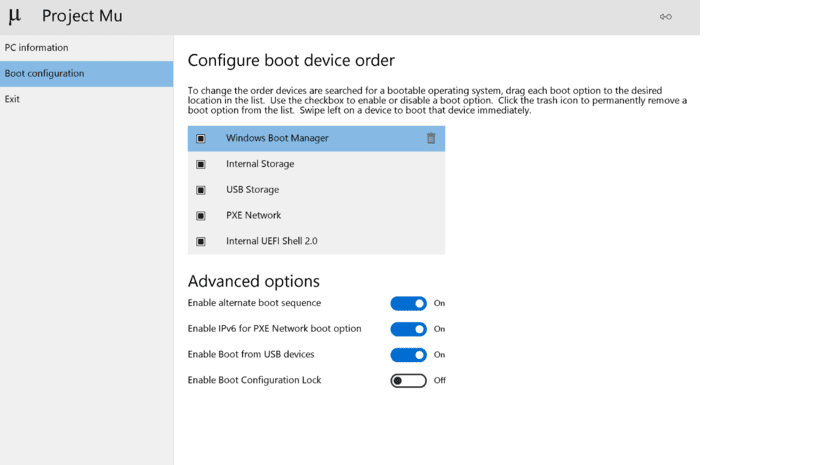
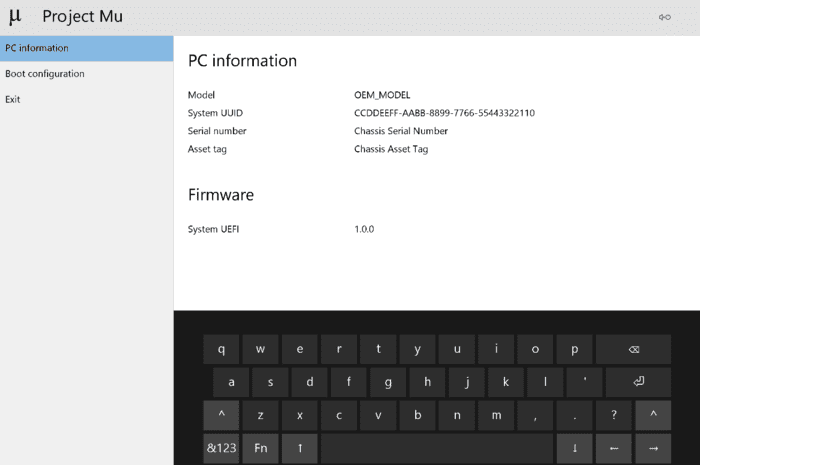
Recientemente Microsoft ha introducido un nuevo proyecto abierto, el “Proyecto Mu”, que está desarrollando un marco para crear entornos UEFI que inicializan el hardware y proporcionan un conjunto de servicios para cargar el sistema operativo.

El firmware basado en Project Mu ya se está utilizando en productos de Microsoft como Surface y Hyper-V.

El proyecto se basa en el trabajo de la pila UEFI abierta TianoCore EDK2, pero no es una bifurcación, sino que se coloca como un complemento (módulo “MU”), recopilado sobre la base de nuevas versiones estables de TianoCore y devolviendo correcciones y cambios específicos de TianoCore al proyecto principal.

Los desarrollos del proyecto se distribuyen bajo la licencia BSD.

Una característica clave del proyecto Mu es el desarrollo de la idea de firmware como un servicio (FaaS, Firmware as a Service), cuya esencia es proporcionar mecanismos para mantener actualizados el firmware y el entorno UEFI.

FaaS le permite ver el firmware como un producto que requiere actualizaciones constantes para brindar rápidamente correcciones de errores y vulnerabilidades a los usuarios, así como para agregar nuevas funciones.

Los desarrolladores del proyecto Mu intentaron resolver los problemas que surgen en el desarrollo del firmware UEFI, causados ​​por la participación de varios proveedores y el uso de diversos componentes propietarios, que están sujetos a estrictas restricciones de licencia.

Hasta ahora, debido a la complejidad de la organización de la interacción entre socios comerciales, los fabricantes practican la creación de una bifurcación de una base de código típica al crear un firmware con la introducción de modificaciones específicas del producto.

El mantenimiento del firmware en tales condiciones es demasiado complicado y el costo de las modificaciones y los riesgos derivados de los cambios le permiten generar actualizaciones solo en situaciones excepcionales.

Sobre el proyecto Mu

Mu proporciona un conjunto de módulos, herramientas de construcción y repositorios enfocados en la reutilización de códigos, un proceso de desarrollo colaborativo distribuido con intercambio de repositorios y un estricto control de calidad.

El firmware generado puede combinar componentes de código abierto con módulos propietarios, que se desarrollan por separado y el propio módulo se adjunta al producto final sin violar los requisitos de licencia del titular de los derechos de autor.

A diferencia de TianoCore, Project Mu incluye características adicionales para mejorar la compatibilidad con los productos de Microsoft, aumentar la escalabilidad (en el contexto del mantenimiento del firmware para muchos productos diferentes que tienen varias compañías involucradas), simplificar el mantenimiento del firmware y organizar las actualizaciones planificadas.

Los componentes del proyecto incluyen una interfaz de usuario, un teclado en pantalla, herramientas para administrar de forma segura la configuración de UEFI, un cargador de arranque de alto rendimiento y un conjunto de ejemplos de menú de BIOS.

Para aumentar la seguridad del proyecto, la base de código de TianoCore se limpió de componentes obsoletos y se realizaron cambios para reducir los posibles vectores de ataque.

Además del código, el proyecto también incluye un conjunto de especificaciones para la organización del proceso de desarrollo del firmware, de acuerdo con el paradigma FaaS, así como una colección de pruebas y herramientas para analizar y optimizar la calidad del firmware.

Las principales características de Mu

  • Interfaz para configurar el firmware (DFCI, interfaz de configuración de firmware del dispositivo) y herramientas para la administración de dispositivos móviles (MDM, Mobile Device Management);
  • El sistema de protección de contraseña del BIOS que utiliza PBKDF2 para el hashing de contraseñas.
  • Compatibilidad con la verificación de componentes mediante firmas digitales basadas en EKU (Extended Key Usage).
  • Usando el marco de Microsoft para pruebas unitarias.
  • Medios para auditar, verificar la funcionalidad y evaluar el rendimiento de todas las capacidades de la plataforma.
  • Sistema de compilación escalable escrito en Python.
  • Complementos para realizar un seguimiento de la reescritura de información y el análisis del descriptor de flash (Descriptor de Flash, marco de programación SPI Flash).
  • Sistema de gestión de paquetes binarios basado en el administrador de paquetes de NuGet.
  • La posibilidad de certificación por firmas digitales de componentes transmitidos mediante el mecanismo de cápsula UEFI (medios para transferir conjuntos de datos binarios al firmware EFI)
  • Compatibilidad con Visual Studio compilador.
  • Soporte de codificación Base64 para objetos binarios.
  • Paquete con soporte XML.

El artículo Microsoft presentó un sistema modular abierto para crear firmware UEFI ha sido originalmente publicado en Linux Adictos.

from Linux Adictos https://ift.tt/2CpOKrf
via IFTTT