Nearly one in three computers was hit with a malware attack this year, and ransomware and backdoors continue to pose a risk.
from Dark Reading: https://ift.tt/2PkJuZ1
via IFTTT

Nearly one in three computers was hit with a malware attack this year, and ransomware and backdoors continue to pose a risk.
from Dark Reading: https://ift.tt/2PkJuZ1
via IFTTT

Can This Little Magic App Make Your Headphones Sound Perfect?
Could the future of making music sound good be an app that compensates for the terrible headphones most of us insist on buying?
December 4, 2018 at 04:46PM
via Digg https://ift.tt/2zHwFTy

We’re No Longer in Smartphone Plateau. We’re in the Smartphone Decline.
Every smartphone manufacturer is now facing a world where, at best, they can hope for single-digit growth in smartphone sales — and many seem to be preparing for a world where they face declines.
December 4, 2018 at 04:46PM
via Digg https://ift.tt/2FZgCX5

from Engadget RSS Feed https://ift.tt/2AQ0UaS
via IFTTT
Software giant Citrix Systems recently forced a password reset for many users of its Sharefile content collaboration service, warning it would be doing this on a regular basis in response to password-guessing attacks that target people who re-use passwords across multiple Web sites. Many Sharefile users interpreted this as a breach at Citrix and/or Sharefile, but the company maintains that’s not the case. Here’s a closer look at what happened, and some ideas about how to avoid a repeat of this scenario going forward.
The notice sent to ShareFile users looked like this:
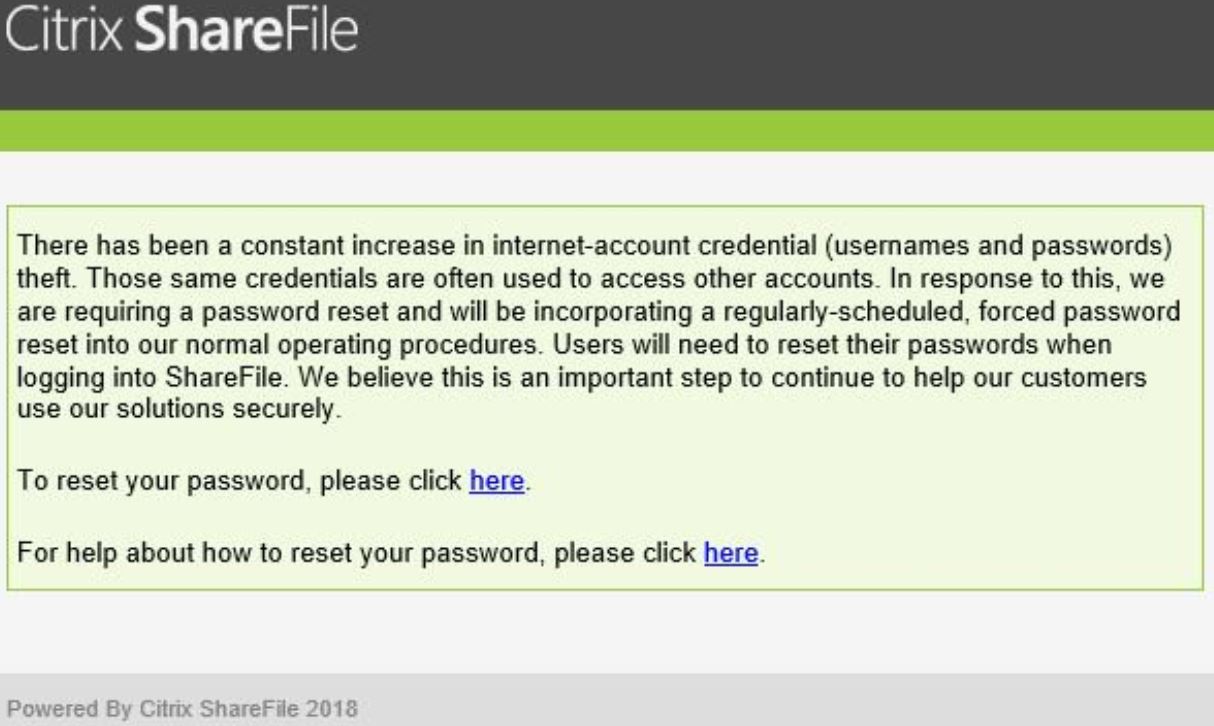
Dozens of readers forwarded the above message to KrebsOnSecurity, saying they didn’t understand the reasoning for the mass password reset and that they suspected a breach at ShareFile.
I reached out to ShareFile and asked them point blank whether this reset effort was in response to any sort of intrusion at Citrix or ShareFile; they said no. I asked if this notice had been sent to everyone, and inquired whether ShareFile offers any form(s) of multi-factor authentication options that customers could use to supplement the security of passwords.
A Citrix spokesperson referred me to this page, which says ShareFile users have a number of options when it comes to locking down their accounts with multi-factor authentication, including a one-time code sent via SMS/text message, as well as one-time passwords generated by support authenticator mobile apps from Google and Microsoft (app-based multi-factor is the more secure option, as discussed here).
More importantly, the Citrix spokesperson said the company did not enforce a password reset on accounts that were using multi-factor authentication. To wit:
“This is not in response to a breach of Citrix products or services,” wrote spokesperson Jamie Buranich. “Citrix forced password resets with the knowledge that attacks of this nature historically come in waves. Attacker’s additional efforts adapt to the results, often tuning the volume and approach of their methods. Our objective was to minimize the risk to our customers. We did not enforce a password reset on accounts that are using more stringent authentication controls [emphasis added]. Citrix also directly integrates with common SSO solutions, which significantly reduces risk.”
The company did not respond to questions about why it decided to adopt regular password resets as a policy when doing so flies in the face of password and authentication best practices recommended the National Institute of Standards and Technology (NIST), which warns:
“Verifiers SHOULD NOT require memorized secrets to be changed arbitrarily (e.g., periodically). However, verifiers SHALL force a change if there is evidence of compromise of the authenticator.”
NIST explains its rationale for steering organizations away from regular forced password resets thusly:
“Users tend to choose weaker memorized secrets when they know that they will have to change them in the near future. When those changes do occur, they often select a secret that is similar to their old memorized secret by applying a set of common transformations such as increasing a number in the password. This practice provides a false sense of security if any of the previous secrets has been compromised since attackers can apply these same common transformations.”
“But if there is evidence that the memorized secret has been compromised, such as by a breach of the verifier’s hashed password database or observed fraudulent activity, subscribers should be required to change their memorized secrets. However, this event-based change should occur rarely, so that they are less motivated to choose a weak secret with the knowledge that it will only be used for a limited period of time.”
In short, NIST says it makes sense to force an across-the-board password reset following a breach — either of a specific user’s account or the entire password database. But doing so at regular intervals absent such evidence of compromise is likely to result in less complex and secure passwords.
Ideally, ShareFile users who received a password reset notice can avoid the next round of password resets by adopting one of the two-step authentication options mentioned above. And I hope it goes without saying, but please don’t re-use a password you used anywhere else.
However, if you are the type of person who likes to re-use passwords, then you definitely need to be using a password manager, which helps you pick and remember strong passwords/passphrases and essentially lets you use the same strong master password/passphrase across all Web sites.
Incidentally, there are several companies — such as auth0 and Okta — that make it easy to integrate with breached password databases like Troy Hunt’s HaveIBeenPwned.com to help proactively prevent users from picking passwords they have used at other sites (or at least at other sites that have been breached publicly).
Whether online merchants are willing to adopt such preemptive approaches is another matter, said Julie Conroy, research director with the Aite Group, a market analyst firm.
“With the reality that such a vast swath of username/password combinations have been compromised, this creates the potential for a ton of inline friction, something that is an anathema to merchants, and which banks work hard to stay away from as well,” Conroy said.
Update: 4:53 p.m. ET: Citrix just published its own blog post about this here.
from Krebs on Security https://ift.tt/2EehBRu
via IFTTT

from Engadget RSS Feed https://ift.tt/2RyyLw8
via IFTTT

Are Headphones A Legit Fashion Accessory Now?
White headphones, both wired and wireless, are becoming an unignorable fashion statement, possibly for the first time since those ’00s ads.
December 4, 2018 at 03:41PM
via Digg https://ift.tt/2APUrfT

from Engadget RSS Feed https://ift.tt/2zI4P9X
via IFTTT
Microsoft acaba de dar un paso más cerca del software libre pues después de la liberación de los códigos fuente, comprar GitHub y crear su propia versión de Linux, llegó otra sorpresa.
La compañía también anunció que Windows Forms, WinUI (Windows UI Library) y WPF (Windows Presentation Foundation) pasaran a ser a partir de ahora de código abierto.
googletag.cmd.push(function() { googletag.display(‘div-gpt-ad-1456225598129-3’); });
Por lo tanto, Microsoft libera el código fuente de algunas aplicaciones junto con la versión de NET Core 3.0 Preview, esto fue lo que Microsoft anunció en parte de la Conferencia Connect 2018.
Que ademas de esto, Microsoft está renunciando a estas estructuras de Windows UX. WPF, Windows Forms y WinUI están ahora disponibles con el código fuente completo de GitHub.
Además, existen rumores de que Microsoft ha decidido terminar con su navegador Edge y en su lugar la empresa estaría desarrollando otro navegador totalmente basado en el Chromium dado que Edge fue considerado un fracaso entre los usuarios.
googletag.cmd.push(function() { googletag.display(‘div-gpt-ad-1495016988643-3’); });
Este nuevo navegador web que está previsto que se entregue de forma predeterminada en Windows 10 en lugar de Edge.
El proyecto se desarrolla bajo el nombre clave “Anaheim” y es notable por la transición a los desarrollos del proyecto Chromium gratuito en lugar de desarrollar su propio motor de navegador EdgeHTML.
De acuerdo con nuevos informes que aparecieron por primera vez en Windows Central, el navegador no necesita mucho tiempo para salir pues puede que Microsoft anuncie su reemplazo ya esta semana.
No está claro bajo qué marca se ofrecerá el nuevo navegador y si cambiará la interfaz de usuario.
Es posible que el nuevo navegador se presente como una actualización importante para Edge y que continúe siendo entregado con el mismo nombre, al tiempo que se conservan los elementos principales de la interfaz.
Por ejemplo, las versiones de Edge para iOS y Android no usan EdgeHTML inicialmente, sino que usan los motores de representación de contenido web regulares proporcionados por las plataformas móviles.

El motivo de la interrupción del desarrollo de Edge es la baja popularidad de este navegador entre los usuarios y los desarrolladores web.
La mayoría de los usuarios de Windows 10 están cambiando a Chrome debido a problemas constantes con la estabilidad y el rendimiento en el Edge.
De acuerdo con la calificación mundial de aplicaciones netas, la participación de Edge en el año disminuyó del 4.61% al 4.34%, la participación de Firefox es del 10%, Internet Explorer – 11.19%, Chrome – 63.6%
El navegador compatible con Chromium probablemente tendría más flexibilidad si la empresa opta por incluir todo en un competidor de Chromebook, en lugar de usar una versión simplificada de Windows 10. La diferenciación del navegador de Google Chrome será otra cuestión.
Microsoft necesitará esforzarse mucho en esta área si quiere recuperar una parte sólida del mercado que en este momento tienen los navegadores de Google.
Pues durante muchos años nunca ha obtenido satisfacción por parte de sus usuarios, debido a que dejaba de lado las tecnologías de último momento sin ofrecer un soporte directo (cosa que aprovecharon muy bien sus competidores).
Según cifras recientes, Chrome controla más de la mitad del mercado mundial de navegadores web.
Y los proyectos dirigidos al código abierto no paran ahí. Microsoft y Docker anunciaron un proyecto de código abierto, Cloud Native Application Bundle (CNAB).
El objetivo es facilitar la gestión del ciclo de vida de las aplicaciones nativas de la nube.
En esencia, CNAB no es más que una especificación que permite a los desarrolladores declarar cómo una aplicación debe ser empaquetada y ejecutada.
Con eso, los desarrolladores pueden definir sus recursos y luego implementar la aplicación para cualquier cosa, desde la estación de trabajo local hasta las nubes públicas.
La especificación nació dentro de Microsoft. Pero el equipo conversó con Docker, pues los ingenieros de esta estaban trabajando en un proyecto similar.
Los dos decidieron unir fuerzas y lanzar el resultado como un solo proyecto de código abierto.
Hace aproximadamente un año, nos dimos cuenta de que los dos estábamos trabajando en lo mismo “, dijo Gabe Monroy, Microsoft. Decidimos combinar fuerzas y ponerlos juntos como un estándar de la industria, se añadió.
El artículo Microsoft amplía su posición en el open source y trabaja en un nuevo navegador ha sido originalmente publicado en Linux Adictos.
from Linux Adictos https://ift.tt/2Edtveb
via IFTTT
Hay ocasiones en las que la pantalla de nuestro móvil se queda pequeña, por mucho que supere las 6 pulgadas. Es en esos momentos cuando entran en juego televisores y pantallas externas, y las capacidades de Android de emitir o duplicar el contenido que se muestra por pantalla en el propio televisor. Existen varias formas distintas de duplicar la pantalla en Android en un televisor, con y sin necesidad de
Entra en Andro4all para leer el artículo completo
Puedes unirte a nosotros en Twitter, Facebook o en Google+
¡Suscríbete a nuestro canal de YouTube!
Publicado recientemente en Andro4all
from Andro4all https://ift.tt/2E1Ejv5
via IFTTT
 Pacosite's Blog