Treasury Sanctions Creators of 911 S5 Proxy Botnet

The U.S. Department of the Treasury today unveiled sanctions against three Chinese nationals for allegedly operating 911 S5, an online anonymity service that for many years was the easiest and cheapest way to route one’s Web traffic through malware-infected computers around the globe. KrebsOnSecurity identified one of the three men in a July 2022 investigation into 911 S5, which was massively hacked and then closed ten days later.

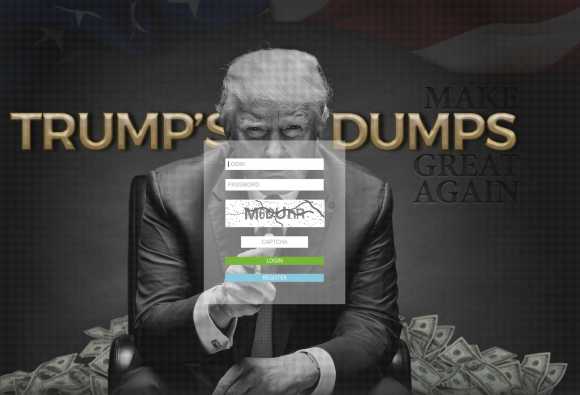
The 911 S5 botnet-powered proxy service, circa July 2022.

From 2015 to July 2022, 911 S5 sold access to hundreds of thousands of Microsoft Windows computers daily, as “proxies” that allowed customers to route their Internet traffic through PCs in virtually any country or city around the globe — but predominantly in the United States.

911 built its proxy network mainly by offering “free” virtual private networking (VPN) services. 911’s VPN performed largely as advertised for the user — allowing them to surf the web anonymously — but it also quietly turned the user’s computer into a traffic relay for paying 911 S5 customers.

911 S5’s reliability and extremely low prices quickly made it one of the most popular services among denizens of the cybercrime underground, and the service become almost shorthand for connecting to that “last mile” of cybercrime. Namely, the ability to route one’s malicious traffic through a computer that is geographically close to the consumer whose stolen credit card is about to be used, or whose bank account is about to be emptied.

In July 2022, KrebsOnSecurity published a deep dive into 911 S5, which found the people operating this business had a history of encouraging the installation of their proxy malware by any means available. That included paying affiliates to distribute their proxy software by secretly bundling it with other software.

A cached copy of flashupdate dot net, a pay-per-install affiliate program that incentivized the silent installation of 911’s proxy software.

That story named Yunhe Wang from Beijing as the apparent owner or manager of the 911 S5 proxy service. In today’s Treasury action, Mr. Wang was named as the primary administrator of the botnet that powered 911 S5.

“A review of records from network infrastructure service providers known to be utilized by 911 S5 and two Virtual Private Networks (VPNs) specific to the botnet operation (MaskVPN and DewVPN) showed Yunhe Wang as the registered subscriber to those providers’ services,” reads the Treasury announcement.

The sanctions say Jingping Liu was Yunhe Wang’s co-conspirator in the laundering of criminally derived proceeds generated from 911 S5, mainly virtual currency. The government alleges the virtual currencies paid by 911 S5 users were converted into U.S. dollars using over-the-counter vendors who wired and deposited funds into bank accounts held by Liu.

“Jingping Liu assisted Yunhe Wang by laundering criminally derived proceeds through bank accounts held in her name that were then utilized to purchase luxury real estate properties for Yunhe Wang,” the document continues. “These individuals leveraged their malicious botnet technology to compromise personal devices, enabling cybercriminals to fraudulently secure economic assistance intended for those in need and to terrorize our citizens with bomb threats.”

The third man sanctioned is Yanni Zheng, a Chinese national the U.S. Treasury says acted as an attorney for Wang and his firm — Spicy Code Company Limited — and helped to launder proceeds from the business into real estate holdings. Spicy Code Company was also sanctioned, as well as Wang-controlled properties Tulip Biz Pattaya Group Company Limited, and Lily Suites Company Limited.

Ten days after the July 2022 story here on 911 S5, the proxy network abruptly closed up shop, citing a data breach that destroyed key components of its business operations.

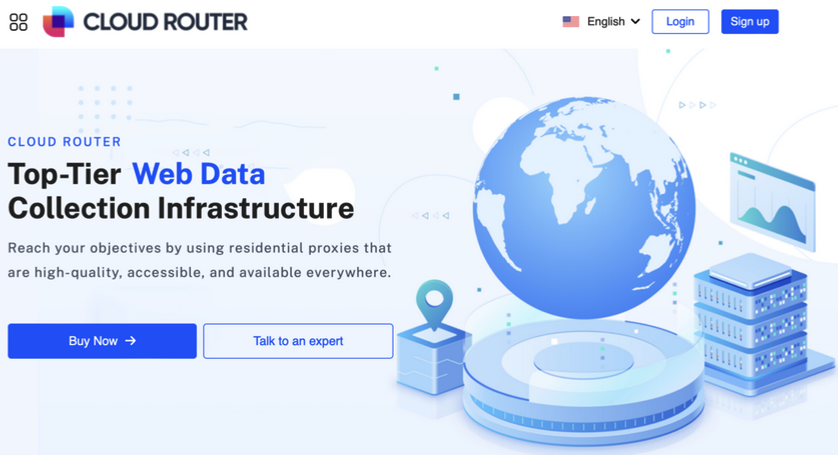
In the months that followed, however, 911 S5 would resurrect itself under a different name: Cloud Router. That’s according to spur.us, a U.S.-based startup that tracks proxy and VPN services. In February 2024, Spur published research showing the Cloud Router operators reused many of the same components from 911 S5, making it relatively simple to draw a connection between the two.

The Cloud Router homepage, which according to Spur has been unreachable since this past weekend.

Spur found that Cloud Router was being powered by a new VPN service called PaladinVPN, which made it much more explicit to users that their Internet connections were going to be used to relay traffic for others. At the time, Spur found Cloud Router had more than 140,000 Internet addresses for rent.

Spur co-founder Riley Kilmer said Cloud Router appears to have suspended or ceased operations sometime this past weekend. Kilmer said the number of proxies advertised by the service had been trending downwards quite recently before the website suddenly went offline.

Cloud Router’s homepage is currently populated by a message from Cloudflare saying the site’s domain name servers are pointing to a “prohibited IP.”

from Krebs on Security https://ift.tt/LuropHM
via IFTTT

Stark Industries Solutions: An Iron Hammer in the Cloud

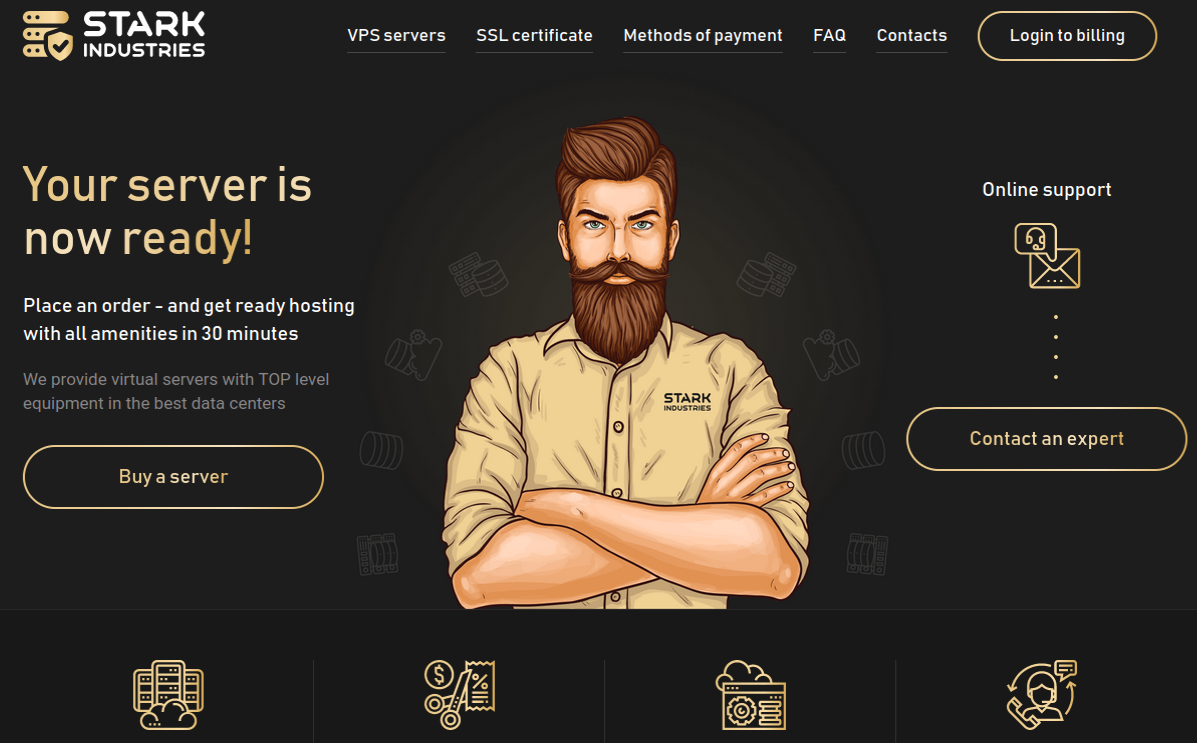
The homepage of Stark Industries Solutions.

Two weeks before Russia invaded Ukraine in February 2022, a large, mysterious new Internet hosting firm called Stark Industries Solutions materialized and quickly became the epicenter of massive distributed denial-of-service (DDoS) attacks on government and commercial targets in Ukraine and Europe. An investigation into Stark Industries reveals it is being used as a global proxy network that conceals the true source of cyberattacks and disinformation campaigns against enemies of Russia.

At least a dozen patriotic Russian hacking groups have been launching DDoS attacks since the start of the war at a variety of targets seen as opposed to Moscow. But by all accounts, few attacks from those gangs have come close to the amount of firepower wielded by a pro-Russia group calling itself “NoName057(16).”
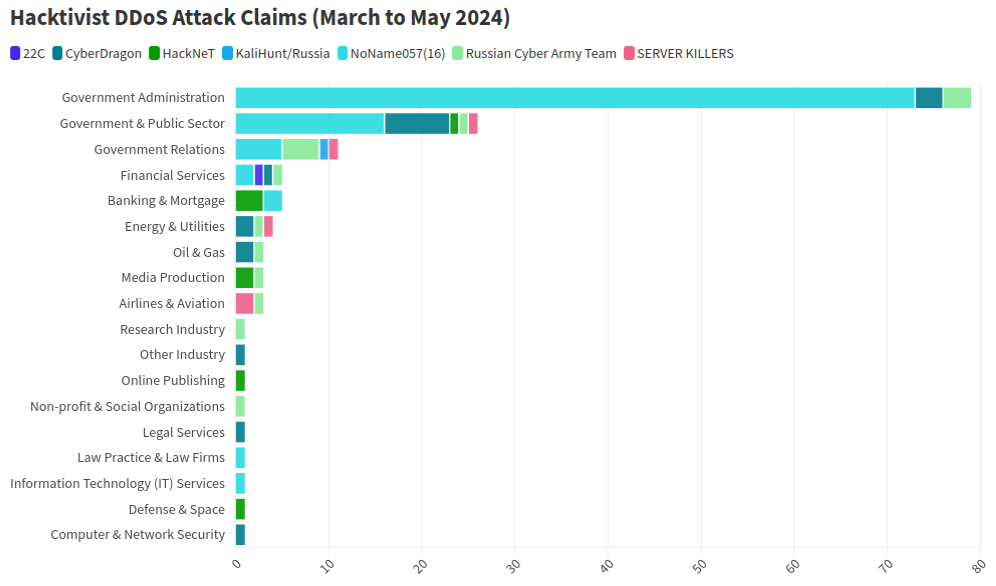
This graphic comes from a recent report from Arbor NETSCOUT about DDoS attacks from Russian hacktivist groups.

As detailed by researchers at Radware, NoName has effectively gamified DDoS attacks, recruiting hacktivists via its Telegram channel and offering to pay people who agree to install a piece of software called DDoSia. That program allows NoName to commandeer the host computers and their Internet connections in coordinated DDoS campaigns, and DDoSia users with the most attacks can win cash prizes.
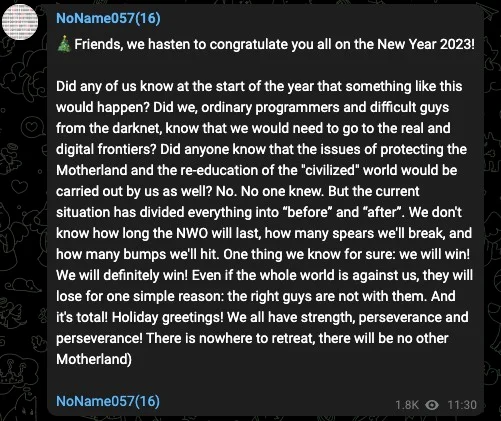
The NoName DDoS group advertising on Telegram. Image: SentinelOne.com.

A report from the security firm Team Cymru found the DDoS attack infrastructure used in NoName campaigns is assigned to two interlinked hosting providers: MIRhosting and Stark Industries. MIRhosting is a hosting provider founded in The Netherlands in 2004. But Stark Industries Solutions Ltd was incorporated on February 10, 2022, just two weeks before the Russian invasion of Ukraine.

PROXY WARS

Security experts say that not long after the war started, Stark began hosting dozens of proxy services and free virtual private networking (VPN) services, which are designed to help users shield their Internet usage and location from prying eyes.

Proxy providers allow users to route their Internet and Web browsing traffic through someone else’s computer. From a website’s perspective, the traffic from a proxy network user appears to originate from the rented IP address, not from the proxy service customer.

These services can be used in a legitimate manner for several business purposes — such as price comparisons or sales intelligence — but they are also massively abused for hiding cybercrime activity because they can make it difficult to trace malicious traffic to its original source.

What’s more, many proxy services do not disclose how they obtain access to the proxies they are renting out, and in many cases the access is obtained through the dissemination of malicious software that turns the infected system in a traffic relay — usually unbeknownst to the legitimate owner of the Internet connection. Other proxy services will allow users to make money by renting out their Internet connection to anyone.

Spur.us is a company that tracks VPNs and proxy services worldwide. Spur finds that Stark Industries (AS44477) currently is home to at least 74 VPN services, and 40 different proxy services. As we’ll see in the final section of this story, just one of those proxy networks has over a million Internet addresses worldwide available for rent worldwide.

Raymond Dijkxhoorn operates a hosting firm in The Netherlands called Prolocation. He also co-runs SURBL, an anti-abuse service that flags domains and Internet address ranges that are strongly associated with spam and cybercrime activity, including DDoS.

Dijkxhoorn said last year SURBL heard from multiple people who said they operated VPN services whose web resources were included in SURBL’s block lists.

“We had people doing delistings at SURBL for domain names that were suspended by the registrars,” Dijkhoorn told KrebsOnSecurity. “And at least two of them explained that Stark offered them free VPN services that they were reselling.”

Dijkxhoorn added that Stark Industries also sponsored activist groups from Ukraine.

“How valuable would it be for Russia to know the real IPs from Ukraine’s tech warriors?” he observed.

CLOUDY WITH A CHANCE OF BULLETS

Richard Hummel is threat intelligence lead at Arbor NETSCOUT. Hummel said when he considers the worst of all the hosting providers out there today, Stark Industries is consistently near or at the top of that list.

“The reason is we’ve had at least a dozen service providers come to us saying, ‘There’s this network out there inundating us with traffic,’” Hummel said. “And it wasn’t even DDoS attacks. [The systems] on Stark were just scanning these providers so fast it was crashing some of their services.”

Hummel said NoName will typically launch their attacks using a mix of resources from rented from major, legitimate cloud services, and those from so-called “bulletproof” hosting providers like Stark. Bulletproof providers are so named when they earn or cultivate a reputation for ignoring any abuse complaints or police reports about activity on their networks.

Combining bulletproof providers with legitimate cloud hosting, Hummel said, likely makes NoName’s DDoS campaigns more resilient because many network operators will hesitate to be too aggressive in blocking Internet addresses associated with the major cloud services.

“What we typically see here is a distribution of cloud hosting providers and bulletproof hosting providers in DDoS attacks,” he said. “They’re using public cloud hosting providers because a lot of times that’s your first layer of network defense, and because [many companies are wary of] over-blocking access to legitimate cloud resources.”

But even if the cloud provider detects abuse coming from the customer, the provider is probably not going to shut the customer down immediately, Hummel said.

“There is usually a grace period, and even if that’s only an hour or two, you can still launch a large number of attacks in that time,” he said. “And then they just keep coming back and opening new cloud accounts.”

MERCENARIES TEAM

Stark Industries is incorporated at a mail drop address in the United Kingdom. UK business records list an Ivan Vladimirovich Neculiti as the company’s secretary. Mr. Neculiti also is named as the CEO and founder of PQ Hosting Plus S.R.L. (aka Perfect Quality Hosting), a Moldovan company formed in 2019 that lists the same UK mail drop address as Stark Industries.

Ivan Neculiti, as pictured on LinkedIn.

Reached via LinkedIn, Mr. Neculiti said PQ Hosting established Stark Industries as a “white label” of its brand so that “resellers could distribute our services using our IP addresses and their clients would not have any affairs with PQ Hosting.”

“PQ Hosting is a company with over 1,000+ of [our] own physical servers in 38 countries and we have over 100,000 clients,” he said. “Though we are not as large as Hetzner, Amazon and OVH, nevertheless we are a fast growing company that provides services to tens of thousands of private customers and legal entities.”

Asked about the constant stream of DDoS attacks whose origins have traced back to Stark Industries over the past two years, Neculiti maintained Stark hasn’t received any official abuse reports about attacks coming from its networks.

“It was probably some kind of clever attack that we did not see, I do not rule out this fact, because we have a very large number of clients and our Internet channels are quite large,” he said. “But, in this situation, unfortunately, no one contacted us to report that there was an attack from our addresses; if someone had contacted us, we would have definitely blocked the network data.”

DomainTools.com finds Ivan V. Neculiti was the owner of war[.]md, a website launched in 2008 that chronicled the history of a 1990 armed conflict in Moldova known as the Transnistria War and the Moldo-Russian war.

An ad for war.md, circa 2009.

Transnistria is a breakaway pro-Russian region that declared itself a state in 1990, although it is not internationally recognized. The copyright on that website credits the “MercenarieS TeaM,” which was at one time a Moldovan IT firm. Mr. Neculiti confirmed personally registering this domain.

DON CHICHO & DFYZ

The data breach tracking service Constella Intelligence reports that an Ivan V. Neculiti registered multiple online accounts under the email address dfyz_bk@bk.ru. Cyber intelligence firm Intel 471 shows this email address is tied to the username “dfyz” on more than a half-dozen Russian language cybercrime forums since 2008. The user dfyz on Searchengines[.]ru in 2008 asked other forum members to review war.md, and said they were part of the MercenarieS TeaM.

Back then, dfyz was selling “bulletproof servers for any purpose,” meaning the hosting company would willfully ignore abuse complaints or police inquiries about the activity of its customers.

DomainTools reports there are at least 33 domain names registered to dfyz_bk@bk.ru. Several of these domains have Ivan Neculiti in their registration records, including tracker-free.cn, which was registered to an Ivan Neculiti at dfyz_bk@bk.ru and referenced the MercenarieS TeaM in its original registration records.

Dfyz also used the nickname DonChicho, who likewise sold bulletproof hosting services and access to hacked Internet servers. In 2014, a prominent member of the Russian language cybercrime community Antichat filed a complaint against DonChicho, saying this user scammed them and had used the email address dfyz_bk@bk.ru.

The complaint said DonChicho registered on Antichat from the Transnistria Internet address 84.234.55[.]29. Searching this address in Constella reveals it has been used to register just five accounts online that have been created over the years, including one at ask.ru, where the user registered with the email address neculitzy1@yandex.ru. Constella also returns for that email address a user by the name “Ivan” at memoraleak.com and 000webhost.com.

Constella finds that the password most frequently used by the email address dfyz_bk@bk.ru was “filecast,” and that there are more than 90 email addresses associated with this password. Among them are roughly two dozen addresses with the name “Neculiti” in them, as well as the address support@donservers[.]ru.

Intel 471 says DonChicho posted to several Russian cybercrime forums that support@donservers[.]ru was his address, and that he logged into cybercrime forums almost exclusively from Internet addresses in Tiraspol, the capital of Transnistria. A review of DonChicho’s posts shows this person was banned from several forums in 2014 for scamming other users.

Cached copies of DonChicho’s vanity domain (donchicho[.]ru) show that in 2009 he was a spammer who peddled knockoff prescription drugs via Rx-Promotion, once one of the largest pharmacy spam moneymaking programs for Russian-speaking affiliates.

Mr. Neculiti told KrebsOnSecurity he has never used the nickname DonChicho.

“I may assure you that I have no relation to DonChicho nor to his bulletproof servers,” he said.

Below is a mind map that shows the connections between the accounts mentioned above.
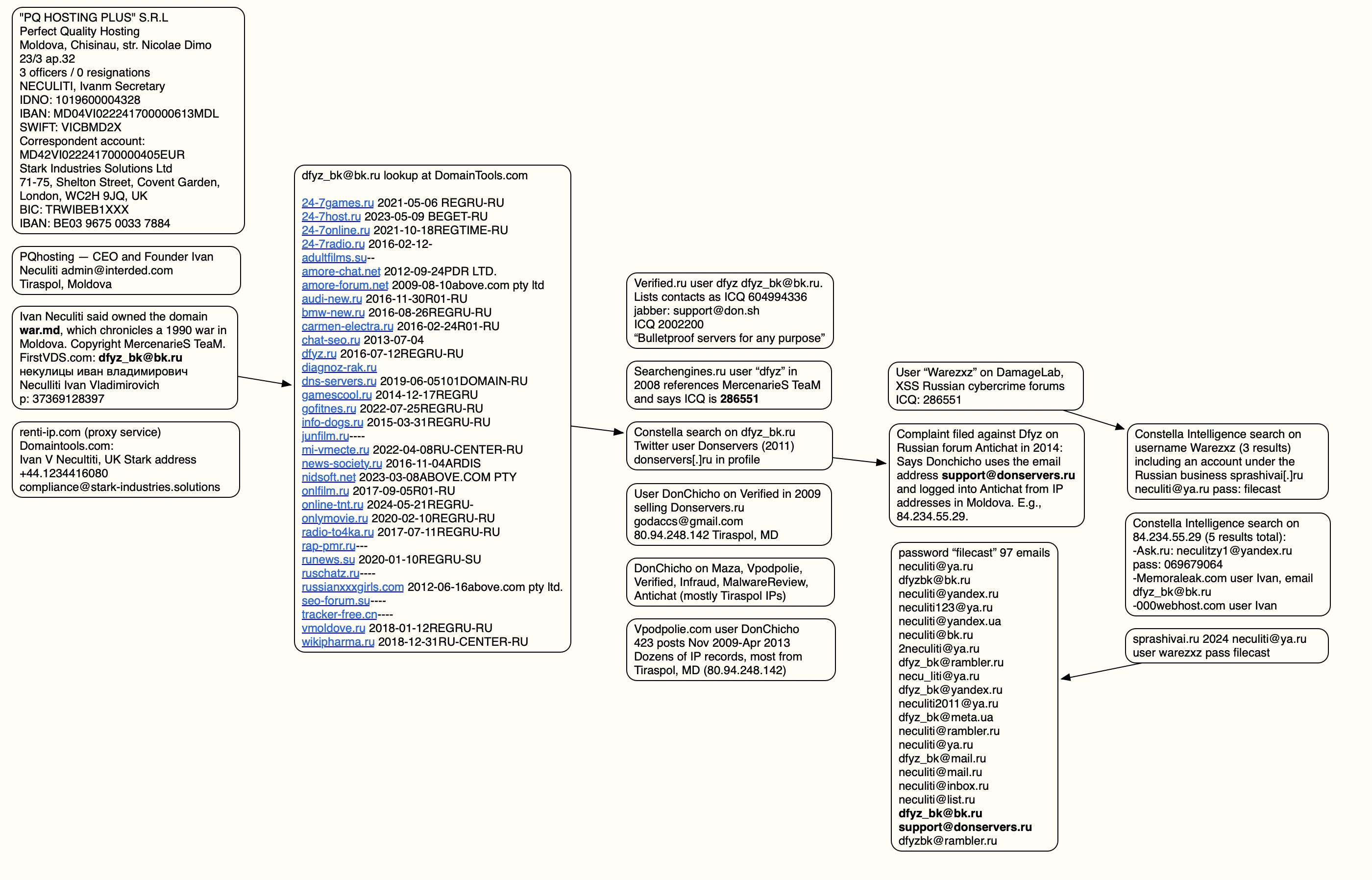
A mind map tracing the history of the user Dfyz. Click to enlarge.

Earlier this year, NoName began massively hitting government and industry websites in Moldova. A new report from Arbor Networks says the attacks began around March 6, when NoName alleged the government of Moldova was “craving for Russophobia.”

“Since early March, more than 50 websites have been targeted, according to posted ‘proof’ by the groups involved in attacking the country,” Arbor’s ASERT Team wrote. “While NoName seemingly initiated the ramp of attacks, a host of other DDoS hacktivists have joined the fray in claiming credit for attacks across more than 15 industries.”

CORRECTIV ACTION

The German independent news outlet Correctiv.org last week published a scathing investigative report on Stark Industries and MIRhosting, which notes that Ivan Neculiti operates his hosting companies with the help of his brother, Yuri.
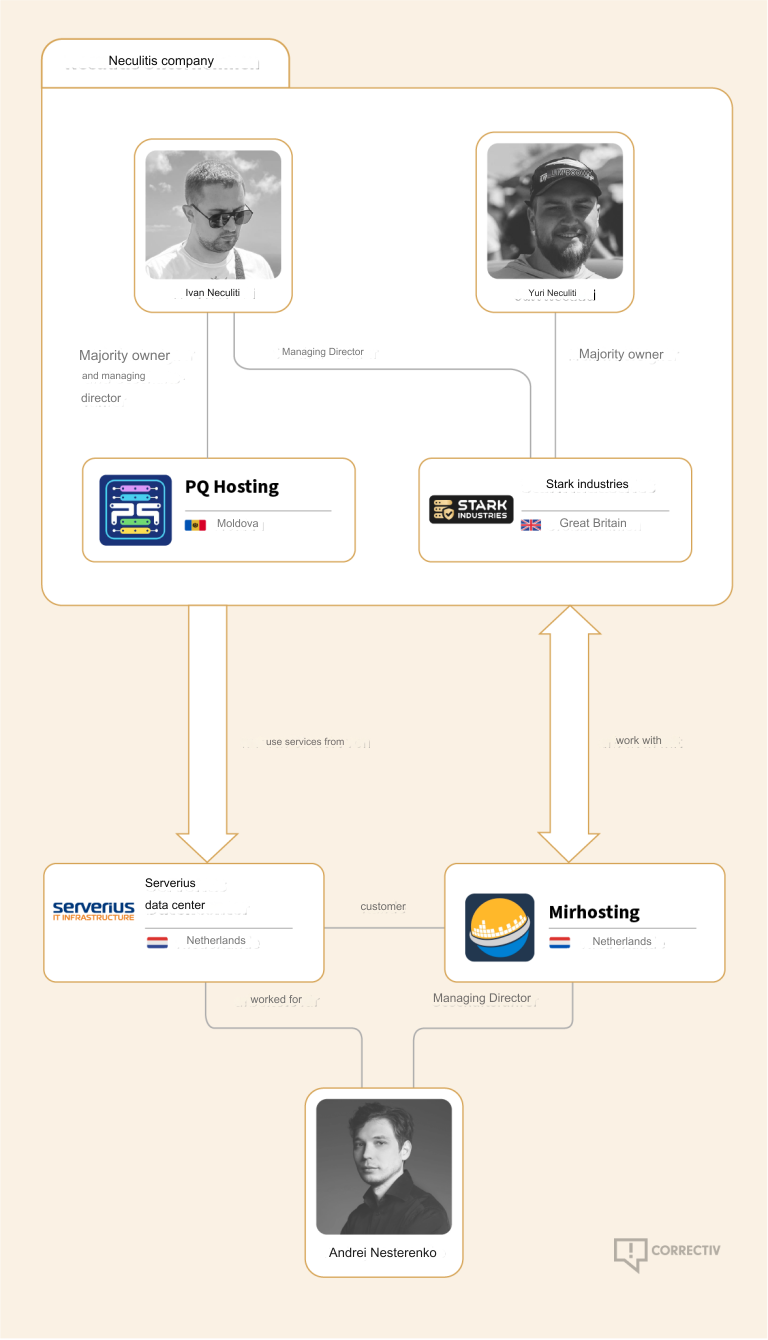
Image credit: correctiv.org.

The report points out that Stark Industries continues to host a Russian disinformation news outlet called “Recent Reliable News” (RRN) that was sanctioned by the European Union in 2023 for spreading links to propaganda blogs and fake European media and government websites.

“The website was not running on computers in Moscow or St. Petersburg until recently, but in the middle of the EU, in the Netherlands, on the computers of the Neculiti brothers,” Correctiv reporters wrote.

“After a request from this editorial team, a well-known service was installed that hides the actual web host,” the report continues. “Ivan Neculiti announced that he had blocked the associated access and server following internal investigations. “We very much regret that we are only now finding out that one of our customers is a sanctioned portal,” said the company boss. However, RRN is still accessible via its servers.”

Correctiv also points to a January 2023 report from the Ukrainian government, which found servers from Stark Industries Solutions were used as part of a cyber attack on the Ukrainian news agency “Ukrinform”. Correctiv notes the notorious hacker group Sandworm — an advanced persistent threat (APT) group operated by a cyberwarfare unit of Russia’s military intelligence service — was identified by Ukrainian government authorities as responsible for that attack.

PEACE HOSTING?

Public records indicate MIRhosting is based in The Netherlands and is operated by 37-year old Andrey Nesterenko, whose personal website says he is an accomplished concert pianist who began performing publicly at a young age.

DomainTools says mirhosting[.]com is registered to Mr. Nesterenko and to Innovation IT Solutions Corp, which lists addresses in London and in Nesterenko’s stated hometown of Nizhny Novgorod, Russia.

This is interesting because according to the book Inside Cyber Warfare by Jeffrey Carr, Innovation IT Solutions Corp. was responsible for hosting StopGeorgia[.]ru, a hacktivist website for organizing cyberattacks against Georgia that appeared at the same time Russian forces invaded the former Soviet nation in 2008. That conflict was thought to be the first war ever fought in which a notable cyberattack and an actual military engagement happened simultaneously.

Responding to questions from KrebsOnSecurity, Mr. Nesterenko said he couldn’t say whether his network had ever hosted the StopGeorgia website back in 2008 because his company didn’t keep records going back that far. But he said Stark Industries Solutions is indeed one of MIRhsoting’s colocation customers.

“Our relationship is purely provider-customer,” Nesterenko said. “They also utilize multiple providers and data centers globally, so connecting them directly to MIRhosting overlooks their broader network.”

“We take any report of malicious activity seriously and are always open to information that can help us identify and prevent misuse of our infrastructure, whether involving Stark Industries or any other customer,” Nesterenko continued. “In cases where our services are exploited for malicious purposes, we collaborate fully with Dutch cyber police and other relevant authorities to investigate and take appropriate measures. However, we have yet to receive any actionable information beyond the article itself, which has not provided us with sufficient detail to identify or block malicious actors.”

In December 2022, security firm Recorded Future profiled the phishing and credential harvesting infrastructure used for Russia-aligned espionage operations by a group dubbed Blue Charlie (aka TAG-53), which has targeted email accounts of nongovernmental organizations and think tanks, journalists, and government and defense officials.

Recorded Future found that virtually all the Blue Charlie domains existed in just ten different ISPs, with a significant concentration located in two networks, one of which was MIRhosting. Both Microsoft and the UK government assess that Blue Charlie is linked to the Russian threat activity groups variously known as Callisto Group, COLDRIVER, and SEABORGIUM.

Mr. Nesterenko took exception to Recorded Future’s report.

“We’ve discussed its contents with our customer, Stark Industries,” he said. “We understand that they have initiated legal proceedings against the website in question, as they firmly believe that the claims made are inaccurate.”

Recorded Future said they updated their story with comments from Mr. Nesterenko, but that they stand by their reporting.

Mr. Nesterenko’s LinkedIn profile says he was previously the foreign region sales manager at Serverius-as, a hosting company in The Netherlands that remains in the same data center as MIRhosting.

In February, the Dutch police took 13 servers offline that were used by the infamous LockBit ransomware group, which had originally bragged on its darknet website that its home base was in The Netherlands. Sources tell KrebsOnSecurity the servers seized by the Dutch police were located in Serverius’ data center in Dronten, which is also shared by MIRhosting.

Serverius-as did not respond to requests for comment. Nesterenko said MIRhosting does use one of Serverius’s data centers for its operations in the Netherlands, alongside two other data centers, but that the recent incident involving the seizure of servers has no connection to MIRhosting.

“We are legally prohibited by Dutch law and police regulations from sharing information with third parties regarding any communications we may have had,” he said.

A February 2024 report from security firm ESET found Serverius-as systems were involved in a series of targeted phishing attacks by Russia-aligned groups against Ukrainian entities throughout 2023. ESET observed that after the spearphishing domains were no longer active, they were converted to promoting rogue Internet pharmacy websites.

PEERING INTO THE VOID

A review of the Internet address ranges recently added to the network operated by Stark Industries Solutions offers some insight into its customer base, usage, and maybe even true origins. Here is a snapshot (PDF) of all Internet address ranges announced by Stark Industries so far in the month of May 2024 (this information was graciously collated by the network observability platform Kentik.com).

Those records indicate that the largest portion of the IP space used by Stark is in The Netherlands, followed by Germany and the United States. Stark says it is connected to roughly 4,600 Internet addresses that currently list their ownership as Comcast Cable Communications.

A review of those address ranges at spur.us shows all of them are connected to an entity called Proxyline, which is a sprawling proxy service based in Russia that currently says it has more than 1.6 million proxies globally that are available for rent.
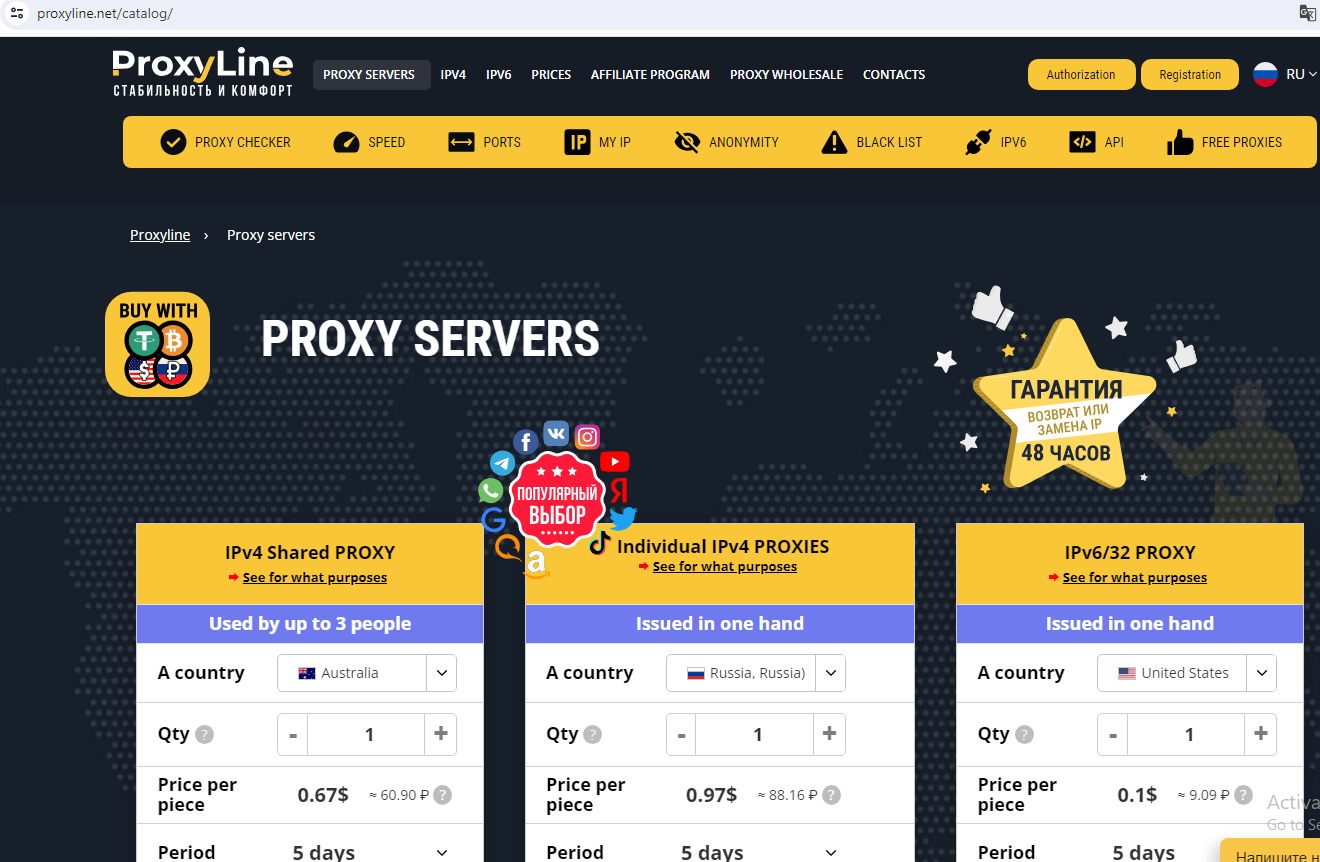
Proxyline dot net.

Reached for comment, Comcast said the Internet address ranges never did belong to Comcast, so it is likely that Stark has been fudging the real location of its routing announcements in some cases.

Stark reports that it has more than 67,000 Internet addresses at Santa Clara, Calif.-based EGIhosting. Spur says the Stark addresses involving EGIhosting all map to Proxyline as well. EGIhosting did not respond to requests for comment.

EGIhosting manages Internet addresses for the Cyprus-based hosting firm ITHOSTLINE LTD (aka HOSTLINE-LTD), which is represented throughout Stark’s announced Internet ranges. Stark says it has more than 21,000 Internet addresses with HOSTLINE. Spur.us finds Proxyline addresses are especially concentrated in the Stark ranges labeled ITHOSTLINE LTD, HOSTLINE-LTD, and Proline IT.

Stark’s network list includes approximately 21,000 Internet addresses at Hockessin, De. based DediPath, which abruptly ceased operations without warning in August 2023. According to a phishing report released last year by Interisle Consulting, DediPath was the fourth most common source of phishing attacks in the year ending Oct. 2022. Spur.us likewise finds that virtually all of the Stark address ranges marked “DediPath LLC” are tied to Proxyline.
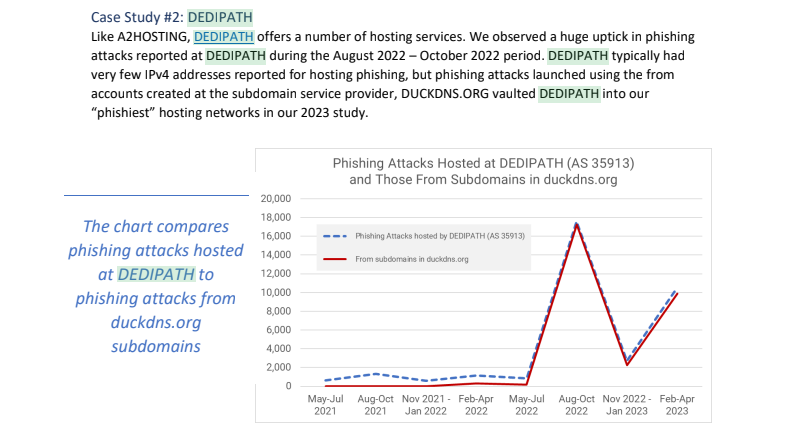
Image: Interisle Consulting.

A large number of the Internet address ranges announced by Stark in May originate in India, and the names that are self-assigned to many of these networks indicate they were previously used to send large volumes of spam for herbal medicinal products, with names like HerbalFarm, AdsChrome, Nutravo, Herbzoot and Herbalve.

The anti-spam organization SpamHaus reports that many of the Indian IP address ranges are associated with known “snowshoe spam,” a form of abuse that involves mass email campaigns spread across several domains and IP addresses to weaken reputation metrics and avoid spam filters.

It’s not clear how much of Stark’s network address space traces its origins to Russia, but big chunks of it recently belonged to some of the oldest entities on the Russian Internet (a.k.a. “Runet”).

For example, many Stark address ranges were most recently assigned to a Russian government entity whose full name is the “Federal State Autonomous Educational Establishment of Additional Professional Education Center of Realization of State Educational Policy and Informational Technologies.”

A review of Internet address ranges adjacent to this entity reveals a long list of Russian government organizations that are part of the Federal Guard Service of the Russian Federation. Wikipedia says the Federal Guard Service is a Russian federal government agency concerned with tasks related to protection of several high-ranking state officials, including the President of Russia, as well as certain federal properties. The agency traces its origins to the USSR’s Ninth Directorate of the KGB, and later the presidential security service.

Stark recently announced the address range 213.159.64.0/20 from April 27 to May 1, and this range was previously assigned to an ancient ISP in St. Petersburg, RU called the Computer Technologies Institute Ltd.

According to a post on the Russian language webmaster forum searchengines[.]ru, the domain for Computer Technologies Institute — ctinet[.]ruis the seventh-oldest domain in the entire history of the Runet.

Curiously, Stark also lists large tracts of Internet addresses (close to 48,000 in total) assigned to a small ISP in Kharkiv, Ukraine called NetAssist. Reached via email, the CEO of NetAssist Max Tulyev confirmed his company provides a number of services to PQ Hosting.

“We colocate their equipment in Warsaw, Madrid, Sofia and Thessaloniki, provide them IP transit and IPv4 addresses,” Tulyev said. “For their size, we receive relatively low number of complains to their networks. I never seen anything about their pro-Russian activity or support of Russian hackers. It is very interesting for me to see proofs of your accusations.”

Spur.us mapped the entire infrastructure of Proxyline, and found more than one million proxies across multiple providers, but by far the biggest concentration was at Stark Industries Solutions. The full list of Proxyline address ranges (.CSV) shows two other ISPs appear repeatedly throughout the list. One is Kharkiv, Ukraine based ITL LLC, also known as Information Technology Laboratories Group, and Integrated Technologies Laboratory.

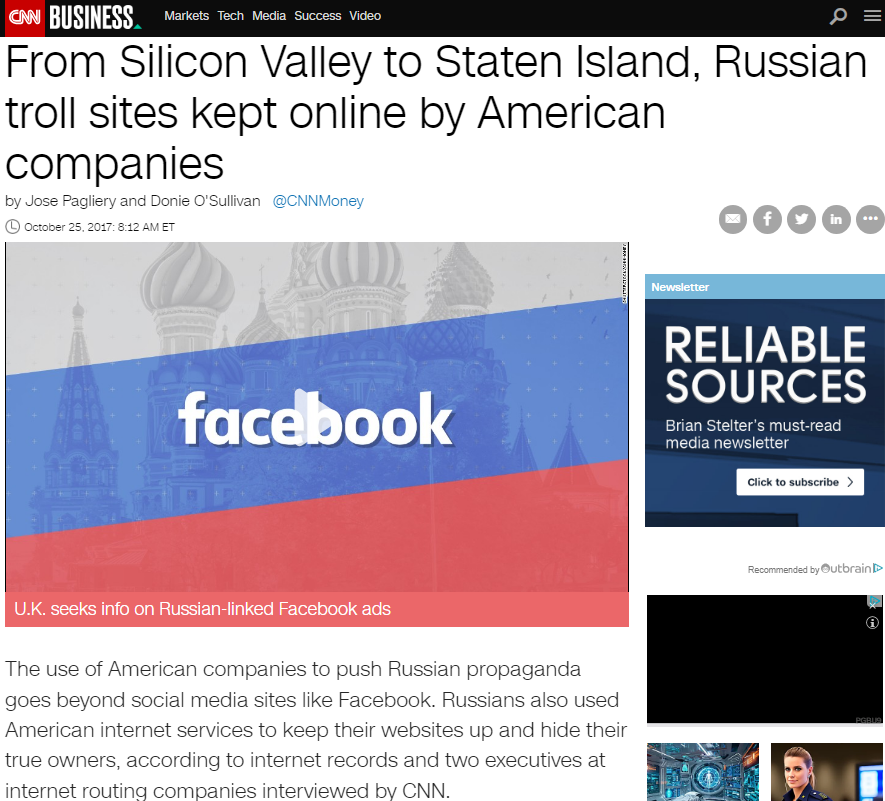
The second is a related hosting company in Miami, called Green Floid LLC. Green Floid featured in a 2017 scoop by CNN, which profiled the company’s owner and quizzed him about Russian troll farms using proxy networks on Green Floid and its parent firm ITL to mask disinformation efforts tied to the Kremlin’s Internet Research Agency (IRA). At the time, the IRA was using Facebook and other social media networks to spread videos showing police brutality against African Americans in an effort to encourage protests across the United States.
from Krebs on Security https://ift.tt/g2kyj6L
via IFTTT

Why Your Wi-Fi Router Doubles as an Apple AirTag

Image: Shutterstock.

Apple and the satellite-based broadband service Starlink each recently took steps to address new research into the potential security and privacy implications of how their services geo-locate devices. Researchers from the University of Maryland say they relied on publicly available data from Apple to track the location of billions of devices globally — including non-Apple devices like Starlink systems — and found they could use this data to monitor the destruction of Gaza, as well as the movements and in many cases identities of Russian and Ukrainian troops.

At issue is the way that Apple collects and publicly shares information about the precise location of all Wi-Fi access points seen by its devices. Apple collects this location data to give Apple devices a crowdsourced, low-power alternative to constantly requesting global positioning system (GPS) coordinates.

Both Apple and Google operate their own Wi-Fi-based Positioning Systems (WPS) that obtain certain hardware identifiers from all wireless access points that come within range of their mobile devices. Both record the Media Access Control (MAC) address that a Wi-FI access point uses, known as a Basic Service Set Identifier or BSSID.

Periodically, Apple and Google mobile devices will forward their locations — by querying GPS and/or by using cellular towers as landmarks — along with any nearby BSSIDs. This combination of data allows Apple and Google devices to figure out where they are within a few feet or meters, and it’s what allows your mobile phone to continue displaying your planned route even when the device can’t get a fix on GPS.

With Google’s WPS, a wireless device submits a list of nearby Wi-Fi access point BSSIDs and their signal strengths — via an application programming interface (API) request to Google — whose WPS responds with the device’s computed position. Google’s WPS requires at least two BSSIDs to calculate a device’s approximate position.

Apple’s WPS also accepts a list of nearby BSSIDs, but instead of computing the device’s location based off the set of observed access points and their received signal strengths and then reporting that result to the user, Apple’s API will return return the geolocations of up to 400 hundred more BSSIDs that are nearby the one requested. It then uses approximately eight of those BSSIDs to work out the user’s location based on known landmarks.

In essence, Google’s WPS computes the user’s location and shares it with the device. Apple’s WPS gives its devices a large enough amount of data about the location of known access points in the area that the devices can do that estimation on their own.

That’s according to two researchers at the University of Maryland, who said they theorized they could use the verbosity of Apple’s API to map the movement of individual devices into and out of virtually any defined area of the world. The UMD pair said they spent a month early in their research continuously querying the API, asking it for the location of more than a billion BSSIDs generated at random.

They learned that while only about three million of those randomly generated BSSIDs were known to Apple’s Wi-Fi geolocation API, Apple also returned an additional 488 million BSSID locations already stored in its WPS from other lookups.

UMD Associate Professor David Levin and Ph.D student Erik Rye found they could mostly avoid requesting unallocated BSSIDs by consulting the list of BSSID ranges assigned to specific device manufacturers. That list is maintained by the Institute of Electrical and Electronics Engineers (IEEE), which is also sponsoring the privacy and security conference where Rye is slated to present the UMD research later today.

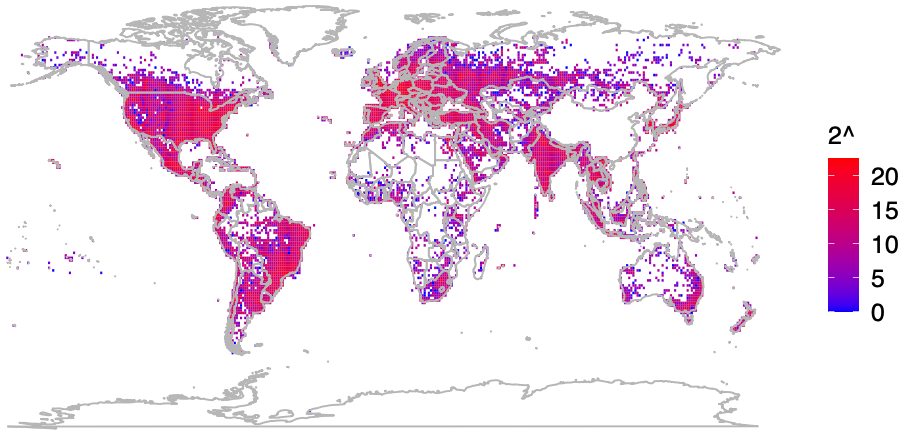
Plotting the locations returned by Apple’s WPS between November 2022 and November 2023, Levin and Rye saw they had a near global view of the locations tied to more than two billion Wi-Fi access points. The map showed geolocated access points in nearly every corner of the globe, apart from almost the entirety of China, vast stretches of desert wilderness in central Australia and Africa, and deep in the rainforests of South America.

A “heatmap” of BSSIDs the UMD team said they discovered by guessing randomly at BSSIDs.

The researchers said that by zeroing in on or “geofencing” other smaller regions indexed by Apple’s location API, they could monitor how Wi-Fi access points moved over time. Why might that be a big deal? They found that by geofencing active conflict zones in Ukraine, they were able to determine the location and movement of Starlink devices used by both Ukrainian and Russian forces.

The reason they were able to do that is that each Starlink terminal — the dish and associated hardware that allows a Starlink customer to receive Internet service from a constellation of orbiting Starlink satellites — includes its own Wi-Fi access point, whose location is going to be automatically indexed by any nearby Apple devices that have location services enabled.

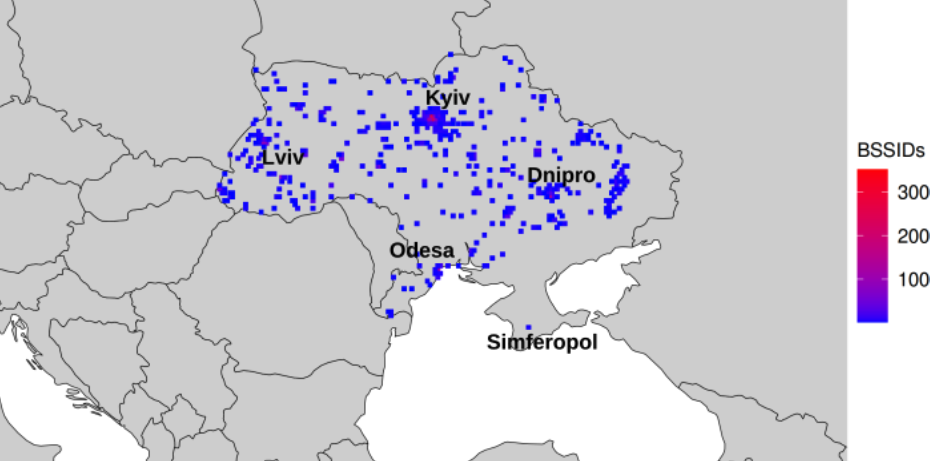
A heatmap of Starlink routers in Ukraine. Image: UMD.

The University of Maryland team geo-fenced various conflict zones in Ukraine, and identified at least 3,722 Starlink terminals geolocated in Ukraine.

“We find what appear to be personal devices being brought by military personnel into war zones, exposing pre-deployment sites and military positions,” the researchers wrote. “Our results also show individuals who have left Ukraine to a wide range of countries, validating public reports of where Ukrainian refugees have resettled.”

In an interview with KrebsOnSecurity, the UMD team said they found that in addition to exposing Russian troop pre-deployment sites, the location data made it easy to see where devices in contested regions originated from.

“This includes residential addresses throughout the world,” Levin said. “We even believe we can identify people who have joined the Ukraine Foreign Legion.”

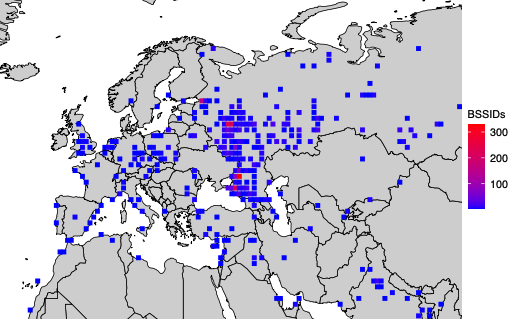
A simplified map of where BSSIDs that enter the Donbas and Crimea regions of Ukraine originate. Image: UMD.

Levin and Rye said they shared their findings with Starlink in March 2024, which said it began shipping software updates in 2023 that force Starlink access points to randomize their BSSIDs.

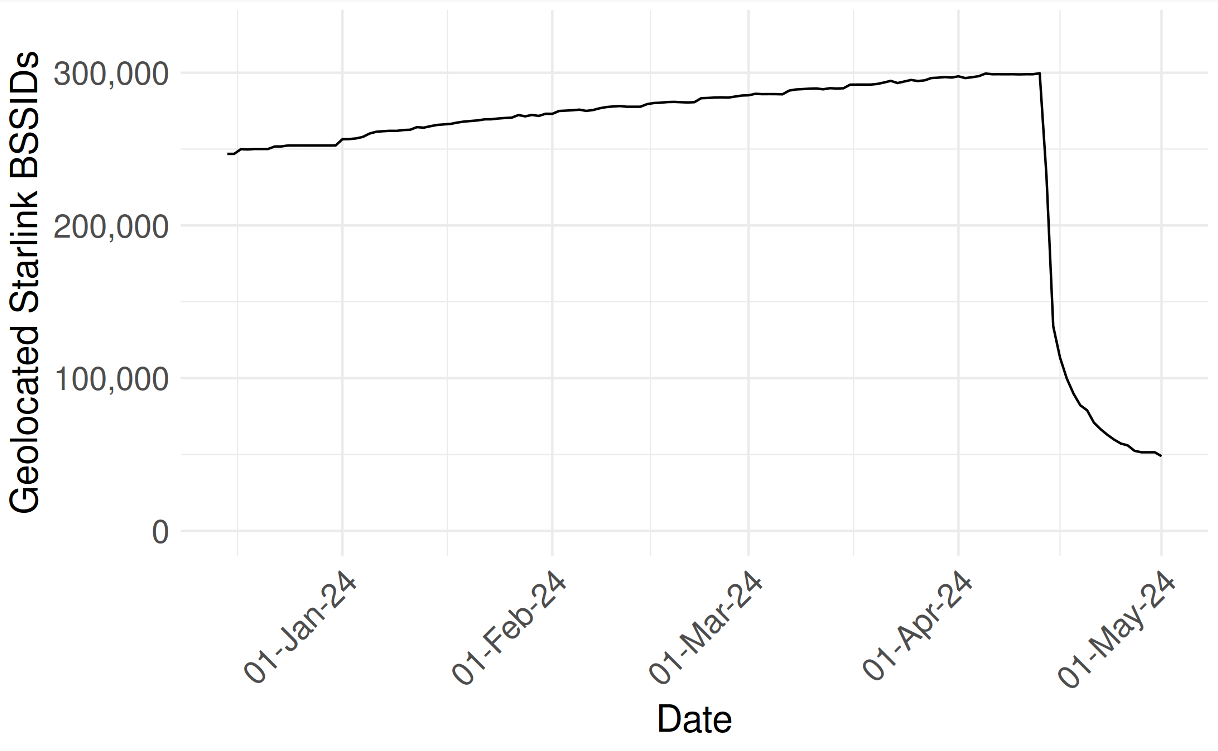
Starlink’s parent SpaceX did not respond to requests for comment. But the researchers shared a graphic they said was created from their Starlink BSSID monitoring data, which shows that just in the past month there was a substantial drop in the number of Starlink devices that were geo-locatable using Apple’s API.

UMD researchers shared this graphic, which shows their ability to monitor the location and movement of Starlink devices by BSSID dropped precipitously in the past month.

They also shared a written statement they received from Starlink, which acknowledged that Starlink User Terminal routers originally used a static BSSID/MAC:

“In early 2023 a software update was released that randomized the main router BSSID,” the statement reads. “Subsequent software releases have included randomization of the BSSID of WiFi repeaters associated with the main router. Software updates that include the repeater randomization functionality are currently being deployed fleet-wide on a region-by-region basis. We believe the data outlined in your paper is based on Starlink main routers and or repeaters that were queried prior to receiving these randomization updates.”

The researchers also focused their geofencing on the Israel-Hamas war in Gaza, and were able to track the migration and disappearance of devices throughout the Gaza Strip as Israeli forces cut power to the country and bombing campaigns knocked out key infrastructure.

“As time progressed, the number of Gazan BSSIDs that are geolocatable continued to decline,” they wrote. “By the end of the month, only 28% of the original BSSIDs were still found in the Apple WPS.”

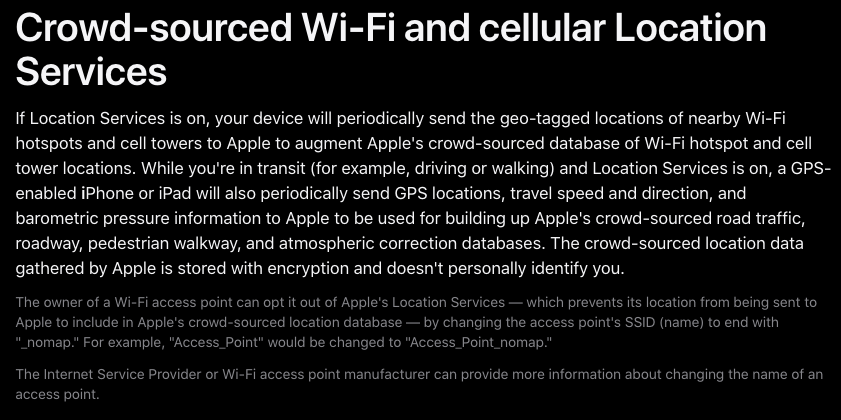
Apple did not respond to requests for comment. But in late March 2024, Apple quietly tweaked its privacy policy, allowing people to opt out of having the location of their wireless access points collected and shared by Apple — by appending “_nomap” to the end of the Wi-Fi access point’s name (SSID).

Apple updated its privacy and location services policy in March 2024 to allow people to opt out of having their Wi-Fi access point indexed by its service, by appending “_nomap” to the network’s name.

Rye said Apple’s response addressed the most depressing aspect of their research: That there was previously no way for anyone to opt out of this data collection.

“You may not have Apple products, but if you have an access point and someone near you owns an Apple device, your BSSID will be in [Apple’s] database,” he said. “What’s important to note here is that every access point is being tracked, without opting in, whether they run an Apple device or not. Only after we disclosed this to Apple have they added the ability for people to opt out.”

The researchers said they hope Apple will consider additional safeguards, such as proactive ways to limit abuses of its location API.

“It’s a good first step,” Levin said of Apple’s privacy update in March. “But this data represents a really serious privacy vulnerability. I would hope Apple would put further restrictions on the use of its API, like rate-limiting these queries to keep people from accumulating massive amounts of data like we did.”

The UMD researchers said they omitted certain details from their research to protect the users they were able to track, noting that the methods they used could present risks for those fleeing abusive relationships or stalkers.

“We observe routers move between cities and countries, potentially representing their owner’s relocation or a business transaction between an old and new owner,” they wrote. “While there is not necessarily a 1-to-1 relationship between Wi-Fi routers and users, home routers typically only have several. If these users are vulnerable populations, such as those fleeing intimate partner violence or a stalker, their router simply being online can disclose their new location.”

The researchers said Wi-Fi access points that can be created using a mobile device’s built-in cellular modem do not create a location privacy risk for their users because mobile phone hotspots will choose a random BSSID when activated.

“Modern Android and iOS devices will choose a random BSSID when you go into hotspot mode,” he said. “Hotspots are already implementing the strongest recommendations for privacy protections. It’s other types of devices that don’t do that.”

For example, they discovered that certain commonly used travel routers compound the potential privacy risks.

“Because travel routers are frequently used on campers or boats, we see a significant number of them move between campgrounds, RV parks, and marinas,” the UMD duo wrote. “They are used by vacationers who move between residential dwellings and hotels. We have evidence of their use by military members as they deploy from their homes and bases to war zones.”

A copy of the UMD research is available here (PDF).

from Krebs on Security https://ift.tt/o902VxN
via IFTTT

Patch Tuesday, May 2024 Edition

Microsoft today released updates to fix more than 60 security holes in Windows computers and supported software, including two “zero-day” vulnerabilities in Windows that are already being exploited in active attacks. There are also important security patches available for macOS and Adobe users, and for the Chrome Web browser, which just patched its own zero-day flaw.

First, the zero-days. CVE-2024-30051 is an “elevation of privilege” bug in a core Windows library. Satnam Narang at Tenable said this flaw is being used as part of post-compromise activity to elevate privileges as a local attacker.

“CVE-2024-30051 is used to gain initial access into a target environment and requires the use of social engineering tactics via email, social media or instant messaging to convince a target to open a specially crafted document file,” Narang said. “Once exploited, the attacker can bypass OLE mitigations in Microsoft 365 and Microsoft Office, which are security features designed to protect end users from malicious files.”

CVE-2024-30040 is a security feature bypass in MSHTML, a component that is deeply tied to the default Web browser on Windows systems. Microsoft’s advisory on this flaw is fairly sparse, but Kevin Breen from Immersive Labs said this vulnerability also affects Office 365 and Microsoft Office applications.

“Very little information is provided and the short description is painfully obtuse,” Breen said of Microsoft’s advisory on CVE-2024-30040.

Meanwhile, Kaspersky Lab, one of two companies credited with reporting exploitation of CVE-2024-30040 to Microsoft, has published a fascinating writeup on how they discovered the exploit in a file shared with Virustotal.com.

Kaspersky said it has since seen the exploit used together with QakBot and other malware. Emerging in 2007 as a banking trojan, QakBot (a.k.a. Qbot and Pinkslipbot) has morphed into an advanced malware strain now used by multiple cybercriminal groups to prepare newly compromised networks for ransomware infestations.

The only vulnerability fixed this month that earned Microsoft’s most-dire “critical” rating is CVE-2024-30044, a flaw in Sharepoint that Microsoft said is likely to be exploited. Tenable’s Narang notes that exploitation of this bug requires an attacker to be authenticated to a vulnerable SharePoint Server with Site Owner permissions (or higher) first and to take additional steps in order to exploit this flaw, which makes this flaw less likely to be widely exploited as most attackers follow the path of least resistance.

Five days ago, Google released a security update for Chrome that fixes a zero-day in the popular browser. Chrome usually auto-downloads any available updates, but it still may require a complete restart of the browser to install them. If you use Chrome and see a “Relaunch to update” message in the upper right corner of the browser, it’s time to restart.

Apple has just shipped macOS Sonoma 14.5 update, which includes nearly two dozen security patches. To ensure your Mac is up-to-date, go to System Settings, General tab, then Software Update and follow any prompts.

Finally, Adobe has critical security patches available for a range of products, including Acrobat, Reader, Illustrator, Adobe Substance 3D Painter, Adobe Aero, Adobe Animate and Adobe Framemaker.

Regardless of whether you use a Mac or Windows system (or something else), it’s always a good idea to backup your data and or system before applying any security updates. For a closer look at the individual fixes released by Microsoft today, check out the complete list over at the SANS Internet Storm Center. Anyone in charge of maintaining Windows systems in an enterprise environment should keep an eye on askwoody.com, which usually has the scoop on any wonky Windows patches.

from Krebs on Security https://ift.tt/xmMPVIw
via IFTTT

How Did Authorities Identify the Alleged Lockbit Boss?

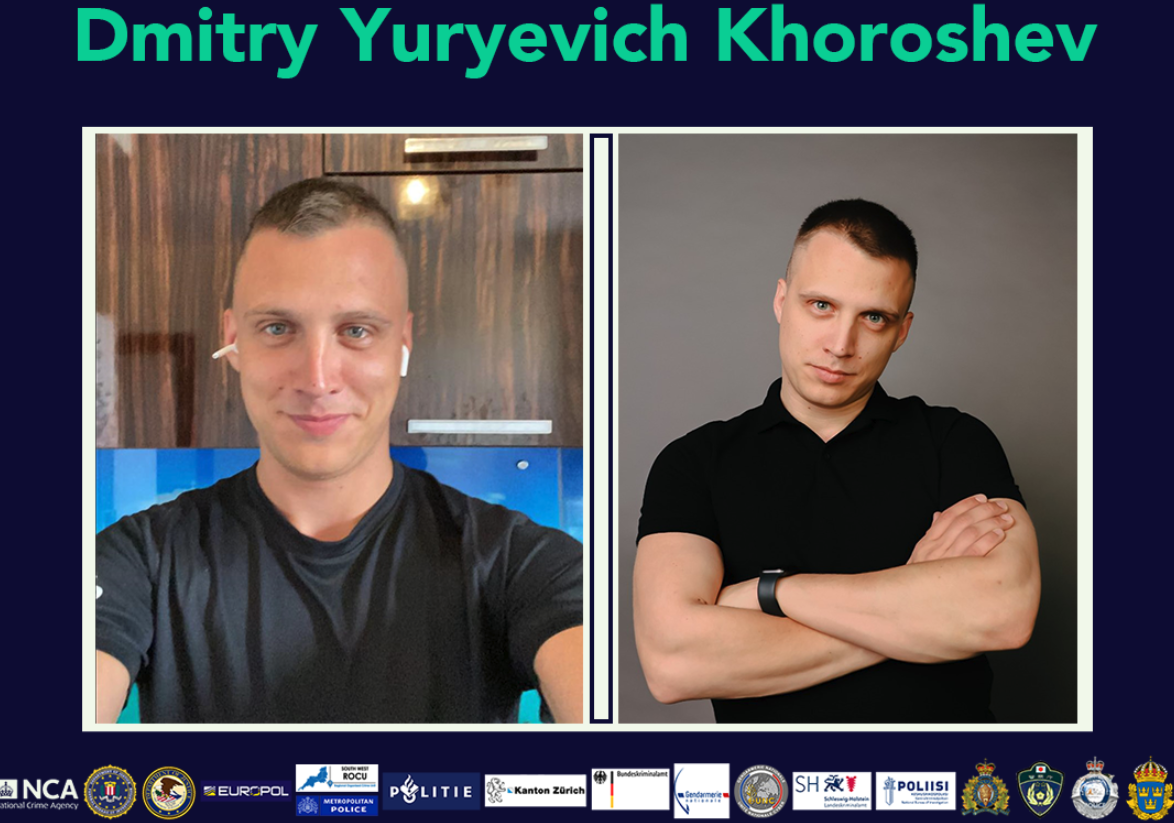
Last week, the United States joined the U.K. and Australia in sanctioning and charging a Russian man named Dmitry Yuryevich Khoroshev as the leader of the infamous LockBit ransomware group. LockBit’s leader “LockBitSupp” claims the feds named the wrong guy, saying the charges don’t explain how they connected him to Khoroshev. This post examines the activities of Khoroshev’s many alter egos on the cybercrime forums, and tracks the career of a gifted malware author who has written and sold malicious code for the past 14 years.

Dmitry Yuryevich Khoroshev. Image: treasury.gov.

On May 7, the U.S. Department of Justice indicted Khoroshev on 26 criminal counts, including extortion, wire fraud, and conspiracy. The government alleges Khoroshev created, sold and used the LockBit ransomware strain to personally extort more than $100 million from hundreds of victim organizations, and that LockBit as a group extorted roughly half a billion dollars over four years.

Federal investigators say Khoroshev ran LockBit as a “ransomware-as-a-service” operation, wherein he kept 20 percent of any ransom amount paid by a victim organization infected with his code, with the remaining 80 percent of the payment going to LockBit affiliates responsible for spreading the malware.

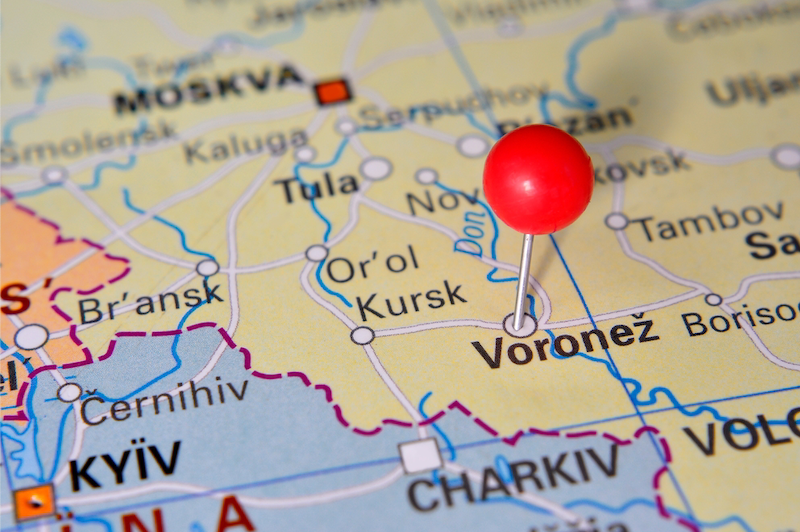
Financial sanctions levied against Khoroshev by the U.S. Department of the Treasury listed his known email and street address (in Voronezh, in southwest Russia), passport number, and even his tax ID number (hello, Russian tax authorities). The Treasury filing says Khoroshev used the emails sitedev5@yandex.ru, and khoroshev1@icloud.com.

According to DomainTools.com, the address sitedev5@yandex.ru was used to register at least six domains, including a Russian business registered in Khoroshev’s name called tkaner.com, which is a blog about clothing and fabrics.

A search at the breach-tracking service Constella Intelligence on the phone number in Tkaner’s registration records  — 7.9521020220 — brings up multiple official Russian government documents listing the number’s owner as Dmitri Yurievich Khoroshev.

Another domain registered to that phone number was stairwell[.]ru, which at one point advertised the sale of wooden staircases. Constella finds that the email addresses webmaster@stairwell.ru and admin@stairwell.ru used the password 225948.

DomainTools reports that stairwell.ru for several years included the registrant’s name as “Dmitrij Ju Horoshev,” and the email address pin@darktower.su. According to Constella, this email address was used in 2010 to register an account for a Dmitry Yurievich Khoroshev from Voronezh, Russia at the hosting provider firstvds.ru.

Image: Shutterstock.

Cyber intelligence firm Intel 471 finds that pin@darktower.ru was used by a Russian-speaking member called Pin on the English-language cybercrime forum Opensc. Pin was active on Opensc around March 2012, and authored 13 posts that mostly concerned data encryption issues, or how to fix bugs in code.

Other posts concerned custom code Pin claimed to have written that would bypass memory protections on Windows XP and Windows 7 systems, and inject malware into memory space normally allocated to trusted applications on a Windows machine.

Pin also was active at that same time on the Russian-language security forum Antichat, where they told fellow forum members to contact them at the ICQ instant messenger number 669316.

NEROWOLFE

A search on the ICQ number 669316 at Intel 471 shows that in April 2011, a user by the name NeroWolfe joined the Russian cybercrime forum Zloy using the email address d.horoshev@gmail.com, and from an Internet address in Voronezh, RU.

Constella finds the same password tied to webmaster@stairwell.ru (225948) was used by the email address 3k@xakep.ru, which Intel 471 says was registered to more than a dozen NeroWolfe accounts across just as many Russian cybercrime forums between 2011 and 2015.

NeroWolfe’s introductory post to the forum Verified in Oct. 2011 said he was a system administrator and C++ coder.

“Installing SpyEYE, ZeuS, any DDoS and spam admin panels,” NeroWolfe wrote. This user said they specialize in developing malware, creating computer worms, and crafting new ways to hijack Web browsers.

“I can provide my portfolio on request,” NeroWolfe wrote. “P.S. I don’t modify someone else’s code or work with someone else’s frameworks.”

In April 2013, NeroWolfe wrote in a private message to another Verified forum user that he was selling a malware “loader” program that could bypass all of the security protections on Windows XP and Windows 7.

“The access to the network is slightly restricted,” NeroWolfe said of the loader, which he was selling for $5,000. “You won’t manage to bind a port. However, it’s quite possible to send data. The code is written in C.”

In an October 2013 discussion on the cybercrime forum Exploit, NeroWolfe weighed in on the karmic ramifications of ransomware. At the time, ransomware-as-a-service didn’t exist yet, and many members of Exploit were still making good money from “lockers,” relatively crude programs that locked the user out of their system until they agreed to make a small payment (usually a few hundred dollars via prepaid Green Dot cards).

Lockers, which presaged the coming ransomware scourge, were generally viewed by the Russian-speaking cybercrime forums as harmless moneymaking opportunities, because they usually didn’t seek to harm the host computer or endanger files on the system. Also, there were still plenty of locker programs that aspiring cybercriminals could either buy or rent to make a steady income.

NeroWolfe reminded forum denizens that they were just as vulnerable to ransomware attacks as their would-be victims, and that what goes around comes around.

“Guys, do you have a conscience?,” NeroWolfe wrote. “Okay, lockers, network gopstop aka business in Russian. The last thing was always squeezed out of the suckers. But encoders, no one is protected from them, including the local audience.”

If Khoroshev was ever worried that someone outside of Russia might be able to connect his early hacker handles to his real life persona, that’s not clear from reviewing his history online. In fact, the same email address tied to so many of NeroWolfe’s accounts on the forums — 3k@xakep.ru — was used in 2011 to create an account for a Dmitry Yurevich Khoroshev on the Russian social media network Vkontakte.

NeroWolfe seems to have abandoned all of his forum accounts sometime in 2016. In November 2016, an exploit[.]ru member filed an official complaint against NeroWolfe, saying NeroWolfe had been paid $2,000 to produce custom code but never finished the project and vanished.

It’s unclear what happened to NeroWolfe or to Khoroshev during this time. Maybe he got arrested, or some close associates did. Perhaps he just decided it was time to lay low and hit the reset on his operational security efforts, given his past failures in this regard. It’s also possible NeroWolfe landed a real job somewhere for a few years, fathered a child, and/or had to put his cybercrime career on hold.

PUTINKRAB

Or perhaps Khoroshev saw the coming ransomware industry for the endless pot of gold that it was about to become, and then dedicated himself to working on custom ransomware code. That’s what the government believes.

The indictment against Khoroshev says he used the hacker nickname Putinkrab, and Intel 471 says this corresponds to a username that was first registered across three major Russian cybercrime forums in early 2019.

KrebsOnSecurity could find no obvious connections between Putinkrab and any of Khoroshev’s older identities. However, if Putinkrab was Khoroshev, he would have learned from his past mistakes and started fresh with a new identity (which he did). But also, it is likely the government hasn’t shared all of the intelligence it has collected against him (more on that in a bit).

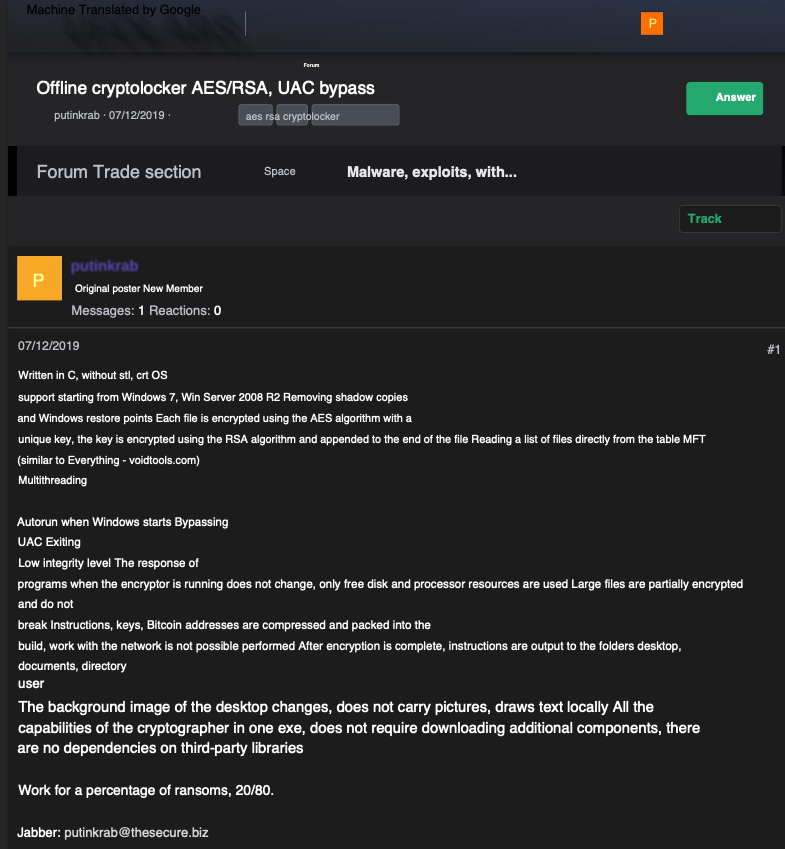
Putinkrab’s first posts on the Russian cybercrime forums XSS, Exploit and UFOLabs saw this user selling ransomware source code written in C.

A machine-translated ad for ransomware source code from Putinkrab on the Russian language cybercrime forum UFOlabs in 2019. Image: Ke-la.com.

In April 2019, Putkinkrab offered an affiliate program that would run on top of his custom-made ransomware code.

“I want to work for a share of the ransoms: 20/80,” Putinkrab wrote on Exploit. “20 percent is my percentage for the work, you get 80% of the ransoms. The percentage can be reduced up to 10/90 if the volumes are good. But now, temporarily, until the service is fully automated, we are working using a different algorithm.”

Throughout the summer of 2019, Putinkrab posted multiple updates to Exploit about new features being added to his ransomware strain, as well as novel evasion techniques to avoid detection by security tools. He also told forum members he was looking for investors for a new ransomware project based on his code.

In response to an Exploit member who complained that the security industry was making it harder to profit from ransomware, Putinkrab said that was because so many cybercriminals were relying on crappy ransomware code.

“The vast majority of top antiviruses have acquired behavioral analysis, which blocks 95% of crypto-lockers at their root,” Putinkrab wrote. “Cryptolockers made a lot of noise in the press, but lazy system administrators don’t make backups after that. The vast majority of cryptolockers are written by people who have little understanding of cryptography. Therefore, decryptors appear on the Internet, and with them the hope that files can be decrypted without paying a ransom. They just sit and wait. Contact with the owner of the key is lost over time.”

Putinkrab said he had every confidence his ransomware code was a game-changer, and a huge money machine.

“The game is just gaining momentum,” Putinkrab wrote. “Weak players lose and are eliminated.”

The rest of his response was structured like a poem:

“In this world, the strongest survive.
Our life is just a struggle.
The winner will be the smartest,
Who has his head on his shoulders.”

Putinkrab’s final post came on August 23, 2019. The Justice Department says the LockBit ransomware affiliate program was officially launched five months later. From there on out, the government says, Khoroshev adopted the persona of LockBitSupp. In his introductory post on Exploit, LockBit’s mastermind said the ransomware strain had been in development since September 2019.

The original LockBit malware was written in C (a language that NeroWolfe excelled at). Here’s the original description of LockBit, from its maker:

“The software is written in C and Assembler; encryption is performed through the I/O Completion Port; there is a port scanning local networks and an option to find all DFS, SMB, WebDAV network shares, an admin panel in Tor, automatic test decryption; a decryption tool is provided; there is a chat with Push notifications, a Jabber bot that forwards correspondence and an option to terminate services/processes in line which prevent the ransomware from opening files at a certain moment. The ransomware sets file permissions and removes blocking attributes, deletes shadow copies, clears logs and mounts hidden partitions; there is an option to drag-and-drop files/folders and a console/hidden mode. The ransomware encrypts files in parts in various places: the larger the file size, the more parts there are. The algorithms used are AES + RSA.

You are the one who determines the ransom amount after communicating with the victim. The ransom paid in any currency that suits you will be transferred to your wallets. The Jabber bot serves as an admin panel and is used for banning, providing decryption tools, chatting – Jabber is used for absolutely everything.”

CONCLUSION

Does the above timeline prove that NeroWolfe/Khoroshev is LockBitSupp? No. However, it does indicate Khoroshev was for many years deeply invested in countless schemes involving botnets, stolen data, and malware he wrote that others used to great effect. NeroWolfe’s many private messages from fellow forum members confirm this.

NeroWolfe’s specialty was creating custom code that employed novel stealth and evasion techniques, and he was always quick to volunteer his services on the forums whenever anyone was looking help on a malware project that called for a strong C or C++ programmer.

Someone with those qualifications — as well as demonstrated mastery of data encryption and decryption techniques — would have been in great demand by the ransomware-as-a-service industry that took off at around the same time NeroWolfe vanished from the forums.

Someone like that who is near or at the top of their game vis-a-vis their peers does not simply walk away from that level of influence, community status, and potential income stream unless forced to do so by circumstances beyond their immediate control.

It’s important to note that Putinkrab didn’t just materialize out of thin air in 2019 — suddenly endowed with knowledge about how to write advanced, stealthy ransomware strains. That knowledge clearly came from someone who’d already had years of experience building and deploying ransomware strains against real-life victim organizations.

Thus, whoever Putinkrab was before they adopted that moniker, it’s a safe bet they were involved in the development and use of earlier, highly successful ransomware strains. One strong possible candidate is Cerber ransomware, the most popular and effective affiliate program operating between early 2016 and mid-2017. Cerber thrived because it emerged as an early mover in the market for ransomware-as-a-service offerings.

In February 2024, the FBI seized LockBit’s cybercrime infrastructure on the dark web, following an apparently lengthy infiltration of the group’s operations. The United States has already indicted and sanctioned at least five other alleged LockBit ringleaders or affiliates, so presumably the feds have been able to draw additional resources from those investigations.

Also, it seems likely that the three national intelligence agencies involved in bringing these charges are not showing all of their cards. For example, the Treasury documents on Khoroshev mention a single cryptocurrency address, and yet experts interviewed for this story say there are no obvious clues connecting this address to Khoroshev or Putinkrab.

But given that LockBitSupp has been actively involved in Lockbit ransomware attacks against organizations for four years now, the government almost certainly has an extensive list of the LockBit leader’s various cryptocurrency addresses — and probably even his bank accounts in Russia. And no doubt the money trail from some of those transactions was traceable to its ultimate beneficiary (or close enough).

Not long after Khoroshev was charged as the leader of LockBit, a number of open-source intelligence accounts on Telegram began extending the information released by the Treasury Department. Within hours, these sleuths had unearthed more than a dozen credit card accounts used by Khoroshev over the past decade, as well as his various bank account numbers in Russia.

The point is, this post is based on data that’s available to and verifiable by KrebsOnSecurity. Woodward & Bernstein’s source in the Watergate investigation — Deep Throat — famously told the two reporters to “follow the money.” This is always excellent advice. But these days, that can be a lot easier said than done — especially with people who a) do not wish to be found, and b) don’t exactly file annual reports.

from Krebs on Security https://ift.tt/UWvqidB
via IFTTT

U.S. Charges Russian Man as Boss of LockBit Ransomware Group

The United States joined the United Kingdom and Australia today in sanctioning 31-year-old Russian national Dmitry Yuryevich Khoroshev as the alleged leader of the infamous ransomware group LockBit. The U.S. Department of Justice also indicted Khoroshev and charged him with using Lockbit to attack more than 2,000 victims and extort at least $100 million in ransomware payments.

Image: U.K. National Crime Agency.

Khoroshev (Дмитрий Юрьевич Хорошев), a resident of Voronezh, Russia, was charged in a 26-count indictment by a grand jury in New Jersey.

“Dmitry Khoroshev conceived, developed, and administered Lockbit, the most prolific ransomware variant and group in the world, enabling himself and his affiliates to wreak havoc and cause billions of dollars in damage to thousands of victims around the globe,” U.S. Attorney Philip R. Sellinger said in a statement released by the Justice Department.

The indictment alleges Khoroshev acted as the LockBit ransomware group’s developer and administrator from its inception in September 2019 through May 2024, and that he typically received a 20 percent share of each ransom payment extorted from LockBit victims.

The government says LockBit victims included individuals, small businesses, multinational corporations, hospitals, schools, nonprofit organizations, critical infrastructure, and government and law-enforcement agencies.

“Khoroshev and his co-conspirators extracted at least $500 million in ransom payments from their victims and caused billions of dollars in broader losses, such as lost revenue, incident response, and recovery,” the DOJ said. “The LockBit ransomware group attacked more than 2,500 victims in at least 120 countries, including 1,800 victims in the United States.”

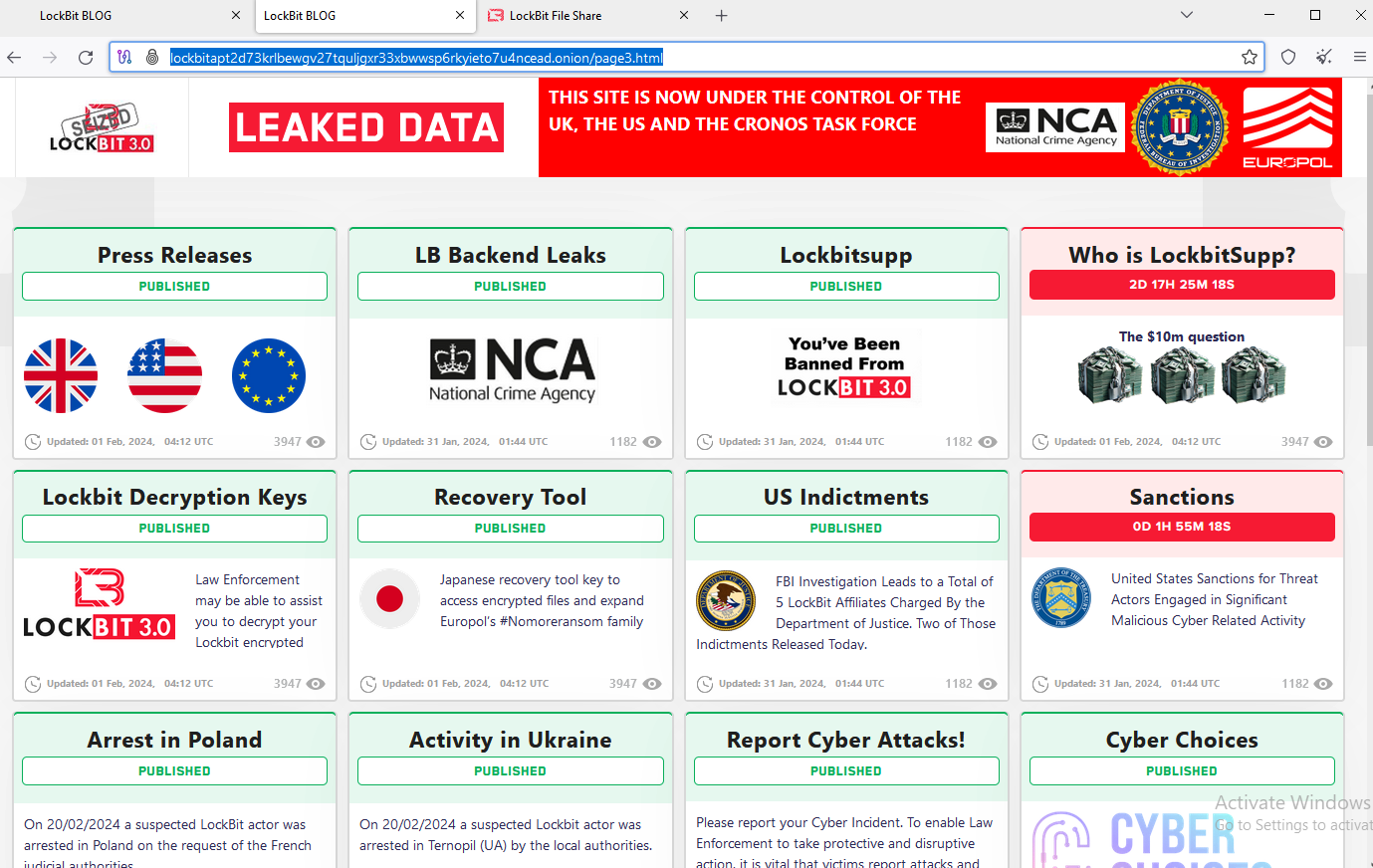
The unmasking of LockBitSupp comes nearly three months after U.S. and U.K. authorities seized the darknet websites run by LockBit, retrofitting it with press releases about the law enforcement action and free tools to help LockBit victims decrypt infected systems.

The feds used the existing design on LockBit’s victim shaming website to feature press releases and free decryption tools.

One of the blog captions that authorities left on the seized site was a teaser page that read, “Who is LockbitSupp?,” which promised to reveal the true identity of the ransomware group leader. That item featured a countdown clock until the big reveal, but when the site’s timer expired no such details were offered.

Following the FBI’s raid, LockBitSupp took to Russian cybercrime forums to assure his partners and affiliates that the ransomware operation was still fully operational. LockBitSupp also raised another set of darknet websites that soon promised to release data stolen from a number of LockBit victims ransomed prior to the FBI raid.

One of the victims LockBitSupp continued extorting was Fulton County, Ga. Eve LockBit’s darknet sites. Following the FBI raid, LockbitSupp vowed to release sensitive documents stolen from the county court system unless paid a ransom demand before LockBit’s countdown timer expired. But when Fulton County officials refused to pay and the timer expired, no stolen records were ever published. Experts said it was likely the FBI had in fact seized all of LockBit’s stolen data.

LockBitSupp also bragged that their real identity would never be revealed, and at one point offered to pay $10 million to anyone who could discover their real name.

KrebsOnSecurity has been in intermittent contact with LockBitSupp for several months over the course of reporting on different LockBit victims. Reached at the same ToX instant messenger identity that the ransomware group leader has promoted on Russian cybercrime forums, LockBitSupp claimed the authorities named the wrong guy.

“It’s not me,” LockBitSupp replied in Russian. “I don’t understand how the FBI was able to connect me with this poor guy. Where is the logical chain that it is me? Don’t you feel sorry for a random innocent person?”

LockBitSupp, who now has a $10 million bounty on his head from the U.S. Department of State, has been known to be flexible with the truth. The Lockbit group routinely practiced “double extortion” against its victims — requiring one ransom payment for a key to unlock hijacked systems, and a separate payment in exchange for a promise to delete data stolen from its victims.

But Justice Department officials say LockBit never deleted its victims data, regardless of whether those organizations paid a ransom to keep the information from being published on LockBit’s victim shaming website.

Khoroshev is the sixth person officially indicted as active members of LockBit. The government says Russian national Artur Sungatov used LockBit ransomware against victims in manufacturing, logistics, insurance and other companies throughout the United States.

Ivan Gennadievich Kondratyev, a.k.a. “Bassterlord,” allegedly deployed LockBit against targets in the United States, Singapore, Taiwan, and Lebanon. Kondratyev is also charged (PDF) with three criminal counts arising from his alleged use of the Sodinokibi (aka “REvil“) ransomware variant to encrypt data, exfiltrate victim information, and extort a ransom payment from a corporate victim based in Alameda County, California.

In May 2023, U.S. authorities unsealed indictments against two alleged LockBit affiliates, Mikhail “Wazawaka” Matveev and Mikhail Vasiliev. In January 2022, KrebsOnSecurity published Who is the Network Access Broker ‘Wazawaka,’ which followed clues from Wazawaka’s many pseudonyms and contact details on the Russian-language cybercrime forums back to a 31-year-old Mikhail Matveev from Abaza, RU.

Matveev remains at large, presumably still in Russia. Meanwhile, the U.S. Department of State has a standing $10 million reward offer for information leading to Matveev’s arrest.

Vasiliev, 35, of Bradford, Ontario, Canada, is in custody in Canada awaiting extradition to the United States (the complaint against Vasiliev is at this PDF).

In June 2023, Russian national Ruslan Magomedovich Astamirov was charged in New Jersey for his participation in the LockBit conspiracy, including the deployment of LockBit against victims in Florida, Japan, France, and Kenya. Astamirov is currently in custody in the United States awaiting trial.

The Justice Department is urging victims targeted by LockBit to contact the FBI at https://lockbitvictims.ic3.gov/ to file an official complaint, and to determine whether affected systems can be successfully decrypted.

from Krebs on Security https://ift.tt/5x6KmTy
via IFTTT

Why Your VPN May Not Be As Secure As It Claims

Virtual private networking (VPN) companies market their services as a way to prevent anyone from snooping on your Internet usage. But new research suggests this is a dangerous assumption when connecting to a VPN via an untrusted network, because attackers on the same network could force a target’s traffic off of the protection provided by their VPN without triggering any alerts to the user.

Image: Shutterstock.

When a device initially tries to connect to a network, it broadcasts a message to the entire local network stating that it is requesting an Internet address. Normally, the only system on the network that notices this request and replies is the router responsible for managing the network to which the user is trying to connect.

The machine on a network responsible for fielding these requests is called a Dynamic Host Configuration Protocol (DHCP) server, which will issue time-based leases for IP addresses. The DHCP server also takes care of setting a specific local address — known as an Internet gateway — that all connecting systems will use as a primary route to the Web.

VPNs work by creating a virtual network interface that serves as an encrypted tunnel for communications. But researchers at Leviathan Security say they’ve discovered it’s possible to abuse an obscure feature built into the DHCP protocol so that other users on the local network are forced to connect to a rogue DHCP server.

“Our technique is to run a DHCP server on the same network as a targeted VPN user and to also set our DHCP configuration to use itself as a gateway,” Leviathan researchers Lizzie Moratti and Dani Cronce wrote. “When the traffic hits our gateway, we use traffic forwarding rules on the DHCP server to pass traffic through to a legitimate gateway while we snoop on it.”

The feature being abused here is known as DHCP option 121, and it allows a DHCP server to set a route on the VPN user’s system that is more specific than those used by most VPNs. Abusing this option, Leviathan found, effectively gives an attacker on the local network the ability to set up routing rules that have a higher priority than the routes for the virtual network interface that the target’s VPN creates.

“Pushing a route also means that the network traffic will be sent over the same interface as the DHCP server instead of the virtual network interface,” the Leviathan researchers said. “This is intended functionality that isn’t clearly stated in the RFC [standard]. Therefore, for the routes we push, it is never encrypted by the VPN’s virtual interface but instead transmitted by the network interface that is talking to the DHCP server. As an attacker, we can select which IP addresses go over the tunnel and which addresses go over the network interface talking to our DHCP server.”

Leviathan found they could force VPNs on the local network that already had a connection to arbitrarily request a new one. In this well-documented tactic, known as a DHCP starvation attack, an attacker floods the DHCP server with requests that consume all available IP addresses that can be allocated. Once the network’s legitimate DHCP server is completely tied up, the attacker can then have their rogue DHCP server respond to all pending requests.

“This technique can also be used against an already established VPN connection once the VPN user’s host needs to renew a lease from our DHCP server,” the researchers wrote. “We can artificially create that scenario by setting a short lease time in the DHCP lease, so the user updates their routing table more frequently. In addition, the VPN control channel is still intact because it already uses the physical interface for its communication. In our testing, the VPN always continued to report as connected, and the kill switch was never engaged to drop our VPN connection.”

The researchers say their methods could be used by an attacker who compromises a DHCP server or wireless access point, or by a rogue network administrator who owns the infrastructure themselves and maliciously configures it. Alternatively, an attacker could set up an “evil twin” wireless hotspot that mimics the signal broadcast by a legitimate provider.

ANALYSIS

Bill Woodcock is executive director at Packet Clearing House, a nonprofit based in San Francisco. Woodcock said Option 121 has been included in the DHCP standard since 2002, which means the attack described by Leviathan has technically been possible for the last 22 years.

“They’re realizing now that this can be used to circumvent a VPN in a way that’s really problematic, and they’re right,” Woodcock said.

Woodcock said anyone who might be a target of spear phishing attacks should be very concerned about using VPNs on an untrusted network.

“Anyone who is in a position of authority or maybe even someone who is just a high net worth individual, those are all very reasonable targets of this attack,” he said. “If I were trying to do an attack against someone at a relatively high security company and I knew where they typically get their coffee or sandwich at twice a week, this is a very effective tool in that toolbox. I’d be a little surprised if it wasn’t already being exploited in that way, because again this isn’t rocket science. It’s just thinking a little outside the box.”

Successfully executing this attack on a network likely would not allow an attacker to see all of a target’s traffic or browsing activity. That’s because for the vast majority of the websites visited by the target, the content is encrypted (the site’s address begins with https://). However, an attacker would still be able to see the metadata — such as the source and destination addresses — of any traffic flowing by.

KrebsOnSecurity shared Leviathan’s research with John Kristoff, a principal threat intelligence analyst at NETSCOUT, a PhD candidate in computer science at the University of Illinois Chicago. Kristoff said practically all user-edge network gear, including WiFi deployments, support some form of rogue DHCP server detection and mitigation, but that it’s unclear how widely deployed those protections are in real-world environments.

“However, and I think this is a key point to emphasize, an untrusted network is an untrusted network, which is why you’re usually employing the VPN in the first place,” Kristoff said. “If local network is inherently hostile and has no qualms about operating a rogue DHCP server, then this is a sneaky technique that could be used to de-cloak some traffic – and if done carefully, I’m sure a user might never notice.”

MITIGATIONS

According to Leviathan, there are several ways to minimize the threat from rogue DHCP servers on an unsecured network. One is using a device powered by the Android operating system, which apparently ignores DHCP option 121.

Relying on a temporary wireless hotspot controlled by a cellular device you own also effectively blocks this attack.

“They create a password-locked LAN with automatic network address translation,” the researchers wrote of cellular hot-spots. “Because this network is completely controlled by the cellular device and requires a password, an attacker should not have local network access.”

Leviathan’s Moratti said another mitigation is to run your VPN from inside of a virtual machine (VM) — like Parallels, VMware or VirtualBox. VPNs run inside of a VM are not vulnerable to this attack, Moratti said, provided they are not run in “bridged mode,” which causes the VM to replicate another node on the network.

In addition, a technology called “deep packet inspection” can be used to deny all in- and outbound traffic from the physical interface except for the DHCP and the VPN server. However, Leviathan says this approach opens up a potential “side channel” attack that could be used to determine the destination of traffic.

“This could be theoretically done by performing traffic analysis on the volume a target user sends when the attacker’s routes are installed compared to the baseline,” they wrote. “In addition, this selective denial-of-service is unique as it could be used to censor specific resources that an attacker doesn’t want a target user to connect to even while they are using the VPN.”

Moratti said Leviathan’s research shows that many VPN providers are currently making promises to their customers that their technology can’t keep.

“VPNs weren’t designed to keep you more secure on your local network, but to keep your traffic more secure on the Internet,” Moratti said. “When you start making assurances that your product protects people from seeing your traffic, there’s an assurance or promise that can’t be met.”

A copy of Leviathan’s research, along with code intended to allow others to duplicate their findings in a lab environment, is available here.

from Krebs on Security https://ift.tt/h6HJpjy
via IFTTT

Man Who Mass-Extorted Psychotherapy Patients Gets Six Years

A 26-year-old Finnish man was sentenced to more than six years in prison today after being convicted of hacking into an online psychotherapy clinic, leaking tens of thousands of patient therapy records, and attempting to extort the clinic and patients.

On October 21, 2020, the Vastaamo Psychotherapy Center in Finland became the target of blackmail when a tormentor identified as “ransom_man” demanded payment of 40 bitcoins (~450,000 euros at the time) in return for a promise not to publish highly sensitive therapy session notes Vastaamo had exposed online.

Ransom_man announced on the dark web that he would start publishing 100 patient profiles every 24 hours. When Vastaamo declined to pay, ransom_man shifted to extorting individual patients. According to Finnish police, some 22,000 victims reported extortion attempts targeting them personally, targeted emails that threatened to publish their therapy notes online unless paid a 500 euro ransom.

Finnish prosecutors quickly zeroed in on a suspect: Julius “Zeekill” Kivimäki, a notorious criminal hacker convicted of committing tens of thousands of cybercrimes before he became an adult. After being charged with the attack in October 2022, Kivimäki fled the country. He was arrested four months later in France, hiding out under an assumed name and passport.

Antii Kurittu is a former criminal investigator who worked on an investigation involving Kivimäki’s use of the Zbot botnet, among other activities Kivimäki engaged in as a member of the hacker group Hack the Planet (HTP).

Kurittu said the prosecution had demanded at least seven years in jail, and that the sentence handed down was six years and three months. Kurittu said prosecutors agreed to knock a few months off of Kivimäki’s sentence because he agreed to pay compensation to his victims, and that Kivimäki will remain in prison during any appeal process.

“I think the sentencing was as expected, knowing the Finnish judicial system,” Kurittu told KrebsOnSecurity. “As Kivimäki has not been sentenced to a non-suspended prison sentence during the last five years, he will be treated as a first-timer, his previous convictions notwithstanding.”

But because juvenile convictions in Finland don’t count towards determining whether somebody is a first-time offender, Kivimäki will end up serving approximately half of his sentence.

“This seems like a short sentence when taking into account the gravity of his actions and the life-altering consequences to thousands of people, but it’s almost the maximum the law allows for,” Kurittu said.

Kivimäki initially gained notoriety as a self-professed member of the Lizard Squad, a mainly low-skilled hacker group that specialized in DDoS attacks. But American and Finnish investigators say Kivimäki’s involvement in cybercrime dates back to at least 2008, when he was introduced to a founding member of what would soon become HTP.

Finnish police said Kivimäki also used the nicknames “Ryan”, “RyanC” and “Ryan Cleary” (Ryan Cleary was actually a member of a rival hacker group — LulzSec — who was sentenced to prison for hacking).

Kivimäki and other HTP members were involved in mass-compromising web servers using known vulnerabilities, and by 2012 Kivimäki’s alias Ryan Cleary was selling access to those servers in the form of a DDoS-for-hire service. Kivimäki was 15 years old at the time.

In 2013, investigators going through devices seized from Kivimäki found computer code that had been used to crack more than 60,000 web servers using a previously unknown vulnerability in Adobe’s ColdFusion software. KrebsOnSecurity detailed the work of HTP in September 2013, after the group compromised servers inside data brokers LexisNexis, Kroll, and Dun & Bradstreet.

The group used the same ColdFusion flaws to break into the National White Collar Crime Center (NWC3), a non-profit that provides research and investigative support to the U.S. Federal Bureau of Investigation (FBI).

As KrebsOnSecurity reported at the time, this small ColdFusion botnet of data broker servers was being controlled by the same cybercriminals who’d assumed control over SSNDOB, which operated one of the underground’s most reliable services for obtaining Social Security Number, dates of birth and credit file information on U.S. residents.

Kivimäki was responsible for making an August 2014 bomb threat against former Sony Online Entertainment President John Smedley that grounded an American Airlines plane. Kivimäki also was involved in calling in multiple fake bomb threats and “swatting” incidents — reporting fake hostage situations at an address to prompt a heavily armed police response to that location.

Ville Tapio, the former CEO of Vastaamo, was fired and also prosecuted following the breach. Ransom_man bragged about Vastaamo’s sloppy security, noting the company had used the laughably weak username and password “root/root” to protect sensitive patient records.

Investigators later found Vastaamo had originally been hacked in 2018 and again in 2019, but that Tapio never told anyone about the intrusions until ransom_man began his extortion spree. In April 2023, a Finnish court handed down a three-month sentence for Tapio, but that sentence was suspended because he had no previous criminal record.

from Krebs on Security https://ift.tt/8a0mJQX
via IFTTT

FCC Fines Major U.S. Wireless Carriers for Selling Customer Location Data

The U.S. Federal Communications Commission (FCC) today levied fines totaling nearly $200 million against the four major carriers — including AT&T, Sprint, T-Mobile and Verizon — for illegally sharing access to customers’ location information without consent.

The fines mark the culmination of a more than four-year investigation into the actions of the major carriers. In February 2020, the FCC put all four wireless providers on notice that their practices of sharing access to customer location data were likely violating the law.

The FCC said it found the carriers each sold access to its customers’ location information to ‘aggregators,’ who then resold access to the information to third-party location-based service providers.

“In doing so, each carrier attempted to offload its obligations to obtain customer consent onto downstream recipients of location information, which in many instances meant that no valid customer consent was obtained,” an FCC statement on the action reads. “This initial failure was compounded when, after becoming aware that their safeguards were ineffective, the carriers continued to sell access to location information without taking reasonable measures to protect it from unauthorized access.”

The FCC’s findings against AT&T, for example, show that AT&T sold customer location data directly or indirectly to at least 88 third-party entities. The FCC found Verizon sold access to customer location data (indirectly or directly) to 67 third-party entities. Location data for Sprint customers found its way to 86 third-party entities, and to 75 third-parties in the case of T-Mobile customers.

The commission said it took action in response to a May 2018 story broken by The New York Times, which exposed how a company called Securus Technologies had been selling location data on customers of virtually any major mobile provider to law enforcement officials.

That same month, KrebsOnSecurity broke the news that LocationSmart — a data aggregation firm working with the major wireless carriers — had a free, unsecured demo of its service online that anyone could abuse to find the near-exact location of virtually any mobile phone in North America.

The carriers promised to “wind down” location data sharing agreements with third-party companies. But in 2019, reporting at Vice.com showed that little had changed, detailing how reporters were able to locate a test phone after paying $300 to a bounty hunter who simply bought the data through a little-known third-party service.

The FCC fined Sprint and T-Mobile $12 million and $80 million respectively. AT&T was fined more than $57 million, while Verizon received a $47 million penalty. Still, these fines represent a tiny fraction of each carrier’s annual revenues. For example, $47 million is less than one percent of Verizon’s total wireless service revenue in 2023, which was nearly $77 billion.

The fine amounts vary because they were calculated based in part on each day that the carriers continued sharing customer location data after being notified that doing so was illegal (the agency also considered the number of active third-party location data sharing agreements). The FCC notes that AT&T and Verizon took more than 320 days from the publication of the Times story to wind down their data sharing agreements; T-Mobile took 275 days; Sprint kept sharing customer location data for 386 days.

from Krebs on Security https://ift.tt/OZQiGhr
via IFTTT

Russian FSB Counterintelligence Chief Gets 9 Years in Cybercrime Bribery Scheme

The head of counterintelligence for a division of the Russian Federal Security Service (FSB) was sentenced last week to nine years in a penal colony for accepting a USD $1.7 million bribe to ignore the activities of a prolific Russian cybercrime group that hacked thousands of e-commerce websites. The protection scheme was exposed in 2022 when Russian authorities arrested six members of the group, which sold millions of stolen payment cards at flashy online shops like Trump’s Dumps.

A now-defunct carding shop that sold stolen credit cards and invoked 45’s likeness and name.

As reported by The Record, a Russian court last week sentenced former FSB officer Grigory Tsaregorodtsev for taking a $1.7 million bribe from a cybercriminal group that was seeking a “roof,” a well-placed, corrupt law enforcement official who could be counted on to both disregard their illegal hacking activities and run interference with authorities in the event of their arrest.

Tsaregorodtsev was head of the counterintelligence department for a division of the FSB based in Perm, Russia. In February 2022, Russian authorities arrested six men in the Perm region accused of selling stolen payment card data. They also seized multiple carding shops run by the gang, including Ferum Shop, Sky-Fraud, and Trump’s Dumps, a popular fraud store that invoked the 45th president’s likeness and promised to “make credit card fraud great again.”

All of the domains seized in that raid were registered by an IT consulting company in Perm called Get-net LLC, which was owned in part by Artem Zaitsev — one of the six men arrested. Zaitsev reportedly was a well-known programmer whose company supplied services and leasing to the local FSB field office.

The message for Trump’s Dumps users left behind by Russian authorities that seized the domain in 2022.

Russian news sites report that Internal Affairs officials with the FSB grew suspicious when Tsaregorodtsev became a little too interested in the case following the hacking group’s arrests. The former FSB agent had reportedly assured the hackers he could have their case transferred and that they would soon be free.

But when that promised freedom didn’t materialize, four the of the defendants pulled the walls down on the scheme and brought down their own roof. The FSB arrested Tsaregorodtsev, and seized $154,000 in cash, 100 gold bars, real estate and expensive cars.

At Tsaregorodtsev’s trial, his lawyers argued that their client wasn’t guilty of bribery per se, but that he did admit to fraud because he was ultimately unable to fully perform the services for which he’d been hired.

The Russian news outlet Kommersant reports that all four of those who cooperated were released with probation or correctional labor. Zaitsev received a sentence of 3.5 years in prison, and defendant Alexander Kovalev got four years.

In 2017, KrebsOnSecurity profiled Trump’s Dumps, and found the contact address listed on the site was tied to an email address used to register more than a dozen domains that were made to look like legitimate Javascript calls many e-commerce sites routinely make to process transactions — such as “js-link[dot]su,” “js-stat[dot]su,” and “js-mod[dot]su.”

Searching on those malicious domains revealed a 2016 report from RiskIQ, which shows the domains featured prominently in a series of hacking campaigns against e-commerce websites. According to RiskIQ, the attacks targeted online stores running outdated and unpatched versions of shopping cart software from Magento, Powerfront and OpenCart.

Those shopping cart flaws allowed the crooks to install “web skimmers,” malicious Javascript used to steal credit card details and other information from payment forms on the checkout pages of vulnerable e-commerce sites. The stolen customer payment card details were then sold on sites like Trump’s Dumps and Sky-Fraud.

from Krebs on Security https://ift.tt/CmgJlxZ
via IFTTT