Unauthorized activities could be triggered even if a phone is locked, its screen is turned off, or a person is in the middle of a call.
from Dark Reading: https://ift.tt/2CZB9X1
via IFTTT

Unauthorized activities could be triggered even if a phone is locked, its screen is turned off, or a person is in the middle of a call.
from Dark Reading: https://ift.tt/2CZB9X1
via IFTTT
A 21-year-old Illinois man was sentenced last week to 13 months in prison for running multiple DDoS-for-hire services that launched millions of attacks over several years. This individual’s sentencing comes more than five years after KrebsOnSecurity interviewed both the defendant and his father and urged the latter to take a more active interest in his son’s online activities.
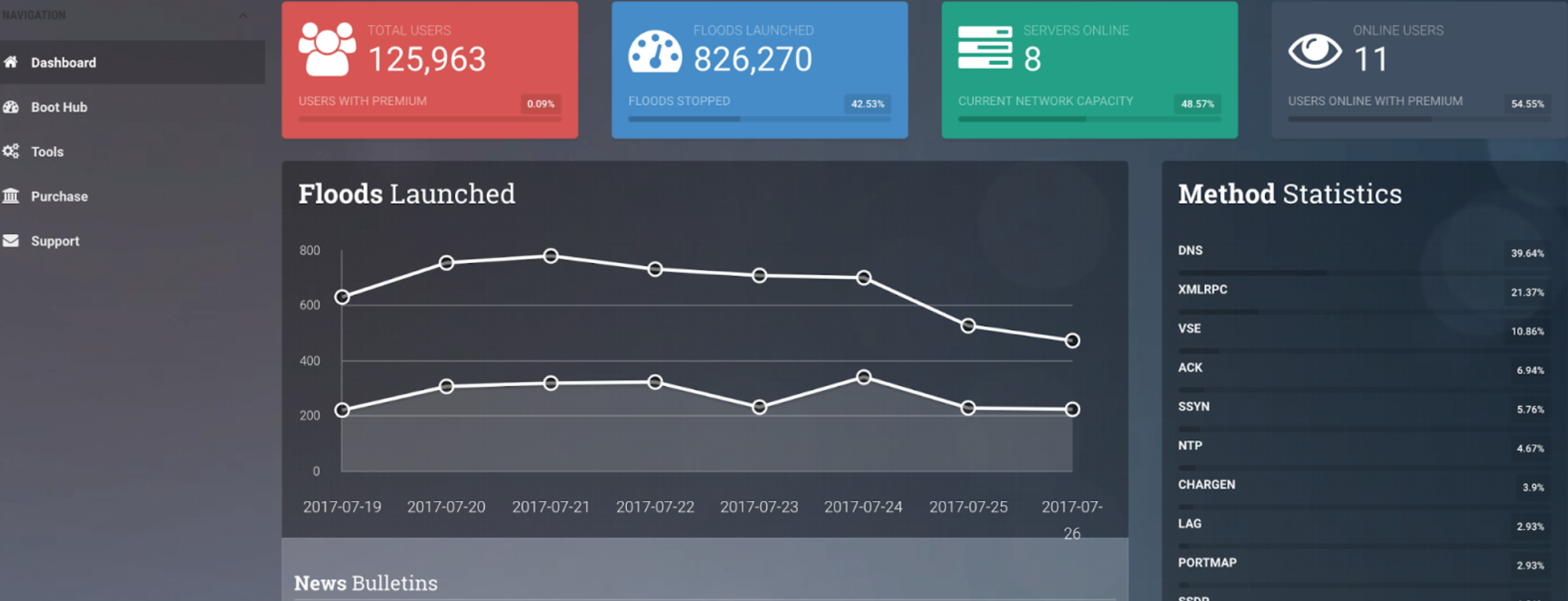
A screenshot of databooter[.]com, circa 2017. Image: Cisco Talos.
The jail time was handed down to Sergiy P. Usatyuk of Orland Park, Ill., who pleaded guilty in February to one count of conspiracy to cause damage to Internet-connected computers and owning, administering and supporting illegal “booter” or “stresser” services designed to knock Web sites offline, including exostress[.]in, quezstresser[.]com, betabooter[.]com, databooter[.]com, instabooter[.]com, polystress[.]com and zstress[.]net.
According to the U.S. Justice Department, in just the first 13 months of the 27-month long conspiracy, Usatyuk’s booter users ordered approximately 3,829,812 DDoS attacks. As of September 12, 2017, ExoStresser advertised on its website that this one booter service had launched 1,367,610 DDoS attacks, and caused targets to suffer 109,186.4 hours of network downtime (-4,549 days).
Usatyuk — operating under the hacker aliases “Andrew Quez” and “Brian Martinez,” among others — admitted developing, controlling and operating the aforementioned booter services from around August 2015 through November 2017. But Usatyuk’s involvement in the DDoS-for-hire space very much predates that period.
In February 2014, KrebsOnSecurity reached out to Usatyuk’s father Peter Usatyuk, an assistant professor at the University of Illinois at Chicago. I did so because a brief amount of sleuthing on Hackforums[.]net revealed that his then 15-year-old son Sergiy — who at the time went by the nicknames “Rasbora” and “Mr. Booter Master” — was heavily involved in helping to launch crippling DDoS attacks.
I phoned Usatyuk the elder because Sergiy’s alter egos had been posting evidence on Hackforums and elsewhere that he’d just hit KrebsOnSecurity.com with a 200 Gbps DDoS attack, which was then considered a fairly impressive DDoS assault.
“I am writing you after our phone conversation just to confirm that you may call evening time/weekend to talk to my son Sergio regarding to your reasons,” Peter Usatyuk wrote in an email to this author on Feb. 13, 2014. “I also have [a] major concern what my 15 yo son [is] doing. If you think that is any kind of illegal work, please, let me know.”
That 2014 story declined to quote Rasbora by name because he was a minor then, but his father seemed alarmed enough about my inquiry that he insisted his son speak with me about the matter.
Here’s an excerpt of what I wrote about Sergiy at the time:
Rasbora’s most recent project just happens to be gathering, maintaining huge “top quality” lists of servers that can be used to launch amplification attacks online. Despite his insistence that he’s never launched DDoS attacks, Rasbora did eventually allow that someone reading his posts on Hackforums might conclude that he was actively involved in DDoS attacks for hire.
“I don’t see what a wall of text can really tell you about what someone does in real life though,” said Rasbora, whose real-life identity is being withheld because he’s a minor. This reply came in response to my reading him several posts that he’d made on Hackforums not 24 hours earlier that strongly suggested he was still in the business of knocking Web sites offline: In a Feb. 12 post on a thread called “Hiring a hit on a Web site” that Rasbora has since deleted, he tells a fellow Hackforums user, “If all else fails and you just want it offline, PM me.”
Rasbora has tried to clean up some of his more self-incriminating posts on Hackforums, but he remains defiantly steadfast in his claim that he doesn’t DDoS people. Who knows, maybe his dad will ground him and take away his Internet privileges.
I’m guessing young Sergiy never had his Internet privileges revoked, nor did he heed advice to use his skills for less destructive activities. His dad hung up on me when I called Wednesday evening requesting comment.
In addition to serving the 13-month jail sentence and three years of supervised release, Usatyuk will forfeit $542,925 in proceeds from the scheme, as well as dozens of servers and other computer equipment that powered his many DDoS-for-hire businesses.
from Krebs on Security https://ift.tt/2KFP0G6
via IFTTT
A now-patched-hole could have allowed remote code execution that could have exposed files and messages. Update your WhatsApp now.
from Naked Security https://ift.tt/2XBOj63
via IFTTT
It was sucking up private profiles by requiring users to hand over their logins, giving it access to whatever accounts they follow.
from Naked Security https://ift.tt/2Oz5tgq
via IFTTT
The bug was fixed at least a month ago so users receiving dynamic email content have one less thing to worry about.
from Naked Security https://ift.tt/2XwahHt
via IFTTT
If you’ve been happily using Adobe Reader 2015 software for the last few years, you’re in for a rude awakening.
from Naked Security https://ift.tt/2XAi72T
via IFTTT
Group-IB’s and Rapid7’s separate analysis of attack activity in recent months shows threat actors are making life harder for enterprise organizations in a variety of ways.
from Dark Reading: https://ift.tt/2rVEdkB
via IFTTT
Cybercriminals attempted to install Cyborg ransomware on target machines by deceiving victims with a fraudulent Windows update.
from Dark Reading: https://ift.tt/2rSyoEz
via IFTTT
DDoS attacks of all sorts were up by triple-digit percentages, with smaller volume attacks growing most rapidly.
from Dark Reading: https://ift.tt/2Xu4X7t
via IFTTT
Trusted Platform Modules are well-suited to a wide range of applications, but for the strongest security, architect them into “defense-in-depth” designs.
from Dark Reading: https://ift.tt/2OqxmHE
via IFTTT

