Data on millions of people stolen from the Bulgarian government has already popped up on hacker trading forums.
from Naked Security https://ift.tt/2SuJh8S
via IFTTT

Data on millions of people stolen from the Bulgarian government has already popped up on hacker trading forums.
from Naked Security https://ift.tt/2SuJh8S
via IFTTT
Axway SecureTransport 5 – Unauthenticated XML Injection
from Exploit-DB.com RSS Feed https://ift.tt/2xZJiYT
via IFTTT
Comtrend-AR-5310 – Restricted Shell Escape
from Exploit-DB.com RSS Feed https://ift.tt/2Z6j2rR
via IFTTT
The UK government should suspend trials of automatic facial recognition systems until it can meet regulators’ concerns about the technology, according to a report released Friday.
from Naked Security https://ift.tt/2JXOBh3
via IFTTT
BACnet Stack 0.8.6 – Denial of Service
from Exploit-DB.com RSS Feed https://ift.tt/2XXuN7j
via IFTTT
From the RDP exploit already at your door to Chrome’s XSS Auditor – and everything in between. It’s weekly roundup time.
from Naked Security https://ift.tt/2SxUKEL
via IFTTT
Docker – Container Escape
from Exploit-DB.com RSS Feed https://ift.tt/2Gn966a
via IFTTT
This week, a Netflix documentary on Cambridge Analytica sheds light on one of the most complex scandals of our time. Carole Cadwalladr, who broke the story and appears in the film, looks at the fallout – and finds ‘surveillance capitalism’ out of control
Related: Arron Banks threatens Netflix over Great Hack documentary
Cambridge Analytica may have become the byword for a scandal, but it’s not entirely clear that anyone knows exactly what that scandal is. It’s more like toxic word association: “Facebook”, “data”, “harvested”, “weaponised”, “Trump” and, in this country, most controversially, “Brexit”.
Cambridge Analytica didn’t decide democracy was for sale. We built this world, so we should own it
(December 11, 2015) First hint of the scandal
People have completely misunderstood the scandal as being about privacy, when it’s actually about power
The Cambridge Analytica files resulted in a multi-year investigation from the UK Information Commissioner’s Office, “the most important ever”, according to Elizabeth Denham, the Information Commissioner.
from Data and computer security | The Guardian https://ift.tt/2JPTTv8
via IFTTT
A code backdoor in a package on the Python Package Index demonstrates the importance of verifying code brought in from code repositories.
from Dark Reading: https://ift.tt/2Sokljt
via IFTTT
Cloud hosting provider iNSYNQ says it is trying to recover from a ransomware attack that shut down its network and has left customers unable to access their accounting data for the past three days. Unfortunately for iNSYNQ, the company appears to be turning a deaf ear to the increasingly anxious cries from its users for more information about the incident.
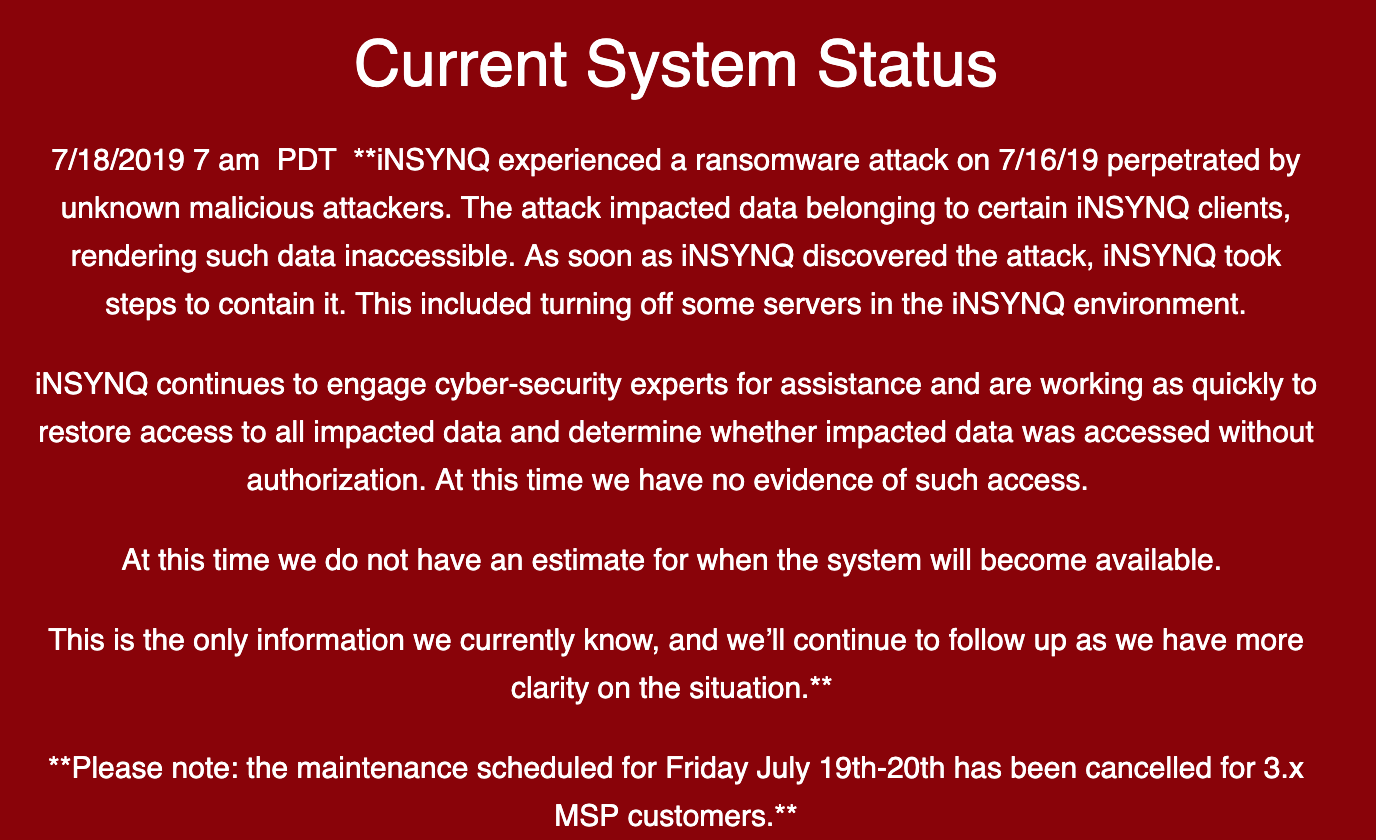
A message from iNSYNQ to customers.
Gig Harbor, Wash.-based iNSYNQ specializes in providing cloud-based QuickBooks accounting software and services. In a statement posted to its status page, iNSYNQ said it experienced a ransomware attack on July 16, and took its network offline in a bid to contain the spread of the malware.
“The attack impacted data belonging to certain iNSYNQ clients, rendering such data inaccessible,” the company said. “As soon as iNSYNQ discovered the attack, iNSYNQ took steps to contain it. This included turning off some servers in the iNSYNQ environment.”
iNSYNQ said it has engaged outside cybersecurity assistance and to determine whether any customer data was accessed without authorization, but that so far it has no estimate for when those files might be available again to customers.
Meanwhile, iNSYNQ’s customers — many of them accountants who manage financial data for a number of their own clients — have taken to Twitter to vent their frustration over a lack of updates since that initial message to users.
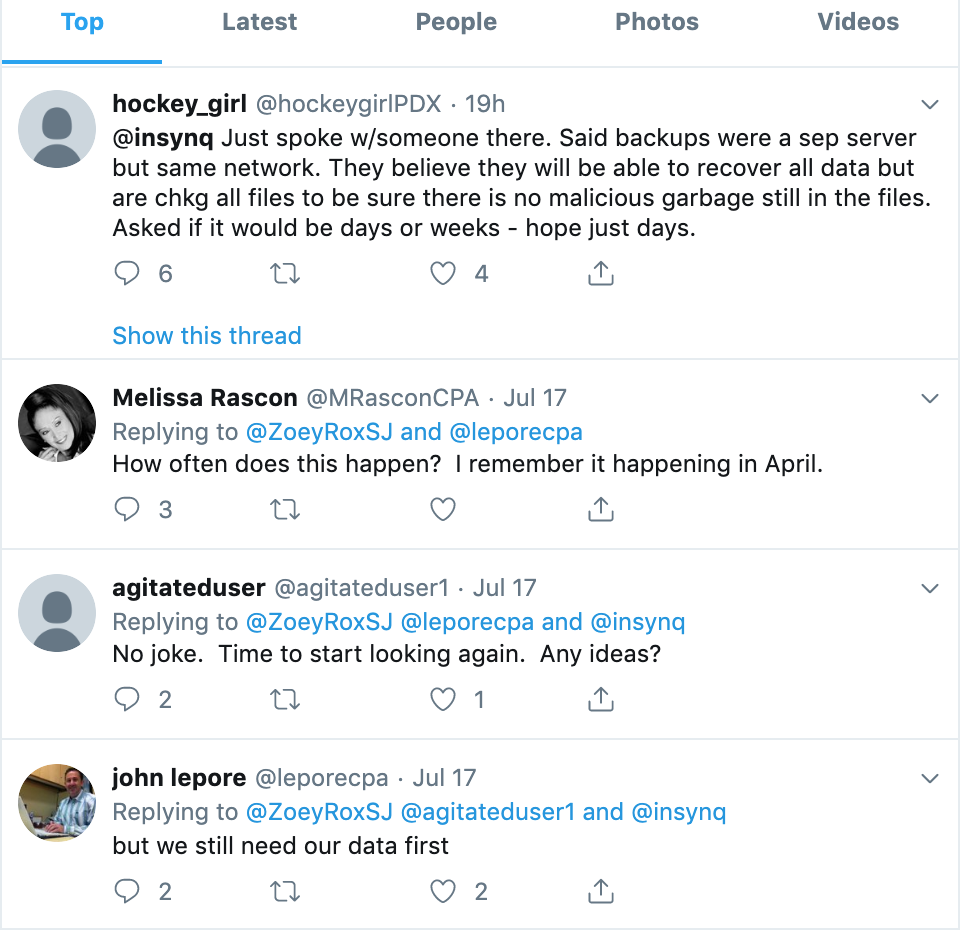
In response, the company appears to have simply deleted or deactivated its Twitter account (a cached copy from June 2019 is available here). Several customers venting about the outage on Twitter also accused the company of unpublishing negative comments about the incident from its Facebook page.
Some of those customers also said iNSYNQ initially blamed the outage on an alleged problem with U.S.-based nationwide cable ISP giant Comcast. Meanwhile, competing cloud hosting providers have been piling on to the tweetstorms about the iNSYNQ outage by marketing their own services, claiming they would never subject their customers to a three-day outage.
iNSYNQ has not yet responded to requests for comment.
There is no question that a ransomware infestation at any business — let alone a cloud data provider — can quickly turn into an all-hands-on-deck, hair-on-fire emergency that diverts all attention to fixing the problem as soon as possible.
But that is no excuse for leaving customers in the dark, and for not providing frequent and transparent updates about what the victim organization is doing to remediate the matter. Particularly when the cloud provider in question posts constantly to its blog about how companies can minimize their risk from such incidents by trusting it with their data.
Ransomware victims perhaps in the toughest spot include those providing cloud data hosting and software-as-service offerings, as these businesses are completely unable to serve their customers while a ransomware infestation is active.
The FBI and multiple security firms have advised victims not to pay any ransom demands, as doing so just encourages the attackers and in any case may not result in actually regaining access to encrypted files.
In practice, however, many cybersecurity consulting firms are quietly urging their customers that paying up is the fastest route back to business-as-usual. It’s not hard to see why: Having customer data ransomed or stolen can send many customers scrambling to find new providers. As a result, the temptation to simply pay up may become stronger with each passing day.
That’s exactly what happened in February, when cloud payroll data provider Apex Human Capital Management was knocked offline for three days following a ransomware infestation.
On Christmas Eve 2018, cloud hosting provider Dataresolution.net took its systems offline in response to a ransomware outbreak on its internal networks. The company was adamant that it would not pay the ransom demand, but it ended up taking several weeks for customers to fully regain access to their data.
KrebsOnSecurity will endeavor to update this story as more details become available. Any iNSYNQ affected by the outage is welcome to contact this author via Twitter (my direct messages are open to all) or at krebsonsecurity @ gmail.com.
from Krebs on Security https://ift.tt/2YiTE4S
via IFTTT

