PAHO issues new epidemiological alert amid rising yellow fever cases in the Americas
Cristina Mitchell
from PAHO/WHO | Pan American Health Organization https://ift.tt/XOQegum
via IFTTT

PAHO issues new epidemiological alert amid rising yellow fever cases in the Americas
Cristina Mitchell
from PAHO/WHO | Pan American Health Organization https://ift.tt/XOQegum
via IFTTT
“Congress shall make no law respecting an establishment of religion, or prohibiting the free exercise thereof; or abridging the freedom of speech, or of the press; or the right of the people peaceably to assemble, and to petition the Government for a redress of grievances.” -U.S. Constitution, First Amendment.

Image: Shutterstock, zimmytws.
In an address to Congress this month, President Trump claimed he had “brought free speech back to America.” But barely two months into his second term, the president has waged an unprecedented attack on the First Amendment rights of journalists, students, universities, government workers, lawyers and judges.
This story explores a slew of recent actions by the Trump administration that threaten to undermine all five pillars of the First Amendment to the U.S. Constitution, which guarantees freedoms concerning speech, religion, the media, the right to assembly, and the right to petition the government and seek redress for wrongs.
The right to petition allows citizens to communicate with the government, whether to complain, request action, or share viewpoints — without fear of reprisal. But that right is being assaulted by this administration on multiple levels. For starters, many GOP lawmakers are now heeding their leadership’s advice to stay away from local town hall meetings and avoid the wrath of constituents affected by the administration’s many federal budget and workforce cuts.
Another example: President Trump recently fired most of the people involved in processing Freedom of Information Act (FOIA) requests for government agencies. FOIA is an indispensable tool used by journalists and the public to request government records, and to hold leaders accountable.
The biggest story by far this week was the bombshell from The Atlantic editor Jeffrey Goldberg, who recounted how he was inadvertently added to a Signal group chat with National Security Advisor Michael Waltz and 16 other Trump administration officials discussing plans for an upcoming attack on Yemen.
One overlooked aspect of Goldberg’s incredible account is that by planning and coordinating the attack on Signal — which features messages that can auto-delete after a short time — administration officials were evidently seeking a way to avoid creating a lasting (and potentially FOIA-able) record of their deliberations.
“Intentional or not, use of Signal in this context was an act of erasure—because without Jeffrey Goldberg being accidentally added to the list, the general public would never have any record of these communications or any way to know they even occurred,” Tony Bradley wrote this week at Forbes.
Petitioning the government, particularly when it ignores your requests, often requires challenging federal agencies in court. But that becomes far more difficult if the most competent law firms start to shy away from cases that may involve crossing the president and his administration.
On March 22, the president issued a memorandum that directs heads of the Justice and Homeland Security Departments to “seek sanctions against attorneys and law firms who engage in frivolous, unreasonable and vexatious litigation against the United States,” or in matters that come before federal agencies.
The POTUS recently issued several executive orders railing against specific law firms with attorneys who worked legal cases against him. On Friday, the president announced that the law firm of Skadden, Arps, Slate, Meager & Flom had agreed to provide $100 million in pro bono work on issues that he supports.
Trump issued another order naming the firm Paul, Weiss, Rifkind, Wharton & Garrison, which ultimately agreed to pledge $40 million in pro bono legal services to the president’s causes.
Other Trump executive orders targeted law firms Jenner & Block and WilmerHale, both of which have attorneys that worked with special counsel Robert Mueller on the investigation into Russian interference in the 2016 election. But this week, two federal judges in separate rulings froze parts of those orders.
“There is no doubt this retaliatory action chills speech and legal advocacy, and that is qualified as a constitutional harm,” wrote Judge Richard Leon, who ruled against the executive order targeting WilmerHale.
President Trump recently took the extraordinary step of calling for the impeachment of federal judges who rule against the administration. Trump called U.S. District Judge James Boasberg a “Radical Left Lunatic” and urged he be removed from office for blocking deportation of Venezuelan alleged gang members under a rarely invoked wartime legal authority.
In a rare public rebuke to a sitting president, U.S. Supreme Court Justice John Roberts issued a statement on March 18 pointing out that “For more than two centuries, it has been established that impeachment is not an appropriate response to disagreement concerning a judicial decision.”
The U.S. Constitution provides that judges can be removed from office only through impeachment by the House of Representatives and conviction by the Senate. The Constitution also states that judges’ salaries cannot be reduced while they are in office.
Undeterred, House Speaker Mike Johnson this week suggested the administration could still use the power of its purse to keep courts in line, and even floated the idea of wholesale eliminating federal courts.
“We do have authority over the federal courts as you know,” Johnson said. “We can eliminate an entire district court. We have power of funding over the courts, and all these other things. But desperate times call for desperate measures, and Congress is going to act, so stay tuned for that.”
President Trump has taken a number of actions to discourage lawful demonstrations at universities and colleges across the country, threatening to cut federal funding for any college that supports protests he deems “illegal.”
A Trump executive order in January outlined a broad federal crackdown on what he called “the explosion of antisemitism” on U.S. college campuses. This administration has asserted that foreign students who are lawfully in the United States on visas do not enjoy the same free speech or due process rights as citizens.
Reuters reports that the acting civil rights director at the Department of Education (DOE) on March 10 sent letters to 60 educational institutions warning they could lose federal funding if they don’t do more to combat anti-semitism. On March 20, Trump issued an order calling for the closure of the DOE.
Meanwhile, U.S. Immigration and Customs Enforcement (ICE) agents have been detaining and trying to deport pro-Palestinian students who are legally in the United States. The administration is targeting students and academics who spoke out against Israel’s attacks on Gaza, or who were active in campus protests against U.S. support for the attacks. Secretary of State Marco Rubio told reporters Thursday that at least 300 foreign students have seen their visas revoked under President Trump, a far higher number than was previously known.
In his first term, Trump threatened to use the national guard or the U.S. military to deal with protesters, and in campaigning for re-election he promised to revisit the idea.
“I think the bigger problem is the enemy from within,” Trump told Fox News in October 2024. “We have some very bad people. We have some sick people, radical left lunatics. And I think they’re the big — and it should be very easily handled by, if necessary, by National Guard, or if really necessary, by the military, because they can’t let that happen.”
This term, Trump acted swiftly to remove the top judicial advocates in the armed forces who would almost certainly push back on any request by the president to use U.S. soldiers in an effort to quell public protests, or to arrest and detain immigrants. In late February, the president and Defense Secretary Pete Hegseth fired the top legal officers for the military services — those responsible for ensuring the Uniform Code of Military Justice is followed by commanders.
Military.com warns that the purge “sets an alarming precedent for a crucial job in the military, as President Donald Trump has mused about using the military in unorthodox and potentially illegal ways.” Hegseth told reporters the removals were necessary because he didn’t want them to pose any “roadblocks to orders that are given by a commander in chief.”
President Trump has sued a number of U.S. news outlets, including 60 Minutes, CNN, The Washington Post, The New York Times and other smaller media organizations for unflattering coverage.
In a $10 billion lawsuit against 60 Minutes and its parent Paramount, Trump claims they selectively edited an interview with former Vice President Kamala Harris prior to the 2024 election. The TV news show last month published transcripts of the interview at the heart of the dispute, but Paramount is reportedly considering a settlement to avoid potentially damaging its chances of winning the administration’s approval for a pending multibillion-dollar merger.
The president sued The Des Moines Register and its parent company, Gannett, for publishing a poll showing Trump trailing Harris in the 2024 presidential election in Iowa (a state that went for Trump). The POTUS also is suing the Pulitzer Prize board over 2018 awards given to The New York Times and The Washington Post for their coverage of purported Russian interference in the 2016 election.
Whether or not any of the president’s lawsuits against news organizations have merit or succeed is almost beside the point. The strategy behind suing the media is to make reporters and newsrooms think twice about criticizing or challenging the president and his administration. The president also knows some media outlets will find it more expedient to settle.
Trump also sued ABC News and George Stephanopoulos for stating that the president had been found liable for “rape” in a civil case [Trump was found liable of sexually abusing and defaming E. Jean Carroll]. ABC parent Disney settled that claim by agreeing to donate $15 million to the Trump Presidential Library.
Following the attack on the U.S. Capitol on Jan. 6, 2021, Facebook blocked President Trump’s account. Trump sued Meta, and after the president’s victory in 2024 Meta settled and agreed to pay Trump $25 million: $22 million would go to his presidential library, and the rest to legal fees. Meta CEO Mark Zuckerberg also announced Facebook and Instagram would get rid of fact-checkers and rely instead on reader-submitted “community notes” to debunk disinformation on the social media platform.
Brendan Carr, the president’s pick to run the Federal Communications Commission (FCC), has pledged to “dismantle the censorship cartel and restore free speech rights for everyday Americans.” But on January 22, 2025, the FCC reopened complaints against ABC, CBS and NBC over their coverage of the 2024 election. The previous FCC chair had dismissed the complaints as attacks on the First Amendment and an attempt to weaponize the agency for political purposes.
According to Reuters, the complaints call for an investigation into how ABC News moderated the pre-election TV debate between Trump and Biden, and appearances of then-Vice President Harris on 60 Minutes and on NBC’s “Saturday Night Live.”
Since then, the FCC has opened investigations into NPR and PBS, alleging that they are breaking sponsorship rules. The Center for Democracy & Technology (CDT), a think tank based in Washington, D.C., noted that the FCC is also investigating KCBS in San Francisco for reporting on the location of federal immigration authorities.
“Even if these investigations are ultimately closed without action, the mere fact of opening them – and the implicit threat to the news stations’ license to operate – can have the effect of deterring the press from news coverage that the Administration dislikes,” the CDT’s Kate Ruane observed.
Trump has repeatedly threatened to “open up” libel laws, with the goal of making it easier to sue media organizations for unfavorable coverage. But this week, the U.S. Supreme Court declined to hear a challenge brought by Trump donor and Las Vegas casino magnate Steve Wynn to overturn the landmark 1964 decision in New York Times v. Sullivan, which insulates the press from libel suits over good-faith criticism of public figures.
The president also has insisted on picking which reporters and news outlets should be allowed to cover White House events and participate in the press pool that trails the president. He barred the Associated Press from the White House and Air Force One over their refusal to call the Gulf of Mexico by another name.
And the Defense Department has ordered a number of top media outlets to vacate their spots at the Pentagon, including CNN, The Hill, The Washington Post, The New York Times, NBC News, Politico and National Public Radio.
“Incoming media outlets include the New York Post, Breitbart, the Washington Examiner, the Free Press, the Daily Caller, Newsmax, the Huffington Post and One America News Network, most of whom are seen as conservative or favoring Republican President Donald Trump,” Reuters reported.
Shortly after Trump took office again in January 2025, the administration began circulating lists of hundreds of words that government staff and agencies shall not use in their reports and communications.
The Brookings Institution notes that in moving to comply with this anti-speech directive, federal agencies have purged countless taxpayer-funded data sets from a swathe of government websites, including data on crime, sexual orientation, gender, education, climate, and global development.
The New York Times reports that in the past two months, hundreds of terabytes of digital resources analyzing data have been taken off government websites.
“While in many cases the underlying data still exists, the tools that make it possible for the public and researchers to use that data have been removed,” The Times wrote.
On Jan. 27, Trump issued a memo (PDF) that paused all federally funded programs pending a review of those programs for alignment with the administration’s priorities. Among those was ensuring that no funding goes toward advancing “Marxist equity, transgenderism, and green new deal social engineering policies.”
According to the CDT, this order is a blatant attempt to force government grantees to cease engaging in speech that the current administration dislikes, including speech about the benefits of diversity, climate change, and LGBTQ issues.
“The First Amendment does not permit the government to discriminate against grantees because it does not like some of the viewpoints they espouse,” the CDT’s Ruane wrote. “Indeed, those groups that are challenging the constitutionality of the order argued as much in their complaint, and have won an injunction blocking its implementation.”
On January 20, the same day Trump issued an executive order on free speech, the president also issued an executive order titled “Reevaluating and Realigning United States Foreign Aid,” which froze funding for programs run by the U.S. Agency for International Development (USAID). Among those were programs designed to empower civil society and human rights groups, journalists and others responding to digital repression and Internet shutdowns.
According to the Electronic Frontier Foundation (EFF), this includes many freedom technologies that use cryptography, fight censorship, protect freedom of speech, privacy and anonymity for millions of people around the world.
“While the State Department has issued some limited waivers, so far those waivers do not seem to cover the open source internet freedom technologies,” the EFF wrote about the USAID disruptions. “As a result, many of these projects have to stop or severely curtail their work, lay off talented workers, and stop or slow further development.”
On March 14, the president signed another executive order that effectively gutted the U.S. Agency for Global Media (USAGM), which oversees or funds media outlets including Radio Free Europe/Radio Liberty and Voice of America (VOA). The USAGM also oversees Radio Free Asia, which supporters say has been one of the most reliable tools used by the government to combat Chinese propaganda.
But this week, U.S. District Court Judge Royce Lamberth, a Reagan appointee, temporarily blocked USAGM’s closure by the administration.
“RFE/RL has, for decades, operated as one of the organizations that Congress has statutorily designated to carry out this policy,” Lamberth wrote in a 10-page opinion. “The leadership of USAGM cannot, with one sentence of reasoning offering virtually no explanation, force RFE/RL to shut down — even if the President has told them to do so.”
The Trump administration rescinded a decades-old policy that instructed officers not to take immigration enforcement actions in or near “sensitive” or “protected” places, such as churches, schools, and hospitals.
That directive was immediately challenged in a case brought by a group of Quakers, Baptists and Sikhs, who argued the policy reversal was keeping people from attending services for fear of being arrested on civil immigration violations. On Feb. 24, a federal judge agreed and blocked ICE agents from entering churches or targeting migrants nearby.
The president’s executive order allegedly addressing antisemitism came with a fact sheet that described college campuses as “infested” with “terrorists” and “jihadists.” Multiple faith groups expressed alarm over the order, saying it attempts to weaponize antisemitism and promote “dehumanizing anti-immigrant policies.”
The president also announced the creation of a “Task Force to Eradicate Anti-Christian Bias,” to be led by Attorney General Pam Bondi. Never mind that Christianity is easily the largest faith in America and that Christians are well-represented in Congress.
The Rev. Paul Brandeis Raushenbush, a Baptist minister and head of the progressive Interfaith Alliance, issued a statement accusing Trump of hypocrisy in claiming to champion religion by creating the task force.
“From allowing immigration raids in churches, to targeting faith-based charities, to suppressing religious diversity, the Trump Administration’s aggressive government overreach is infringing on religious freedom in a way we haven’t seen for generations,” Raushenbush said.
A statement from Americans United for Separation of Church and State said the task force could lead to religious persecution of those with other faiths.
“Rather than protecting religious beliefs, this task force will misuse religious freedom to justify bigotry, discrimination, and the subversion of our civil rights laws,” said Rachel Laser, the group’s president and CEO.
Where is President Trump going with all these blatant attacks on the First Amendment? The president has made no secret of his affection for autocratic leaders and “strongmen” around the world, and he is particularly enamored with Hungary’s far-right Prime Minister Viktor Orbán, who has visited Trump’s Mar-a-Lago resort twice in the past year.
A March 15 essay in The Atlantic by Hungarian investigative journalist András Pethő recounts how Orbán rose to power by consolidating control over the courts, and by building his own media universe while simultaneously placing a stranglehold on the independent press.
“As I watch from afar what’s happening to the free press in the United States during the first weeks of Trump’s second presidency — the verbal bullying, the legal harassment, the buckling by media owners in the face of threats — it all looks very familiar,” Pethő wrote. “The MAGA authorities have learned Orbán’s lessons well.”
from Krebs on Security https://ift.tt/2Y5OxMi
via IFTTT

La reciente estrategia empresarial de Elon Musk ha reordenado el panorama tecnológico global. Su startup de inteligencia artificial, xAI, ha consolidado su influencia con la adquisición de X, la red social anteriormente conocida como Twitter. Aunque ambas compañías ya estaban bajo el control del magnate sudafricano, ahora pasan a estar fusionadas legalmente tras un acuerdo ejecutado mediante un intercambio de acciones.
Este movimiento, que tiene implicaciones tanto financieras como tecnológicas, marca un nuevo capítulo en la ambición de Musk por integrar sus distintos frentes de innovación. En una publicación en la propia plataforma X, Musk explicó que la valoración atribuida a xAI se sitúa en 80.000 millones de dólares, frente a los 33.000 millones asignados a X. Sin embargo, al contabilizar una deuda pendiente de 12.000 millones, el valor total de la red social asciende hasta los 45.000 millones.
Desde hace meses, las actividades de xAI y X estaban ya entrelazadas en la práctica. Grok, el chatbot insignia de xAI, estaba plenamente integrado en la plataforma X, proporcionando a los usuarios funciones avanzadas de inteligencia artificial. Además, se ha revelado que parte del equipo de xAI colaboraba estrechamente con personal de X, e incluso compartían acceso a sistemas y algoritmos de la red social.
La operación recién anunciada oficializa esa relación y la convierte en una única estructura empresarial, con implicaciones que van más allá del cambio de estatuto legal. Según palabras del propio Musk, el objetivo es desbloquear nuevas oportunidades al unificar “datos, modelos, computación, distribución y talento” en una sola entidad.
La fusión posiciona a xAI como un actor más sólido frente a gigantes del sector como OpenAI. Mientras que la compañía liderada por Sam Altman está valorada en más de 150.000 millones de dólares y sigue dominando con ChatGPT, la alianza de xAI con una red social como X proporciona un acceso único a datos, usuarios y canales de distribución global que otras firmas de inteligencia artificial no poseen de forma directa.
Musk ha calificado esta sinergia como una vía para acelerar el progreso humano a gran escala. El empresario ha recalcado que ahora la empresa puede ofrecer “experiencias inteligentes” a miles de millones de personas y buscar la verdad mediante el conocimiento compartido, una retórica ambiciosa que se alinea con su visión de utilizar la tecnología para resolver problemas estructurales a nivel global.
Desde el punto de vista operativo, aún no se han anunciado cambios significativos que afecten a los usuarios de X. Sin embargo, la reestructuración legal podría derivar en futuras decisiones como ajustes en las oficinas, unificación de equipos o cambios en la gobernanza corporativa.
Para los inversores, la operación se ha estructurado mediante un canje de acciones. Aquellos que tengan participación en X recibirán títulos equivalentes de xAI, permitiendo una continuidad de intereses. Esta estrategia también ha servido como vía para reevaluar el valor de ambas compañías en un mercado con constantes fluctuaciones.
No es la primera vez que Elon Musk fusiona dos de sus propios negocios. En 2016, Tesla absorbió SolarCity, una empresa especializada en paneles solares fundada por familiares de Musk. Aunque la operación fue inicialmente criticada por los accionistas, finalmente fue validada en los tribunales. El patrón parece repetirse ahora con la integración de xAI y X.
Ambas empresas comparten también una base de inversores comunes de peso, entre los que figuran firmas como Sequoia Capital, Fidelity Investments y Andreessen Horowitz. Esta coincidencia ha facilitado el proceso y revela un interés compartido por parte de los fondos en mantener la sinergia entre plataformas digitales y tecnologías emergentes como la IA.
El anuncio ha tenido eco considerable en los mercados y medios especializados. Mientras algunos analistas valoran positivamente la operación como un paso natural para consolidar líneas de negocio complementarias, otros han mostrado preocupación por la creciente concentración de poder en torno a la figura de Musk.
La propia CEO de X, Linda Yaccarino, ha compartido públicamente su entusiasmo con un mensaje optimista: “El futuro no puede ser más brillante”. No obstante, la historia reciente de X, marcada por despidos masivos, abandono de la moderación de contenido y pérdida de anunciantes, ofrece un contexto más complejo del que se desprende de sus declaraciones.
La fusión también podría tener un impacto significativo en la viabilidad financiera de X, que desde su privatización no ha estado exenta de dificultades. Documentos recientes indican que la plataforma podría registrar por primera vez un incremento en ingresos publicitarios desde la compra por parte de Musk, con una previsión de ingresos de hasta 2.260 millones de dólares a nivel global en 2025.
Sin embargo, la situación está lejos de ser estable. La red social enfrenta una deuda considerable, y su reputación ha sufrido debido a la proliferación de desinformación, bots y una percepción general de deterioro en la experiencia del usuario. Integrar la red con una empresa de IA podría revitalizar esos problemas o, por el contrario, representar un punto de inflexión.
Grok, el asistente de IA desarrollado por xAI, ya se presenta como una pieza clave en la estrategia combinada. Musk lo ha promocionado como “la IA más inteligente del planeta”, pese a que su adopción aún está lejos de competir con la de productos como ChatGPT. La integración plena con X permitirá recolectar más datos y alimentar los modelos de lenguaje con información en tiempo real, lo que se espera aumente su capacidad de aprendizaje y respuesta.
Además de Grok, xAI está ampliando sus centros de computación, con instalaciones como Colossus en Tennessee que se destacan como algunas de las mayores infraestructuras para entrenamiento de modelos del mundo. Todo apunta a que la empresa fusionada invertirá tanto en capacidad técnica como en expansión del alcance de sus sistemas de IA.
La decisión de integrar xAI con X podría transformar profundamente tanto la red social como el ámbito de la inteligencia artificial comercial. A medida que se diluyen las fronteras entre plataformas de comunicación y desarrollos tecnológicos avanzados, el control centralizado que ostenta Musk se convierte en un factor clave para entender hacia dónde se dirige este nuevo ecosistema digital.
from Linux Adictos https://ift.tt/pIQaDzJ
via IFTTT
Join a loyalty scheme and you often get a reward or discount on your special day – but it may have strings attached
Celebrating your birthday isn’t just about getting presents and cards from family and friends. Signing up to loyalty schemes and newsletters can give you access to a host of freebies, deals and discounts from retailers to mark the big day.
With my birthday on the horizon I decided to look at what was on offer, and see which gifts came with some small print.
from Data and computer security | The Guardian https://ift.tt/zv5yajN
via IFTTT

Calibre, la herramienta de código abierto para la gestión de libros electrónicos, ha lanzado su versión 8.1 con una serie de mejoras técnicas y nuevas funcionalidades. Esta actualización trae consigo cambios que afectan tanto a la experiencia de usuario como al soporte multiplataforma, en especial para usuarios de macOS y FreeBSD. Con esta nueva versión, Calibre demuestra una vez más su compromiso por mantenerse como una opción robusta y flexible dentro del mundo del software libre dedicado a la lectura digital.
La comunidad ha recibido con interés las novedades de Calibre 8.1, sobre todo porque esta versión corrige diversas limitaciones anteriores y atiende a peticiones históricas de usuarios que buscaban una mayor estabilidad en sistemas operativos alternativos o menos convencionales, como FreeBSD, y una mejor experiencia en el entorno macOS. Además, las funciones de gestión de e-books se han optimizado.
Una de las principales novedades de la versión 8.1 de Calibre es la mejora significativa en el soporte para macOS, algo que numerosos usuarios esperaban desde hace tiempo. El equipo de desarrollo ha trabajado en resolver numerosos errores que afectaban al rendimiento general de la aplicación en este sistema operativo, lo que se traduce en una interacción más fluida y estable con la interfaz de usuario. Además, se han integrado ajustes que permiten una mejor adaptación a las nuevas arquitecturas de Apple, como los chips M1 y M2, lo cual optimiza los tiempos de carga y reduce el consumo de recursos.
Por primera vez, Calibre amplía oficialmente su compatibilidad a dispositivos que utilizan FreeBSD, un movimiento que ha sido bien recibido por los entusiastas de este sistema operativo. Aunque FreeBSD no es tan popular como Linux o Windows, su comunidad es muy activa y valora altamente las herramientas de código abierto. Calibre ahora permite una conectividad más directa con dispositivos gestionados por FreeBSD, facilitando tanto la transferencia de libros como la sincronización de bibliotecas. Esto se alinea con la tendencia observada en versiones anteriores.
Más allá de la compatibilidad, Calibre 8.1 introduce mejoras en la usabilidad a través de nuevas funcionalidades dentro de la interfaz de gestión de bibliotecas. Se ha implementado una opción que permite editar portadas de libros desde fuentes externas, una característica especialmente útil para los usuarios que buscan una personalización más visual de sus bibliotecas. Asimismo, se ha añadido la posibilidad de bloquear pestañas dentro de las bibliotecas virtuales, lo que permite organizar mejor el contenido y evitar cambios accidentales.
Estas funciones no solo están enfocadas a usuarios experimentados sino también a aquellos que están comenzando a utilizar Calibre, gracias a su implementación intuitiva y su inclusión sin necesidad de configuraciones adicionales.
Además de las novedades visibles, la versión 8.1 incluye una importante labor de mantenimiento interno. Se han corregido errores menores, limpiado partes del código, y optimizado el uso de memoria en determinadas operaciones que implican grandes volúmenes de datos. Todo esto contribuye a que, aunque los cambios no siempre sean visibles al usuario, sí supongan una notable mejora en la experiencia de uso diaria.
El equipo de desarrollo ha confirmado que estas mejoras son parte de una hoja de ruta más amplia, en la que se espera seguir elevando los estándares de accesibilidad y personalización del software en futuras versiones. También se ha señalado que se está trabajando en una mayor integración con servicios en la nube, aunque estos avances todavía se encuentran en fases preliminares de desarrollo. Como se discutió en Calibre 5, el enfoque en estabilidad es crucial.
La acogida por parte de la comunidad ha sido bastante positiva, sobre todo entre usuarios que utilizan Calibre como herramienta de apoyo profesional, como editores, escritores o bibliotecarios digitales. La posibilidad de gestionar grandes cantidades de libros con eficiencia y adaptarlo al entorno de cada uno sigue siendo uno de los puntos fuertes del programa.
Aunque la actualización no introduce un rediseño completo, sí representa un paso importante hacia una mayor madurez del software, y muestra que Calibre sigue evolucionando junto a las necesidades cambiantes de sus usuarios.
Con la llegada de Calibre 8.1, los usuarios pueden disfrutar de una versión más versátil y adaptable, con mejoras que abarcan desde la compatibilidad con sistemas operativos menos comunes hasta herramientas más detalladas para la organización dentro de la biblioteca. Esta evolución consolida a Calibre como una de las soluciones más completas en su categoría dentro del ecosistema del software libre.
La nueva versión se puede descargar desde su sitio web oficial.
from Linux Adictos https://ift.tt/VNsnlvj
via IFTTT

El ecosistema Android se encamina hacia un cambio estructural en su modelo de desarrollo. Google ha confirmado recientemente que todas las labores de programación y evolución de su sistema operativo se realizarán de forma privada, un giro que marca el inicio de una nueva etapa más cerrada respecto al software libre. Este cambio es relevante en el contexto de la discusión sobre si Android es realmente un sistema open source.
Este cambio afectará directamente al llamado Android Open Source Project (AOSP), que hasta ahora funcionaba como la rama pública y abierta del sistema operativo. Si bien Google ha asegurado que continuará compartiendo el código fuente de las nuevas versiones una vez completadas, el proceso de desarrollo en tiempo real dejará de estar accesible para la comunidad externa, lo que contrasta con la filosofía del proyecto microG, que busca mantener la apertura en Android.
La medida no implica que Android pase a ser un sistema cerrado en sentido estricto, ya que el código seguirá siendo publicado bajo licencias de código abierto. Sin embargo, limita de manera considerable la participación de desarrolladores independientes, fabricantes sin acuerdos con Google y entusiastas del software libre en la evolución de la plataforma. La situación actual contrasta con el panorama anterior, donde Android 13 se lanzó con una mayor participación de la comunidad.
Hasta ahora, Google mantenía dos ramas de desarrollo de Android: una interna y otra pública (AOSP). Esta dualidad generaba frecuentemente conflictos de integración y retrasos en la implementación de novedades. Así, con la propuesta de unificar bajo una única rama privada, la empresa pretende agilizar procesos y reducir errores, una estrategia que podría beneficiar la estabilidad del sistema operativo.

Android nació como un sistema operativo con vocación de apertura, inscrito en la Open Handset Alliance, y durante años se presentó como alternativa al modelo cerrado de Apple. Sin embargo, con el paso del tiempo, Google ha ido desmarcándose progresivamente del espíritu de colaboración abierto, priorizando sus propios intereses y los de sus socios comerciales. Esta evolución podría ser comparada con la tendencia hacia una mayor centralización que se observa en otros ecosistemas.
El nuevo enfoque potenciará más aún la dependencia de la licencia GMS (Google Mobile Services), que permite a los fabricantes acceder a servicios y apps esenciales como Google Play, Maps o Gmail. Solo quienes cuenten con esta licencia tendrán visibilidad anticipada del desarrollo e incluso posibilidad de colaborar con Google antes de la liberación del código, lo que podría afectar a nuevos proyectos en desarrollo.
Este modelo deja fuera a los desarrolladores independientes que contribuían desinteresadamente desde la comunidad open source, así como a fabricantes que basaban sus adaptaciones de Android directamente en AOSP. En regiones como China, donde no se utilizan los servicios de Google, esta decisión podría derivar en mayores obstáculos técnicos e incluso una fragmentación más acusada, similares a los que enfrentan las alternativas en el ecosistema de software libre.
Google ha defendido que esta consolidación responde a la necesidad de acelerar el desarrollo, facilitar la depuración de errores y reducir los tiempos de implementación. No obstante, también implica una menor transparencia en el proceso y refuerza el control exclusivo de la empresa sobre el futuro de la plataforma.

La coexistencia de las ramas pública y privada generaba grandes retos internos en Google. Los ciclos de desarrollo no coincidían, lo que provocaba desajustes y duplicidades. En ocasiones, el trabajo realizado en AOSP debía ser integrado o descartado en función de los avances paralelos realizados en la rama interna, con los consecuentes “conflictos de fusión”. Este conflicto de intereses es similar al que se ha observado en el desarrollo de otras plataformas de software.
Con el nuevo modelo, todos los desarrollos se realizarán de puertas adentro. Solo cuando Google libere una nueva versión estable – por ejemplo, Android 16 – los cambios serán compartidos públicamente. Esto incluirá tanto el código fuente general como el de ciertos componentes específicos del sistema operativo, un paisaje muy diferente al que disfrutaban los desarrolladores actualmente.
Uno de los temores más extendidos es que esta estrategia repercuta negativamente en iniciativas independientes, como las ROMs personalizadas (LineageOS, GrapheneOS, etc.) o desarrollos dirigidos a dispositivos abandonados por sus fabricantes. Al retrasarse el acceso al código, mantener estas iniciativas será más complejo, lo que podría ser un desafío a largo plazo para los usuarios que dependen de soluciones alternativas.

Desde el punto de vista del usuario común, estos cambios no se traducirán en modificaciones visibles a corto plazo. Los móviles seguirán recibiendo actualizaciones, los servicios de Google continuarán funcionando como hasta ahora y las nuevas versiones de Android seguirán llegando con sus ciclos preestablecidos. Sin embargo, es importante estar al tanto de cómo estos cambios podrían afectar el ecosistema general de Android.
Los desarrolladores de aplicaciones tampoco se verán significativamente afectados. Continuarán accediendo al código una vez liberado y podrán compilar sus apps como de costumbre. Las herramientas de desarrollo como Android Studio, las API públicas y los kits de compatibilidad se mantendrán operativos, a pesar de los cambios en la estructura de desarrollo.
La transformación afecta sobre todo al proceso interno y al modelo de gobernanza del proyecto. La capacidad para proponer mejoras, señalar fallos o sugerir nuevas funcionalidades quedará restringida a aquellos que formen parte del ecosistema cerrado de colaboradores de Google. Este enfoque puede generar preocupación sobre el futuro de la innovación en la plataforma.
Por tanto, aunque Android técnicamente sigue siendo de código abierto, la dirección que toma Google lo aleja de los principios que inspiraron su nacimiento. El control exclusivo de la empresa sobre el desarrollo, sus ritmos y sus prioridades refuerzan su poder sobre el software más utilizado del planeta.
Mientras el sistema operativo del robot verde mantiene su estatus de código abierto sobre el papel, el modelo actual cada vez se aleja más del ideal de comunidad y colaboración descentralizada. Google busca más eficiencia y control, pero a costa de sacrificar parte de la transparencia y apertura que distinguía a Android de su competidor directo.
from Linux Adictos https://ift.tt/KqNyWAs
via IFTTT
Many successful phishing attacks result in a financial loss or malware infection. But falling for some phishing scams, like those currently targeting Russians searching online for organizations that are fighting the Kremlin war machine, can cost you your freedom or your life.

The real website of the Ukrainian paramilitary group “Freedom of Russia” legion. The text has been machine-translated from Russian.
Researchers at the security firm Silent Push mapped a network of several dozen phishing domains that spoof the recruitment websites of Ukrainian paramilitary groups, as well as Ukrainian government intelligence sites.
The website legiohliberty[.]army features a carbon copy of the homepage for the Freedom of Russia Legion (a.k.a. “Free Russia Legion”), a three-year-old Ukraine-based paramilitary unit made up of Russian citizens who oppose Vladimir Putin and his invasion of Ukraine.
The phony version of that website copies the legitimate site — legionliberty[.]army — providing an interactive Google Form where interested applicants can share their contact and personal details. The form asks visitors to provide their name, gender, age, email address and/or Telegram handle, country, citizenship, experience in the armed forces; political views; motivations for joining; and any bad habits.
“Participation in such anti-war actions is considered illegal in the Russian Federation, and participating citizens are regularly charged and arrested,” Silent Push wrote in a report released today. “All observed campaigns had similar traits and shared a common objective: collecting personal information from site-visiting victims. Our team believes it is likely that this campaign is the work of either Russian Intelligence Services or a threat actor with similarly aligned motives.”
Silent Push’s Zach Edwards said the fake Legion Liberty site shared multiple connections with rusvolcorps[.]net. That domain mimics the recruitment page for a Ukrainian far-right paramilitary group called the Russian Volunteer Corps (rusvolcorps[.]com), and uses a similar Google Forms page to collect information from would-be members.
Other domains Silent Push connected to the phishing scheme include: ciagov[.]icu, which mirrors the content on the official website of the U.S. Central Intelligence Agency; and hochuzhitlife[.]com, which spoofs the Ministry of Defense of Ukraine & General Directorate of Intelligence (whose actual domain is hochuzhit[.]com).
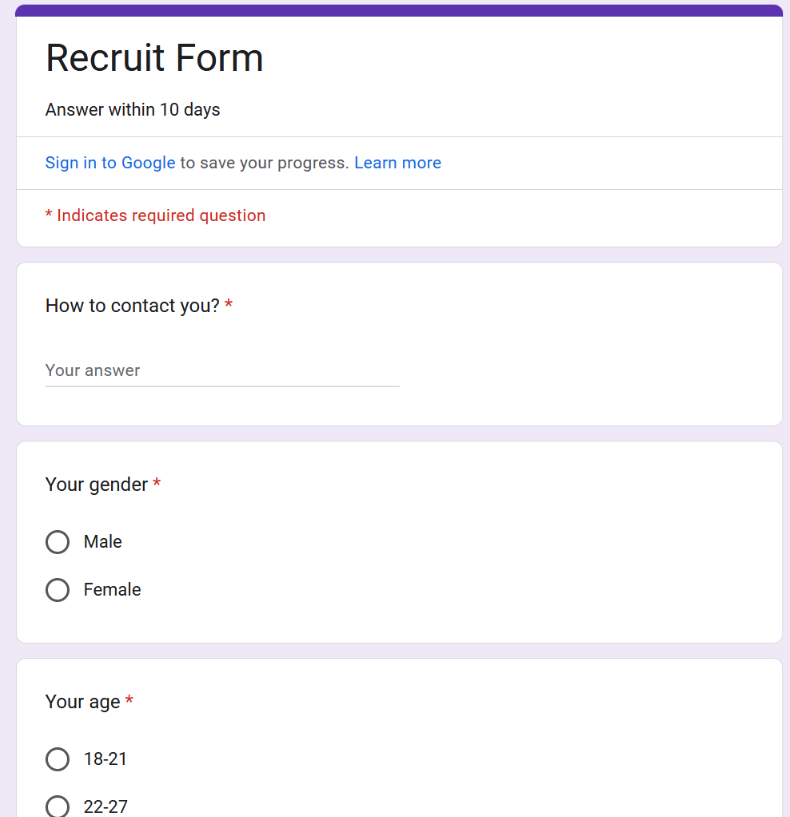
According to Edwards, there are no signs that these phishing sites are being advertised via email. Rather, it appears those responsible are promoting them by manipulating the search engine results shown when someone searches for one of these anti-Putin organizations.
In August 2024, security researcher Artem Tamoian posted on Twitter/X about how he received startlingly different results when he searched for “Freedom of Russia legion” in Russia’s largest domestic search engine Yandex versus Google.com. The top result returned by Google was the legion’s actual website, while the first result on Yandex was a phishing page targeting the group.
“I think at least some of them are surely promoted via search,” Tamoian said of the phishing domains. “My first thread on that accuses Yandex, but apart from Yandex those websites are consistently ranked above legitimate in DuckDuckGo and Bing. Initially, I didn’t realize the scale of it. They keep appearing to this day.”

The results of a search at DuckDuckGo on Mar. 27, 2025 for “Freedom of Russia legion” shows the first result returned is a phishing domain.
Tamoian, a native Russian who left the country in 2019, is the founder of the cyber investigation platform malfors.com. He recently discovered two other sites impersonating the Ukrainian paramilitary groups — legionliberty[.]world and rusvolcorps[.]ru — and reported both to Cloudflare. When Cloudflare responded by blocking the sites with a phishing warning, the real Internet address of these sites was exposed as belonging to a known “bulletproof hosting” network called Stark Industries Solutions Ltd.
Stark Industries Solutions appeared two weeks before Russia invaded Ukraine in February 2022, materializing out of nowhere with hundreds of thousands of Internet addresses in its stable — many of them originally assigned to Russian government organizations. In May 2024, KrebsOnSecurity published a deep dive on Stark, which has repeatedly been used to host infrastructure for distributed denial-of-service (DDoS) attacks, phishing, malware and disinformation campaigns from Russian intelligence agencies and pro-Kremlin hacker groups.
In March 2023, Russia’s Supreme Court designated the Freedom of Russia legion as a terrorist organization, meaning that Russians caught communicating with the group could face between 10 and 20 years in prison.
Tamoian said those searching online for information about these paramilitary groups have become easy prey for Russian security services.
“I started looking into those phishing websites, because I kept stumbling upon news that someone gets arrested for trying to join [the] Ukrainian Army or for trying to help them,” Tamoian told KrebsOnSecurity. “I have also seen reports [of] FSB contacting people impersonating Ukrainian officers, as well as using fake Telegram bots, so I thought fake websites might be an option as well.”
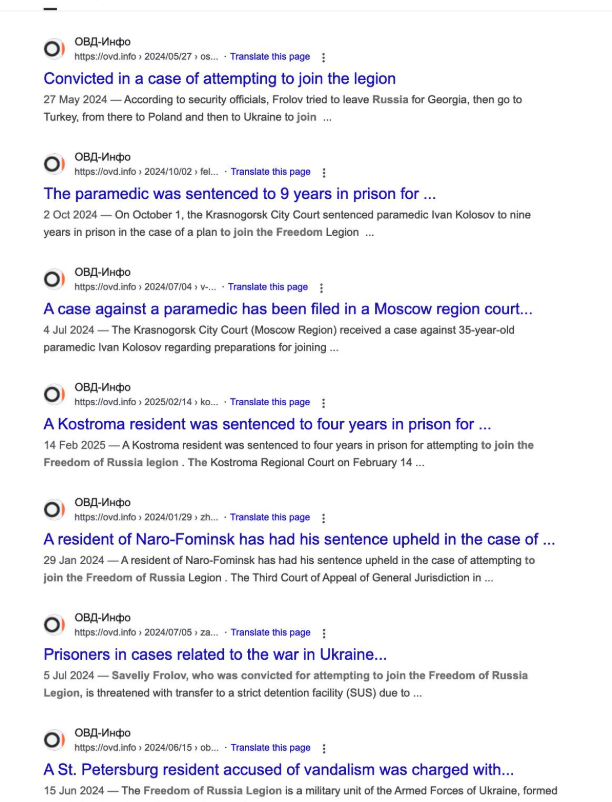
Search results showing news articles about people in Russia being sentenced to lengthy prison terms for attempting to aid Ukrainian paramilitary groups.
Tamoian said reports surface regularly in Russia about people being arrested for trying carry out an action requested by a “Ukrainian recruiter,” with the courts unfailingly imposing harsh sentences regardless of the defendant’s age.
“This keeps happening regularly, but usually there are no details about how exactly the person gets caught,” he said. “All cases related to state treason [and] terrorism are classified, so there are barely any details.”
Tamoian said while he has no direct evidence linking any of the reported arrests and convictions to these phishing sites, he is certain the sites are part of a larger campaign by the Russian government.
“Considering that they keep them alive and keep spawning more, I assume it might be an efficient thing,” he said. “They are on top of DuckDuckGo and Yandex, so it unfortunately works.”
Further reading: Silent Push report, Russian Intelligence Targeting its Citizens and Informants.
from Krebs on Security https://ift.tt/oTXM1g2
via IFTTT

LibreOffice ha lanzado su última versión de mantenimiento, LibreOffice 25.2.2, destinada a mejorar la estabilidad y corregir errores en esta popular suite ofimática de código abierto. Se trata de la segunda actualización de la serie 25.2 y llega aproximadamente un mes después de la anterior versión, LibreOffice 25.2.1.
Esta actualización introduce un total de 83 correcciones de errores, incluyendo mejoras para evitar fallos inesperados en las aplicaciones de la suite. Los cambios detallados pueden consultarse en los registros de cambios de sus versiones candidatas (RC1 y RC2). Como es habitual, LibreOffice 25.2.2 se encuentra disponible para su descarga en el sitio web oficial, con archivos binarios para sistemas operativos basados en DEB y RPM.
La prioridad de esta actualización ha sido mejorar la fiabilidad de la suite, atendiendo a los reportes de fallos enviados por usuarios. Entre las mejoras más destacadas se encuentran:
Con la llegada de la serie 25.2 en febrero de 2025, se introdujo una nueva función de privacidad que permite eliminar automáticamente información personal de los documentos. Con esta característica, los usuarios pueden asegurarse de que sus archivos no conserven datos como:
Los usuarios que hayan instalado LibreOffice a través del sistema de repositorios de su distribución GNU/Linux deberán esperar a que la actualización esté disponible en sus repositorios oficiales. Se recomienda actualizar a esta nueva versión tan pronto como sea posible para beneficiarse de sus mejoras.
LibreOffice 25.2 seguirá recibiendo siete actualizaciones de mantenimiento hasta el 30 de noviembre de 2025. La próxima versión, LibreOffice 25.2.3, está programada para lanzarse entre finales de abril y principios de mayo de 2025.
Además, The Document Foundation recuerda que LibreOffice se ofrece en su edición comunitaria, mantenida por voluntarios. Para entornos empresariales, recomiendan optar por la versión LibreOffice Enterprise, que cuenta con soporte de socios del ecosistema.
Esta actualización refuerza la estabilidad de LibreOffice y mantiene su compromiso con la privacidad del usuario, a la vez que garantiza compatibilidad y correcciones constantes para optimizar la experiencia de uso.
from Linux Adictos https://ift.tt/EUe3yWg
via IFTTT

Desde hace poco, LaLiga está fastidiando a muchos usuarios y empresarios para proteger sus derechos. No es algo que hayamos cubierto aquí en LXA, pero la cosa quedaría así: para limitar el uso de ciertas plataformas IPTV, está bloqueando las IP que usan, y éstas están compartidas con otras plataformas. Está matando moscas a cañonazos, y aunque la justicia española les está dando la razón, están fastidiando también a terceras personas y empresas. Una manera de saltarse el bloqueo es vía VPN — por lo menos por ahora — y en esa dirección ha ido el último movimiento de Vivaldi.
Para proteger parte de nuestra privacidad, podemos usar un DNS distinto al que nos proporciona nuestra operadora. Por ejemplo, 1.1.1.1 de Cloudflare o 8.8.8.8 de Google. Al usar otro DNS, es éste el que gestiona nuestras consultas y, en teoría, nos aparta de la vista de nuestro proveedor. Un paso más allá es usar un VPN, que ofrece protección extra. Uno de los mejores y más fiables es ProtonVPN, hasta el punto de ser el que uso en cualquier dispositivo compatible.
Mi Vivaldi usa pocas extensiones. Tres concretamente: no he eliminado uBlock Origin por lo que pueda pasar — ya no está en la tienda –, uso la extensión de integración de Plasma, pues soy usuario de KDE, y, lo habréis adivinado, ProtonVPN. No lo uso mucho, pero sí cuando quiero acceder a una página bloqueada por mi operadora y si no es suficiente con otra DNS. Pues bien: es posible que pronto «caiga» también esa extensión.
Hace unas horas, Vivaldi ha anunciado un acuerdo con ProtonVPN… pero no ha dado ningún detalle.
Official announcement: We’ve partnered with @ProtonVPN to help you break free from Big Tech!#BreakFree @ProtonPrivacy https://t.co/W3zYKfszSm pic.twitter.com/slOPRwwQDD
— Vivaldi (@vivaldibrowser) March 27, 2025
https://platform.twitter.com/widgets.js
Hasta ahora, creo que no me equivoco cuando digo que Opera es el único navegador con VPN integrado. ¿Cómo funciona? Se activa desde los ajustes y enmascara nuestro uso de Internet. Aunque muchos aseguran que lo que usa Opera no pasa de DNS. Vivaldi debería aportar más información en el futuro, y aclarar cosas como el uso y si la función será gratuita o de pago.
Poco más podemos decir además de que debemos tener paciencia para conocer todos los detalles.
ACTUALIZADO: La novedad es parte de un nuevo lanzamiento de Vivaldi, concretamente la versión 7.3 que ya se puede descargar. Como explica el CEO de la compañía, sólo hay que usar una cuenta de Vivaldi y activar el interruptor que aparece en la barra de herramientas.
from Linux Adictos https://ift.tt/d3wktMH
via IFTTT
India-UN Fund Supports 15 Caribbean Countries in Eliminating Mother-to-Child Transmission of Diseases
Cristina Mitchell
from PAHO/WHO | Pan American Health Organization https://ift.tt/lQTtA5F
via IFTTT
 Pacosite's Blog