A Tumultuous Week for Federal Cybersecurity Efforts

Image: Shutterstock. Greg Meland.

President Trump last week issued a flurry of executive orders that upended a number of government initiatives focused on improving the nation’s cybersecurity posture. The president fired all advisors from the Department of Homeland Security’s Cyber Safety Review Board, called for the creation of a strategic cryptocurrency reserve, and voided a Biden administration action that sought to reduce the risks that artificial intelligence poses to consumers, workers and national security.

On his first full day back in the White House, Trump dismissed all 15 advisory committee members of the Cyber Safety Review Board (CSRB), a nonpartisan government entity established in February 2022 with a mandate to investigate the causes of major cybersecurity events. The CSRB has so far produced three detailed reports, including an analysis of the Log4Shell vulnerability crisis, attacks from the cybercrime group LAPSUS$, and the 2023 Microsoft Exchange Online breach.

The CSRB was in the midst of an inquiry into cyber intrusions uncovered recently across a broad spectrum of U.S. telecommunications providers at the hands of Chinese state-sponsored hackers. One of the CSRB’s most recognizable names is Chris Krebs (no relation), the former director of the Cybersecurity and Infrastructure Security Agency (CISA). Krebs was fired by President Trump in November 2020 for declaring the presidential contest was the most secure in American history, and for refuting Trump’s false claims of election fraud.

South Dakota Governor Kristi Noem, confirmed by the U.S. Senate last week as the new director of the DHS, criticized CISA at her confirmation hearing, TheRecord reports.

Noem told lawmakers CISA needs to be “much more effective, smaller, more nimble, to really fulfill their mission,” which she said should be focused on hardening federal IT systems and hunting for digital intruders. Noem said the agency’s work on fighting misinformation shows it has “gotten far off mission” and involved “using their resources in ways that was never intended.”

“The misinformation and disinformation that they have stuck their toe into and meddled with, should be refocused back onto what their job is,” she said.

Moses Frost, a cybersecurity instructor with the SANS Institute, compared the sacking of the CSRB members to firing all of the experts at the National Transportation Safety Board (NTSB) while they’re in the middle of an investigation into a string of airline disasters.

“I don’t recall seeing an ‘NTSB Board’ being fired during the middle of a plane crash investigation,” Frost said in a recent SANS newsletter. “I can say that the attackers in the phone companies will not stop because the review board has gone away. We do need to figure out how these attacks occurred, and CISA did appear to be doing some good for the vast majority of the federal systems.”

Speaking of transportation, The Record notes that Transportation Security Administration chief David Pekoske was fired despite overseeing critical cybersecurity improvements across pipeline, rail and aviation sectors. Pekoske was appointed by Trump in 2017 and had his 5-year tenure renewed in 2022 by former President Joe Biden.

AI & CRYPTOCURRENCY

Shortly after being sworn in for a second time, Trump voided a Biden executive order that focused on supporting research and development in artificial intelligence. The previous administration’s order on AI was crafted with an eye toward managing the safety and security risks introduced by the technology. But a statement released by the White House said Biden’s approach to AI had hindered development, and that the United States would support AI systems that are “free from ideological bias or engineered social agendas,” to maintain leadership.

The Trump administration issued its own executive order on AI, which calls for an “AI Action Plan” to be led by the assistant to the president for science and technology, the White House “AI & crypto czar,” and the national security advisor. It also directs the White House to revise and reissue policies to federal agencies on the government’s acquisition and governance of AI “to ensure that harmful barriers to America’s AI leadership are eliminated.”

Trump’s AI & crypto czar is David Sacks, an entrepreneur and Silicon Valley venture capitalist who argues that the Biden administration’s approach to AI and cryptocurrency has driven innovation overseas. Sacks recently asserted that non-fungible cryptocurrency tokens and memecoins are neither securities nor commodities, but rather should be treated as “collectibles” like baseball cards and stamps.

There is already a legal definition of collectibles under the U.S. tax code that applies to things like art or antiques, which can be be subject to high capital gains taxes. But Joe Hall, a capital markets attorney and partner at Davis Polk, told Fortune there are no market regulations that apply to collectibles under U.S. securities law. Hall said Sacks’ comments “suggest a viewpoint that it would not be appropriate to regulate these things the way we regulate securities.”

The new administration’s position makes sense considering that the Trump family is deeply and personally invested in a number of recent memecoin ventures that have attracted billions from investors. President Trump and First Lady Melania Trump each launched their own vanity memecoins this month, dubbed $TRUMP and $MELANIA.

The Wall Street Journal reported Thursday the market capitalization of $TRUMP stood at about $7 billion, down from a peak of near $15 billion, while $MELANIA is hovering somewhere in the $460 million mark. Just two months before the 2024 election, Trump’s three sons debuted a cryptocurrency token called World Liberty Financial.

Despite maintaining a considerable personal stake in how cryptocurrency is regulated, Trump issued an executive order on January 23 calling for a working group to be chaired by Sacks that would develop “a federal regulatory framework governing digital assets, including stablecoins,” and evaluate the creation of a “strategic national digital assets stockpile.”

Translation: Using taxpayer dollars to prop up the speculative, volatile, and highly risky cryptocurrency industry, which has been marked by endless scams, rug-pulls, 8-figure cyber heists, rampant fraud, and unrestrained innovations in money laundering.

WEAPONIZATION & DISINFORMATION

Prior to the election, President Trump frequently vowed to use a second term to exact retribution against his perceived enemies. Part of that promise materialized in an executive order Trump issued last week titled “Ending the Weaponization of the Federal Government,” which decried “an unprecedented, third-world weaponization of prosecutorial power to upend the democratic process,” in the prosecution of more than 1,500 people who invaded the U.S. Capitol on Jan. 6, 2021.

On Jan. 21, Trump commuted the sentences of several leaders of the Proud Boys and Oath Keepers who were convicted of seditious conspiracy. He also issued “a full, complete and unconditional pardon to all other individuals convicted of offenses related to events that occurred at or near the United States Capitol on January 6, 2021,” which include those who assaulted law enforcement officers.

The New York Times reports “the language of the document suggests — but does not explicitly state — that the Trump administration review will examine the actions of local district attorneys or state officials, such as the district attorneys in Manhattan or Fulton County, Ga., or the New York attorney general, all of whom filed cases against President Trump.”

Another Trump order called “Restoring Freedom of Speech and Ending Federal Censorship” asserts:

“Over the last 4 years, the previous administration trampled free speech rights by censoring Americans’ speech on online platforms, often by exerting substantial coercive pressure on third parties, such as social media companies, to moderate, deplatform, or otherwise suppress speech that the Federal Government did not approve,” the Trump administration alleged. “Under the guise of combatting ‘misinformation,’ ‘disinformation,’ and ‘malinformation,’ the Federal Government infringed on the constitutionally protected speech rights of American citizens across the United States in a manner that advanced the Government’s preferred narrative about significant matters of public debate.”

Both of these executive orders have potential implications for security, privacy and civil liberties activists who have sought to track conspiracy theories and raise awareness about disinformation efforts on social media coming from U.S. adversaries.

In the wake of the 2020 election, Republicans created the House Judiciary Committee’s Select Subcommittee on the Weaponization of the Federal Government. Led by GOP Rep. Jim Jordan of Ohio, the committee’s stated purpose was to investigate alleged collusion between the Biden administration and tech companies to unconstitutionally shut down political speech.

The GOP committee focused much of its ire at members of the short-lived Disinformation Governance Board, an advisory board to DHS created in 2022 (the “combating misinformation, disinformation, and malinformation” quote from Trump’s executive order is a reference to the board’s stated mission). Conservative groups seized on social media posts made by the director of the board, who resigned after facing death threats. The board was dissolved by DHS soon after.

In his first administration, President Trump created a special prosecutor to probe the origins of the FBI’s investigation into possible collusion between the Trump campaign and Russian operatives seeking to influence the 2016 election. Part of that inquiry examined evidence gathered by some of the world’s most renowned cybersecurity experts who identified frequent and unexplained communications between an email server used by the Trump Organization and Alfa Bank, one of Russia’s largest financial institutions.

Trump’s Special Prosecutor John Durham later subpoenaed and/or deposed dozens of security experts who’d collected, viewed or merely commented on the data. Similar harassment and deposition demands would come from lawyers for Alfa Bank. Durham ultimately indicted Michael Sussman, the former federal cybercrime prosecutor who reported the oddity to the FBI. Sussman was acquitted in May 2022. Last week, Trump appointed Durham to lead the U.S. attorney’s office in Brooklyn, NY.

Quinta Jurecic at Lawfare notes that while the executive actions are ominous, they are also vague, and could conceivably generate either a campaign of retaliation, or nothing at all.

“The two orders establish that there will be investigations but leave open the questions of what kind of investigations, what will be investigated, how long this will take, and what the consequences might be,” Jurecic wrote. “It is difficult to draw firm conclusions as to what to expect. Whether this ambiguity is intentional or the result of sloppiness or disagreement within Trump’s team, it has at least one immediate advantage as far as the president is concerned: generating fear among the broad universe of potential subjects of those investigations.”

On Friday, Trump moved to fire at least 17 inspectors general, the government watchdogs who conduct audits and investigations of executive branch actions, and who often uncover instances of government waste, fraud and abuse. Lawfare’s Jack Goldsmith argues that the removals are probably legal even though Trump defied a 2022 law that required congressional notice of the terminations, which Trump did not give.

“Trump probably acted lawfully, I think, because the notice requirement is probably unconstitutional,” Goldsmith wrote. “The real bite in the 2022 law, however, comes in the limitations it places on Trump’s power to replace the terminated IGs—limitations that I believe are constitutional. This aspect of the law will make it hard, but not impossible, for Trump to put loyalists atop the dozens of vacant IG offices around the executive branch. The ultimate fate of IG independence during Trump 2.0, however, depends less on legal protections than on whether Congress, which traditionally protects IGs, stands up for them now. Don’t hold your breath.”

Among the many Biden administration executive orders revoked by President Trump last week was an action from December 2021 establishing the United States Council on Transnational Organized Crime, which is charged with advising the White House on a range of criminal activities, including drug and weapons trafficking, migrant smuggling, human trafficking, cybercrime, intellectual property theft, money laundering, wildlife and timber trafficking, illegal fishing, and illegal mining.

So far, the White House doesn’t appear to have revoked an executive order that former President Biden issued less than a week before President Trump took office. On Jan. 16, 2025, Biden released a directive that focused on improving the security of federal agencies and contractors, and giving the government more power to sanction the hackers who target critical infrastructure.

from Krebs on Security https://ift.tt/OUX2zFq
via IFTTT

New UN Report: 74 percent of Latin American and Caribbean countries are highly exposed to extreme weather events, affecting food security

New UN Report: 74 percent of Latin American and Caribbean countries are highly exposed to extreme weather events, affecting food security

Cristina Mitchell

27 Jan 2025

from PAHO/WHO | Pan American Health Organization https://ift.tt/lu0PvEx
via IFTTT

Solus 4.7 llega con Linux 6.7 y escritorios actualizados, entre otras novedades

Solus 4.7

El equipo de desarrollo de Solus ha anunciado recientemente el lanzamiento de su versión 4.7, denominada «Endurance». Esta nueva iteración trae consigo importantes novedades y mejoras que buscan garantizar una experiencia optimizada para sus usuarios. Diseñada como una distribución rolling-release independiente, Solus sigue evolucionando y adaptándose a las necesidades de los entusiastas del software libre.

Una de las principales características de Solus 4.7 es la inclusión del kernel Linux 6.12 LTS, que asegura un soporte prolongado para hardware moderno y mayor estabilidad del sistema. Además, la actualización incluye Mesa 24.3, el conjunto de bibliotecas gráficas que optimiza el rendimiento en tareas relacionadas con gráficos y juegos.

Mejoras en los entornos de escritorio de Solus 4.7

Solus 4.7 ofrece las últimas versiones de los entornos de escritorio más populares:

  • Budgie 10.9.2: Continuando con su enfoque en la sencillez y elegancia, este entorno ofrece pequeñas pero significativas mejoras en la experiencia del usuario.
  • GNOME 47.3: Incorpora funcionalidades como colores de acento, compatibilidad mejorada con pantallas pequeñas y un rendimiento más rápido en la renderización GTK.
  • KDE Plasma 6.2.5: Aporta un rendimiento más pulido gracias a sus actualizaciones de Plasma Desktop, Frameworks y Gear.
  • Xfce 4.20: Aunque el soporte para Wayland sigue siendo experimental, esta versión incluye herramientas mejoradas como Mousepad y Thunar.

Compatibilidad con hardware NVIDIA y nuevos gestores de software

Otro de los puntos destacados de esta versión es su soporte nativo para las tarjetas gráficas NVIDIA RTX 4000, eliminando inconvenientes relacionados con pantallas negras durante el proceso de instalación. Esto asegura que los usuarios puedan disfrutar de un sistema plenamente funcional desde el inicio.

Además, Solus 4.7 promueve el uso de gestores de software modernos como GNOME Software y Plasma Discover, en lugar del clásico Solus Software Center. Los usuarios de los entornos Budgie y Xfce también pueden instalar GNOME Software si lo prefieren.

Actualización del software predeterminado en Solus 4.7

El sistema incluye varias aplicaciones actualizadas que refuerzan su utilidad directa tras la instalación de cero:

  • Mozilla Firefox 134.0.2: Ideal para navegación web.
  • Thunderbird 128.6.0: Una herramienta completa para correo y calendario.
  • LibreOffice 24.8.4: Un conjunto de herramientas de oficina para tareas profesionales y personales.

Por otra parte, cada edición de Solus incorpora aplicaciones multimedia específicamente seleccionadas para garantizar la mejor experiencia según el entorno de escritorio elegido. Por ejemplo, Rhythmbox para audio en las ediciones Budgie y GNOME, y Elisa para KDE Plasma.

Modelo Rolling-Release y descarga

Gracias al modelo rolling-release, los usuarios actuales solo necesitan actualizar sus sistemas mediante el gestor de paquetes predeterminado. Esto elimina la necesidad de reinstalaciones frecuentes, permitiendo disfrutar de las últimas versiones de software y funciones sin contratiempos. Para los nuevos usuarios, las imágenes ISO de Solus 4.7 están disponibles en la página de descargas del proyecto.

En el marco de esta actualización, se reafirma el compromiso del equipo de Solus de mantener un flujo constante de mejoras y actualizaciones que sigan garantizando estabilidad y funcionalidad.

from Linux Adictos https://ift.tt/asclobn
via IFTTT

OpenAI lanza Operator: el agente de IA que automatiza tareas online

OpenAI Operator automatiza tareas online

La tecnología de inteligencia artificial ha dado un nuevo paso adelante con la llegada de Operator, el reciente agente presentado por OpenAI. Este innovador sistema promete facilitar nuestras actividades diarias en el entorno digital, automatizando tareas como formularios, reservas o compras en línea. Sin embargo, la herramienta, que actualmente se encuentra en fase de investigación, está limitada a un grupo reducido de usuarios Pro de ChatGPT en Estados Unidos.

Operator, desarrollado por OpenAI, utiliza el modelo denominado Computer-Using Agent (CUA), que combina capacidades avanzadas de visión y razonamiento para interactuar con interfaces gráficas de usuario (GUI). Esto significa que la IA puede simular las acciones de un humano en navegadores web: hacer clic en botones, desplazarse por páginas o rellenar campos de texto.

Características principales de Operator

El principal objetivo de Operator es agilizar las tareas cotidianas que se realizan en línea. Por ejemplo, el usuario puede solicitar al agente que reserve una mesa en un restaurante, busque un vuelo o complete una compra en una tienda online. En caso de encontrarse con un problema, como la falta de disponibilidad en el horario seleccionado o la necesidad de ingresar datos confidenciales, Operator solicitará la intervención humana para finalizar el proceso.

Ejemplo de uso del agente Operator

Una característica destacada es su capacidad de personalización. Los usuarios pueden configurar sus preferencias para tareas recurrentes, como las compras mensuales, o guardar configuraciones específicas para ciertos sitios web. Esta flexibilidad lo convierte en una herramienta útil no solo para particulares, sino también para empresas en busca de soluciones que optimicen sus procesos digitales.

El modelo CUA permite a Operator «ver» las pantallas a través de capturas y utilizar el ratón y el teclado virtualmente para interactuar con elementos como botones, listas desplegables y menús. Además, si detecta errores o desafíos, el agente posee la capacidad de autocorregirse, garantizando así una experiencia más fluida para el usuario.

Acceso y disponibilidad de OpenAI Operator

El acceso a Operator está limitado por ahora a los suscriptores Pro del servicio ChatGPT, quienes deben pagar una cuota mensual de 200 dólares. Además, solo está disponible en los Estados Unidos, aunque OpenAI ha adelantado planes para expandir la herramienta a otras regiones y tipos de suscripción como Plus, Team y Enterprise. La empresa ha creado una plataforma dedicada, operator.chatgpt.com, para facilitar el uso inicial de la herramienta.

Pantalla de uso de Operator

OpenAI ha explicado que esta implementación limitada tiene como objetivo recopilar comentarios y datos del mundo real para perfeccionar el desempeño del agente. Esta «vista previa de investigación» permitirá ajustar sus capacidades antes de ofrecer el servicio a un público más amplio.

Medidas de seguridad y privacidad

Consciente de los riesgos que entraña una herramienta que interactúa autónomamente en la web, OpenAI ha desarrollado Operator con un enfoque particular en la seguridad. La IA está diseñada para solicitar confirmaciones en acciones sensibles como introducir credenciales de inicio de sesión o realizar pagos. Asimismo, rechaza solicitudes maliciosas o ilícitas, y permite al usuario excluirse del uso de sus datos en el entrenamiento del modelo.

Además, Operator incluye filtros preventivos para evitar el acceso a sitios de contenido inapropiado o peligroso y cuenta con un sistema de monitoreo que detecta actividades sospechosas, pausando la ejecución cuando se encuentra contenido potencialmente fraudulento.

El camino por recorrer de OpenAI Operator

Si bien Operator representa un importante avance en la automatización de tareas digitales, OpenAI reconoce que el sistema todavía presenta limitaciones. A la herramienta le cuesta en las interfaces más complejas, como la creación de presentaciones o la gestión detallada de calendarios. No obstante, la empresa trabaja continuamente en colaboración con grandes plataformas como Uber, Instacart y DoorDash para mejorar y expandir su funcionalidad.

Por último, cabe destacar que OpenAI no es la única compañía explorando este ámbito. Empresas como Google y Anthropic también desarrollan agentes similares con capacidades de interacción web, lo que pone de manifiesto un creciente interés en esta tecnología por parte de la industria.

Operator supone un nuevo hito en la evolución de la inteligencia artificial aplicada a la vida cotidiana. Aunque aún queda mucho por perfeccionar para garantizar su accesibilidad global, su combinación de innovación técnica y medidas de seguridad sienta las bases para el desarrollo de asistentes digitales más avanzados y prácticos.

from Linux Adictos https://ift.tt/5BiEvhV
via IFTTT

Bazzite soportará pronto la Lenovo Legion Go S

Bazzite en Lenovo Legion Go S

A principios de este año, durante el CES de 2025 se presentó la Lenovo Legion Go S. Será el primer ordenador de mano, o la primera consola si así lo preferís, en usar SteamOS que no sea la Steam Deck de Valve. Tras ese anuncio, no fuimos pocos los que pensamos que distribuciones como Bazzite tenían los días contados. Nos equivocábamos. Entre otras cosas, cuando afirmaron que seguirían adelante, dijeron que no es el mismo enfoque, y hace unos instantes han anunciado un paso más en dirección a la permanencia.

Ha sido en la red social X, antes Twitter, en la que han publicado la imagen que encabeza este artículo. En ella vemos una Steam Deck blanca, que sin más información tenemos que dar por sentado que no está modificada y es una OLED de edición limitada, y una Lenovo Legion Go S, ambas con el mismo sistema operativo.

Bazzite seguirá adelante a pesar de la liberación de SteamOS

El post no da muchos detalles, más allá de decir que «¿Quién lo llevó mejor? ¿El Steam Deck o el Lenovo Legion Go S? ¡Así es! La compatibilidad con Lenovo Legion Go S estará disponible en la próxima versión estable de Bazzite«. Esa versión estable aún no está disponible, pero lo estará cuando la Legion Go S se ponga a la venta, que será en mayo de este año.

El motivo por el que sigue teniendo sentido una distribución como Bazzite es que no es exactamente lo mismo que SteamOS. Para empezar, la base, que es Fedora y Universal Blue; para continuar, que el software instalado por defecto no tiene nada que ver — Bazzite tiene más programas para jugar tras la instalación de cero –; y para terminar, el soporte para diferente hardware. Valve se centra en su sistema operativo y el hardware de sus socios, y Bazzite piensa diferente.

Bien mirado, los únicos parecidos entre Bazzite y SteamOS son que tienen base Linux y están preparados para usar el modo Big Picture para que la experiencia sea similar a la de una consola tipo la PSP antigua.

En cualquier caso, Bazzite sigue y seguirá vivo como proyecto, y que haya alternativas suele ser positivo.

from Linux Adictos https://ift.tt/UHPiWlN
via IFTTT

Ventoy 1.1 llega con soporte para eweSO

Ventoy 1.1

Desde hace tan sólo unas horas, ya tenemos disponible una nueva versión de una de las herramientas para crear unidades arrancables o bootables más populares. En Linux muchos tiran de Etcher o Raspberry Pi Imager, mientras que nuestros amigos de las ventanitas suelen preferir Rufus. Pero el protagonista de este artículo facilita mucho las cosas, pues, una vez creada la unidad, nos permite arrastrar y soltar ISOs que se podrán iniciar en modo Live. Estoy hablando de Ventoy, concretamente del Ventoy 1.1 lanzado hoy.

Quizá la novedad más destacada de Ventoy 1.1 es el soporte para eweOS. Es una distribución Linux no muy conocida, basada en musl, ligera y para propósito general. Su escritorio por defecto es Xfce, y entre otras cosas usa el gestor de paquetes Pacman de Arch Linux. Lo más importante de esta adición es que los desarrolladores de Ventoy siguen mejorando su software para soportar todo tipo de imágenes, ya sean de distribuciones conocidas como de otras que no lo son tanto.

Ventoy 1.1 incluye correcciones

La lista completa de cambios de Ventoy 1.1 la completarían dos puntos más: se ha actualizado Shim a su última versión y se ha corregido el problema del arranque de SystemRescue con versión 11.02 o posterior. Sus desarrolladores han aprovechado el momento para hablarnos de iVentoy, lo que permite lanzar e instalar sistemas operativos a través de la red (PXE). Para más información, han habilitado una página web, disponible aquí.

Con lanzamientos como el de Ventoy 1.1, se confirma que los desarrolladores que hay detrás de esta herramienta están comprometidos con ofrecer el mejor de los soportes. Ya hace años que es un software fiable, y adiciones como la de eweOS sólo suman opciones.

Sin lugar a dudas, Ventoy seguirá siendo la herramienta favorita para muchos, entre los que se incluye el autor de este artículo. Su facilidad de uso y versatilidad no tienen rival.

from Linux Adictos https://ift.tt/pzEtXWM
via IFTTT

Vivaldi 7.1 llega con un giro más de tuerca en su «tablero», ahora con widget meteorolǵico

Vivaldi 7.1

El pasado octubre, Jon von Tetzchner, CEO de Vivaldi Technologies, nos presentó la versión 7.0 de su navegador en la que se destacaba el nuevo «tablero». Conocido también como «dashboard» por su nombre en inglés, es un filón para todos aquellos usuarios que quieren ver todo tipo de información en pestañas nuevas. Si no recuerdo mal, fue en redes sociales donde preguntaron qué podían añadir en este apartado para mejorarlo, para lo que muchos dijeron que añadiendo un widget con información meteorológica. Hoy nos han presentado Vivaldi 7.1 y parece que, una vez más, escucharon a la comunidad.

Yo recuerdo que me picó el gusanillo y decidí crear mi propio widget de meteorología. Sin trabajarlo mucho, intenté meter uno en una página web propia, pero requería mucho trabajo y decidí añadir un widget de página web con la URL de Weather Channel en mi ubicación. Bueno… queda… usable, pero el nuevo widget del tiempo de Vivaldi 7.1 juega en otra liga.

A mí me gusta ser honesto, y tengo que decir que la captura de cabecera la he hecho en mi máquina virtual con Windows. El motivo es sencillo: aunque Vivaldi y Manjaro trabajan bien juntos — tienen un acuerdo con su versión Cinnamon comunitaria — el lanzamiento oficial se ha producido hace menos de dos horas, por lo que aún no está disponible en mi distribución. Pero el resultado debería ser el mismo.

Otras novedades de Vivaldi 7.1

Siguiendo con el tablero o dashboard, se han añadido varias actualizaciones para mejorarlo. Los estilos de fondos permiten personalizar la vista de los widgets con estilos; el color del tema para el widget web permite ahora coger colores del mismo como se haría con las herramientas para el desarrollador.

Por otra parte, ahora cambiar a Vivaldi o mover las pestañas entre dispositivos es más sencillo. Se ha implementado una nueva función para importar pestañas abiertas que permite enviar las pestañas activas desde otro navegador directamente a Vivaldi.

El inicio rápido es algo más que un apartado con favoritos; es más bien como nuestro lanzador personalizado. Desde mi punto de vista, perdió protagonismo cuando llegó el tablero, pero también ha recibido cariño en Vivaldi 7.1. Ahora es más fácil añadir los enlaces al inicio rápido e intuitivo.

Inicio rápido

Para los usuarios que tengamos Vivaldi instalado en varios dispositivos, la v7.1 tiene una mejora para enviar pestañas de una a otra instancia. ¿Que encontramos un artículo que nos interesaría ver en otro aparato? Hasta hoy teníamos que confiar en la función de sincronización, pero ahora se puede enviar esa pestaña a cualquier instalación del navegador con nombre de famoso compositor. Ya existía el código QR para hacer algo similar con un móvil, pero esto es más sencillo y productivo.

Nuevos motores de búsqueda por defecto y mejoras de rendimiento

Los motores de búsqueda por defecto han cambiado. Vivaldi está asociada con StartPage, Ecosia, DuckDuckGo y Qwant. Las imágenes las buscará en Bing, y StartPage se encargará de las búsquedas en modo incógnito. Claro está, todo esto se puede poner a gusto del consumidor desde los ajustes, y uno no debe pensar mucho para saber que muchos volveréis a poner Google para todo.

Algo que no llama tanto la atención, pero no deja de ser importante,  se ha corregido un bug que pasaba en raras ocasiones, pero podía ser molesto. Se trataba de cierres en sesiones que podían provocar algunas pérdidas de información. Vivaldi 7.1 puede detectar y recuperarse de esos fallos, asegurándonos que toda nuestra navegación vuelve al mismo punto si experimentamos algún accidente.

Cuando pasa algo como lo descrito y volvemos a abrir el navegador, podemos recuperar la sesión desde una ventana emergente. Y si marcamos la casilla de verificación, enviaremos informes automáticos a los desarrolladores. Para mayor privacidad, podemos no marcarla. Pero yo recomiendo colaborar. Es una postura propia, aunque podría entender si alguien no quiere compartir nada del uso que hace en su navegador, y más teniendo en cuenta que usa uno que promete privacidad.

Vivaldi 7.1 se ha anunciado hoy y ya está disponible desde su página web y su versión en paquete snap. Pronto deberían actualizar su paquete flatpak — aún no oficial — y el paquete de su repositorio para distribuciones con base Debian.

from Linux Adictos https://ift.tt/Ey1Y3ao
via IFTTT

SDL 3: La Nueva Era para el Desarrollo en Linux y Juegos Multiplataforma

SDL 3

SDL 3, conocida por ser una de las librerías más usadas en el desarrollo de videojuegos y software multiplataforma, ha lanzado oficialmente su versión más reciente (3.2). Este nuevo lanzamiento promete facilitar aún más el trabajo de los desarrolladores, ofreciendo una experiencia mejorada gracias a una serie de innovaciones tecnológicas y optimizaciones.

El lanzamiento de SDL 3 no solo revoluciona la forma en que los desarrolladores abordan el hardware y software en múltiples plataformas, sino que además ofrece herramientas avanzadas que son cruciales para el desarrollo moderno. Desde una compatibilidad optimizada hasta un amplio soporte para hardware moderno, esta nueva versión es un salto significativo respecto a SDL 2. Cabe destacar que SDL 3.2 es la primera versión estable de la serie 3.x.

¿Qué novedades trae SDL 3?

La versión 3.0 de SDL ha sido diseñada para dar respuesta a las crecientes demandas del desarrollo moderno, especialmente en entornos como Linux. Entre sus principales avances, destacan:

  • APIs nuevas y mejoradas: SDL 3 introduce APIs que permiten manejar gráficos en 3D avanzados, compatibilidad con cámaras, sistemas de almacenamiento, entre otros.
  • Soporte para Vulkan y PipeWire: En sistemas Linux, SDL 3 prioriza PipeWire sobre PulseAudio, y mejora significativamente el soporte para Wayland.
  • Compatibilidad con SDL 2: Gracias a un sistema de compatibilidad llamado sdl2-compat, los desarrolladores pueden seguir ejecutando proyectos en SDL 2 mientras aprovechan los beneficios que trae la versión más reciente.
  • Optimización HiDPI: Mejora considerablemente la forma en que se manejan pantallas de alta resolución en plataformas móviles y de escritorio.

Una documentación más completa y amigable

Uno de los aspectos más celebrados de SDL 3 es su documentación, que ha sido completamente revisada y ampliada. Los desarrolladores cuentan ahora con ejemplos funcionales que pueden ejecutar directamente en navegadores web, lo que facilita la adopción y experimentación con las nuevas APIs. El cambio hacia una nomenclatura más consistente dentro de las APIs es igualmente destacable, ofreciendo claridad y reduciendo la confusión entre diferentes subsistemas.

Características técnicas atractivas de SDL 3

La nueva versión también incorpora funcionalidades que estaban ausentes en iteraciones previas:

  • Dispositivos de audio lógicos y personalizables: Ahora es posible asignar dispositivos de audio únicos a diferentes partes de una aplicación.
  • Gestión avanzada de colores y DPI: Preparando el camino hacia un mejor soporte para HDR y colorespaces diferenciados.
  • Nuevas capacidades de hardware: La compatibilidad con cámaras, lápices digitales como Apple Pencil o Wacom, y teclados virtuales personalizables en Android e iOS son evidencia de su enfoque en tecnologías modernas.

Estas mejoras hacen posible un desarrollo más robusto y adaptativo para entornos mucho más exigentes que los de SDL 2.

Diseño pensado en la flexibilidad

SDL 3 integra también un conjunto de APIs como la de almacenamiento y propiedades, que son vitales para manejar datos y configuraciones en aplicaciones multiplataforma. Además, la nueva API GPU permite renderizado avanzado y cálculos a nivel de GPU con un enfoque completamente transversal.

Unas de las inclusiones más destacadas son la API de procesos para trabajar con subprocesos, la API de sistema de diálogo, y la posibilidad de ejecutar programas principales desde callbacks en lugar del clásico main(). Herramientas altamente funcionales y flexibles.

SDL 3 viene cargado con una enorme cantidad de innovaciones que apuntan no solo a optimizar la experiencia del desarrollador, sino también a garantizar que las aplicaciones desarrolladas ofrezcan el mayor rendimiento y compatibilidad posible en múltiples escenarios. Su código está disponible en GitHub.

from Linux Adictos https://ift.tt/baXnxz2
via IFTTT

MasterCard DNS Error Went Unnoticed for Years

The payment card giant MasterCard just fixed a glaring error in its domain name server settings that could have allowed anyone to intercept or divert Internet traffic for the company by registering an unused domain name. The misconfiguration persisted for nearly five years until a security researcher spent $300 to register the domain and prevent it from being grabbed by cybercriminals.

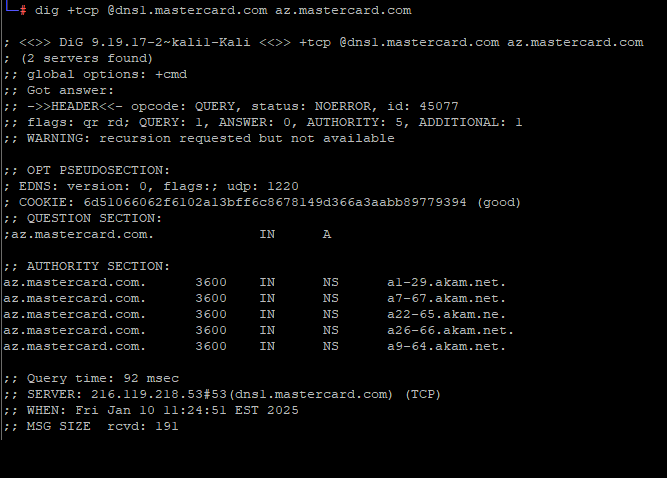
A DNS lookup on the domain az.mastercard.com on Jan. 14, 2025 shows the mistyped domain name a22-65.akam.ne.

From June 30, 2020 until January 14, 2025, one of the core Internet servers that MasterCard uses to direct traffic for portions of the mastercard.com network was misnamed. MasterCard.com relies on five shared Domain Name System (DNS) servers at the Internet infrastructure provider Akamai [DNS acts as a kind of Internet phone book, by translating website names to numeric Internet addresses that are easier for computers to manage].

All of the Akamai DNS server names that MasterCard uses are supposed to end in “akam.net” but one of them was misconfigured to rely on the domain “akam.ne.”

This tiny but potentially critical typo was discovered recently by Philippe Caturegli, founder of the security consultancy Seralys. Caturegli said he guessed that nobody had yet registered the domain akam.ne, which is under the purview of the top-level domain authority for the West Africa nation of Niger.

Caturegli said it took $300 and nearly three months of waiting to secure the domain with the registry in Niger. After enabling a DNS server on akam.ne, he noticed hundreds of thousands of DNS requests hitting his server each day from locations around the globe. Apparently, MasterCard wasn’t the only organization that had fat-fingered a DNS entry to include “akam.ne,” but they were by far the largest.

Had he enabled an email server on his new domain akam.ne, Caturegli likely would have received wayward emails directed toward mastercard.com or other affected domains. If he’d abused his access, he probably could have obtained website encryption certificates (SSL/TLS certs) that were authorized to accept and relay web traffic for affected websites. He may even have been able to passively receive Microsoft Windows authentication credentials from employee computers at affected companies.

But the researcher said he didn’t attempt to do any of that. Instead, he alerted MasterCard that the domain was theirs if they wanted it, copying this author on his notifications. A few hours later, MasterCard acknowledged the mistake, but said there was never any real threat to the security of its operations.

“We have looked into the matter and there was not a risk to our systems,” a MasterCard spokesperson wrote. “This typo has now been corrected.”

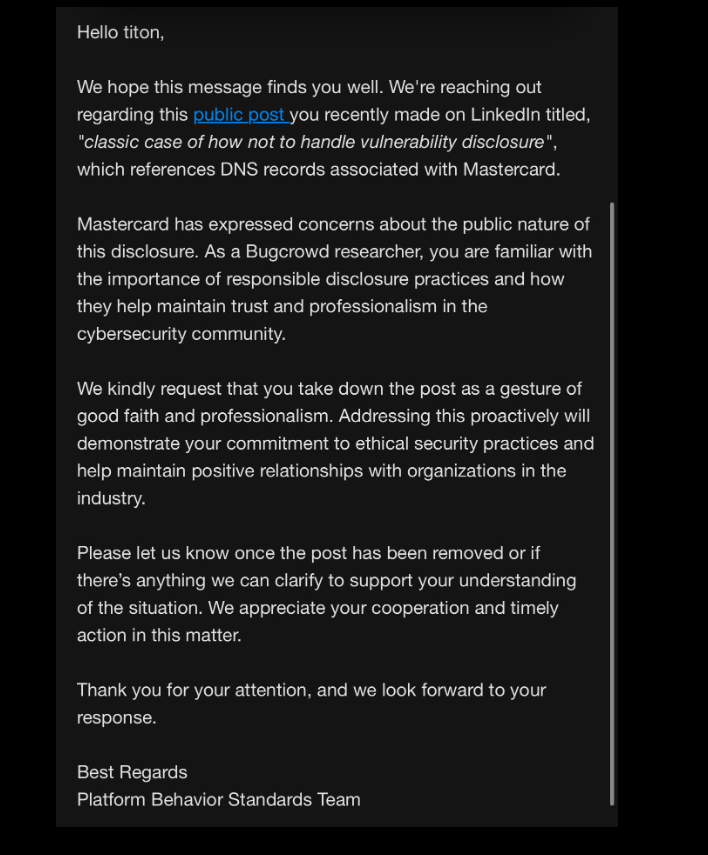
Meanwhile, Caturegli received a request submitted through Bugcrowd, a program that offers financial rewards and recognition to security researchers who find flaws and work privately with the affected vendor to fix them. The message suggested his public disclosure of the MasterCard DNS error via a post on LinkedIn (after he’d secured the akam.ne domain) was not aligned with ethical security practices, and passed on a request from MasterCard to have the post removed.

MasterCard’s request to Caturegli, a.k.a. “Titon” on infosec.exchange.

Caturegli said while he does have an account on Bugcrowd, he has never submitted anything through the Bugcrowd program, and that he reported this issue directly to MasterCard.

“I did not disclose this issue through Bugcrowd,” Caturegli wrote in reply. “Before making any public disclosure, I ensured that the affected domain was registered to prevent exploitation, mitigating any risk to MasterCard or its customers. This action, which we took at our own expense, demonstrates our commitment to ethical security practices and responsible disclosure.”

Most organizations have at least two authoritative domain name servers, but some handle so many DNS requests that they need to spread the load over additional DNS server domains. In MasterCard’s case, that number is five, so it stands to reason that if an attacker managed to seize control over just one of those domains they would only be able to see about one-fifth of the overall DNS requests coming in.

But Caturegli said the reality is that many Internet users are relying at least to some degree on public traffic forwarders or DNS resolvers like Cloudflare and Google.

“So all we need is for one of these resolvers to query our name server and cache the result,” Caturegli said. By setting their DNS server records with a long TTL or “Time To Live” — a setting that can adjust the lifespan of data packets on a network — an attacker’s poisoned instructions for the target domain can be propagated by large cloud providers.

“With a long TTL, we may reroute a LOT more than just 1/5 of the traffic,” he said.

The researcher said he’d hoped that the credit card giant might thank him, or at least offer to cover the cost of buying the domain.

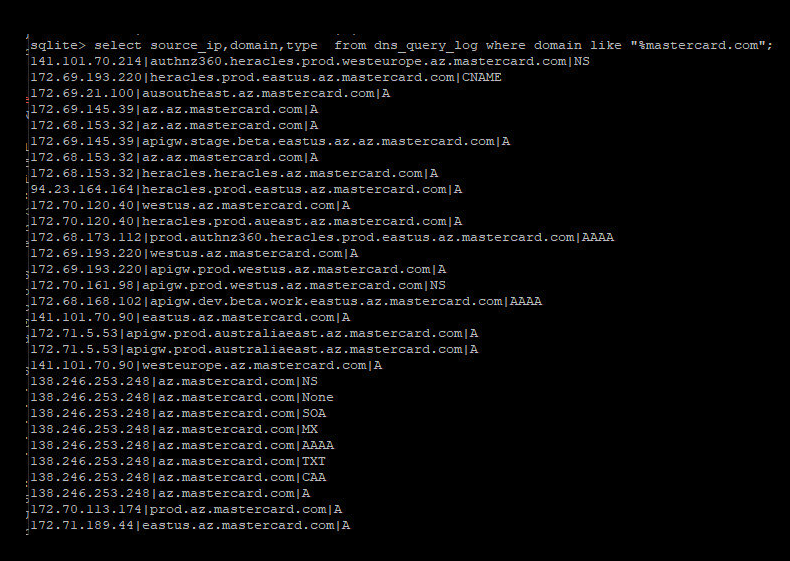
“We obviously disagree with this assessment,” Caturegli wrote in a follow-up post on LinkedIn regarding MasterCard’s public statement. “But we’ll let you judge— here are some of the DNS lookups we recorded before reporting the issue.”

Caturegli posted this screenshot of MasterCard domains that were potentially at risk from the misconfigured domain.

As the screenshot above shows, the misconfigured DNS server Caturegli found involved the MasterCard subdomain az.mastercard.com. It is not clear exactly how this subdomain is used by MasterCard, however their naming conventions suggest the domains correspond to production servers at Microsoft’s Azure cloud service. Caturegli said the external Internet address of these servers is mostly Cloudflare, but internally the domains all resolve to Internet addresses at Microsoft.

“Don’t be like Mastercard,” Caturegli concluded in his LinkedIn post. “Don’t dismiss risk, and don’t let your marketing team handle security disclosures.”

One final note: The domain akam.ne has been registered previously — in December 2016 by someone using the email address um-i-delo@yandex.ru. The Russian search giant Yandex reports this user account belongs to an “Ivan I.” from Moscow. Passive DNS records from DomainTools.com show that between 2016 and 2018 the domain was connected to an Internet server in Germany, and that the domain was left to expire in 2018.

This is interesting given a comment on Caturegli’s LinkedIn post from an ex-Cloudflare employee who linked to a report he co-authored on a similar typo domain apparently registered in 2017 for organizations that may have mistyped their AWS DNS server as “awsdns-06.ne” instead of “awsdns-06.net.” DomainTools reports that this typo domain also was registered to a Yandex user (playlotto@yandex.ru), and was hosted at the same German ISP — Team Internet (AS61969).

from Krebs on Security https://ift.tt/GSsNbVx
via IFTTT