Darktable 5.0 ha llegado para revolucionar la edición de imágenes RAW, gracias a una multitud de mejoras diseñadas tanto para fotógrafos profesionales como para entusiastas. Este software de código abierto se ha convertido en una herramienta indispensable para quienes buscan un flujo de trabajo completo y eficiente en la postproducción de fotografía digital.
En esta nueva versión, se destaca un enfoque renovado en la experiencia y la interfaz del usuario (UX/UI), ofreciendo estilos específicos para más de 500 modelos de cámaras. Esto permite que las imágenes editadas emulen con mayor precisión la apariencia de los JPEG directamente desde la cámara. Además, se ha incluido un tema de alto contraste con texto blanco brillante sobre un fondo gris oscuro, ideal para sesiones de trabajo prolongadas. Los usuarios principiantes también cuentan con nuevas pistas visuales para facilitar su curva de aprendizaje.
Principales características y mejoras de Darktable 5.0
Darktable 5.0 no solo actualiza su interfaz, sino que también introduce funcionalidades que optimizan el flujo de trabajo. Entre sus novedades más destacadas se encuentran:
Arrastrar y soltar módulos: Ahora se pueden reorganizar los módulos en los paneles laterales, tanto horizontal como verticalmente. Esto aporta una flexibilidad nunca antes vista en la configuración de la herramienta.
Filtros avanzados: Incorporación de filtros basados en datos de exposición y nuevas funcionalidades para la corrección de color con herramientas mejoradas.
Compatibilidad ampliada: Introducción de soporte para cámaras como Fujifilm X-M5, Leica Q3, y Sony ILCE-1M2, entre muchas otras. También se añaden perfiles de ruido y balance de blancos para modelos adicionales.
Soporte de nuevos formatos: Importación de formatos como JPEG 2000 y HEIF con diferentes extensiones y características avanzadas.
Incremento en el rendimiento
Además de las mejoras en la usabilidad, Darktable 5.0 ha optimizado su rendimiento para operaciones en lote, agilizando tareas como la exportación de imágenes y la carga de archivos complejos. Esto es posible gracias a la implementación de un núcleo OpenCL para el ecualizador de color y técnicas de paralelización en sus algoritmos.
Los usuarios también podrán experimentar una codificación más rápida en el formato AVIF, manteniendo una calidad de salida excelente. Estas mejoras no solo ahorran tiempo, sino que también garantizan una experiencia más fluida incluso al trabajar con grandes volúmenes de imágenes.
Nuevas funciones para fotógrafos exigentes
El equipo detrás de Darktable ha implementado herramientas avanzadas que facilitan tareas específicas. Por ejemplo, ahora es posible editar muestras de color en vivo, aplicar ajustes de módulos específicos a múltiples imágenes al mismo tiempo y personalizar patrones de nombres para archivos exportados.
En el ámbito del color, destaca la incorporación de un indicador visual en el módulo de calibración de color cuando se aplican ajustes no estándar. Para los usuarios que utilizan histogramas, también se han añadido nuevas funciones que permiten una interacción más precisa y personalizada, reflejando el compromiso de Darktable con la flexibilidad y el detalle.
Corrección de errores y estabilidad
Como en toda actualización importante, Darktable 5.0 ha resuelto numerosos errores que mejoran la estabilidad general del programa. Desde la sincronización de módulos hasta ajustes para garantizar resultados consistentes entre CPU y GPU, este lanzamiento asegura un funcionamiento confiable para los usuarios más exigentes.
Disponibilidad y descarga de Darktable 5.0
Darktable 5.0 ya está disponible para su descarga en todas las principales plataformas, incluyendo distribuciones GNU/Linux, Windows y macOS. Además, los usuarios pueden acceder a esta nueva versión como una aplicación Flatpak a través de Flathub. Para detalles más técnicos y notas completas de la versión, se pueden consultar en el repositorio oficial de GitHub.
Darktable sigue siendo una opción sólida y en crecimiento para los fotógrafos que buscan alternativas de código abierto, ofreciendo un equilibrio perfecto entre potencia, versatilidad y facilidad de uso.
WineHQ sigue dándole la forma final a la próxima versión estable de Wine IS Not an Emulator. Hace una semana, siempre en viernes, llegó la rc2 con casi 50 cambios, y esta semana han realizado varios retoques más con el lanzamiento de WINE 10.0-rc3. Como dice el dicho, nunca es tarde si la dicha es buena, y en los últimos siete días han corregido un bug añejo, que estaba presente desde hacía casi 16 años.
Las notas de lanzamiento, es decir, en la lista de destacados sigue sin mostrar nada en especial, y en ese apartado sólo se puede leer «Corrección de errores sólo, estamos en la congelación de código«. Sí se sabe que han realizado un total de 40 cambios, entre los que hay 15 bugs. Entre ellos se encuentra uno que se ha cerrado a lo largo de esta semana, pero que fue reportado en febrero de 2008. El fallo en cuestión hacía que dual no fuera compatible con World of Warcraft y Starcraft 2 en sistemas multinúcleo / SMP.
Bugs corregidos en WINE 10.0-rc3
Dual-core no soportado en WoW y SC2.
Los vídeos de Chaos Legion se reproducen al revés.
No hay entrada de teclado en «STREET CHAVES – O LUTADOR DA VILA».
Parallel Port Tester no arranca (no localiza el driver «System32\Drivers\inpoutx64.sys», pero cambiando a ruta absoluta funciona).
Ladrillos: al mover un ladrillo, éste alterna rápidamente de posición.
El inicio de un programa nativo con «start /unix …» no funciona.
Explorer no puede ejecutar ningún archivo en modo de compatibilidad con Windows ME (o inferior).
Startopia se queda atascado en una pantalla negra al iniciarse.
IL-2 1946 se bloquea al iniciarse.
Dark Age of Camelot – camelot.exe requiere igd10umd32.dll pero el archivo .dll no se encuentra.
Pintar en una aplicación propietaria se rompe con el renderizador vulkan.
El modo escritorio ya no muestra la barra de tareas.
PokerTracker 4: ya no se puede iniciar.
No se puede interactuar con los iconos de Systray.
CMake no encuentra toolchain.
WINE 10.0-rc3 yase puede descargar desde el botón que tenéis debajo de estas líneas. En su página de descargas hay también información sobre cómo instalar esta y otras versiones en sistemas operativos Linux y otros como macOS e incluso Android.
Si todo va según lo programado, dentro de siete días llegará WINE 10.0-rc4, y habrá una nueva RC cada semana hasta el lanzamiento de la versión estable que veremos en enero o principios de febrero.
Lenovo parece estar lista para dar un paso decisivo en el mercado de las consolas portátiles con su próximo modelo, la Lenovo Legion Go S. Este dispositivo no solo apunta a rivalizar directamente con la popular Steam Deck de Valve, sino que también podría convertirse en la primera consola portátil ajena a Valve en adoptar de manera oficial el sistema operativo SteamOS, una noticia que ha generado un gran revuelo en la comunidad de jugadores.
La Lenovo Legion Go S ha captado la atención de expertos y aficionados tras una serie de filtraciones y anuncios que han dejado entrever sus características. El CES 2025, que se celebrará el próximo 7 de enero en Las Vegas, será el escenario escogido para su presentación oficial. En teoría. Este evento contará con la presencia destacada de Pierre-Loup Griffais, codiseñador de SteamOS y Steam Deck, y Jason Ronald, vicepresidente de dispositivos y ecosistemas de Xbox de Microsoft. Estas figuras clave del sector refuerzan la importancia del lanzamiento.
Lenovo Legion Go S: un diseño innovador con acento en SteamOS
Según las imágenes reveladas, la Lenovo Legion Go S contará con un diseño cuidadosamente pensado, que incluirá un botón dedicado para Steam, un indicio claro de que el dispositivo se ejecutará bajo el sistema operativo de Valve. SteamOS podría ofrecer ventajas significativas frente a Windows, tanto en términos de precio como en optimización para juegos.
La consola estará disponible en variantes con diferentes acabados, destacando los modelos en blanco y gris oscuro. Se especula que solo algunos colores tendrán el botón dedicado a Steam, posiblemente como una estrategia para ofrecer opciones tanto con SteamOS como con Windows, atendiendo a diferentes segmentos de usuarios.
Hardware a la altura de las expectativas
En cuanto al apartado técnico, todo apunta a que la Lenovo Legion Go S estará equipada con el procesador AMD Ryzen Z2, un chip diseñado específicamente para dispositivos portátiles de alto rendimiento. Este hardware promete un equilibrio ideal entre potencia y eficiencia, posicionando a la consola como una opción competitiva en el mercado.
Además, su diseño compacto y modular incluirá mandos desmontables al estilo Joy-Con y posiblemente una pantalla de alta calidad con tecnología OLED, que ofrecerá colores más vibrantes y negros más profundos en comparación con los paneles LCD tradicionales.
Un movimiento estratégico de Valve
La colaboración de Valve con Lenovo para implementar SteamOS en la Legion Go S parece ser una estrategia clave para expandir su ecosistema más allá de la Steam Deck. Valve no solo busca posicionarse como un referente en hardware, sino también consolidar su sistema operativo como una alternativa viable a Windows en dispositivos de juego portátiles. Esto abre la puerta a nuevas oportunidades de negocio para otros fabricantes que deseen integrar SteamOS en sus dispositivos.
Además de la Lenovo Legion Go S, ¿qué más podemos esperar del CES 2025?
El evento «Lenovo Legion x AMD: El futuro de los dispositivos portátiles para juegos» también promete importantes anuncios relacionados con la tecnología de AMD. Entre las posibles novedades está la presentación de los procesadores AMD Ryzen Z2 Extreme, que podrían incluirse en modelos superiores como la Lenovo Legion Go 2.
Por otro lado, Microsoft también parece jugar un papel crucial en este ecosistema emergente. Aunque es poco probable que se anuncie una consola portátil de Xbox, su colaboración con Lenovo podría reforzar la integración de servicios como Xbox Game Pass y xCloud en dispositivos que utilicen SteamOS, expandiendo aún más las posibilidades para los jugadores.
Adicionalmente, filtraciones sugieren que Lenovo podría lanzar una versión de la Legion Go S más económica, aprovechando las ventajas de SteamOS para reducir costes asociados a licencias de Windows. Esto posicionaría a la consola como una alternativa accesible dentro de un mercado cada vez más competitivo.
Con el lanzamiento de la Lenovo Legion Go S, el segmento de las consolas portátiles híbridas está a punto de entrar en una nueva etapa. Este dispositivo no solo amplía las opciones para los jugadores, sino que también marca un paso significativo hacia la diversificación de sistemas operativos en el ámbito gaming portátil. La cita está servida para el 7 de enero de 2025, donde finalmente conoceremos todos los detalles sobre esta prometedora consola.
IPFire 2.29 Core Update 190ha llegado para revolucionar la experiencia de los usuarios con un conjunto de mejoras que combinan seguridad, rendimiento y preparativos para las tecnologías más avanzadas, como el Wi-Fi 7. Esta actualización de la plataforma GNU/Linux, reconocida por su robustez como firewall y router, se presenta como una herramienta esencial para empresas y usuarios que priorizan la protección y la funcionalidad.
Con base en el kernel de Linux 6.6 LTS, concretamente 6.6.63, este lanzamiento no solo aborda las demandas actuales del mercado, sino que también anticipa futuras necesidades al incorporar innovaciones como la criptografía post-cuántica. Por otra parte, se han realizado mejoras clave en su interfaz y funcionalidad, lo que lo posiciona como uno de los sistemas de seguridad más completos del momento.
IPFire 2.29 Core 190: soporte avanzado de criptografía para un futuro más seguro
Uno de los aspectos más destacados es la inclusión de soporte para criptografía post-cuántica en los intercambios de claves SSH. Este avance incluye el novedoso Streamlined NTRU Prime (sntrup761) y el mecanismo de encapsulación basado en módulos, MK-KEM (mlkem768x25519-sha256). Con estas herramientas, IPFire se adelanta a las amenazas que podrían surgir con la llegada de la computación cuántica.
Por otro lado, esta versión elimina el soporte para claves RSA en la interfaz web y en las conexiones SSH en instalaciones nuevas. Sin embargo, para los sistemas existentes, las claves RSA permanecerán intactas con el fin de evitar problemas con herramientas de monitorización.
Preparativos para la era del Wi-Fi 7
El lanzamiento de Core Update 190 también prepara el sistema para la implementación de Wi-Fi 7, una tecnología que promete transformar la conectividad inalámbrica. Entre las novedades, se incluye la función de escaneo por vecindario para encontrar automáticamente el mejor canal disponible. Además, se han revisado partes de la interfaz web para facilitar la configuración del punto de acceso inalámbrico.
Otro detalle notable es el registro de eventos de «hostapd» en el syslog, lo que simplifica significativamente los procesos de depuración y ajuste del sistema.
Mejoras en la seguridad y gestión del cortafuegos
La seguridad sigue siendo una prioridad, y así lo demuestran las mejoras en la configuración del cortafuegos, como la posibilidad de activar o desactivar individualmente el escaneo del tráfico IPsec. También se han optimizado las reglas relacionadas con la protección contra SYN Flood, asegurando que los cambios se apliquen de manera eficiente.
Además, la nueva versión permite gestionar claves precompartidas que contengan comas, algo que anteriormente no era posible. Estas opciones amplían la flexibilidad y personalización del sistema.
Correcciones y mejoras adicionales
No han faltado las correcciones de errores en esta actualización. Se han solucionado fallos en el puente entre Unbound y las concesiones DHCP, así como un error en la página de ajustes de OpenVPN cuando se utilizaban conexiones roadwarrior con grupos de IP estáticas.
Por otra parte, IPFire ahora ofrece una opción de instalación de consola serie en sistemas UEFI, mejora el proceso de arranque para mostrar menos mensajes informativos innecesarios y actualiza el paquete de certificados CA para incrementar la compatibilidad.
Asimismo, se han actualizado diversos complementos y componentes internos del sistema, asegurando que cada elemento funcione con la última tecnología disponible.
IPFire 2.29 Core 190: un sistema robusto y preparado para el futuro
IPFire 2.29 Core Update 190 no solo reafirma su compromiso con la seguridad digital, sino que también demuestra su capacidad de adaptación a los cambios tecnológicos. Desde la integración de criptografía avanzada hasta los preparativos para un mundo conectado con Wi-Fi 7, esta actualización es una muestra de innovación constante.
Con una interfaz optimizada, mejoras en la experiencia del usuario y actualizaciones internas significativas, este software se convierte en una herramienta imprescindible para quienes buscan una solución de red fiable y de alto rendimiento.
Cybercriminals are selling hundreds of thousands of credential sets stolen with the help of a cracked version of Acunetix, a powerful commercial web app vulnerability scanner, new research finds. The cracked software is being resold as a cloud-based attack tool by at least two different services, one of which KrebsOnSecurity traced to an information technology firm based in Turkey.
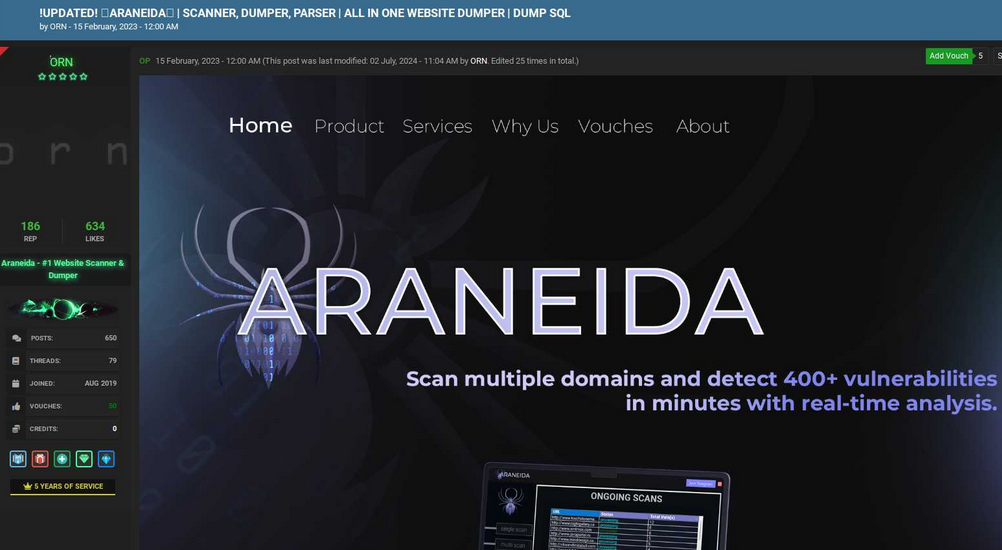
Araneida Scanner.
Cyber threat analysts at Silent Push said they recently received reports from a partner organization that identified an aggressive scanning effort against their website using an Internet address previously associated with a campaign by FIN7, a notorious Russia-based hacking group.
But on closer inspection they discovered the address contained an HTML title of “Araneida Customer Panel,” and found they could search on that text string to find dozens of unique addresses hosting the same service.
It soon became apparent that Araneida was being resold as a cloud-based service using a cracked version of Acunetix, allowing paying customers to conduct offensive reconnaissance on potential target websites, scrape user data, and find vulnerabilities for exploitation.
Silent Push also learned Araneida bundles its service with a robust proxy offering, so that customer scans appear to come from Internet addresses that are randomly selected from a large pool of available traffic relays.
The makers of Acunetix, Texas-based application security vendor Invicti Security, confirmed Silent Push’s findings, saying someone had figured out how to crack the free trial version of the software so that it runs without a valid license key.
“We have been playing cat and mouse for a while with these guys,” said Matt Sciberras, chief information security officer at Invicti.
Silent Push said Araneida is being advertised by an eponymous user on multiple cybercrime forums. The service’s Telegram channel boasts nearly 500 subscribers and explains how to use the tool for malicious purposes.
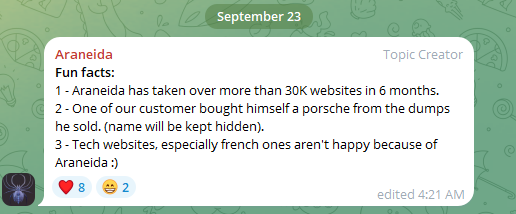
In a “Fun Facts” list posted to the channel in late September, Araneida said their service was used to take over more than 30,000 websites in just six months, and that one customer used it to buy a Porsche with the payment card data (“dumps”) they sold.
Araneida Scanner’s Telegram channel bragging about how customers are using the service for cybercrime.
“They are constantly bragging with their community about the crimes that are being committed, how it’s making criminals money,” said Zach Edwards, a senior threat researcher at Silent Push. “They are also selling bulk data and dumps which appear to have been acquired with this tool or due to vulnerabilities found with the tool.”
Silent Push also found a cracked version of Acunetix was powering at least 20 instances of a similar cloud-based vulnerability testing service catering to Mandarin speakers, but they were unable to find any apparently related sales threads about them on the dark web.
According to an August 2023 report (PDF) from the U.S. Department of Health and Human Services (HHS), Acunetix (presumably a cracked version) is among several tools used by APT 41, a prolific Chinese state-sponsored hacking group.
THE TURKISH CONNECTION
Silent Push notes that the website where Araneida is being sold — araneida[.]co — first came online in February 2023. But a review of this Araneida nickname on the cybercrime forums shows they have been active in the criminal hacking scene since at least 2018.
A search in the threat intelligence platform Intel 471 shows a user by the name Araneida promoted the scanner on two cybercrime forums since 2022, including Breached and Nulled. In 2022, Araneida told fellow Breached members they could be reached on Discord at the username “Ornie#9811.”
According to Intel 471, this same Discord account was advertised in 2019 by a person on the cybercrime forum Cracked who used the monikers “ORN” and “ori0n.” The user “ori0n” mentioned in several posts that they could be reached on Telegram at the username “@sirorny.”
Orn advertising Araneida Scanner in Feb. 2023 on the forum Cracked. Image: Ke-la.com.
The Sirorny Telegram identity also was referenced as a point of contact for a current user on the cybercrime forum Nulled who is selling website development services, and who references araneida[.]co as one of their projects. That user, “Exorn,” has posts dating back to August 2018.
In early 2020, Exorn promoted a website called “orndorks[.]com,” which they described as a service for automating the scanning for web-based vulnerabilities. A passive DNS lookup on this domain at DomainTools shows that its email records pointed to the address ori0nbusiness@protonmail.com.
Constella Intelligence, a company that tracks information exposed in data breaches, finds this email address was used to register an account at Breachforums in July 2024 under the nickname “Ornie.” Constella also finds the same email registered at the website netguard[.]codes in 2021 using the password “ceza2003” [full disclosure: Constella is currently an advertiser on KrebsOnSecurity].
A search on the password ceza2003 in Constella finds roughly a dozen email addresses that used it in an exposed data breach, most of them featuring some variation on the name “altugsara,” including altugsara321@gmail.com. Constella further finds altugsara321@gmail.com was used to create an account at the cybercrime community RaidForums under the username “ori0n,” from an Internet address in Istanbul.
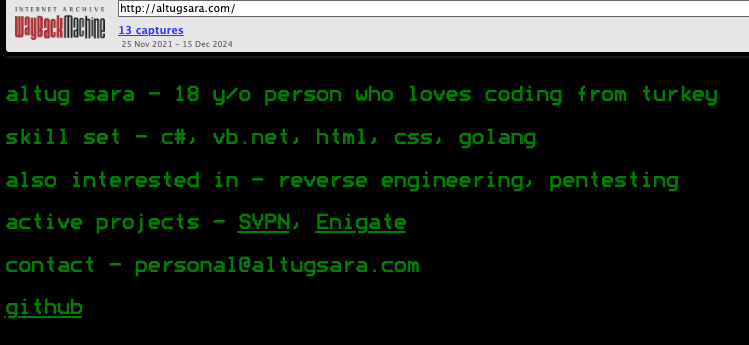
According to DomainTools, altugsara321@gmail.com was used in 2020 to register the domain name altugsara[.]com. Archive.org’s history for that domain shows that in 2021 it featured a website for a then 18-year-old Altuğ Şara from Ankara, Turkey.
Archive.org’s recollection of what altugsara dot com looked like in 2021.
LinkedIn finds this same altugsara[.]com domain listed in the “contact info” section of a profile for an Altug Sara from Ankara, who says he has worked the past two years as a senior software developer for a Turkish IT firm called Bilitro Yazilim.
Neither Altug Sara nor Bilitro Yazilim responded to requests for comment.
Invicti’s website states that it has offices in Ankara, but the company’s CEO said none of their employees recognized either name.
“We do have a small team in Ankara, but as far as I know we have no connection to the individual other than the fact that they are also in Ankara,” Invicti CEO Neil Roseman told KrebsOnSecurity.
Researchers at Silent Push say despite Araneida using a seemingly endless supply of proxies to mask the true location of its users, it is a fairly “noisy” scanner that will kick off a large volume of requests to various API endpoints, and make requests to random URLs associated with different content management systems.
What’s more, the cracked version of Acunetix being resold to cybercriminals invokes legacy Acunetix SSL certificates on active control panels, which Silent Push says provides a solid pivot for finding some of this infrastructure, particularly from the Chinese threat actors.
Siguiendo con su calendario habitual, en el que hay nueva actualización de mantenimiento cada mes o mes y medio aproximadamente, The Document Foundation acaba de hacer oficial el lanzamiento de LibreOffice 24.8.4. Esta es la cuarta versión correctiva de la serie 24.8, que llegó en agosto — como indica el número 8 — de 2024 — como indica el número 24. Lógicamente, la cuarta ha llegado después de la tercera, disponible desde mediados de noviembre, hace justo cinco semanas.
En LibreOffice 24.8.4 se han corregido un total de 55 fallos, 43 de los cuales encontramos en la nota de lanzamiento de la RC1 y otros 12 en la nota de la RC2. En cuanto a nuevas funciones, no hay, ya que éstas llegan en las actualizaciones mayores o medianas, que suelen tener lugar cada seis meses. La última en recibir cambios en forma de funciones nuevas llegó, como ya hemos indicado, en agosto de este 2024. Entre las novedades encontrábamos algunas como retoques visuales.
LibreOffice 24.8.4 ya se recomienda en cualquier entorno
LibreOffice 24.8.4 es la iteración más reciente y la que contiene las últimas novedades y parches de todo tipo. Es la que corresponde al canal fresh, y sigue sin recomendarse en entornos de producción… o no directamente.
Con la numeración anterior, The Document Foundation se esperaba al menos a la versión punto-cinco para recomendar en equipos de producción, pero eso ha cambiado. Si vamos a la página de descargas del proyecto, ahora sólo vemos dos opciones, las v24.8.4 y 24.8.3. La serie 24.2 ya ha llegado al final de su ciclo de vida y se recomienda subir a la 24.8, pero porque 24.2 ya no se actualizará más. La filosofía es ahora un poco diferente: se sigue recomendando la versión anterior para equipos de producción, pero ahora se va un poco más rápido.
En cualquier caso, LibreOffice 24.8.4 ya se puede descargar desde su página web oficial. La llegada a los repositorios oficiales de las diferentes distribuciones Linux dependerá de la filosofía de cada una.
En un movimiento que está causando revuelo en la comunidad de programadores, GitHub, en colaboración con Microsoft, ha anunciado que su popular herramienta de inteligencia artificial para autocompletar código, Copilot, estará disponible de forma gratuita para todos los usuarios. Este cambio, que ya está activo, supone una revolución en el acceso a herramientas avanzadas para desarrolladores de software, especialmente aquellos que utilizan el popular editor Visual Studio Code.
Hasta ahora, utilizar GitHub Copilot implicaba un costo mensual de $10, excepto para ciertos usuarios como estudiantes, profesores o colaboradores en proyectos de código abierto. Sin embargo, este nuevo giro elimina esas barreras económicas y abre el acceso a millones de personas interesadas en mejorar su productividad a través de la inteligencia artificial.
¿Qué incluye el plan gratuito de GitHub Copilot?
El plan gratuito de Copilot ofrece una experiencia de desarrollo mejorada con varias características clave diseñadas para usuarios ocasionales. Ahora, los desarrolladores tendrán acceso a un máximo de 2,000 sugerencias de código al mes. Cada vez que la herramienta sugiera una línea de código, se contabilizará dentro de este límite, incluso si la sugerencia no es utilizada.
Además, los usuarios podrán interactuar con GitHub Copilot Chat, aunque con una limitación de 50 mensajes mensuales. Esta función permite mantener conversaciones con la inteligencia artificial para resolver dudas o recibir soporte durante el desarrollo de proyectos.
En términos de algoritmos de lenguaje, la versión gratuita incluye acceso a modelos como GPT-4o de OpenAI y Claude 3.5 Sonnet de Anthropic. Los planes pagos, por su parte, ofrecen modelos adicionales y más avanzados como Gemini 1.5 Pro de Google, que estarán disponibles a partir de 2025.
Beneficios añadidos y cómo activarlo
Activar el plan gratuito de GitHub Copilot es un proceso sumamente sencillo. Solo necesitas disponer de una cuenta en GitHub y habilitar la herramienta desde el propio menú del editor Visual Studio Code. No se requiere ningún pago ni registro adicional, lo que facilita aún más el acceso.
Este cambio no se limita únicamente a Visual Studio Code. Copilot también estará disponible en otros entornos como JetBrains o directamente desde la plataforma web de GitHub, lo que amplía considerablemente sus posibilidades de uso para desarrolladores que prefieran otros IDEs o herramientas de desarrollo.
Entre las novedades más destacadas de esta versión gratuita se encuentran:
Edición simultánea de múltiples archivos: La herramienta puede analizar y realizar cambios en varios documentos abiertos al mismo tiempo.
Interacciones por voz: Ahora es posible interactuar con GitHub Copilot utilizando comandos de voz, lo que simplifica su uso.
Instrucciones personalizadas: Permite configurar la IA para que adapte las sugerencias según tus preferencias o las necesidades de tu proyecto.
Análisis contextual completo:Copilot analiza el proyecto en su totalidad para ofrecer las sugerencias más adecuadas.
Un movimiento estratégico en un mercado competitivo
Desde su lanzamiento en 2021, GitHub Copilot se ha posicionado como líder en herramientas de desarrollo asistidas por inteligencia artificial. Sin embargo, la competencia no ha tardado en reaccionar, con ofertas de empresas como AWS y startups emergentes como Tabnine. El hecho de que GitHub ahora ofrezca Copilot de forma gratuita refuerza su posición en el mercado, al tiempo que maximiza la adopción gracias a la popularidad de Visual Studio Code.
La decisión también responde a un propósito más inclusivo. Según declaraciones de Thomas Dohmke, CEO de GitHub, uno de los objetivos clave es romper barreras económicas, especialmente en países donde el costo de la suscripción podría haber sido un obstáculo. “Queremos empoderar a desarrolladores en lugares como Brasil, India o Indonesia, y permitirles acceder a herramientas avanzadas sin restricciones económicas”, dijo Dohmke.
Este enfoque no solo beneficia a usuarios individuales, sino que también promete revolucionar la forma en que las empresas y comunidades colaboran en proyectos de software. La eliminación del requisito de certificación para estudiantes y mantenedores de software libre simplifica aún más el acceso, fomentando una comunidad más inclusiva.
Por último, Dohmke subraya que este movimiento encarna la misión más amplia de GitHub: convertir el desarrollo de software en una actividad accesible para mil millones de personas en todo el mundo. “La inteligencia artificial tiene el potencial de democratizar la tecnología, y este es solo el comienzo de lo que podemos lograr”, concluye.
Con esta audaz estrategia, GitHub consolida su liderazgo al tiempo que redefine las expectativas en el ámbito de las herramientas de desarrollo, demostrando una vez más su compromiso con la innovación y el empoderamiento de los desarrolladores.
Adam Griffin is still in disbelief over how quickly he was robbed of nearly $500,000 in cryptocurrencies. A scammer called using a real Google phone number to warn his Gmail account was being hacked, sent email security alerts directly from google.com, and ultimately seized control over the account by convincing him to click “yes” to a Google prompt on his mobile device.
Griffin is a battalion chief firefighter in the Seattle area, and on May 6 he received a call from someone claiming they were from Google support saying his account was being accessed from Germany. A Google search on the phone number calling him — (650) 203-0000 — revealed it was an official number for Google Assistant, an AI-based service that can engage in two-way conversations.
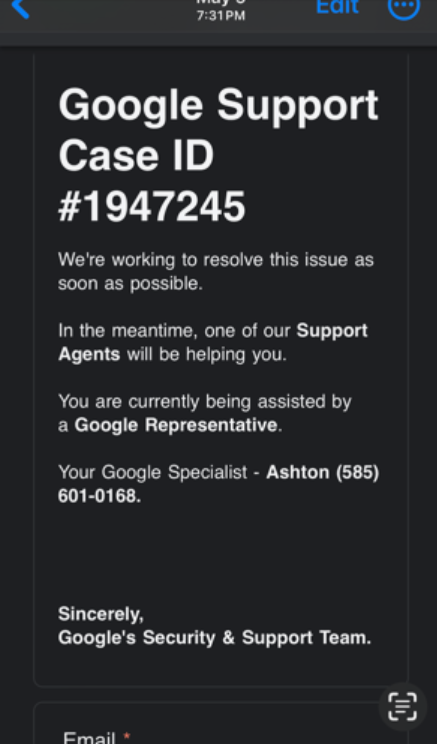
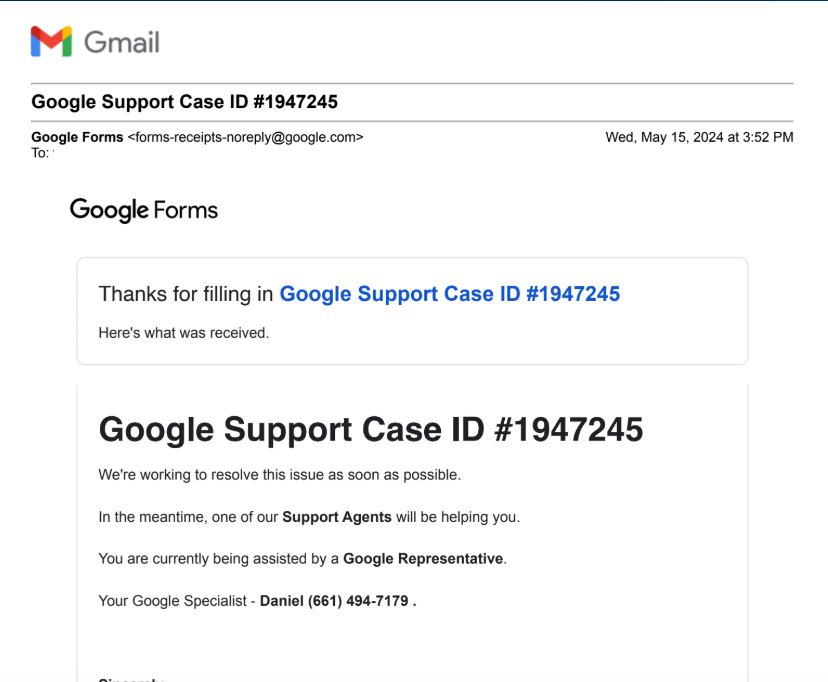
At the same time, he received an email that came from a google.com email address, warning his Google account was compromised. The message included a “Google Support Case ID number” and information about the Google representative supposedly talking to him on the phone, stating the rep’s name as “Ashton”— the same name given by the caller.
Griffin didn’t learn this until much later, but the email he received had a real google.com address because it was sent via Google Forms, a service available to all Google Docs users that makes it easy to send surveys, quizzes and other communications.
A phony security alert Griffin received prior to his bitcoin heist, via Google Forms.
According to tripwire.com’s Graham Cluely, phishers will use Google Forms to create a security alert message, and then change the form’s settings to automatically send a copy of the completed form to any email address entered into the form. The attacker then sends an invitation to complete the form to themselves, not to their intended victim.
“So, the attacker receives the invitation to fill out the form – and when they complete it, they enter their intended victim’s email address into the form, not their own,” Cluely wrote in a December 2023 post. “The attackers are taking advantage of the fact that the emails are being sent out directly by Google Forms (from the google.com domain). It’s an established legitimate domain that helps to make the email look more legitimate and is less likely to be intercepted en route by email-filtering solutions.”
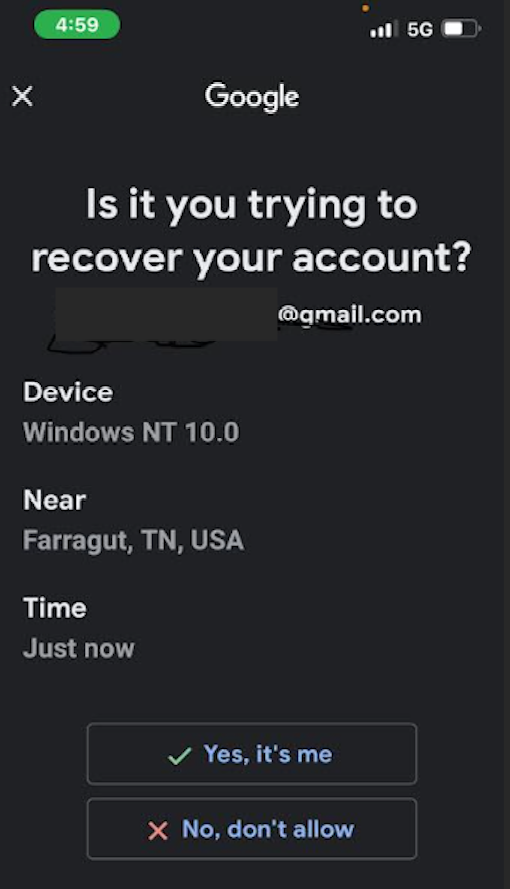
The fake Google representative was polite, patient, professional and reassuring. Ashton told Griffin he was going to receive a notification that would allow him to regain control of the account from the hackers. Sure enough, a Google prompt instantly appeared on his phone asking, “Is it you trying to recover your account?”
Adam Griffin clicked “yes,” to an account recovery notification similar to this one on May 6.
Griffin said that after receiving the pop-up prompt from Google on his phone, he felt more at ease that he really was talking to someone at Google. In reality, the thieves caused the alert to appear on his phone merely by stepping through Google’s account recovery process for Griffin’s Gmail address.
“As soon as I clicked yes, I gave them access to my Gmail, which was synched to Google Photos,” Griffin said.
Unfortunately for Griffin, years ago he used Google Photos to store an image of the secret seed phrase that was protecting his cryptocurrency wallet. Armed with that phrase, the phishers could drain all of his funds.
“From there they were able to transfer approximately $450,000 out of my Exodus wallet,” Griffin recalled.
Griffin said just minutes after giving away access to his Gmail account he received a call from someone claiming to be with Coinbase, who likewise told him someone in Germany was trying to take over his account.
Griffin said a follow-up investigation revealed the attackers had used his Gmail account to gain access to his Coinbase account from a VPN connection in California, providing the multi-factor code from his Google Authenticator app. Unbeknownst to him at the time, Google Authenticator by default also makes the same codes available in one’s Google account online.
But when the thieves tried to move $100,000 worth of cryptocurrency out of his account, Coinbase sent an email stating that the account had been locked, and that he would have to submit additional verification documents before he could do anything with it.
GRAND THEFT AUTOMATED
Just days after Griffin was robbed, a scammer impersonating Google managed to phish 45 bitcoins — approximately $4,725,000 at today’s value — from Tony, a 42-year-old professional from northern California. Tony agreed to speak about his harrowing experience on condition that his last name not be used.
Tony got into bitcoin back in 2013 and has been investing in it ever since. On the evening of May 15, 2024, Tony was putting his three- and one-year-old boys to bed when he received a message from Google about an account security issue, followed by a phone call from a “Daniel Alexander” at Google who said his account was compromised by hackers.
Tony said he had just signed up for Google’s Gemini AI (an artificial intelligence platform formerly known as “Bard”), and mistakenly believed the call was part of that service. Daniel told Tony his account was being accessed by someone in Frankfurt, Germany, and that he could evict the hacker and recover access to the account by clicking “yes” to the prompt that Google was going to send to his phone.
The Google prompt arrived seconds later. And to his everlasting regret, Tony clicked the “Yes, it’s me” button.
Then came another call, this one allegedly from security personnel at Trezor, a company that makes encrypted hardware devices made to store cryptocurrency seed phrases securely offline. The caller said someone had submitted a request to Trezor to close his account, and they forwarded Tony a message sent from his Gmail account that included his name, Social Security number, date of birth, address, phone number and email address.
Tony said he began to believe then that his Trezor account truly was compromised. The caller convinced him to “recover” his account by entering his cryptocurrency seed phrase at a phishing website (verify-trezor[.]io) that mimicked the official Trezor website.
“At this point I go into fight or flight mode,” Tony recalled. “I’ve got my kids crying, my wife is like what the heck is going on? My brain went haywire. I put my seed phrase into a phishing site, and that was it.”
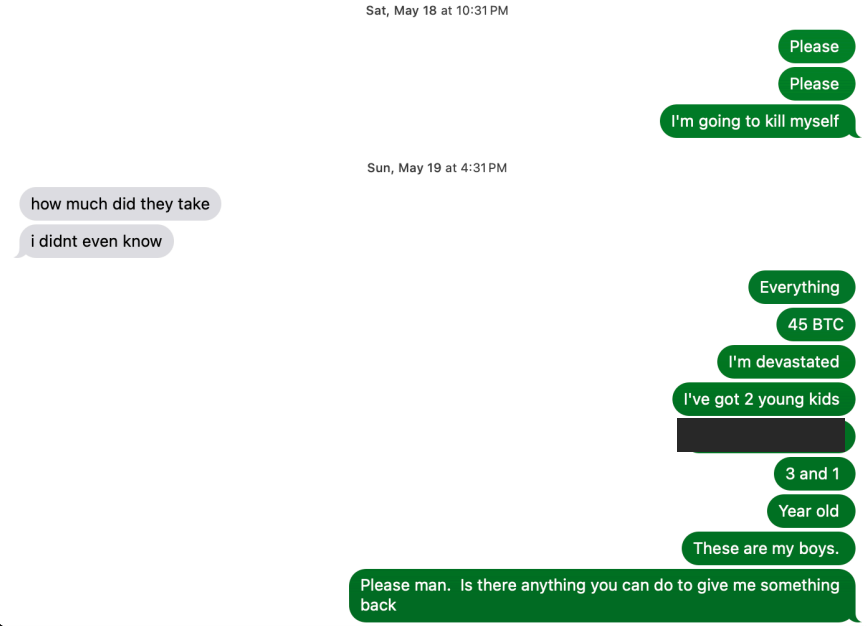
Almost immediately, all of the funds he was planning to save for retirement and for his children’s college fund were drained from his account.
“I made mistakes due to being so busy and not thinking correctly,” Tony told KrebsOnSecurity. “I had gotten so far away from the security protocols in bitcoin as life had changed so much since having kids.”
Tony shared this text message exchange of him pleading with his tormentors after being robbed of 45 bitcoins.
Tony said the theft left him traumatized and angry for months.
“All I was thinking about was protecting my boys and it ended up costing me everything,” he said. “Needless to say I’m devastated and have had to do serious therapy to get through it.”
MISERY LOVES COMPANY
Tony told KrebsOnSecurity that in the weeks following the theft of his 45 bitcoins, he became so consumed with rage and shame that he was seriously contemplating suicide. Then one day, while scouring the Internet for signs that others may have been phished by Daniel, he encountered Griffin posting on Reddit about the phone number involved in his recent bitcoin theft.
Griffin said the two of them were initially suspicious of each other — exchanging cautious messages for about a week — but he decided Tony was telling the truth after contacting the FBI agent that Tony said was working his case. Comparing notes, they discovered the fake Google security alerts they received just prior to their individual bitcoin thefts referenced the same phony “Google Support Case ID” number.
Adam Griffin and Tony said they received the same Google Support Case ID number in advance of their thefts. Both were sent via Google Forms, which sends directly from the google.com domain name.
More importantly, Tony recognized the voice of “Daniel from Google” when it was featured in an interview by Junseth, a podcaster who covers cryptocurrency scams. The same voice that had coaxed Tony out of his considerable cryptocurrency holdings just days earlier also had tried to phish Junseth, who played along for several minutes before revealing he knew it was a scam.
Daniel told Junseth he was a teenager and worked with other scam callers who had all met years ago on the game Minecraft, and that he recently enjoyed a run of back-to-back Gmail account compromises that led to crypto theft paydays.
“No one gets arrested,” Daniel enthused to Junseth in the May 7 podcast, which quickly went viral on social media. “It’s almost like there’s no consequences. I have small legal side hustles, like businesses and shit that I can funnel everything through. If you were to see me in real life, I look like a regular child going to school with my backpack and shit, you’d never expect this kid is stealing all this shit.”
Daniel explained that they often use an automated bot that initiates calls to targets warning that their account is experiencing suspicious activity, and that they should press “1” to speak with a representative. This process, he explained, essentially self-selects people who are more likely to be susceptible to their social engineering schemes. [It is possible — but not certain — that this bot Daniel referenced explains the incoming call to Griffin from Google Assistant that precipitated his bitcoin heist].
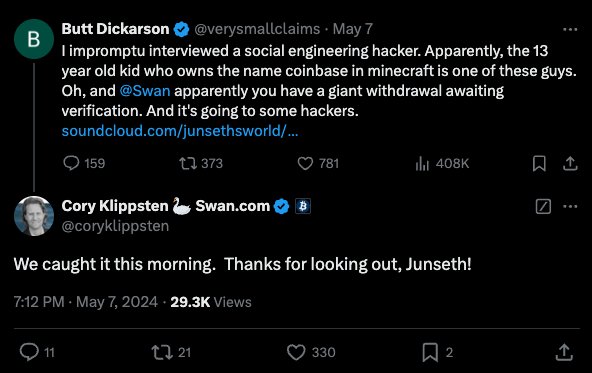
Daniel told Junseth he and his co-conspirators had just scored a $1.2 million theft that was still pending on the bitcoin investment platform SwanBitcoin. In response, Junseth tagged SwanBitcoin in a post about his podcast on Twitter/X, and the CEO of Swan quickly replied that they caught the $1.2 million transaction that morning.
Apparently, Daniel didn’t appreciate having his voice broadcast to the world (or his $1.2 million bitcoin heist disrupted) because according to Junseth someone submitted a baseless copyright infringement claim about it to Soundcloud, which was hosting the recording.
The complaint alleged the recording included a copyrighted song, but that wasn’t true: Junseth later posted a raw version of the recording to Telegram, and it clearly had no music in the background. Nevertheless, Soundcloud removed the audio file.
“All these companies are very afraid of copyright,” Junseth explained in a May 2024 interview with the podcast whatbitcoindid.com, which features some of the highlights from his recorded call with Daniel.
“It’s interesting because copyright infringement really is an act that you’re claiming against the publisher, but for some reason these companies have taken a very hard line against it, so if you even claim there’s copyrighted material in it they just take it down and then they leave it to you to prove that you’re innocent,” Junseth said. “In Soundcloud’s instance, part of declaring your innocence is you have to give them your home address and everything else, and it says right on there, ‘this will be provided to the person making the copyright claim.’”
AFTERMATH
When Junseth asked how potential victims could protect themselves, Daniel explained that if the target doesn’t have their Google Authenticator synced to their Google cloud account, the scammers can’t easily pivot into the victim’s accounts at cryptocurrency exchanges, as they did with Griffin.
By default, Google Authenticator syncs all one-time codes with a Gmail user’s account, meaning if someone gains access to your Google account, they can then access all of the one-time codes handed out by your Google Authenticator app.
To change this setting, open Authenticator on your mobile device, select your profile picture, and then choose “Use without an Account” from the menu. If you disable this, it’s a good idea to keep a printed copy of one-time backup codes, and to store those in a secure place.
You may also wish to download Google Authenticator to another mobile device that you control. Otherwise, if you turn off cloud synching and lose that sole mobile device with your Google Authenticator app, it could be difficult or impossible to recover access to your account if you somehow get locked out.
Griffin told KrebsOnSecurity he had no idea it was so easy for thieves to take over his account, and to abuse so many different Google services in the process.
“I know I definitely made mistakes, but I also know Google could do a lot better job protecting people,” he said.
In response to questions from KrebsOnSecurity, Google said it can confirm that this was a narrow phishing campaign, reaching a “very small group of people.”
“We’re aware of this narrow and targeted attack, and have hardened our defenses to block recovery attempts from this actor,” the company said in a written statement, which emphasized that the real Google will never call you.
“While these types of social engineering campaigns are constantly evolving, we are continuously working to harden our systems with new tools and technical innovations, as well as sharing updated guidance with our users to stay ahead of attackers,” the statement reads.
Both Griffin and Tony say they continue to receive “account security” calls from people pretending to work for Google or one of the cryptocurrency platforms.
“It’s like you get put on some kind of list, and then those lists get recycled over and over,” Tony said.
Griffin said that for several months after his ordeal, he accepted almost every cryptocurrency scam call that came his way, playing along in the vain hope of somehow tricking the caller into revealing details about who they are in real life. But he stopped after his taunting caused one of the scammers to start threatening him personally.
“I probably shouldn’t have, but I recorded two 30-minute conversations with these guys,” Griffin said, acknowledging that maybe it wasn’t such a great idea to antagonize cybercriminals who clearly already knew everything about him. “One guy I talked to about his personal life, and then his friend called me up and said he was going to dox me and do all this other bad stuff. My FBI contact later told me not to talk to these guys anymore.”
Sound advice. So is hanging up whenever anyone calls you about a security problem with one of your accounts. Even security-conscious people tend to underestimate the complex and shifting threat from phone-based phishing scams, but they do so at their peril.
When in doubt: Hang up, look up, and call back. If your response to these types of calls involves anything other than hanging up, researching the correct phone number, and contacting the entity that claims to be calling, you may be setting yourself up for a costly and humbling learning experience.
Understand that your email credentials are more than likely the key to unlocking your entire digital identity. Be sure to use a long, unique passphrase for your email address, and never pick a passphrase that you have ever used anywhere else (not even a variation on an old password).
Finally, it’s also a good idea to take advantage of the strongest multi-factor authentication methods offered. For Gmail/Google accounts, that includes the use of passkeys or physical security keys, which are heavily phishing resistant. For Google users holding measurable sums of cryptocurrency, the most secure option is Google’s free Advanced Protection program, which includes more extensive account security features but also comes with some serious convenience trade-offs.





 Pacosite's Blog