Lamborghini Carjackers Lured by $243M Cyberheist

The parents of a 19-year-old Connecticut honors student accused of taking part in a $243 million cryptocurrency heist in August were carjacked a week later — while out house-hunting in a brand new Lamborghini. Prosecutors say the couple was beaten and briefly kidnapped by six young men who traveled from Florida as part of a botched plan to hold the parents for ransom.

Image: ABC7NY.  youtube.com/watch?v=xoiaGzwrunY

Late in the afternoon of Aug. 25, 2024 in Danbury, Ct., a married couple in their 50s pulled up to a gated community in a new Lamborghini Urus (investigators say the sports car still had temporary tags) when they were intentionally rear-ended by a Honda Civic.

A witness told police they saw three men exit a van that was following the Honda, and said the men began assaulting the couple and forcing them into the van. Local police officers spotted the van speeding from the scene and pursued it, only to find the vehicle crashed and abandoned a short distance away.

Inside the disabled van the police found the couple with their hands and feet bound in duct tape, the man visibly bruised after being assaulted with a baseball bat. Danbury police soon reported arresting six suspects in the kidnapping, all men aged 18-26 from Florida. They also recovered the abandoned Lamborghini from a wooded area.

A criminal complaint (PDF) filed on Sept. 24 against the six men does not name the victims, referring to them only as a married couple from Danbury with the initials R.C. and S.C. But prosecutors in Connecticut said they were targeted “because the co-conspirators believed the victims’ son had access to significant amounts of digital currency.”

What made the Miami men so convinced R.C. and S.C.’s son was loaded with cryptocurrency? Approximately one week earlier, on Aug. 19, a group of cybercriminals that allegedly included the couple’s son executed a sophisticated phone-based social engineering attack in which they stole $243 million worth of cryptocurrency from a victim in Washington, D.C.

That’s according to ZachXBT, a frequently cited crypto crime investigator who published a lengthy thread that broke down how the theft was carried out and ultimately exposed by the perpetrators themselves.

ZachXBT’s post included a screen recording of a Discord chat session made by one of the participants to the $243 million robbery, noting that two of the people involved managed to leak the username of the Microsoft Windows PCs they were using to participate in the chat.

One of the usernames leaked during the chat was Veer Chetal. According to ZachXBT, that name corresponds to a 19-year-old from Danbury who allegedly goes by the nickname “Wiz,” although in the leaked video footage he allegedly used the handle “Swag.”  Swag was reportedly involved in executing the early stages of the crypto heist — gaining access to the victim’s Gmail and iCloud accounts.
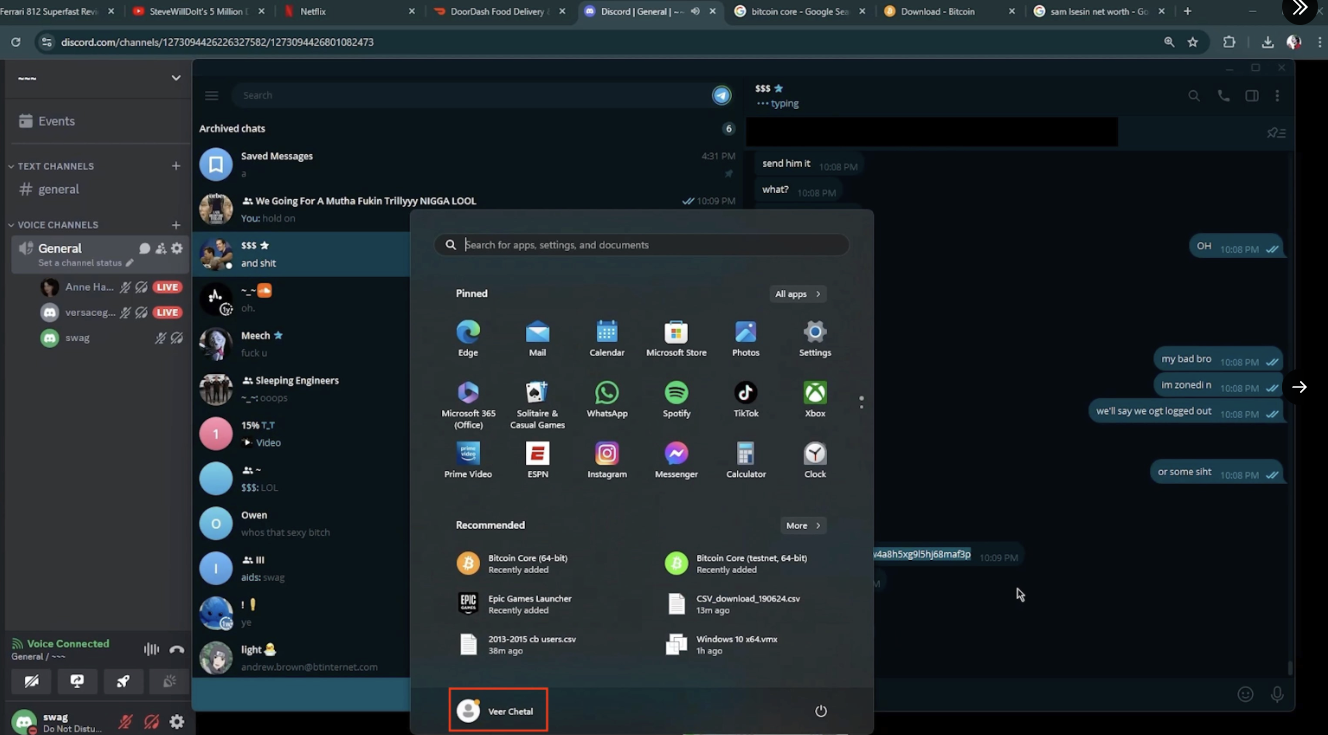
A still shot from a video screenshare in which one of the participants on the Discord voice chat used the Windows username Veer Chetal. Image: x.com/zachxbt

The same day ZachXBT published his findings, a criminal indictment was issued in Washington D.C. charging two of the men he named as involved in the heist. Prosecutors allege Malone “Greavys” Lam, 20, of Miami and Los Angeles, and Jeandiel “Box” Serrano, 21, of Los Angeles conspired to steal and launder over $230 million in cryptocurrency from a victim in Washington, D.C. The indictment alleges Lam and Serrano were helped by other unnamed co-conspirators.

“Lam and Serrano then allegedly spent the laundered cryptocurrency proceeds on international travel, nightclubs, luxury automobiles, watches, jewelry, designer handbags, and rental homes in Los Angeles and Miami,” reads a press release from the U.S. Department of Justice.

By tracing the flow of funds stolen in the heist, ZachXBT concluded that Wiz received a large percentage from the theft, noting that “additional comfort [in naming him as involved] was gained as throughout multiple recordings accomplices refer to him as ‘Veer’ on audio and in chats.”

“A cluster of [cryptocurrency] addresses tied to both Box/Wiz received $41M+ from two exchanges over the past few weeks primarily flowing to luxury goods brokers to purchase cars, watches, jewelry, and designer clothes,” ZachXBT wrote.

KrebsOnSecurity sought comment from Veer Chetal, and from his parents — Radhika Chetal and Suchil Chetal. This story will be updated in the event that anyone representing the Chetal family responds. Veer Chetal has not been publicly charged with any crime.

According to a news brief published by a private Catholic high school in Danbury that Veer Chetal attended, in 2022 he successfully completed Harvard’s Future Lawyers Program, a “unique pre-professional program where students, guided by qualified Harvard undergraduate instructors, learn how to read and build a case, how to write position papers, and how to navigate a path to law school.” A November 2022 story at patch.com quoted Veer Chetal (class of 2024) crediting the Harvard program with his decision to pursue a career in law.

It remains unclear which Chetal family member acquired the 2023 Lamborghini Urus, which has a starting price of around $233,000. Sushil Chetal’s LinkedIn profile says he is a vice president at the investment bank Morgan Stanley.

It is clear that other alleged co-conspirators to the $243 million heist displayed a conspicuous consumption of wealth following the date of the heist. ZachXBT’s post chronicled Malone’s flashy lifestyle, in which he allegedly used the stolen money to purchase more than 10 vehicles, rent palatial properties, travel with friends on chartered jets, and spend between $250,000 and $500,000 a night at clubs in Los Angeles and Miami.
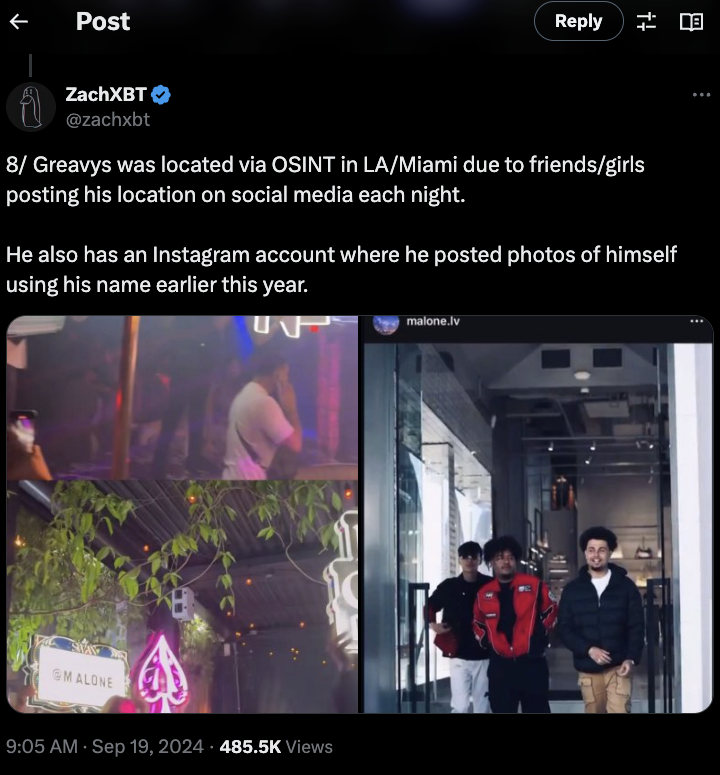
In the photo on the bottom right, Greavys/Lam is the individual on the left wearing shades. They are pictured leaving a luxury goods store. Image: x.com/zachxbt

WSVN-TV in Miami covered an FBI raid of a large rented Miami waterfront home around the time Malone and Serrano were arrested. The news station interviewed a neighbor of the home’s occupants, who reported a recent large party at the residence wherein the street was lined with high-end luxury vehicles — all of them with temporary paper tags.

ZachXBT unearthed a video showing a person identified as Wiz at a Miami nightclub earlier this year, wherein they could be seen dancing to the crowd’s chants while holding an illuminated sign with the message, “I win it all.”

It appears that all of the suspects in the cyber heist (and at least some of the alleged carjackers) are members of The Com, an archipelago of crime-focused chat communities which collectively functions as a kind of distributed cybercriminal social network that facilitates instant collaboration.

As documented in last month’s deep dive on top Com members,  The Com is also a place where cybercriminals go to boast about their exploits and standing within the community, or to knock others down a peg or two. Prominent Com members are endlessly sniping over who pulled off the most impressive heists, or who has accumulated the biggest pile of stolen virtual currencies.

And as often as they extort and rob victims for financial gain, members of The Com are trying to wrest stolen money from their cybercriminal rivals — often in ways that spill over into physical violence in the real world.

One of the six Miami-area men arrested in the carjacking and extortion plot gone awry — Reynaldo “Rey” Diaz — was shot twice while parked in his bright yellow Corvette in Miami’s design district in 2022. In an interview with a local NBC television station, Diaz said he was probably targeted for the jewelry he was wearing, which he described as “pretty expensive.”

KrebsOnSecurity has learned Diaz also went by the alias “Pantic” on Telegram chat channels dedicated to stealing cryptocurrencies. Pantic was known for participating in several much smaller cyber heists in the past, and spending most of his cut on designer clothes and jewelry.

The Corvette that Diaz was sitting in when he was shot in 2022. Image: NBC 6, South Florida.

Earlier this year, Diaz was “doxed,” or publicly outed as Pantic, with his personal and family information posted on a harassment and extortion channel frequented by members of The Com. The reason cited for Pantic’s doxing was widely corroborated by multiple Com members: Pantic had inexplicably robbed two close friends at gunpoint, one of whom recently died of a drug overdose.

Government prosecutors say the brazen daylight carjacking was paid for and organized by 23-year-old Miami resident Angel “Chi Chi” Borrero. In 2022, Borrero was arrested in Miami for aggravated assault with a deadly weapon.

The six Miami men face charges including first-degree assault, kidnapping and reckless endangerment, and five of them are being held on a $1 million bond. One suspect is also charged with reckless driving, engaging police in pursuit and evading responsibility; his bond was set at $2 million. Lam and Serrano are each charged with conspiracy to commit wire fraud and conspiracy to launder money.

Cybercriminals hail from all walks of life and income levels, but some of the more accomplished cryptocurrency thieves also tend to be among the more privileged, and from relatively well-off families. In other words, these individuals aren’t stealing to put food on the table: They’re doing it so they can amass all the trappings of instant wealth, and so they can boast about their crimes to others on The Com.

There is also a penchant among this crowd to call attention to their activities in conspicuous ways that hasten their arrest and criminal charging. In many ways, the story arc of the young men allegedly involved in the $243 million heist tracks closely to that of Joel Ortiz, a valedictorian who was sentenced in 2019 to 10 years in prison for stealing more than $5 million in cryptocurrencies.

Ortiz famously posted videos of himself and co-conspirators chartering flights and partying it up at LA nightclubs, with scantily clad women waving giant placards bearing their “OG” usernames — highly-prized, single-letter social media accounts that they’d stolen or purchased stolen from others.

Ortiz earned the distinction of being the first person convicted of SIM-swapping, a crime that involves using mobile phone company insiders or compromised employee accounts to transfer a target’s phone number to a mobile device controlled by the attackers. From there, the attacker can intercept any password reset links, and any one-time passcodes sent via SMS or automated voice calls.

But as the mobile carriers seek to make their networks less hospitable to SIM-swappers, and as more financial platforms seek to harden user account security, today’s crypto thieves are finding they don’t need SIM-swaps to steal obscene amounts of cryptocurrency. Not when tricking people over the phone remains such an effective approach.

According to ZachXBT, the crooks responsible for the $243 million theft initially compromised the target’s personal accounts after calling them as Google Support and using a spoofed number. The attackers also spoofed a call from account support representatives at the cryptocurrency exchange Gemini, claiming the target’s account had been hacked.

From there the target was social engineered over the phone into resetting multi-factor authentication and sending Gemini funds to a compromised wallet. ZachXBT says the attackers also convinced the victim to use AnyDesk to share their screen, and in doing so the victim leaked their private keys.

from Krebs on Security https://ift.tt/8sHXIES
via IFTTT

Rejoice! The charade of having to change our passwords every few months is coming to an end | Kate O’Flaherty

The US government is finally admitting there’s no need – instead, to fend off cyber-attacks we need passwords that are long but memorable

Over the past decade or so, people have accumulated a vast array of logins for dozens of sites and apps, as more of our work and home lives moves on to the internet. That’s why it has never made sense that so many IT departments have belligerently insisted on maintaining a major hurdle to password management. Namely, the need to change passwords regularly.

It’s a familiar scenario. You arrive at the office and need to log on to your company laptop quickly, before your morning meeting. But speed is not going to be of the essence today, because an annoying prompt has appeared: you need to change your password.

Kate O’Flaherty is a freelance technology journalist

Continue reading…

from Data and computer security | The Guardian https://ift.tt/p1Ymy7q
via IFTTT

Qt 6.8 LTS llega con Qt Graphs, mejoras en el apartado multimedia y estos otros cambios

Qt 6.8

Desde el mismo día en el que KDE liberó Plasma 6.2, ya tenemos aquí otro lanzamiento mediano de la biblioteca en la que confían KDE y otros proyectos como LXQt. Disponible desde hace aproximadamente 24 horas, Qt 6.8 ha aterrizado con muchas novedades, aunque la mayoría de ellas las notarán más los desarrolladores que el usuario final, grupo en el que nos encontramos la mayoría de lectores y editores de este medio.

En este lanzamiento, los desarrolladores de Qt Group se ha centrado en mejorar y estabilizar la funcionalidad. Hay más de 500 bugs corregidos desde la anterior versión de punto, lanzada hace aproximadamente seis meses, y el código existente funcionará sin cambiar una sola línea. En teoría, cuando se cambia el primer decimal se puede romper la compatibilidad con versiones anteriores, pero este no ha sido el caso. Algo que agradecerán los desarrolladores, sin lugar a dudas. Hay varios módulos que han sido completados: Qt Graphs, Qt HttpServer y Qt GRPC.

Novedades de Qt 6.8

  • Las aplicaciones creadas con Qt 6.8 son compatibles con iOS 18 y Android 14.
  • Soporte para Windows ARM.
  • Añadido soporte para gafas como Apple Vision Pro y Meta Quest 3 XR.
  • Se ha añadido soporte para la Raspberry Pi 5 y NVIDIA AGX Orin, así como otras placas simples de NXP, Toradex y STM.
  • Posibilidad de crear aplicaciones más pequeñas gracias a mejoras en el rendimiento y eficiencia y a la eliminación de funciones no usadas.
  • Qt Graphs para soportar visualización de datos 3D.
  • Datos personalizados y post-procesado de audio en Qt Multimedia.
  • Qt Quick con más efectos y gráficos de vector escalables.
  • Qt Quick Controls para una mejor integración con el escritorio.
  • Nuevo módulo XR.
  • Qt Quick 3D.
  • Mejoras en las redes con Qt Network, Qt Network Auth, Qt GRPC y Qt HttpServer.
  • Mejoras en los módulos Qt Core, Qt Gui, Qt Sql, Qt Test, Qt WebEngine, Qt Widgets y Tools.
  • Para una lista detallada, merece la pena visitar las notas de este lanzamiento — en inglés — a las que enlazamos al principio de este artículo.

Qt 6.8 fue anunciado el día 8 de octubre y ya está disponible su código. Su llegada a las diferentes aplicaciones, escritorios y proyectos depende de los desarrolladores de cada uno de ellos. Qt 6.8 es una versión LTS y estará soportada de 3 a 5 años.

from Linux Adictos https://ift.tt/ViX1T3n
via IFTTT

Patch Tuesday, October 2024 Edition

Microsoft today released security updates to fix at least 117 security holes in Windows computers and other software, including two vulnerabilities that are already seeing active attacks. Also, Adobe plugged 52 security holes across a range of products, and Apple has addressed a bug in its new macOS 15Sequoia” update that broke many cybersecurity tools.

One of the zero-day flaws — CVE-2024-43573 — stems from a security weakness in MSHTML, the proprietary engine of Microsoft’s Internet Explorer web browser. If that sounds familiar it’s because this is the fourth MSHTML vulnerability found to be exploited in the wild so far in 2024.

Nikolas Cemerikic, a cybersecurity engineer at Immersive Labs, said the vulnerability allows an attacker to trick users into viewing malicious web content, which could appear legitimate thanks to the way Windows handles certain web elements.

“Once a user is deceived into interacting with this content (typically through phishing attacks), the attacker can potentially gain unauthorized access to sensitive information or manipulate web-based services,” he said.

Cemerikic noted that while Internet Explorer is being retired on many platforms, its underlying MSHTML technology remains active and vulnerable.

“This creates a risk for employees using these older systems as part of their everyday work, especially if they are accessing sensitive data or performing financial transactions online,” he said.

Probably the more serious zero-day this month is CVE-2024-43572, a code execution bug in the Microsoft Management Console, a component of Windows that gives system administrators a way to configure and monitor the system.

Satnam Narang, senior staff research engineer at Tenable, observed that the patch for CVE-2024-43572 arrived a few months after researchers at Elastic Security Labs disclosed an attack technique called GrimResource that leveraged an old cross-site scripting (XSS) vulnerability combined with a specially crafted Microsoft Saved Console (MSC) file to gain code execution privileges.

“Although Microsoft patched a different MMC vulnerability in September (CVE-2024-38259) that was neither exploited in the wild nor publicly disclosed,” Narang said. “Since the discovery of CVE-2024-43572, Microsoft now prevents untrusted MSC files from being opened on a system.”

Microsoft also patched Office, Azure, .NET, OpenSSH for Windows; Power BI; Windows Hyper-V; Windows Mobile Broadband, and Visual Studio. As usual, the SANS Internet Storm Center has a list of all Microsoft patches released today, indexed by severity and exploitability.

Late last month, Apple rolled out macOS 15, an operating system update called Sequoia that broke the functionality of security tools made by a number of vendors, including CrowdStrike, SentinelOne and Microsoft. On Oct. 7, Apple pushed an update to Sequoia users that addresses these compatibility issues.

Finally, Adobe has released security updates to plug a total of 52 vulnerabilities in a range of software, including Adobe Substance 3D Painter, Commerce, Dimension, Animate, Lightroom, InCopy, InDesign, Substance 3D Stager, and Adobe FrameMaker.

Please consider backing up important data before applying any updates. Zero-days aside, there’s generally little harm in waiting a few days to apply any pending patches, because not infrequently a security update introduces stability or compatibility issues. AskWoody.com usually has the skinny on any problematic patches.

And as always, if you run into any glitches after installing patches, leave a note in the comments; chances are someone else is stuck with the same issue and may have even found a solution.

from Krebs on Security https://ift.tt/sOhbt4q
via IFTTT

Microsoft te aconseja cómprarte un PC más nuevo si el tuyo no es compatible con Windows 11. Nosotros te recomendamos instalar Linux

Windows 11

Yo, que aunque no quiera soy como el informático de mi círculo social, ya he tenido que actualizar algunos equipos de gente conocida a Windows 11. En algún caso me han preguntado y yo les he dicho que sí, que si quieren seguir recibiendo soporte deben actualizar. También hay casos en los que un equipo no es compatible, y mientras sea posible, Rufus permite eliminar ciertas restricciones. Eso es algo que no hará Microsoft, quienes tienen otro consejo para ti si tu PC no es compatible con la última versión del sistema de las ventanas.

Windows 11 pide unos requisitos mínimos para poder instalarse. A mí los que más me llaman la atención son los 64GB de almacenamiento, que me parece una burrada, UEFI compatible con Secure Boot y, claro está, soporte para TPM 2.0. El último es el enemigo publico #1 para actualizar a Windows 11, aunque hay maneras de «puentearlo». No de manera oficial, cuya respuesta tenemos en este enlace.

Si tu PC no puede con Windows 11, tíralo

«¿Qué significa que Windows no esté soportado?«, leemos en el título. El resto es la respuesta, y empieza explicando lo que ya sabemos: no recibirá más actualizaciones de Microsoft, entre las que se incluyen parches de seguridad. Tampoco se recibirán nuevas funciones. Este último punto lo añado yo: funcionará mientras funcione, que puede ser para siempre, pero por ejemplo el navegador irá perdiendo capacidades hasta que sea difícil navegar con él.

Lo interesante de esta página de soporte es el siguiente párrafo: «Si tiene dispositivos que ejecutan una versión de Windows no compatible, le recomendamos que los actualice a una versión de Windows más actual, en servicio y compatible. Si sus dispositivos no cumplen los requisitos técnicos para ejecutar una versión más actual de Windows, le recomendamos que los sustituya por otros compatibles con Windows 11«.

Usa Rufus mientras sea posible, o vente a Linux

A nadie le gusta tirar su PC cuando funciona perfectamente. Esto es más grave en los Mac, ya que puede que en 5 años los dejen en la estacada, pero también pasa, como ha quedado patente, en los PC con Windows. Si funciona perfectamente, ¿por qué los tengo que cambiar?

De tener un equipo con cierta potencia, se le puede instalar cualquier distribución Linux. Ubuntu es la más popular, pero también están Fedora o Manjaro/EndeavourOS/Garuda si se busca base Arch sin la dificultad del puro, entre otras.  Si el equipo va un poco justo, yo recomendaría Linux Mint en su versión MATE, que ha llegado a resucitar un equipo mío que parecía más muerto que vivo. Y si no, otra opción es instalar ChromeOS, sea en su versión Flex, FydeOS o la oficial con algún hack.

Si lo que se busca es poder jugar, Steam es compatible con Linux, y a Valve le interesa maximizar la compatibilidad para que compremos más juegos.

O quédate en Windwos 10 todo el tiempo posible

Esta es una opinión impopular, pero es algo que merece la pena valorar. Cuando Windows 10 se quede sin soporte, no recibirá más actualizaciones de Microsoft, pero los desarrolladores pueden tener otros planes. Es probable que sigan lanzando actualizaciones compatibles varios años más, y mientras siga funcionando lo que necesitamos, puede servirnos.

Pongamos un ejemplo: Windows 7 dejó de recibir soporte en enero de 2020, mientras que Chrome, el navegador web más usado, abandonó el soporte para esa versión de Windows justo tres años después, en enero de 2023. Por lo tanto, si lo único que necesitáramos fuera un navegador web, Google habría decidido que nuestro equipo sería útil durante 36 meses más.

Claro está, hay que saber que las actualizaciones de seguridad del sistema operativo no llegarían durante ese periodo de tiempo. Aunque Windows 7 ya estaba muy bien pulido, fallos de seguridad se siguieron descubriendo, y es decisión de cada uno si prefiere alargar la vida del equipo corriendo el riesgo de esta manera o no.

Pero, como explicábamos en el punto anterior, lo mejor es hacer el cambio a Linux y empezar a usar un equipo rápido que sirve para todo, por lo menos a nivel usuario. Y si no, pues cómprate otro PC como dice Microsoft.

from Linux Adictos https://ift.tt/Eiu2kYo
via IFTTT

In record year of dengue cases, PAHO urges countries to strengthen response as seasonal transmission set to begin in South America

In record year of dengue cases, PAHO urges countries to strengthen response as seasonal transmission set to begin in South America

Cristina Mitchell


from PAHO/WHO | Pan American Health Organization https://ift.tt/HjCmTpD
via IFTTT