Watch live as hot dog-eating champion Joey Chestnut faces off against rival Takeru Kobayashi in the ultimate wiener-takes-all competition.
from New On Netflix USA https://ift.tt/wT7FS0O
via IFTTT

Watch live as hot dog-eating champion Joey Chestnut faces off against rival Takeru Kobayashi in the ultimate wiener-takes-all competition.
from New On Netflix USA https://ift.tt/wT7FS0O
via IFTTT

El septiembre pasado, hace casi un año, el panda rojo empezó a permitirnos traducir páginas completas en su navegador web. En los poco más de once meses que han pasado, Mozilla ha lanzado varias actualizaciones más para mejorar esta función, y la última es el Firefox 130 que ya se puede descargar. No, el lanzamiento no es oficial, pero ya han subido la nueva entrega a su servidor y se conocen las notas de lanzamiento que publicarán mañana al medio día español.
Firefox 130 no incluye una larga lista de novedades, por lo menos si se compara con otros lanzamientos. Un par de los puntos de la lista se lo queda la herramienta de traducción. Por empezar con uno, ahora soporta 11 idiomas más: catalán, croata, checo, danés, indonesio, letón, lituano, rumano, serbio, eslovaco y vietnamita. Este cambio convierte a la herramienta en algo útil de verdad con la que ya será difícil encontrar una página que no sea capaz de traducir.
También para traducir idiomas, ahora es capaz de traducir texto seleccionado de una página que previamente había sido traducida. Ya se podía traducir texto seleccionado, pero esta mejora le da un giro más de tuerca.
Entre el resto de novedades, destaca que Firefox Labs ha llegado a la versión estable. Firefox Labs es un apartado que ya estaba disponible en versiones preliminares, como Nightly, y desde él es más fácil activar ciertas funciones. En Firefox 130 la mejora se estrena con la capacidad de activar un chatbot, a elegir entre varias opciones — y ChatGPT está entre ellas –, y la posibilidad de que las páginas con vídeos despeguen y hagan flotar el mismo si cambiamos a otra pestaña.
La lista de cambios la completarían que WebCryptoAPI ahora soporta primitivas Curve25519, se ha habilitado la Web Codecs API en plataformas de escritorio, se ha corregido un problema por el que los elementos del menú contextual «Copiar» y «Pegar» no se activaban de forma intermitente cuando se esperaba y varias correcciones de errores y parches de seguridad.
Firefox 130 ya se puede descargar desde el servidor de Mozilla, disponible en este enlace. Mañana se podrá descargar también desde su página web. También desde el repositorio oficial y actualizarán los paquetes snap y flatpak.
from Linux Adictos https://ift.tt/nNoJLdQ
via IFTTT
Three men in the United Kingdom have pleaded guilty to operating otp[.]agency, a once popular online service that helped attackers intercept the one-time passcodes (OTPs) that many websites require as a second authentication factor in addition to passwords.
Launched in November 2019, OTP Agency was a service for intercepting one-time passwords needed to log in to various websites. Scammers who had already stolen someone’s bank account credentials could enter the target’s phone number and name, and the service would initiate an automated phone call to the target that warned them about unauthorized activity on their account.
The call would prompt the target to enter a one-time passcode generated by their phone’s mobile app, and the code was then relayed to the scammer’s user panel at the OTP Agency website.
A statement published Aug. 30 by the U.K.’s National Crime Agency (NCA) said three men pleaded guilty to running OTP Agency: Callum Picari, 22, from Hornchurch, Essex; Vijayasidhurshan Vijayanathan, 21, from Aylesbury, Buckinghamshire; and Aza Siddeeque, 19, from Milton Keynes, Buckinghamshire.
KrebsOnSecurity profiled OTP Agency in a February 2021 story about arrests tied to another phishing-related service based in the U.K. Someone claiming to represent OTP Agency then posted several comments on the piece, wherein they claimed the story was libelous and that they were a legitimate anti-fraud service. However, the service’s Telegram channel clearly showed its proprietors had built OTP Agency with one purpose in mind: To help their customers take over online accounts.
Within hours of that publication, OTP Agency shuttered its website and announced it was closing up shop and purging its user database. The NCA said the February 2021 story prompted a panicked message exchange between Picari and Vijayanathan:
Picari said: bro we are in big trouble… U will get me bagged… Bro delete the chat
Vijayanathan: Are you sure
Picari: So much evidence in there
Vijayanathan: Are you 100% sure
Picari: It’s so incriminating…Take a look and search ‘fraud’…Just think of all the evidence…that we cba to find…in the OTP chat…they will find
Vijayanathan: Exactly so if we just shut EVERYTHING down
Picari: They went to our first ever msg…We look incriminating…if we shut down…I say delete the chat…Our chat is Fraud 100%
Vijayanathan : Everyone with a brain will tell you stop it here and move on
Picari: Just because we close it doesn’t mean we didn’t do it…But deleting our chat…Will f*^k their investigations…There’s nothing fraudulent on the site
Despite deleting its Telegram channel, OTP Agency evidently found it difficult to walk away from its customers (and/or the money). Instead of shutting down as Vijayanathan wisely advised, just a few days later OTP Agency was communicating with customers on a new Telegram channel, offering a new login page and assuring existing customers that their usernames, passwords and balances would remain the same.
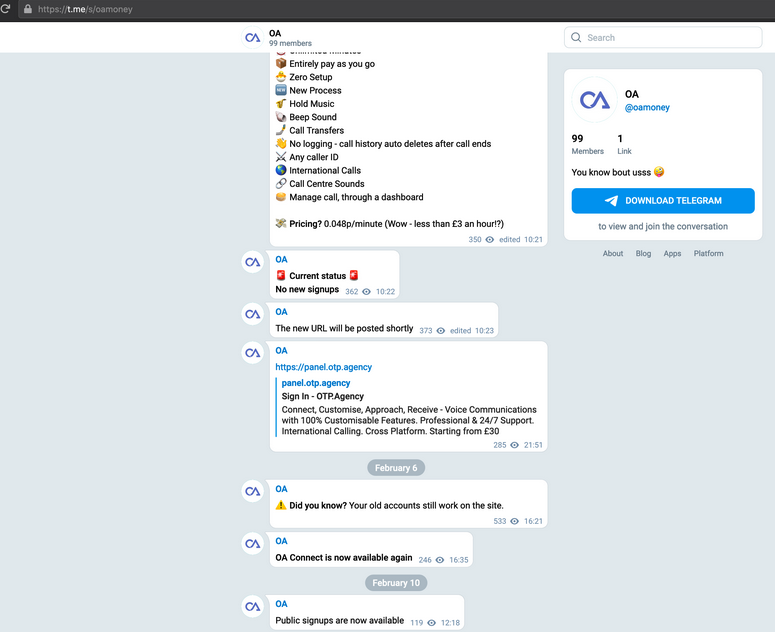
OTP Agency, immediately after their initial shutdown, telling customers their existing logins will still work.
But that revival would be short-lived. The NCA said the site was taken offline less than a month later when the trio were arrested. NCA investigators said more than 12,500 people were targeted by OTP Agency users during the 18 month the service was active.
Picari was the owner, developer and main beneficiary of the service, and his personal information and ownership of OTP Agency was revealed in February 2020 in a “dox” posted to the now-defunct English-language cybercrime forum Raidforums. The NCA said it began investigating the service in June 2020.

The OTP Agency operators who pleaded guilty to running the service; Aza Siddeeque, Callum Picari, and Vijayasidhurshan Vijayanathan.
OTP Agency might be gone, but several other similar OTP interception services are still in operation and accepting new customers, including a long-running service KrebsOnSecurity profiled in September 2021 called SMSRanger. More on SMSRanger in an upcoming post.
Text messages, emails and phone calls warning recipients about potential fraud are some of the most common scam lures. If someone (or something) calls saying they’re from your bank, or asks you to provide any personal or financial information, do not respond. Just hang up, full stop.
If the call has you worried about the security and integrity of your account, check the account status online, or call your financial institution — ideally using a phone number that came from the bank’s Web site or from the back of your payment card.
Further reading: When in Doubt, Hang Up, Look Up, and Call Back
from Krebs on Security https://ift.tt/RFnGgav
via IFTTT
A thriving Black businessman moves his family from South Central LA to the largely white suburbs, where they try to fit in while being themselves.
from New On Netflix USA https://ift.tt/1U5HsOW
via IFTTT
[Episodes Removed] On a tiny island, Pororo the penguin has fun adventures with his friends Eddy the fox, Loopy the beaver, Poby the polar bear and Crong the dinosaur.
from New On Netflix USA https://ift.tt/klKux58
via IFTTT
[New Episodes] In impoverished East London in the ’50s and ’60s, a group of midwives — some of whom are also nuns — find joy and heartbreak in and outside their work.
from New On Netflix USA https://ift.tt/NOe6DCp
via IFTTT

Hace unos meses publicábamos un artículo con varias alternativas que nos permitirían visitar un poco menos youtube.com sin que por ello tuviéramos que renunciar a su contenido. Hay varias opciones, entre las que destaca FreeTube. Todas están bien, pero podemos encontrarnos con el mismo problema: si yo quiero ver un vídeo en FreeTube y tengo un navegador abierto, tengo que ir al menú de inicio, hacer clic en su icono, luego en la caja de búsqueda — también Ctrl + L –, introducir la búsqueda y pulsar intro. En el navegador me basta con ir a la caja de URL e introducir !yt búsqueda, ya que mi buscador soporta !bangs.
Esto tiene una solución y es hacer uso de un pequeño script. La caja de búsqueda de FreeTube soporta enlaces de YouTube, y ese es parte del secreto. Si acepta enlaces, acepta sus búsquedas, y nuestro pequeño programita tiene que aceptar un texto, unirlo a la búsqueda de YouTube y lanzar la aplicación. No sería necesario si FreeTube añadiera una opción nativa, pero no es así en la actualidad.
El script quedaría así:
#!/bin/bash

if [ $# -eq 0 ]; then
echo "No se ha proporcionado búsqueda."
exit 1
fi

busqueda="$*"

freetube "https://www.youtube.com/results?search_query=$(echo "$busqueda" | sed 's/ /+/g')"
Incluso se podría eliminar el condicional si queremos simplificarlo más, pero es una gestión de errores que evita que salten excepciones o algo similar.
El código haría lo siguiente:
El archivo puede llamarse como queramos. Yo lo tengo como «fts», sin las comillas y por «FreeTube Search», y para realizar una búsqueda el comando queda como «fts gatitos graciosos», también sin las comillas.
Si tras darle permiso de ejecución — chmod -x archivo — colocamos el ejecutable en la carpeta ~/.local/bin, podremos lanzarlo desde cualquier parte, como Kickoff o Krunner de KDE o el lanzador de aplicaciones de cualquier entorno que soporte lanzar comandos. Si no hay lanzador, la combinación más general es Alt + F2.
No es algo que vaya a salvarnos la vida ni hacernos ricos, pero es un script útil que nos permitirá alejarnos un poco más de las garras de Google.
.barra {display: flex;justify-content: flex-end;height: 25px; background-color: #333;border-radius: 5px 5px 0 0;}.rojo, .naranja, .verde{width: 12px;height: 12px; position: relative;border-radius: 50%;top: 7px; margin: 0 3px;}.rojo{background-color: rgb(248, 82, 82); margin-right: 7px;}.naranja{background-color: rgb(252, 186, 63);}.verde{background-color: rgb(17, 187, 17);}.terminal{background-color: black !important; border-radius: 5px !important; margin-bottom:20px}pre{font-family:monospace !important; padding: 0 10px 10px; line-height: 1.5em; overflow: auto; background-color: black !important; color: #0EE80E !important} kbd {color: white; background-color: #353535; padding:3px 5px; border-radius: 7px; border: 4px double white;}
from Linux Adictos https://ift.tt/1Zj5huJ
via IFTTT

Cuando se empezó a popularizar ChatGPT, en Google activaron el código rojo. Los usuarios empezamos a preguntarle al chatbot de OpenAI para encontrar respuestas rápidas, y por ende usamos menos el famoso buscador. Ahora ya se está empezando a probar SearchGPT, pero poco podemos decir de él porque nos mantienen en la lista de espera. Mientras llega nuestro turno, hemos conocido iAsk, un buscador basado en inteligencia artificial que parece que funciona bien y con precisión.
Como ejemplo, una prueba que hice a mediados de esta semana: publiqué una nota sobre el lanzamiento de Ubuntu 24.04.1 en uno de nuestros blogs hermanos, pero desconocía un dato. Llegó con dos semanas de retraso, eso lo sabía, pero no me había preocupado por conocer el motivo. Así que se lo pregunté a iAsk y a ChatGPT (4o). El resultado me sorprendió: iAsk me dijo que «se debió principalmente al descubrimiento de varios errores de actualización de alto impacto que podrían interrumpir significativamente el proceso de actualización para los usuarios que realizaran la transición desde Jammy Jellyfish (22.04)» — algo más –; por su parte, ChatGPT, aunque se lo pedí, no buscó en Internet y me dio la típica charla que valora posibilidades. iAsk fue más preciso.
Lo de ChatGPT a veces desespera. Le haces una pregunta actual y su respuesta mirando atrás, incluso ahora que puede buscar en Internet, no sirve para nada. Por su parte, iAsk es un buscador, y si le preguntas buscará para encontrar la respuesta. Por lo tanto y por lo general, es más preciso que ChatGPT para consultas actuales. Pero tampoco es perfecto.
En ocasiones dará respuestas imprecisas, pero lo bueno que tiene es que se pueden hacer consultas relacionadas. En el cuadro de diálogo, actualmente sólo en inglés, «Ask a follow-up question» se le puede replicar o continuar con la consulta para obtener más información. Si no lo hacemos, lo que obtendremos tendrá una estructura como la siguiente:
Como curiosidad, por lo menos en la actualidad tarda un poco en renderizar el markdown y no vemos la mayoría del formato hasta que termina de responder.
Usar iAsk es gratuito, pero también hay una versión de pago. Sin coste podremos usar su buscador y herramienta para resumir, pero no las de creación de documentos e imágenes — la de la gramática es otra herramienta, Flawlesly –. iAsk Pro tiene un precio de 9.95$/mes.
iAsk no requiere registro, pero con uno podremos mantener un historial y respuestas más personalizadas, además de funciones extra basadas en nuestro uso. En la actualidad sólo está disponible en inglés, pero nos responderá en cualquier lengua en la que le consultemos.
Siendo honesto, y tras probar lo del ejemplo anterior, creo que me quedo con iAsk para las consultas rápidas. Ahora el código rojo no lo tiene que activar sólo Google.
from Linux Adictos https://ift.tt/AaPrwW2
via IFTTT
 Pacosite's Blog