Kodi 21.1 usa PulseAudio en Linux por defecto en una versión que ha llegado para corregir errores

Kodi 21.1

Hace ya días que se puede descargar desde su paquete oficial para Linux, que como explicaremos más adelante es el flatpak, pero aún tienen que oficializar su lanzamiento. Es algo que también podemos ver en otros anuncios, como los de Firefox: Mozilla sube los binarios a su servidor un par de días antes de publicar las novedades de la nueva versión y permitir su descarga desde su página principal. Pero la noticia que os traemos hoy es que Kodi 21.1 ya está disponible.

La lista de novedades se puede resumir mucho en que es una versión para corregir errores y regresiones, poco más. Sin embargo, para los usuarios de Linux hay un cambio importante, o más bien una vuelta atrás: se ha vuelto a usar PulseAudio por defecto. En mayo escribimos un artículo diciendo como hacer esto manualmente para que Kodi tuviera audio en algunos equipos, pero ya no será necesario. Por lo menos de momento.

Kodi 21.1 ya disponible

Kodi Team aún no ha hecho oficial el lanzamiento de Kodi 21.1, pero es sólo cuestión de días que lo haga. En ese momento empezará a llegar a la mayoría de distribuciones que lo ofrecen en sus repositorios oficiales.

Como ya hemos explicado al inicio de este artículo, para Linux Kodi Team sólo mantiene directamente la versión flatpak desde hace un tiempo. No hace mucho que dejaron de ofrecer la versión para distribuciones basadas en Debian, para lo que también había un repositorio oficial. Si preferimos paquetes nativos de nuestra distribución, tenemos que confiar en ella e instalar lo que hay en sus repositorios oficiales, pero Kodi Team se centra ahora en su paquete flatpak.

Los usuarios interesados en instalar Kodi 21.1 pueden hacerlo desde este enlace a Flathub o, como hemos explicado, buscándolo en los repositorios de su distro, para lo que es posible que aún haya que esperar unos días.

from Linux Adictos https://ift.tt/Kp4sAUi
via IFTTT

GIMP 3.0 entra en la congelación de funciones. Se acerca su lanzamiento

GIMP 3.0

El desarrollo de la próxima entrega de GNU Image Manipulation Program se ha visto frenado en los últimos meses. Se esperaba que tuviéramos nueva versión mayor en mayo, junio a lo sumo, pero estamos en agosto y seguimos esperando. Sólo los que están muy metidos en su desarrollo saben por qué no tenemos GIMP 3.0 aún, pero nos estamos acercando a su lanzamiento, y esta vez de verdad, tal y como anunciaron ayer en la red social X, anteriormente Twitter.

«¡Hemos entrado en la congelación para GIMP 3.0.0! ¡Un paso más hacia la próxima versión principal de GIMP!«,  publicaron. No dieron más detalles, pero ya sabemos qué significa eso de la congelación: no se aceptan más cambios porque la intención es darle forma a todo lo que ya tienen entre manos y, cuando lo hagan, lanzar la versión estable de GIMP 3.0.

https://platform.twitter.com/widgets.js

GIMP 3.0 llegarán en ¿unas semanas?

Al no haber dado detalles, tampoco podemos saber cuándo llegará GIMP 3.0 exactamente. Las congelaciones pueden tener lugar un mes antes de un lanzamiento, puede que más. Estando en agosto, yo apostaría por que llega este 2024, pero también esperábamos VLC 4.0 en 2021, 2022, 2023, estamos en 2024 y ni rastro de la versión estable. Habrá que esperar para tener más noticias.

GIMP 3.0 llegará aproximadamente 10 años después de la v2 y será la versión que pasará de GTK2 a GTK3, y también dará el salto de Python 2 a Python 3. Lo primero ya le dará un diseño notablemente diferente, pero también introducirán otros retoques estéticos que harán que la alternativa a Photoshop más popular se vea mejor que nunca.

Del salto a GTK4, la opinión de sus desarrolladores es que no es una prioridad, que hace falta mucho trabajo para ganar muy poco y que la mayoría de usuarios ni nos daríamos cuenta. En teoría, podrían ponerse a ello cuando el resto de funciones estén bien implementadas.

from Linux Adictos https://ift.tt/beIy5Sn
via IFTTT

Si la memoria en uso no es tu prioridad, ahora tienes una Raspberry Pi 5 más barata con 2GB de RAM

Raspberry Pi 5

El pasado septiembre, la compañía de la frambuesa actualizó su placa base y presentó la Raspberry Pi 5. Sin habernos hecho con una, tenemos que confiar en lo que nos cuentan las revisiones de diferentes medios, entre los que está YouTube, y creernos aquello de que su rendimiento es parecido al de un ordenador medio. Debe ser verdad, porque también se lanzaron accesorios para mejorar la refrigeración, entre otras cosas. Unos 11 meses después han lanzado un modelo más económico.

Hasta hace menos de 24 horas, había disponibles dos modelos: La Raspberry Pi 5 de 8GB de RAM por 89.90€ y la de 4GB de RAM por 68€. Ahora también hay una opción con 2GB de RAM, y su precio baja hasta los 56.95€. Los precios son de uno de los vendedores autorizados que ofrece la compañía si visitas su web desde España, pero en la nota de presentación nos dicen que está por 50$, suponemos que para los que la pidan en territorio estadounidense.

Raspberry Pi 5 en modelos de 8GB, 4GB y ahora también en 2GB de RAM

¿A quién va dirigido este modelo? Difícil de decir. Placas de este tipo hay muchas, incluidas algunas mas pequeñas que pueden ser la base de consolas retro. Hay que saber qué se espera hacer con ellas y elegir en consecuencia. Por poner unos ejemplos, si se va a usa la RPi para usar Android TV de KonstaKANG y LibreELEC, puede ser suficiente con la de 2GB de RAM, pero es que para eso también vale la anterior RPi4 si se encuentra.

El tema aquí es qué es la memoria RAM: es la memoria en uso, la que almacena información volátil de lo que se está usando, la que nos permite tener más procesos abiertos al mismo tiempo. Si necesitamos pocos, la potencia es importante y queremos pagar algo menos, puede que la RPi 5 de 2GB de RAM sea lo que buscamos.

La Raspberry Pi 5 de 2GB de RAM está disponible desde hace unas horas. Para poder comprar este u otro modelo hay que ir a esta página, indicar nuestra zona de residencia y elegir una de las tiendas que nos ofrece.

from Linux Adictos https://ift.tt/ujUN0dS
via IFTTT

National Public Data Published Its Own Passwords

New details are emerging about a breach at National Public Data (NPD), a consumer data broker that recently spilled hundreds of millions of Americans’ Social Security Numbers, addresses, and phone numbers online. KrebsOnSecurity has learned that another NPD data broker which shares access to the same consumer records inadvertently published the passwords to its back-end database in a file that was freely available for download from its homepage until today.

In April, a cybercriminal named USDoD began selling data stolen from NPD. In July, someone leaked what was taken, including the names, addresses, phone numbers and in some cases email addresses for more than 272 million people (including many who are now deceased).

NPD acknowledged the intrusion on Aug. 12, saying it dates back to a security incident in December 2023. In an interview last week, USDoD blamed the July data leak on another malicious hacker who also had access to the company’s database, which they claimed has been floating around the underground since December 2023.

Following last week’s story on the breadth of the NPD breach, a reader alerted KrebsOnSecurity that a sister NPD property — the background search service recordscheck.net — was hosting an archive that included the usernames and password for the site’s administrator.

A review of that archive, which was available from the Records Check website until just before publication this morning (August 19), shows it includes the source code and plain text usernames and passwords for different components of recordscheck.net, which is visually similar to nationalpublicdata.com and features identical login pages.

The exposed archive, which was named “members.zip,” indicates RecordsCheck users were all initially assigned the same six-character password and instructed to change it, but many did not.

According to the breach tracking service Constella Intelligence, the passwords included in the source code archive are identical to credentials exposed in previous data breaches that involved email accounts belonging to NPD’s founder, an actor and retired sheriff’s deputy from Florida named Salvatore “Sal” Verini.

Reached via email, Mr. Verini said the exposed archive (a .zip file) containing recordscheck.net credentials has been removed from the company’s website, and that the site is slated to cease operations “in the next week or so.”

“Regarding the zip, it has been removed but was an old version of the site with non-working code and passwords,” Verini told KrebsOnSecurity. “Regarding your question, it is an active investigation, in which we cannot comment on at this point. But once we can, we will [be] with you, as we follow your blog. Very informative.”

The leaked recordscheck.net source code indicates the website was created by a web development firm based in Lahore, Pakistan called creationnext.com, which did not return messages seeking comment. CreationNext.com’s homepage features a positive testimonial from Sal Verini.

A testimonial from Sal Verini on the homepage of CreationNext, the Lahore, Pakistan-based web development firm that apparently designed NPD and RecordsCheck.

There are now several websites that have been stood up to help people learn if their SSN and other data was exposed in this breach. One is npdbreach.com, a lookup page erected by Atlas Data Privacy Corp. Another lookup service is available at npd.pentester.com. Both sites show NPD had old and largely inaccurate data on Yours Truly.

The best advice for those concerned about this breach is to freeze one’s credit file at each of the major consumer reporting bureaus. Having a freeze on your files makes it much harder for identity thieves to create new accounts in your name, and it limits who can view your credit information.

A freeze is a good idea because all of the information that ID thieves need to assume your identity is now broadly available from multiple sources, thanks to the multiplicity of data breaches we’ve seen involving SSN data and other key static data points about people.
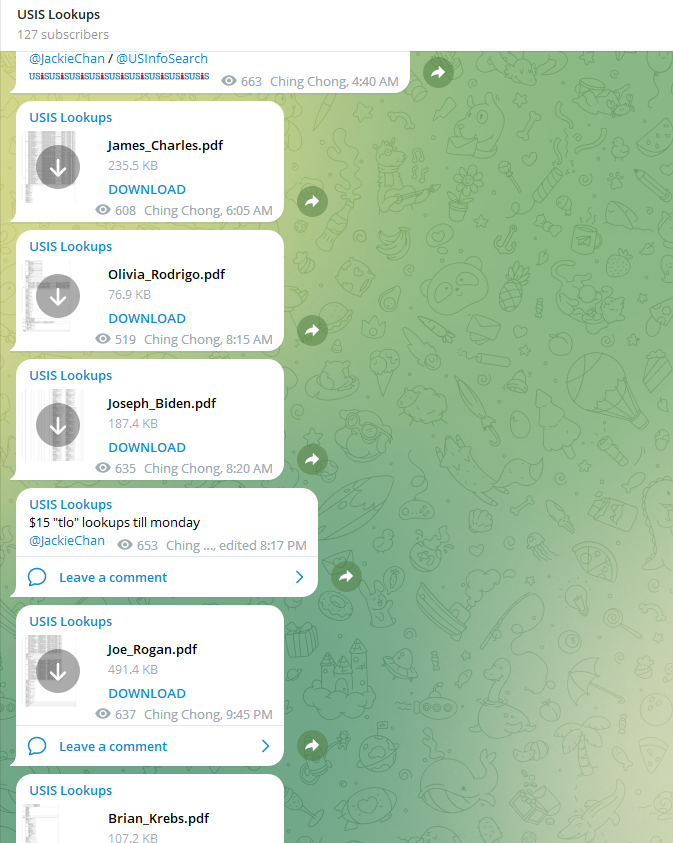
Screenshots of a Telegram-based ID theft service that was selling background reports using hacked law enforcement accounts at USInfoSearch.

There are numerous cybercriminal services that offer detailed background checks on consumers, including full SSNs. These services are powered by compromised accounts at data brokers that cater to private investigators and law enforcement officials, and some are now fully automated via Telegram instant message bots.

In November 2023, KrebsOnSecurity wrote about one such service, which was being powered by hacked accounts at the U.S. consumer data broker USInfoSearch.com. This is notable because the leaked source code indicates Records Check pulled background reports on people by querying NPD’s database and records at USInfoSearch. KrebsOnSecurity sought comment from USInfoSearch and will update this story if they respond.

The point is, if you’re an American who hasn’t frozen their credit files and you haven’t yet experienced some form of new account fraud, the ID thieves probably just haven’t gotten around to you yet.

All Americans are also entitled to obtain a free copy of their credit report weekly from each of the three major credit bureaus. It used to be that consumers were allowed one free report from each of the bureaus annually, but in October 2023 the Federal Trade Commission announced the bureaus had permanently extended a program that lets you check your credit report once a week for free.

If you haven’t done this in a while, now would be an excellent time to order your files. To place a freeze, you’ll need to create an account at each of the three major reporting bureaus, EquifaxExperian and TransUnion. Once you’ve established an account, you should be able to then view and freeze your credit file. If you spot errors, such as random addresses and phone numbers you don’t recognize, do not ignore them. Dispute any inaccuracies you may find.

from Krebs on Security https://ift.tt/TUOtJan
via IFTTT