Hunger numbers stubbornly high for three consecutive years as global crises deepen: UN report
Cristina Mitchell
from PAHO/WHO | Pan American Health Organization https://ift.tt/idVOkqW
via IFTTT

Hunger numbers stubbornly high for three consecutive years as global crises deepen: UN report
Cristina Mitchell
from PAHO/WHO | Pan American Health Organization https://ift.tt/idVOkqW
via IFTTT
Comedian Chris Redd works with a dream team of car experts to breathe new life into worn-out rides with stunning customized makeovers.
from New On Netflix USA https://ift.tt/BQ9TJjO
via IFTTT
Backstreet Boys. NSYNC. Lou Pearlman created the biggest boy bands of the ’90s — and one of the largest Ponzi schemes in history. A riveting docuseries.
from New On Netflix USA https://ift.tt/5UWmtYF
via IFTTT

Clem Lefebvre ha publicado la nota de julio de Linux Mint, y lo ha hecho en julio. Es poco habitual que no sea a mes caído, pero sólo se ha publicado para informar de que Linux Mint 22, de nombre en clave «Wilma», llegará a lo largo de esta semana. Aún no hay fecha oficial, pero si echamos una mirada atrás en el tiempo, es probable que llegue durante este fin de semana. Ahora bien, para el que tenga prisa, ya está disponible.
Clem ha aprovechado la ocasión para agradecer las donaciones recibidas, para confirmar que Linux Mint 22 llegará durante esta semana y que poco después publicará tanto la información sobre cómo actualizar desde 21.3 como que empezarán a llevar todo lo necesario a LMDE 6, la edición basada en Debian. También afirma que la fase beta ha sido muy productiva y que ha servido para corregir 203 bugs.
El anuncio oficial se hará en los próximos días, pero las imágenes ya están subidas. Aunque yo no lo recomendaría por mis propias manías, las que me hacen pensar que en estos días puede haber cambios y subir nuevas ISOs, se pueden descargar desde estos botones:
.boton {margin: 10px;color: white; background-color: grey; padding: 20px; font-size: 2rem; text-decoration: none; border-radius: 10px; position: relative; top: 15px; border: 4px solid #555;}.boton:hover {box-shadow:1px 1px 2.5px black !important;}
Llegado el momento, cuando el lanzamiento sea oficial, publicaremos el correspondiente artículo con las novedades más destacadas, pero podemos adelantar que la base sube a Ubuntu 24.04 Noble Numbat, el kernel a Linux 6.8 y el escritorio de la edición principal será Cinnamon 6.2. También se mejorará el soporte para paquetes flatpak, con información relevante, y se estrenarán las «Acciones» de Nemo. El cuanto al sonido, dará el salto a PipeWire, y aunque no se menciona mucho, han seguido mejorando en el terreno de Wayland. Hay que destacar que Thunderbird seguirá como paquete nativo, nada de snap.
Linux Mint 22 estará soportado durante 5 años, hasta mediados de 2029. Si no puedes esperar, descarga ya las nuevas ISO. Si no tienes prisa, sólo faltan unos días para la nueva versión de Mint.
from Linux Adictos https://ift.tt/1bBEFwY
via IFTTT

En las últimas semanas, un ingeniero de software ha creado algo que ha llamado EarlGreyTV. Tal y como se ve en su página web, es un ordenador colgando en la parte trasera de la tele, pero con ello se obtiene una experiencia próxima a la de una Smart TV sin que por ello tengamos que entrar a la interfaz de un escritorio de PC. El uso del PC antiguo da que pensar.
EarlGreyTV es una interfaz alternativa para la Smart TV basada en Linux y Firefox, con enlaces directos a los servicios que podamos necesitar. En su página de GitHub se explica cómo añadir estos servicios. Pero que nadie piense que conseguir esto es fácil. De hecho, yo recomendaría otras cosas, también tirando de un PC.
En el vídeo vemos cómo funciona la interfaz, entre otras cosas, y hay aplicaciones como YouTube o Netflix. Pero no se ve mucho más que la pantalla de inicio y que detrás hay «colgando» un PC.
Cómo se añaden las aplicaciones también da que pensar. En realidad está preparado para que sea añadir el texto de la URL y una ruta a la imagen, lo que suena perfecto y sencillo, si no fuera porque la base es Linux. «Pablo, ¿qué te ha pasado para que digas que esto es un problema?», os estaréis preguntando. Pues que los servicios de streaming limitan la calidad en Linux. Si se usa Netflix junto a una extensión, se puede aumentar la calidad, pero esto no está incluido en EarlGreyTV. De Amazon Prime Video ni hablamos.
De lo que sí vamos a hablar es de crearnos nuestro propio TV Box con un PC viejo, con sus pros y sus contras.
A mí me parece que EarlGreyTV está mejor que usar todo un PC, pero también está más limitado. Para crear un TV Box con un PC viejo, lo único necesario es un PC viejo, a poder ser con arquitectura de 64bits, y un teclado inalámbrico, a poder ser con panel táctil.
El sistema operativo que yo recomendaría es Manjaro, pero también algún otro con base Debian (más información) en sus ediciones KDE. El motivo es que si queremos una interfaz de TV, hay que instalar Plasma BigScreen. Es una cuyo desarrollo avanza lento, pero es más liviana que Plasma y no es hay escritorio.
Con un sistema compatible, una interfaz de TV y un teclado con panel táctil a modo de mando – aunque Plasma BigScreen soporta mandos IR -, lo que quedaría ya es ir añadiendo software, como:
La arquitectura del procesador es importante. Se puede hacer todo esto con una Raspberry Pi, pero hay software que no está disponible para ARM o ARM64. Por lo tanto, es posible que se quede coja. Por otra parte, un TV Box con Android tiene ciertas restricciones que no todo el mundo sabe cómo sortear. Además, su rendimiento no suele ser el mejor para emular, y si lo queremos todo…
Y si se necesita aún más y el dinero no es problema, se puede incluso tener un PC más potente con Windows, con lo que podremos jugar a todos los títulos del mercado.
Un ordenador cualquiera vale de TV Box, que me lo digan a mí que llevo años con uno de 2015 que compré en 2016. Y si te sientes osado, siempre puedes intentar hacerte con un EarlGreyTV. Pero lo que parece claro es que lo mejor es un PC.
from Linux Adictos https://ift.tt/KyNEnwv
via IFTTT

By David McCabe and Cecilia Kang
The presumptive Democratic nominee has won concessions from Big Tech leaders on A.I., but she hasn’t successfully pushed Congress to regulate.
Published: July 24, 2024 at 03:03AM
from NYT Technology https://ift.tt/DfkjmTv
via IFTTT

By Nico Grant
Wiz’s chief executive said the company walked away from a “humbling offer” and would pursue an initial public offering instead.
Published: July 22, 2024 at 06:00PM
from NYT Technology https://ift.tt/ky7KW9r
via IFTTT
By Steve Lohr
A.I.’s math problem reflects how much the new technology is a break with computing’s past.
Published: July 22, 2024 at 06:00PM
from NYT Technology https://ift.tt/GtY5In8
via IFTTT

By Nico Grant
Google’s parent company narrowly topped revenue and profit expectations, driven by its search engine, while growth in YouTube ad sales fell short.
Published: July 23, 2024 at 02:40PM
from NYT Technology https://ift.tt/T6oVMZf
via IFTTT
The Chinese company in charge of handing out domain names ending in “.top” has been given until mid-August 2024 to show that it has put in place systems for managing phishing reports and suspending abusive domains, or else forfeit its license to sell domains. The warning comes amid the release of new findings that .top was the most common suffix in phishing websites over the past year, second only to domains ending in “.com.”

Image: Shutterstock.
On July 16, the Internet Corporation for Assigned Names and Numbers (ICANN) sent a letter to the owners of the .top domain registry. ICANN has filed hundreds of enforcement actions against domain registrars over the years, but this is thought to be the first in which ICANN has singled out a domain registry responsible for maintaining an entire top-level domain (TLD).
Among other reasons, the missive chided the registry for failing to respond to reports about phishing attacks involving .top domains.
“Based on the information and records gathered through several weeks, it was determined that .TOP Registry does not have a process in place to promptly, comprehensively, and reasonably investigate and act on reports of DNS Abuse,” the ICANN letter reads (PDF).
ICANN’s warning redacted the name of the recipient, but records show the .top registry is operated by a Chinese entity called Jiangsu Bangning Science & Technology Co. Ltd. Representatives for the company have not responded to requests for comment.
Domains ending in .top were represented prominently in a new phishing report released today by the Interisle Consulting Group, which sources phishing data from several places, including the Anti-Phishing Working Group (APWG), OpenPhish, PhishTank, and Spamhaus.
Interisle’s newest study examined nearly two million phishing attacks in the last year, and found that phishing sites accounted for more than four percent of all new .top domains between May 2023 and April 2024. Interisle said .top has roughly 2.76 million domains in its stable, and that more than 117,000 of those were phishing sites in the past year.
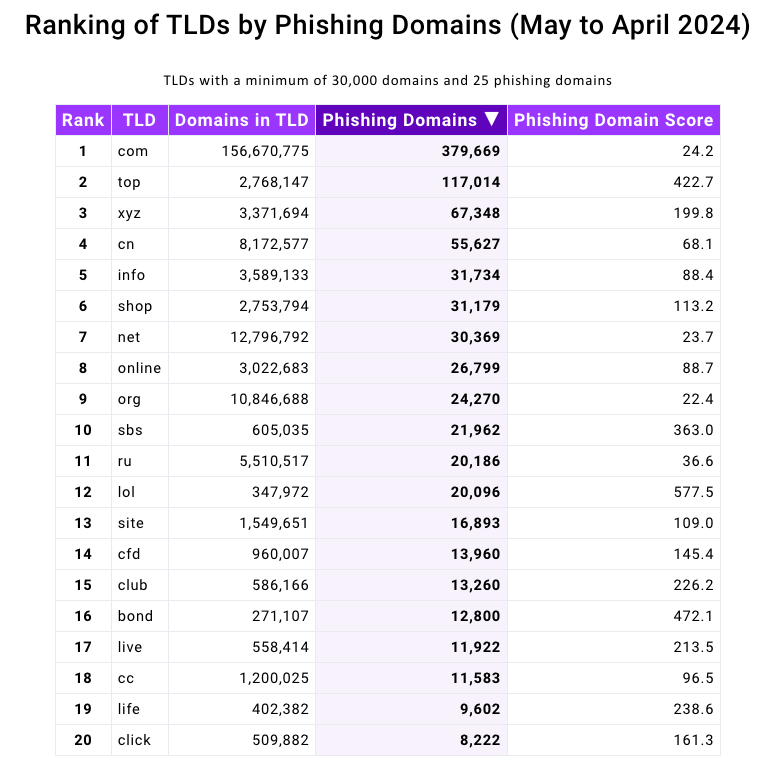
Source: Interisle Consulting Group.
ICANN said its review was based on information collected and studied about .top domains over the past few weeks. But the fact that high volumes of phishing sites are being registered through Jiangsu Bangning Science & Technology Co Ltd. is hardly a new trend.
For example, more than 10 years ago the same Chinese registrar was the fourth most common source of phishing websites, as tracked by the APWG. Bear in mind that the APWG report excerpted below was published more than a year before Jiangsu Bangning received ICANN approval to introduce and administer the new .top registry.
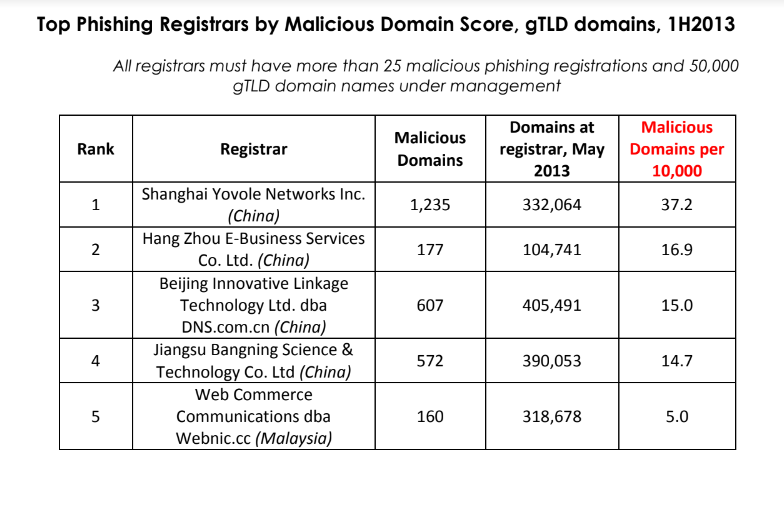
Source: APWG phishing report from 2013, two years before .top came into being.
A fascinating new wrinkle in the phishing landscape is the growth in scam pages hosted via the InterPlanetary File System (IPFS), a decentralized data storage and delivery network that is based on peer-to-peer networking. According to Interisle, the use of IPFS to host and launch phishing attacks — which can make phishing sites more difficult to take down — increased a staggering 1,300 percent, to roughly 19,000 phishing sites reported in the last year.
Last year’s report from Interisle found that domain names ending in “.us” — the top-level domain for the United States — were among the most prevalent in phishing scams. While .us domains are not even on the Top 20 list of this year’s study, “.com” maintained its perennial #1 spot as the largest source of phishing domains overall.
A year ago, the phishiest domain registrar by far was Freenom, a now-defunct registrar that handed out free domains in several country-code TLDs, including .tk, .ml, .ga and .cf. Freenom went out of business after being sued by Meta, which alleged Freenom ignored abuse complaints while monetizing traffic to abusive domains.
Following Freenom’s demise, phishers quickly migrated to other new low-cost TLDs and to services that allow anonymous, free domain registrations — particularly subdomain services. For example, Interisle found phishing attacks involving websites created on Google’s blogspot.com skyrocketed last year more than 230 percent. Other subdomain services that saw a substantial growth in domains registered by phishers include weebly.com, github.io, wix.com, and ChangeIP, the report notes.
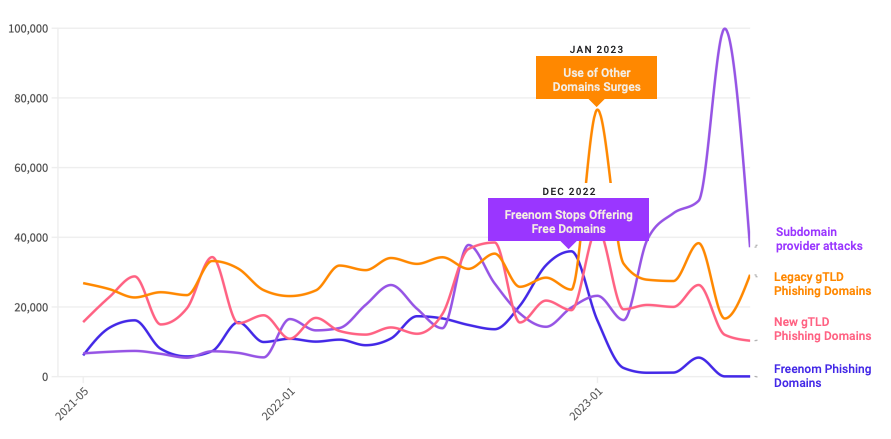
Source: Interisle Consulting.
Interisle Consulting partner Dave Piscitello said ICANN could easily send similar warning letters to at least a half-dozen other top-level domain registries, noting that spammers and phishers tend to cycle through the same TLDs periodically — including .xyz, .info, .support and .lol, all of which saw considerably more business from phishers after Freenom’s implosion.
Piscitello said domain registrars and registries could significantly reduce the number of phishing sites registered through their services just by flagging customers who try to register huge volumes of domains at once. Their study found that at least 27% of the domains used for phishing were registered in bulk — i.e. the same registrant paid for hundreds or thousands of domains in quick succession.
The report includes a case study in which a phisher this year registered 17,562 domains over the course of an eight-hour period — roughly 38 domains per minute — using .lol domains that were all composed of random letters.
ICANN tries to resolve contract disputes privately with the registry and registrar community, and experts say the nonprofit organization usually only publishes enforcement letters when the recipient is ignoring its private notices. Indeed, ICANN’s letter notes Jiangsu Bangning didn’t even open its emailed notifications. It also cited the registry for falling behind in its ICANN membership fees.
With that in mind, a review of ICANN’s public enforcement activity suggests two trends: One is that there have been far fewer public compliance and enforcement actions in recent years — even as the number of new TLDs has expanded dramatically.
The second is that in a majority of cases, the failure of a registry or registrar to pay its annual ICANN membership fees was cited as a reason for a warning letter. A review of nearly two dozen enforcement letters ICANN has sent to domain registrars since 2022 shows that failure to pay dues was cited as a reason (or the reason) for the violation at least 75 percent of the time.
Piscitello, a former ICANN board member, said nearly all breach notices sent out while he was at ICANN were because the registrar owed money.
“I think the rest is just lipstick to suggest that ICANN’s on top of DNS Abuse,” Piscitello said.
KrebsOnSecurity has sought comment from ICANN and will update this story if they respond.
from Krebs on Security https://ift.tt/QwWRuxK
via IFTTT
 Pacosite's Blog