
By Lazaro Gamio
Here’s a visual explanation for how a faulty software update crippled machines.
Published: July 19, 2024 at 02:01PM
from NYT Technology https://ift.tt/PfWqoIc
via IFTTT

By Lazaro Gamio
Here’s a visual explanation for how a faulty software update crippled machines.
Published: July 19, 2024 at 02:01PM
from NYT Technology https://ift.tt/PfWqoIc
via IFTTT

By Eshe Nelson and Danielle Kaye
Airlines to banks to retailers were affected in many countries. Businesses are struggling to recover.
Published: July 18, 2024 at 06:00PM
from NYT Technology https://ift.tt/l7JDpRu
via IFTTT
A faulty software update from cybersecurity vendor Crowdstrike crippled countless Microsoft Windows computers across the globe today, disrupting everything from airline travel and financial institutions to hospitals and businesses online. Crowdstrike said a fix has been deployed, but experts say the recovery from this outage could take some time, as Crowdstrike’s solution needs to be applied manually on a per-machine basis.

A photo taken at San Jose International Airport today shows the dreaded Microsoft “Blue Screen of Death” across the board. Credit: Twitter.com/adamdubya1990
Earlier today, an errant update shipped by Crowdstrike began causing Windows machines running the software to display the dreaded “Blue Screen of Death,” rendering those systems temporarily unusable. Like most security software, Crowdstrike requires deep hooks into the Windows operating system to fend off digital intruders, and in that environment a tiny coding error can quickly lead to catastrophic outcomes.
In a post on Twitter/X, Crowdstrike CEO George Kurtz said an update to correct the coding mistake has been shipped, and that Mac and Linux systems are not affected.
“This is not a security incident or cyberattack,” Kurtz said on Twitter, echoing a written statement by Crowdstrike. “The issue has been identified, isolated and a fix has been deployed.”
Posting to Twitter/X, the director of Crowdstrike’s threat hunting operations said the fix involves booting Windows into Safe Mode or the Windows Recovery Environment (Windows RE), deleting the file “C-00000291*.sys” and then restarting the machine.
The software snafu may have been compounded by a recent series of outages involving Microsoft’s Azure cloud services, The New York Times reports, although it remains unclear whether those Azure problems are at all related to the bad Crowdstrike update.
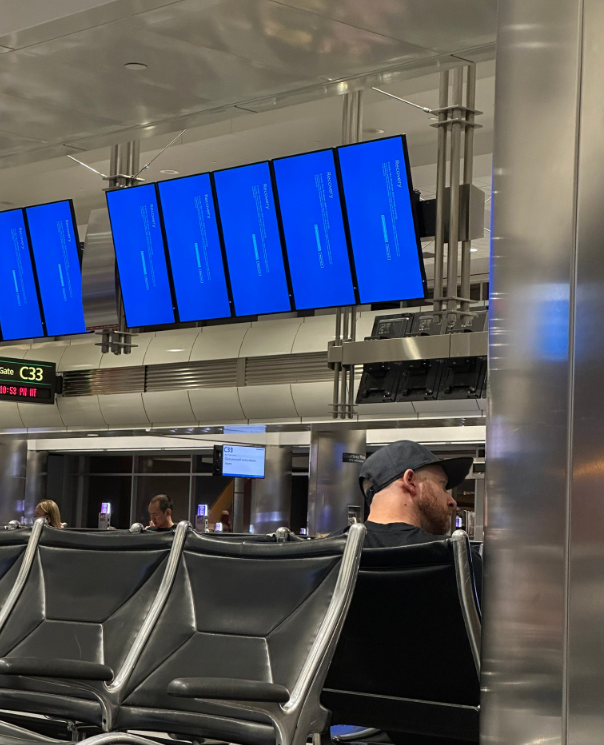
A reader shared this photo taken earlier today at Denver International Airport. Credit: Twitter.com/jterryy07
Reactions to today’s outage were swift and brutal on social media, which was flooded with images of people at airports surrounded by computer screens displaying the Microsoft blue screen error. Many Twitter/X users chided the Crowdstrike CEO for failing to apologize for the massively disruptive event, while others noted that doing so could expose the company to lawsuits.
Meanwhile, the international Windows outage quickly became the most talked-about subject on Twitter/X, whose artificial intelligence bots collated a series of parody posts from cybersecurity professionals pretending to be on their first week of work at Crowdstrike. Incredibly,Twitter/X’s AI summarized these sarcastic posts into a sunny, can-do story about Crowdstrike that was promoted as the top discussion on Twitter this morning.
“Several individuals have recently started working at the cybersecurity firm Crowdstrike and have expressed their excitement and pride in their new roles,” the AI summary read. “They have shared their experiences of pushing code to production on their first day and are looking forward to positive outcomes in their work.”
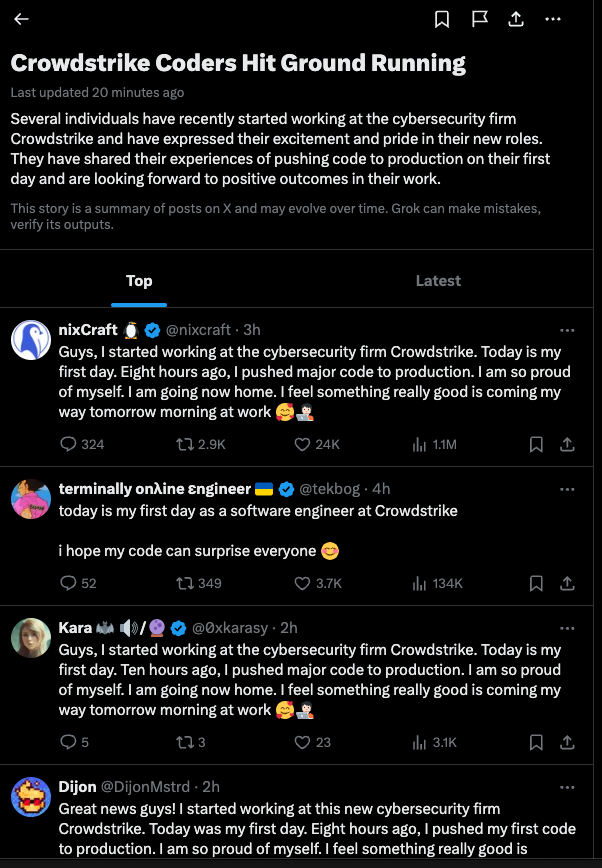
The top story today on Twitter/X, as brilliantly summarized by X’s AI bots.
Wired.com’s Matt Burgess writes that within health care and emergency services, various medical providers around the world have reported issues with their Windows-linked systems, sharing news on social media or their own websites.
“The US Emergency Alert System, which issues hurricane warnings, said that there had been various 911 outages in a number of states,” Burgess wrote. “Germany’s University Hospital Schleswig-Holstein said it was canceling some nonurgent surgeries at two locations. In Israel, more than a dozen hospitals have been impacted, as well as pharmacies, with reports saying ambulances have been rerouted to nonimpacted medical organizations.”
In the United Kingdom, NHS England has confirmed that appointment and patient record systems have been impacted by the outages.
“One hospital has declared a ‘critical’ incident after a third-party IT system it used was impacted,” Wired reports. “Also in the country, train operators have said there are delays across the network, with multiple companies being impacted.”
This is an evolving story. Stay tuned for updates.
from Krebs on Security https://ift.tt/85Lx2kE
via IFTTT

Tras el lanzamiento de una nueva versión estable de Firefox, Mozilla actualiza también el resto de canales. Hay un canal beta y otro para desarrolladores, que se parecen bastante, pero lo más nuevo y en donde más experimentan es en Firefox Nightly. Va adelantado 8 semanas con respecto a la versión estable, y mucho de lo que implementan llega a ésta. Pero también hay otro mucho que no, por lo que lo que vemos en Nightly son novedades que podrían llegar o no hacerlo.
Una novedad reciente está en el Labs de Firefox Nightly. Es un apartado en los ajustes con funciones que se pueden activar y desactivar, sin que para ello tengamos que ir a about:config ni nada parecido. El cambio que se plantean en Mozilla es integrar chatbots de inteligencia artificial, como ChatGPT, en el navegador. ¿Cómo funcionaría todo esto? Eso es lo que vamos a explicar a continuación.
Lo primero que hay que hacer para probar esta función es conseguir Firefox Nightly. En este enlace podemos conseguirlo, aunque desde allí descargaremos un archivo comprimido. Podremos iniciar Firefox Nightly haciendo doble clic sobre el icono «firefox» o «firefox-bin». Las actualizaciones se harán automáticamente, tal y como lo hacen en Windows y macOS.
Con Firefox Nightly ya en nuestro equipo, lo abrimos, hacemos clic en la hamburguesa y luego vamos a «Ajustes». Allí hacemos clic en «Firefox Labs» y dentro marcamos la casilla «AI Chatbot Integration». En el momento de escribir este artículo todo está en inglés. En ese apartado también tenemos que elegir un chatbot, y para esta explicación hemos elegido el más famoso: ChatGPT.
Una vez activada la opción y elegido chatbot, para ver lo de la captura de cabecera tendremos que seleccionar un texto, en el ejemplo «Firefox 128», hacer clic derecho y elegir «Ask ChatGPT». Habrá tres opciones:
Para poder usar cualquier modelo de IA, es necesario hacer uso de una cuenta, diferente a lo que propone DuckDuckGo.
¿Qué me parece a mí esta función? Como usuario de Vivaldi que tiene ChatGPT en su panel lateral, creo que es una función con sus luces y sus sombras. Para empezar, en estos momentos no está en español. Lo bueno es que se integre la opción en el menú contextual, de manera que podemos realizar consultas rápidamente. Que requiera cuenta también significa que sólo podremos usar GPT-4o unas pocas veces antes de que nos pase a GPT3.5.
Pero en general, si no nos preocupa la privacidad, algo que no debería si solemos usar alguno de estos chatbots, es algo que aporta. ¿Lo veremos en Firefox 130?
from Linux Adictos https://ift.tt/QA9b0sS
via IFTTT
[New Episodes] As humans turn into savage monsters and the world plunges into terror, a handful of survivors fight for their lives — and to hold on to their humanity.
from New On Netflix USA https://ift.tt/KlUhbfC
via IFTTT
The 500-day manhunt for Colombia’s Pablo Escobar is detailed through interviews and archival images in this crime documentary.
from New On Netflix USA https://ift.tt/WIh6vFm
via IFTTT
When their long, loveless marriage ends in betrayal, a princess and her husband mysteriously wake up as 18-year-olds in the year they were first married.
from New On Netflix USA https://ift.tt/2gwDaVF
via IFTTT
[New Episodes] On the shores of paradise, gorgeous singles meet and mingle. But there’s a twist. To win an enticing grand prize, they’ll have to give up sex.
from New On Netflix USA https://ift.tt/M2r7NLH
via IFTTT
Sweet, energetic kitten Chi travels to Okinawa for the summer with the Yamada family, where they discover the joys of island life and make new friends.
from New On Netflix USA https://ift.tt/ONgB1R7
via IFTTT
Crushed by his sudden forced retirement, a professional soccer player pivots into a new career when he starts working for a sports management company.
from New On Netflix USA https://ift.tt/BarDHtb
via IFTTT
 Pacosite's Blog