Fueron detectadas nuevas vulnerabilidades de autenticación WiFi en Linux 

Vulnerabilidades WiFi

Las vulnerabilidades afecta a los dispositivos Android, ChromeOS y Linux que se conectan a redes WiFi

Hace poco se dio a conocer la noticia de que fueron identificadas dos nuevas vulnerabilidades en los paquetes de software de código abierto Wifi de Linux que permiten a los atacantes engañar a las víctimas para que se conecten a redes clonadas (FakeAP imitando al original) e intercepten su tráfico.

Las vulnerabilidades descubiertas fueron detectadas en los paquetes IWD (Intel inet Wireless Daemon) y wpa_supplicant, los cuales se utilizan para gestionar la conexión de sistemas cliente Linux a redes inalámbricas.

Naturaleza de las vulnerabilidades : dos ataques de omisión de autenticación en redes WPA2/3 modernas: uno contra usuarios que se conectan a Enterprise WiFi y el otro contra redes WiFi domésticas existentes .

Impacto:

wpa_supplicant: permite a un atacante engañar a una víctima para que se conecte a un clon malicioso de una red WiFi empresarial y posteriormente interceptar su tráfico.

IWD: permite a un adversario obtener acceso no autorizado a una red WiFi doméstica protegida, exponiendo a los usuarios y dispositivos existentes a ataques.

En el caso de IWD, la vulnerabilidad (catalogada bajo CVE-2023-52161) se manifiesta únicamente cuando se habilita el modo de punto de acceso, que no es una configuración habitual para IWD, diseñado principalmente para conectarse a redes inalámbricas. Esta vulnerabilidad permite conectarse a un punto de acceso creado sin necesidad de conocer la contraseña, por ejemplo, cuando un usuario proporciona acceso a la red a través de su dispositivo (hotspot).

Se menciona que la vulnerabilidad se origina en la falta de verificación del orden de los pasos durante la negociación de la conexión inalámbrica. Esta negociación se basa en un canal de comunicación de 4 pasos al conectarse por primera vez a una red inalámbrica segura. El problema radica en que IWD acepta mensajes para cualquier etapa de esta negociación sin verificar si se ha completado la etapa anterior.

Por ejemplo, un atacante puede omitir el envío del mensaje de la segunda etapa y enviar directamente un mensaje de la cuarta etapa, evitando así la etapa en la que se verifica la autenticación. Al procesar este mensaje de la cuarta etapa sin la verificación adecuada, la clave PTK se establece en cero. Con esto, el atacante puede calcular el código MIC (Código de Integridad del Mensaje) utilizando un PTK nulo, y el IWD aceptará este código de verificación como válido.

Como resultado, el atacante completa esta negociación parcial de la conexión y obtiene acceso total a la red inalámbrica, ya que el punto de acceso recibirá las tramas que envíe cifradas con una clave PTK nula. Cabe mencionar que este problema fue solucionado en la versión 2.14 de IWD.

Por otro lado, en wpa_supplicant la vulnerabilidad (CVE-2023-52160) permite a un atacante atraer a un usuario a una red inalámbrica ficticia, actuando como un clon de la red a la que el usuario pretende conectarse. Esta falla en la implementación del protocolo PEAP permite al atacante omitir la segunda etapa de autenticación al conectar un dispositivo de usuario mal configurado, lo que facilita la creación de un clon falso de una red Wi-Fi confiable. Este problema afecta a redes con WPA2-Enterprise o WPA3-Enterprise que utilizan el protocolo PEAP.

Sobre esta vulnerabilidad se menciona que para llevar a cabo con éxito un ataque en wpa_supplicant, primero se deben cumplir algunas condiciones:

  1. Verificación del certificado TLS del servidor deshabilitada: El usuario debe deshabilitar la verificación del certificado TLS del servidor en su configuración de wpa_supplicant. Esta es una configuración peligrosa que permite al atacante engañar al cliente para que se conecte a una red falsa.
  2. Conocimiento del SSID de la red clonada: El atacante debe conocer el identificador de la red inalámbrica (SSID) de la red clonada. Esto le permite al atacante configurar una red falsa que imita la red legítima y engañar al cliente para que se conecte a ella.
  3. Posicionamiento del atacante: El atacante debe estar dentro del alcance del adaptador inalámbrico de la víctima, pero fuera del alcance del punto de acceso de la red inalámbrica clonada. Esto significa que el atacante debe estar lo suficientemente cerca de la víctima para interceptar su tráfico, pero lo suficientemente lejos del punto de acceso legítimo para que el cliente elija la red falsa.
  4. Tipo de red: El ataque es posible en redes que utilizan WPA2-Enterprise o WPA3-Enterprise que implementan el protocolo PEAP. Este protocolo se utiliza comúnmente en entornos empresariales y educativos para autenticar usuarios en redes inalámbricas seguras.

Los desarrolladores de wpa_supplicant consideran que el problema no es una vulnerabilidad, ya que solo se manifiesta en redes inalámbricas configuradas incorrectamente que utilizan autenticación EAP junto con PEAP sin verificar el certificado TLS del servidor. Para mitigar este problema, se ha lanzado un parche que añade un modo de paso obligatorio de la segunda fase de autenticación, además de comprobar el certificado TLS. Sin embargo, para abordar completamente la vulnerabilidad, los administradores de red deben configurar una cadena de confianza para verificar el certificado del servidor mediante el parámetro ca_cert.

Finalmente si estás interesado en poder conocer más al respecto, puedes consultar los detalles en el siguiente enlace.

from Linux Adictos https://ift.tt/x2wPSMy
via IFTTT

BlackCat Ransomware Group Implodes After Apparent $22M Payment by Change Healthcare

There are indications that U.S. healthcare giant Change Healthcare has made a $22 million extortion payment to the infamous BlackCat ransomware group (a.k.a. “ALPHV“) as the company struggles to bring services back online amid a cyberattack that has disrupted prescription drug services nationwide for weeks. However, the cybercriminal who claims to have given BlackCat access to Change’s network says the crime gang cheated them out of their share of the ransom, and that they still have the sensitive data Change reportedly paid the group to destroy. Meanwhile, the affiliate’s disclosure appears to have prompted BlackCat to cease operations entirely.

Image: Varonis.

In the third week of February, a cyber intrusion at Change Healthcare began shutting down important healthcare services as company systems were taken offline. It soon emerged that BlackCat was behind the attack, which has disrupted the delivery of prescription drugs for hospitals and pharmacies nationwide for nearly two weeks.

On March 1, a cryptocurrency address that security researchers had already mapped to BlackCat received a single transaction worth approximately $22 million. On March 3, a BlackCat affiliate posted a complaint to the exclusive Russian-language ransomware forum Ramp saying that Change Healthcare had paid a $22 million ransom for a decryption key, and to prevent four terabytes of stolen data from being published online.

The affiliate claimed BlackCat/ALPHV took the $22 million payment but never paid him his percentage of the ransom. BlackCat is known as a “ransomware-as-service” collective, meaning they rely on freelancers or affiliates to infect new networks with their ransomware. And those affiliates in turn earn commissions ranging from 60 to 90 percent of any ransom amount paid.

“But after receiving the payment ALPHV team decide to suspend our account and keep lying and delaying when we contacted ALPHV admin,” the affiliate “Notchy” wrote. “Sadly for Change Healthcare, their data [is] still with us.”

Change Healthcare has neither confirmed nor denied paying, and has responded to multiple media outlets with a similar non-denial statement — that the company is focused on its investigation and on restoring services.

Assuming Change Healthcare did pay to keep their data from being published, that strategy seems to have gone awry: Notchy said the list of affected Change Healthcare partners they’d stolen sensitive data from included Medicare and a host of other major insurance and pharmacy networks.

On the bright side, Notchy’s complaint seems to have been the final nail in the coffin for the BlackCat ransomware group, which was infiltrated by the FBI and foreign law enforcement partners in late December 2023. As part of that action, the government seized the BlackCat website and released a decryption tool to help victims recover their systems.

BlackCat responded by re-forming, and increasing affiliate commissions to as much as 90 percent. The ransomware group also declared it was formally removing any restrictions or discouragement against targeting hospitals and healthcare providers.

However, instead of responding that they would compensate and placate Notchy, a representative for BlackCat said today the group was shutting down and that it had already found a buyer for its ransomware source code.

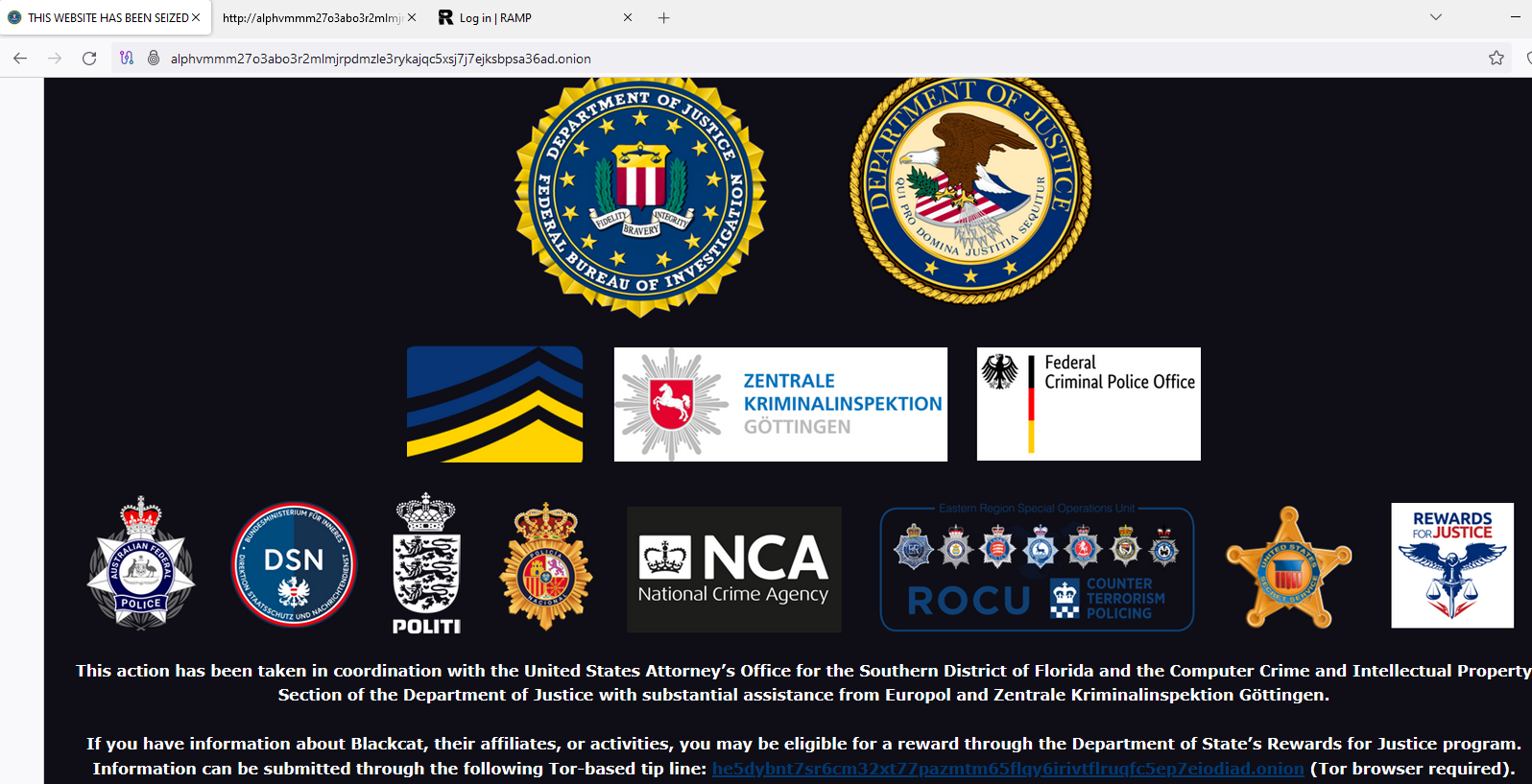
The seizure notice now displayed on the BlackCat darknet website.

“There’s no sense in making excuses,” wrote the RAMP member “Ransom.” “Yes, we knew about the problem, and we were trying to solve it. We told the affiliate to wait. We could send you our private chat logs where we are shocked by everything that’s happening and are trying to solve the issue with the transactions by using a higher fee, but there’s no sense in doing that because we decided to fully close the project. We can officially state that we got screwed by the feds.”

BlackCat’s website now features a seizure notice from the FBI, but several researchers noted that this image seems to have been merely cut and pasted from the notice the FBI left in its December raid of BlackCat’s network. The FBI has not responded to requests for comment.

Fabian Wosar, head of ransomware research at the security firm Emsisoft, said it appears BlackCat leaders are trying to pull an “exit scam” on affiliates by withholding many ransomware payment commissions at once and shutting down the service.

“ALPHV/BlackCat did not get seized,” Wosar wrote on Twitter/X today. “They are exit scamming their affiliates. It is blatantly obvious when you check the source code of their new takedown notice.”

Dmitry Smilyanets, a researcher for the security firm Recorded Future, said BlackCat’s exit scam was especially dangerous because the affiliate still has all the stolen data, and could still demand additional payment or leak the information on his own.

“The affiliates still have this data, and they’re mad they didn’t receive this money, Smilyanets told Wired.com. “It’s a good lesson for everyone. You cannot trust criminals; their word is worth nothing.”

BlackCat’s apparent demise comes closely on the heels of the implosion of another major ransomware group — LockBit, a ransomware gang estimated to have extorted over $120 million in payments from more than 2,000 victims worldwide. On Feb. 20, LockBit’s website was seized by the FBI and the U.K.’s National Crime Agency (NCA) following a months-long infiltration of the group.

LockBit also tried to restore its reputation on the cybercrime forums by resurrecting itself at a new darknet website, and by threatening to release data from a number of major companies that were hacked by the group in the weeks and days prior to the FBI takedown.

But LockBit appears to have since lost any credibility the group may have once had. After a much-promoted attack on the government of Fulton County, Ga., for example, LockBit threatened to release Fulton County’s data unless paid a ransom by Feb. 29. But when Feb. 29 rolled out, LockBit simply deleted the entry for Fulton County from its site, along with those of several financial organizations that had previously been extorted by the group.

Fulton County held a press conference to say that it had not paid a ransom to LockBit, nor had anyone done so on their behalf, and that they were just as mystified as everyone else as to why LockBit never followed through on its threat to publish the county’s data. Exerts told KrebsOnSecurity LockBit likely balked because it was bluffing, and that the FBI likely relieved them of that data in their raid.

Smilyanets’ comments are driven home in revelations first published last month by Recorded Future, which quoted an NCA official as saying LockBit never deleted the data after being paid a ransom, even though that is the only reason many of its victims paid.

“If we do not give you decrypters, or we do not delete your data after payment, then nobody will pay us in the future,” LockBit’s extortion notes typically read.

Hopefully, more companies are starting to get the memo that paying cybercrooks to delete stolen data is a losing proposition all around.

from Krebs on Security https://ift.tt/pO4EjAK
via IFTTT

Linux Mint presenta Jargonaut, la aplicación que podría sustituir a HexChat como aplicación para IRC (o no)

Jargonaut en Linux Mint

Clem Lefebvre ha publicado el boletín de marzo de Linux Mint, correspondiente a lo que ha pasado en febrero de este 2024. En él no se ha hablado mucho del sistema operativo y se han tratado otros temas. El primero para lamentarse porque Google Adsense esté siendo cada vez más intrusivo, lo que les hace planterase hacer cambios o eliminar todos los anuncios en su página web. Luego han tratado otro tema más, en este caso una mala noticia de las que hacen bueno el refrán de que «no hay mal que por bien no venga».

HexChat lanzó su última versión en febrero. Fue una actualización que llegó para corregir errores y para despedirse de la comunidad. Linux Mint usa HexChat como cliente de IRC, y antes de eso usaba Xchat. Siempre han usado un cliente de este tipo de mensajería porque tienen incluido el servidor de soporte del proyecto, y allí se pueden resolver muchas dudas. Podrían hacerse cargo del desarrollo de HexChat como han hecho, por ejemplo, con Timeshift, pero sería demasiado trabajo y ya están mirando a un futuro con Jargonaut.

Linux Mint usaría Jargonaut como cliente IRC

HexChat estaba basado en GTK2 (vaya, yo que pensaba que sólo GIMP…), y deberían subirlo a GTK3, entre otras cosas, para que fuera compatible con HiDPI. Linux Mint necesita un cliente de IRC, y Jargonaut puede ser la apuesta ganadora. Aunque use IRC no será desarrollado como un cliente de IRC, y soportará pastebin e imgur vía DND, subir las especificaciones del sistema, problemas y muchas funciones que no están disponibles en un cliente IRC normal. Por otra parte, no permitirá unirse a canales ni usar comandos IRC.

Un cliente IRC que no es cliente IRC. Eso será.

Jargonaut será una XAPP, es decir, una aplicación de Linux Mint como el mencionado Timeshift u otras como Warpinator o el gestor de aplicaciones web. Quedarán especialmente en el sistema operativo con sabor a menta, pero se podrán usar en otras distribuciones. Probablemente la suban a Flathub cuando esté lista, aunque quizá no merezca la pena fuera de Linux Mint.

from Linux Adictos https://ift.tt/Z0oAVRN
via IFTTT