After his activist mother disappears without a trace, a young man sets out to get justice — a quest that leads him to a wealthy family with dark secrets.
from New On Netflix USA https://ift.tt/k4zX95E
via IFTTT

After his activist mother disappears without a trace, a young man sets out to get justice — a quest that leads him to a wealthy family with dark secrets.
from New On Netflix USA https://ift.tt/k4zX95E
via IFTTT

Aunque creo que no me equivoco cuando digo que la mayoría de usuarios de Linux preferimos tener todo el control sobre nuestro sistema operativo, también hay otro tipo de usuario que lo que quiere es sencillamente tener algo que funcione y poder usar ciertas aplicaciones. Para este tipo de persona existen cada vez más distribuciones inmutables, que son aquellas en las que podemos instalar software y hacer algunas modificaciones, pero mínimas para que no se rompa nada. Como ejemplos, SteamOS, como no, y Fedora Silverblue, a los que se le puede sumar Ubuntu Core Desktop.
El junio pasado tuvimos las primeras noticias sobre este proyecto, y pocos días después pudimos probar ese experimento. Poco más se supo hasta esta semana, cuando se ha confirmado que, aunque el plan inicial contaba con lanzar Ubuntu Core Desktop como parte de la familia Noble Numbat, al final no va a ser posible. El que esté esperando esta opción, tendrá que armarse de paciencia, ya que Tim Holmes-Mitra (vía OMG! Ubuntu!) dice que tampoco pueden dar ninguna fecha.
«No se lanzará en 24.04 y, por desgracia, no puedo dar una fecha hasta que hayamos solucionado los problemas que necesitan resolución – queremos que la experiencia del usuario sea excelente y eso va a llevar tiempo«.
No se conocen los detalles sobre los problemas a los que se están enfrentando, pero tiene sentido que no quieran lanzar algo como esto si no ofrece una experiencia notable. Lo que ahora se conoce como Ubuntu Core Desktop está pensado para las personas que sólo quieren poder usar un sistema operativo sin quebraderos de cabeza, y se empezaría mal si la experiencia se ve mermada por los bugs.
Con mucha suerte, esos problemas se arreglan en los próximos meses y lanzan la nueva ISO en octubre, pero esto no está ni cerca de confirmarse. Ubuntu Core Desktop no pasará a ser la versión principal de Ubuntu, algo que podría preocupar a algunos usuarios del sistema de Canonical. Si no llega para 24.10, lo más probable es que tengamos versión inmutable de Ubuntu en abril de 2025.
from Linux Adictos https://ift.tt/aVdLxvP
via IFTTT
Until earlier this week, the support website for networking equipment vendor Juniper Networks was exposing potentially sensitive information tied to customer products, including which devices customers bought, as well as each product’s warranty status, service contracts and serial numbers. Juniper said it has since fixed the problem, and that the inadvertent data exposure stemmed from a recent upgrade to its support portal.

Sunnyvale, Calif. based Juniper Networks makes high-powered Internet routers and switches, and its products are used in some of the world’s largest organizations. Earlier this week KrebsOnSecurity heard from a reader responsible for managing several Juniper devices, who found he could use Juniper’s customer support portal to find device and support contract information for other Juniper customers.
Logan George is a 17-year-old intern working for an organization that uses Juniper products. Speaking on condition that his employer not be named, George said he found the data exposure earlier this week by accident while searching for support information on a particular Juniper product.
George discovered that after logging in with a regular customer account, Juniper’s support website allowed him to list detailed information about virtually any Juniper device purchased by other customers. Searching on Amazon.com in the Juniper portal, for example, returned tens of thousands of records. Each record included the device’s model and serial number, the approximate location where it is installed, as well as the device’s status and associated support contract information.
George said a few minutes of digging around the Juniper support portal revealed he could even see product and support information for the U.S. Department of Defense (DoD).
“If there’s one thing I know it’s that I should not be able to see the DoD’s Juniper products,” George said. “But this information was available for hundreds of companies, and I could see what products they had installed and where.”
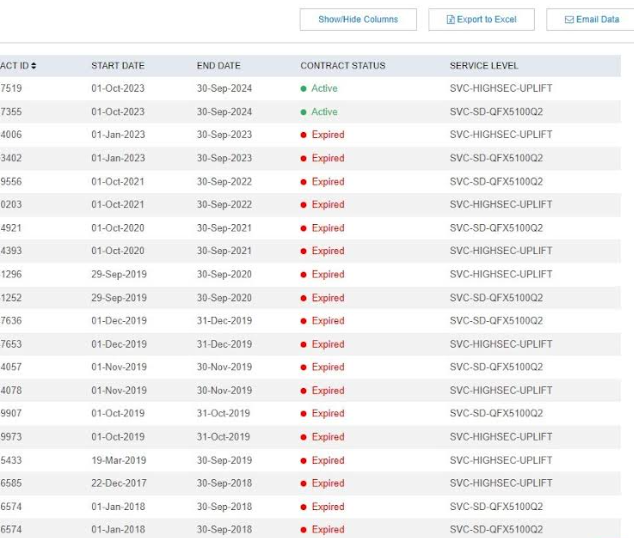
Information exposed by the Juniper support portal. Columns not pictured include Serial Number, Software Support Reference number, Product, Warranty Expiration Date and Contract ID.
George said the exposed support contract information is potentially sensitive because it shows which Juniper products are most likely to be lacking critical security updates.
“If you don’t have a support contract you don’t get updates, it’s as simple as that,” George said. “Using serial numbers, I could see which products aren’t under support contracts. And then I could narrow down where each device was sent through their serial number tracking system, and potentially see all of what was sent to the same location. A lot of companies don’t update their switches very often, and knowing what they use allows someone to know what attack vectors are possible.”
In a written statement, Juniper said the data exposure was the result of a recent upgrade to its support portal.
“We were made aware of an inadvertent issue that allowed registered users to our system to access serial numbers that were not associated with their account,” the statement reads. “We acted promptly to resolve this issue and have no reason to believe at this time that any identifiable or personal customer data was exposed in any way. We take these matters seriously and always use these experiences to prevent further similar incidents. We are actively working to determine the root cause of this defect and thank the researcher for bringing this to our attention.”
The company has not yet responded to requests for information about exactly when those overly permissive user rights were introduced. However, the changes may date back to September 2023, when Juniper announced it had rebuilt its customer support portal.
George told KrebsOnSecurity the back-end for Juniper’s support website appears to be supported by Salesforce, and that Juniper likely did not have the proper user permissions established on its Salesforce assets. In April 2023, KrebsOnSecurity published research showing that a shocking number of organizations — including banks, healthcare providers and state and local governments — were leaking private and sensitive data thanks to misconfigured Salesforce installations.
Nicholas Weaver, a researcher at University of California, Berkeley’s International Computer Science Institute (ICSI) and lecturer at UC Davis, said the complexity layered into modern tech support portals leaves much room for error.
“This is a reminder of how hard it is to build these large systems like support portals, where you need to be able to manage gazillions of users with distinct access roles,” Weaver said. “One minor screw up there can produce hilarious results.”
Last month, computer maker Hewlett Packard Enterprise announced it would buy Juniper Networks for $14 billion, reportedly to help beef up the 100-year-old technology company’s artificial intelligence offerings.
from Krebs on Security https://ift.tt/9KmdDMr
via IFTTT
[Episodes Removed] Eight lively young Southerners gather in a popular beach town on Florida’s Emerald Coast for a summer of hookups and wild adventures, Floribama-style.
from New On Netflix USA https://ift.tt/loFBdrU
via IFTTT
[New Episodes] Pedro, Luis, Raúl and Santi are four friends who feel a bit lost in the new world of empowered women, each trying to adjust in their own haphazard way.
from New On Netflix USA https://ift.tt/pFtSYGl
via IFTTT
Nanase fell in love with Dr. Tendo five years ago. Now she’s a nurse and ready to meet him again. But he’s nothing like the nice guy she thought he was!
from New On Netflix USA https://ift.tt/nGHmVw2
via IFTTT
A fund manager trades her cushy life in London for a tiny Scottish village, where she chases her singing dreams coached by a crotchety former opera star.
from New On Netflix USA https://ift.tt/qtrfN01
via IFTTT
A bold newcomer in a conservative village opens a lingerie store, which gains both ardent support and opposition.
from New On Netflix USA https://ift.tt/C3Dpo0B
via IFTTT
From an intoxicating fantasy to a dangerous affair, a wealthy married woman finds her life irreversibly shattered after picking up an unpublished novel.
from New On Netflix USA https://ift.tt/qn51mKY
via IFTTT
Years after his mother abandons him and remarries, a man demands answers when he’s asked to sign a document denying he is her son as she runs for office.
from New On Netflix USA https://ift.tt/3MDi7xY
via IFTTT
 Pacosite's Blog