Llega la nueva versión de AV Linux 23.1 «Enlightened»

AV Linux 23.1

Screenshot de AV Linux 23.1 con Enlightenment

Después de varios meses de desarrollo, se dio a conocer el lanzamiento de la nueva versión de AV Linux 23.1 «Enlightened», la cual llega construida sobre la base de MX-23/Debian 12 “Bookworm”, con el entorno Enlightenment 0.25.4 y PipeWire 1.0.0

Para quienes desconocen de AV Linux, deben saber que esta es una distribución que promete revolucionar la creación y procesamiento de contenido multimedia. Diseñada sobre la sólida base de MX Linux y el repositorio KXStudio, AV Linux ofrece una amplia gama de herramientas y aplicaciones para satisfacer las necesidades más exigentes de los creadores de contenido multimedia.

Entre las aplicaciones destacadas se encuentran Ardour, ArdourVST, Harrison Mixbus, Blender, Cinelerra, Openshot, LiVES, y una variedad de herramientas para la conversión de formatos de archivos multimedia.

Principales novedades de AV Linux 23.1 «Enlightened»

En esta nueva versión que se presenta de AV Linux 23.1 «Enlightened» se ha actualizado el Kernel de Linux a la versión 6.6.9 con parches de Liquorix, el cual es conocido por su enfoque en cargas de trabajo multimedia y por ofrecer mejoras en la capacidad de respuesta del sistema durante el procesamiento de audio.

Por la parte de la base del sistema, podremos encontrar que se ha actualizado a la base de MX-23 y Debian 12 “Bookworm”, mientras que por la parte del entorno de usuario, Xfce ha sido reemplazado por Enlightenment 0.25.4 y con la cual se nos ofrecen variantes oscuras y claras con temas de íconos y escritorio GTK.

Con la introducción de Enlightenment 0.25.4, los usuarios pueden disfrutar de variantes oscuras y claras con temas de íconos y escritorios GTK, lo que les permite personalizar su entorno según sus preferencias individuales. Además, se ha agregado un nuevo estante en la sección derecha del escritorio, proporcionando accesos directos convenientes a las aplicaciones de audio y vídeo para una mayor productividad.

El panel inferior ha sido cuidadosamente equipado con los accesos directos necesarios, elementos de bandeja y dos menús principales, facilitando la navegación y el acceso a las herramientas esenciales para la producción multimedia.

Además de ello, ahora por defecto, se habilita el servidor de medios PipeWire 1.0.0, mejorando la gestión de audio, asi como también que los usuarios ahora pueden elegir entre systemd o sysvinit como sistema de inicialización predeterminado.

Por otra parte, se menciona que AV Linux 23.1 viene con un detallado manual ilustrado en formato PDF, con 72 páginas de información útil y orientación para aprovechar al máximo todas las características y aplicaciones disponibles.

De los demás cambios que se destacan de esta nueva versión:

  • Se ofrecen más de 1000 complementos de audio comerciales y de código abierto, proporcionando a los usuarios una amplia gama de herramientas para explorar y utilizar en sus proyectos multimedia.
  • AV Linux 23.1 hereda las poderosas herramientas de MX Linux, incluidas las venerables ‘ MX-Tools ‘ que mejoran la experiencia general del usuario.
  • Las versiones de software han sido actualizadas, incluyendo Kdenlive 23.08.4 y Openshot 3.1.1, mientras que los compositores de música pueden profundizar en MuseScore 4 y Hydrogen 1.2.0, Audacity 3.4.0 para edición de audio y Blender 4.0.2, Ardour 8.2.5,  AviDemux 2.8.1, Cinelerra 20231230, Harrison Mixbus 32C 9.2.172 (demo) y Reaper 7.07 (demo).
  • La aplicación relacionada con imágenes incluye Inkscape para dibujo vectorial, GIMP para edición de trama y visor de imágenes Mirage .
  • AV Linux Utilities ofrece utilidades personalizadas especializadas diseñadas para profesionales multimedia, ofreciendo eficiencia y conveniencia en los flujos de trabajo de producción de audio y video.
  • Para administrar el software, puede utilizar el administrador de paquetes Synaptic o el instalador del paquete MX.

Finalmente si estás interesado en conocer más al respecto sobre esta nueva versión, puedes consultar los detalles en el siguiente enlace.

Descarga y obtener AV Linux 23.1 «Enlightened»

Para quienes estén interesados en descargar y probar esta nueva versión de AV Linux 23.1 «Enlightened», solo debes dirigirte a su página web oficial y en su sección de descargas encontraras los links para descargar esta distro de Linux.

El enlace es este.

Ahora si ya eres usuario de esta distro y quieres obtener las nuevas actualizaciones proporcionadas en esta liberación, es importante mencionar que debido a que algunos de los cambios son bastante grandes, no existe una ruta de actualización del repositorio desde AV Linux 21.3. Y esta nueva versión requerirá una instalación nueva.

from Linux Adictos https://ift.tt/qW7pN2Z
via IFTTT

RAWRLAB Games dio a conocer su port de Godot para Nintendo Switch

RAWRLAB Games

RAWRLAB Games presento su port de
godot

Se dio a conocer la noticia por parte de RAWRLAB Games, un estudio desarrollador de juegos independiente, el lanzamiento de un conjunto de herramientas de Godot Engine, las cuales diseñadas para facilitar la migración de juegos de Godot a la plataforma Nintendo Switch.

Este es un movimiento significativo para los desarrolladores de juegos independientes y la iniciativa tiene como objetivo ampliar la accesibilidad del motor Godot, a una amplia gama de creadores que buscan desarrollar juegos para la Nintendo Switch.

Se menciona que el port ofrece soporte a proyectos realizados con las versiones 3.5.xy 4.1.x de Godot, de las cuales se destaca por ejemplo en Godot 4.1 una interfaz gráfica mejorada, nuevas texturas 3D con ruido visual, rediseñó del algoritmo de navegación con IA para evitar colisiones, un algoritmo basado en hashes rápidos para mejorar la velocidad de operaciones, soporte para crear nodos de sombreado, complementos de editor usando GDExtension y un backend de renderizado basado en Vulkan.

Mientras que por la parte de la versión de Godot 3.5 se proporciona el nodo Label3D listo para usar para mostrar texto en escenas 3D., nuevos contenedores de flujo (HFlowContainer y VFlowContainer), la compilación asincrónica de shaders + almacenamiento en caché y la interpolación de objetos físicos 3D, acceso a objetos de escena mediante nombres únicos, nuevos contenedores de transmisión para GUI, oclusión 3D y soporte Android.

Cabe mencionar que el port se ofrece sin coste alguno para los desarrolladores con autorización de Nintendo y aunque el port no está altamente optimizado, se considera suficientemente eficiente para la mayoría de los proyectos, destacando el compromiso de RAWRLAB Games.

«Este puerto representa un esfuerzo de colaboración, escrito en coautoría por varios miembros de los foros del Portal de desarrolladores de Nintendo. Subraya nuestro compromiso de hacer que Godot Engine sea más accesible para una gama más amplia de creadores».

Entre las características principales de la solución se encuentran:

  • Acceso de cortesía: disponible sin costo para todos los desarrolladores autorizados de Nintendo Switch.
  • Licencia: El código fuente se distribuye bajo la Licencia MIT, ofreciendo amplios derechos de uso y modificación.
  • Aprovisionamiento de software: el software se proporciona «tal cual», sin garantía implícita ni soporte de ningún tipo.
  • Funcionalidad básica incluida: este puerto incluye solo funcionalidad básica.
  • Sin C# ni GDNative/GDExtension : solo se admite GDScript. Las extensiones nativas no son compatibles, pero puedes intentar convertirlas en módulos internos.
  • Nivel de optimización: es importante tener en cuenta que el puerto no está altamente optimizado pero es adecuadamente eficiente para la mayoría de los proyectos de juegos pequeños y medianos.
  • Capacidad de ampliación: al tener acceso al código fuente, los desarrolladores con conocimientos de C++ tienen la oportunidad de agregar e integrar funcionalidades adicionales según sea necesario.
  • No se proporciona soporte: este puerto se proporciona sin soporte. Se anima a los desarrolladores a interactuar con la comunidad en el Portal de desarrolladores de Nintendo para obtener colaboración y asistencia.
  • Procedimiento de acceso: El acceso se puede solicitar a través del Portal de desarrolladores de Nintendo.

Aunque RAWRLAB Games ha desarrollado, adaptado y publicado una cartera de 13 proyectos en Switch desde 2014, hasta el momento no ha logrado alcanzar un éxito notable en la industria de los juegos y por mencionar algunos de los juegos publicados en Nintendo Switch gracias a esta herramienta se destacan: Simona’s Requiem, Constellations, 8-Colors Star Guardians +, Colored Effects, Murtop, Space Ducks, Donut Dodo, Inhabit, The hero with a thousand arms y Crystal Chip Collector e.

Finalmente para los interesados, vale recordarles que código se distribuye bajo la licencia MIT y viene «tal cual», sin garantía ni soporte de ningún tipo. El port incluye sólo funcionalidad básica y es compatible con GDScript, sin extensiones nativas. RAWRLAB dice que los desarrolladores con conocimientos de C++ pueden agregar e integrar funcionalidades adicionales, pero no esperen que el puerto esté altamente optimizado. Si estás interesado en ello, solo debes de solicitar el acceso a través del portal de desarrolladores de Nintendo.

Fuente: https://www.rawrlab.com

from Linux Adictos https://ift.tt/AlIctq9
via IFTTT

Fla. Man Charged in SIM-Swapping Spree is Key Suspect in Hacker Groups Oktapus, Scattered Spider

On Jan. 9, 2024, U.S. authorities arrested a 19-year-old Florida man charged with wire fraud, aggravated identity theft, and conspiring with others to use SIM-swapping to steal cryptocurrency. Sources close to the investigation tell KrebsOnSecurity the accused was a key member of a criminal hacking group blamed for a string of cyber intrusions at major U.S. technology companies during the summer of 2022.
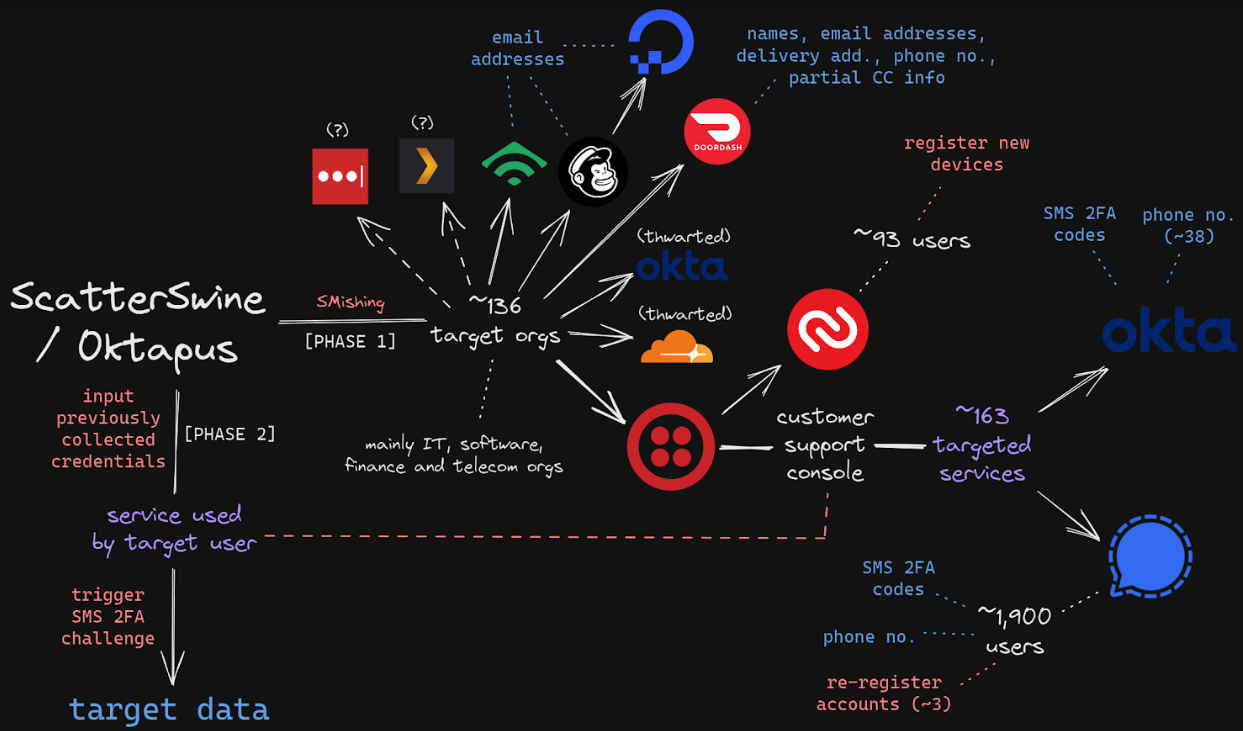
A graphic depicting how 0ktapus leveraged one victim to attack another. Image credit: Amitai Cohen of Wiz.

Prosecutors say Noah Michael Urban of Palm Coast, Fla., stole at least $800,000 from at least five victims between August 2022 and March 2023. In each attack, the victims saw their email and financial accounts compromised after suffering an unauthorized SIM-swap, wherein attackers transferred each victim’s mobile phone number to a new device that they controlled.

The government says Urban went by the aliases “Sosa” and “King Bob,” among others. Multiple trusted sources told KrebsOnSecurity that Sosa/King Bob was a core member of a hacking group behind the 2022 breach at Twilio, a company that provides services for making and receiving text messages and phone calls. Twilio disclosed in Aug. 2022 that an intrusion had exposed a “limited number” of Twilio customer accounts through a sophisticated social engineering attack designed to steal employee credentials.

Shortly after that disclosure, the security firm Group-IB published a report linking the attackers behind the Twilio intrusion to separate breaches at more than 130 organizations, including LastPass, DoorDash, Mailchimp, and Plex. Multiple security firms soon assigned the hacking group the nickname “Scattered Spider.”

Group-IB dubbed the gang by a different name — 0ktapus — which was a nod to how the criminal group phished employees for credentials. The missives asked users to click a link and log in at a phishing page that mimicked their employer’s Okta authentication page. Those who submitted credentials were then prompted to provide the one-time password needed for multi-factor authentication.

A booking photo of Noah Michael Urban released by the Volusia County Sheriff.

0ktapus used newly-registered domains that often included the name of the targeted company, and sent text messages urging employees to click on links to these domains to view information about a pending change in their work schedule. The phishing sites used a Telegram instant message bot to forward any submitted credentials in real-time, allowing the attackers to use the phished username, password and one-time code to log in as that employee at the real employer website.

0ktapus often leveraged information or access gained in one breach to perpetrate another. As documented by Group-IB, the group pivoted from its access to Twilio to attack at least 163 of its customers. Among those was the encrypted messaging app Signal, which said the breach could have let attackers re-register the phone number on another device for about 1,900 users.

On July 28 and again on Aug. 7, several employees at email delivery firm Mailchimp provided their remote access credentials to this phishing group. According to an Aug. 12 blog post, the attackers used their access to Mailchimp employee accounts to steal data from 214 customers involved in cryptocurrency and finance.

On August 25, 2022, the password manager service LastPass disclosed a breach in which attackers stole some source code and proprietary LastPass technical information, and weeks later LastPass said an investigation revealed no customer data or password vaults were accessed.

However, on November 30, 2022 LastPass disclosed a far more serious breach that the company said leveraged data stolen in the August breach. LastPass said criminal hackers had stolen encrypted copies of some password vaults, as well as other personal information.

In February 2023, LastPass disclosed that the intrusion involved a highly complex, targeted attack against a DevOps engineer who was one of only four LastPass employees with access to the corporate vault. In that incident, the attackers exploited a security vulnerability in a Plex media server that the employee was running on his home network, and succeeded in installing malicious software that stole passwords and other authentication credentials. The vulnerability exploited by the intruders was patched back in 2020, but the employee never updated his Plex software.

As it happens, Plex announced its own data breach one day before LastPass disclosed its initial August intrusion. On August 24, 2022, Plex’s security team urged users to reset their passwords, saying an intruder had accessed customer emails, usernames and encrypted passwords.

KING BOB’S GRAILS

The Justice Department says Urban went by went by the nicknames “Sosa,” “Elijah,” and “King Bob.” A review of thousands of messages that these users posted to several public forums and Discord servers over the past two years shows that the person behind these identities was mainly focused on two things: Sim-swapping, and trading in stolen, unreleased rap music recordings from popular recording artists.

Indeed, those messages show Sosa/King Bob was obsessed with finding new “grails,” the slang term used in some cybercrime discussion channels to describe recordings from popular artists that have never been officially released. It stands to reason that King Bob was SIM-swapping important people in the music industry to obtain these files, although there is little to support this conclusion from the public chat records available.

“I got the most music in the com,” King Bob bragged in a Discord server in November 2022. “I got thousands of grails.”

King Bob’s chats show he was particularly enamored of stealing the unreleased works of his favorite artists — Lil Uzi Vert, Playboi Carti, and Juice Wrld. When another Discord user asked if he has Eminem grails, King Bob said he was unsure.

“I have two folders,” King Bob explained. “One with Uzi, Carti, Juicewrld. And then I have ‘every other artist.’ Every other artist is unorganized as fuck and has thousands of random shit.”

King Bob’s posts on Discord show he quickly became a celebrity on Leaked[.]cx, one of most active forums for trading, buying and selling unreleased music from popular artists. The more grails that users share with the Leaked[.]cx community, the more their status and access on the forum grows.
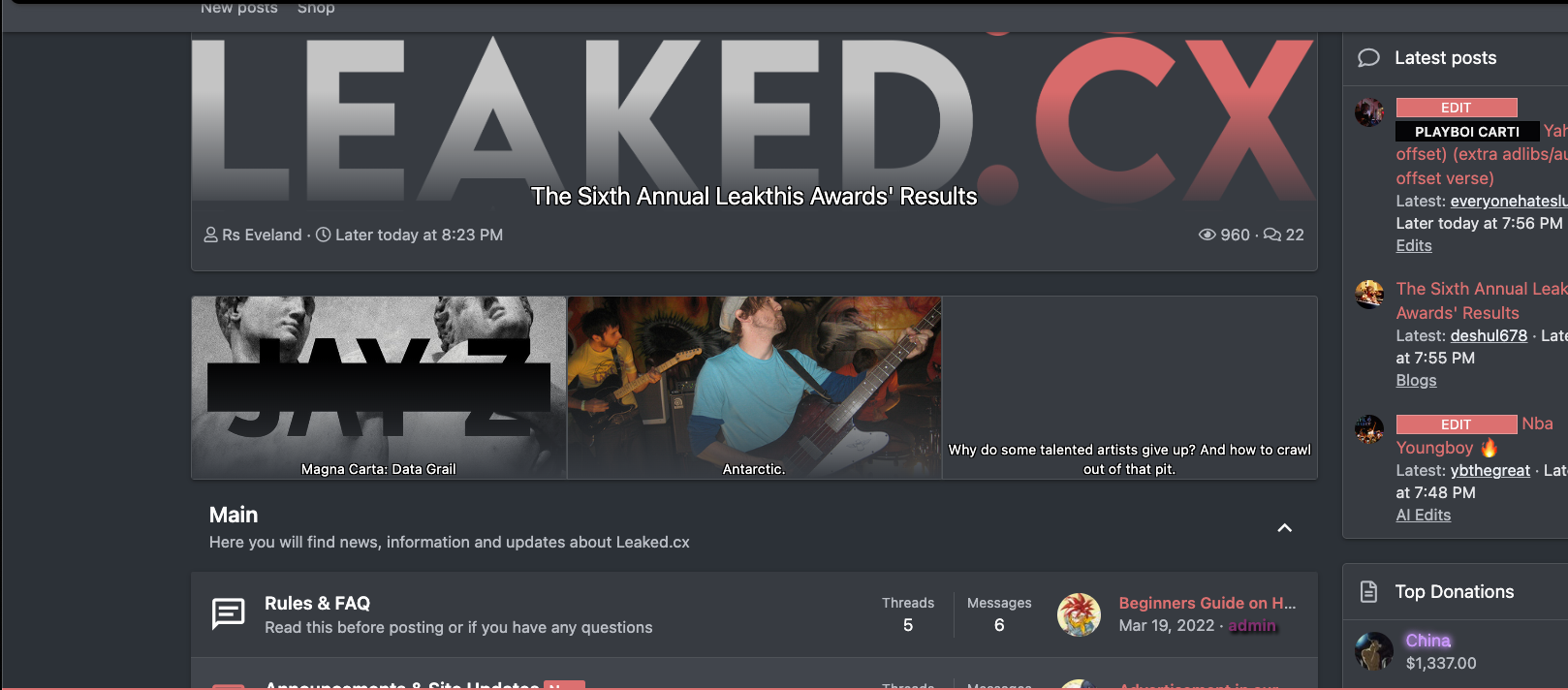
The last cache of Leaked dot cx indexed by the archive.org on Jan. 11, 2024.

And King Bob shared a large number of his purloined tunes with this community. Still others he tried to sell. It’s unclear how many of those sales were ever consummated, but it is not unusual for a prized grail to sell for anywhere from $5,000 to $20,000.

In mid-January 2024, several Leaked[.]cx regulars began complaining that they hadn’t seen King Bob in a while and were really missing his grails. On or around Jan. 11, the same day the Justice Department unsealed the indictment against Urban, Leaked[.]cx started blocking people who were trying to visit the site from the United States.

Days later, frustrated Leaked[.]cx users speculated about what could be the cause of the blockage.

“Probs blocked as part of king bob investigation i think?,” wrote the user “Plsdontarrest.” “Doubt he only hacked US artists/ppl which is why it’s happening in multiple countries.”

FORESHADOWING

On Sept. 21, 2022, KrebsOnSecurity told the story of a “Foreshadow,” the nickname chosen by a Florida teenager who was working for a SIM-swapping crew when he was abducted, beaten and held for a $200,000 ransom. A rival SIM-swapping group claimed that Foreshadow and his associates had robbed them of their fair share of the profits from a recent SIM-swap.

In a video released by his abductors on Telegram, a bloodied, battered Foreshadow was made to say they would kill him unless the ransom was paid.

As I wrote in that story, Foreshadow appears to have served as a “holder” — a term used to describe a low-level member of any SIM-swapping group who agrees to carry out the riskiest and least rewarding role of the crime: Physically keeping and managing the various mobile devices and SIM cards that are used in SIM-swapping scams.

KrebsOnSecurity has since learned that Foreshadow was a holder for a particularly active SIM-swapper who went by “Elijah,” which was another nickname that prosecutors say Urban used.

Shortly after Foreshadow’s hostage video began circulating on Telegram and Discord, multiple known actors in the SIM-swapping space told everyone in the channels to delete any previous messages with Foreshadow, claiming he was fully cooperating with the FBI.

This was not the first time Sosa and his crew were hit with violent attacks from rival SIM-swapping groups. In early 2022, a video surfaced on a popular cybercrime channel purporting to show attackers hurling a brick through a window at an address that matches the spacious and upscale home of Urban’s parents in Sanford, Fl.

“Brickings” are among the “violence-as-a-service” offerings broadly available on many cybercrime channels. SIM-swapping and adjacent cybercrime channels are replete with job offers for in-person assignments and tasks that can be found if one searches for posts titled, “If you live near,” or “IRL job” — short for “in real life” job.

A number of these classified ads are in service of performing brickings, where someone is hired to visit a specific address and toss a brick through the target’s window. Other typical IRL job offers involve tire slashings and even drive-by shootings.

THE COM

Sosa was known to be a top member of the broader cybercriminal community online known as “The Com,” wherein hackers boast loudly about high-profile exploits and hacks that almost invariably begin with social engineering — tricking people over the phone, email or SMS into giving away credentials that allow remote access to corporate internal networks.

Sosa also was active in a particularly destructive group of accomplished criminal SIM-swappers known as “Star Fraud.” Cyberscoop’s AJ Vincens reported last year that individuals within Star Fraud were likely involved in the high-profile Caesars Entertainment an MGM Resorts extortion attacks.

“ALPHV, an established ransomware-as-a-service operation thought to be based in Russia and linked to attacks on dozens of entities, claimed responsibility for Caesars and MGM attacks in a note posted to its website earlier this month,” Vincens wrote. “Experts had said the attacks were the work of a group tracked variously as UNC 3944 or Scattered Spider, which has been described as an affiliate working with ALPHV made up of people in the United States and Britain who excel at social engineering.”

In February 2023, KrebsOnSecurity published data taken from the Telegram channels for Star Fraud and two other SIM-swapping groups showing these crooks focused on SIM-swapping T-Mobile customers, and that they collectively claimed access to T-Mobile on 100 separate occasions over a 7-month period in 2022.

The SIM-swapping groups were able to switch targeted phone numbers to another device on demand because they constantly phished T-Mobile employees into giving up credentials to employee-only tools. In each of those cases the goal was the same: Phish T-Mobile employees for access to internal company tools, and then convert that access into a cybercrime service that could be hired to divert any T-Mobile user’s text messages and phone calls to another device.

Allison Nixon, chief research officer at the New York cybersecurity consultancy Unit 221B, said the increasing brazenness of many Com members is a function of how long it has taken federal authorities to go after guys like Sosa.

“These incidents show what happens when it takes too long for cybercriminals to get arrested,” Nixon said. “If governments fail to prioritize this source of threat, violence originating from the Internet will affect regular people.”

NO FIXED ADDRESS

The Daytona Beach News-Journal reports that Urban was arrested Jan. 9 and his trial is scheduled to begin in the trial term starting March 4 in Jacksonville. The publication said the judge overseeing Urban’s case denied bail because the defendant was a strong flight risk.

At Urban’s arraignment, it emerged that he had no fixed address and had been using an alias to stay at an Airbnb. The judge reportedly said that when a search warrant was executed at Urban’s residence, the defendant was downloading programs to delete computer files.

What’s more, the judge explained, despite telling authorities in May that he would not have any more contact with his co-conspirators and would not engage in cryptocurrency transactions, he did so anyway.

Urban entered a plea of not guilty. Urban’s court-appointed attorney said her client would have no comment at this time.

Prosecutors charged Urban with eight counts of wire fraud, one count of conspiracy to commit wire fraud, and five counts of aggravated identity theft. According to the government, if convicted Urban faces up to 20 years in federal prison on each wire fraud charge. He also faces a minimum mandatory penalty of two years in prison for the aggravated identity offenses, which will run consecutive to any other prison sentence imposed.

from Krebs on Security https://ift.tt/xSq0Rf3
via IFTTT

Durante 7 días un ataque DDos mantuvo fuera a SourceHut 

SourceHut

Logo de SourceHut

Hace poco, los desarrolladores de la popular plataforma de desarrollo colaborativo «SourceHut» dieron a conocer un informe detallado sobre un incidente que resultó en una interrupción del servicio durante 7 días debido a un ataque DDoS prolongado, para el cual la infraestructura del proyecto no estaba preparada.

En su informe, detallan que durante la etapa inicial del ataque, los desarrolladores se vieron sorprendidos y no tuvieron tiempo suficiente para reaccionar y contrarrestar el problema en sus servidores, lo que llevó al bloqueo total del tráfico hacia los servidores de SourceHut por parte del proveedor ascendente.

Para quienes desconocen de la plataforma SourceHut, deben saber que esta se distingue por una interfaz única que se aparta de la apariencia de GitHub y GitLab, pero que se caracteriza por su simplicidad, velocidad y funcionamiento sin necesidad de JavaScript. SourceHut ofrece una amplia gama de funciones, incluyendo el trabajo con repositorios públicos y privados de Git y Mercurial, un sistema de control de acceso flexible, funcionalidad de wiki, generación de informes de errores, integración continua integrada, capacidades de chat, entre otras mas.

Sobre el ataque a SourceHut

Los desarrolladores mencionan que para garantizar la continuidad de SourceHut, se emplearon servidores distribuidos en tres centros de datos. El primero fue utilizado para la configuración de producción, el segundo para respaldo, y el tercero para realizar experimentos sobre la migración de la infraestructura a una implementación de servicio más escalable y resistente a fallos (dado que la versión de próxima generación de SourceHut estaba en desarrollo).

Aunque los servicios básicos se restauraron al tercer día, (algunos servicios permanecieron no disponibles del 10 al 17 de enero), se requirieron aproximadamente 9 horas para resolver el problema de acceso a los servidores en el centro de datos principal después del bloqueo inicial.

Sin embargo, los desarrolladores enfrentaron otra dificultad cuando, a la mañana siguiente, el ataque se intensificó y comenzó a afectar toda la subred, lo que llevó al proveedor a redirigir nuevamente el tráfico hacia la interfaz nula. Ante esta situación, los desarrolladores se vieron obligados a iniciar urgentemente la implementación de la infraestructura de SourceHut en otro centro de datos utilizando copias de seguridad. Solo después de 2 días lograron obtener una subred temporal para acceder a los servidores principales y continuar con la recuperación del servicio.

Para protegerse contra los ataques DDoS a nivel de red, se tomó la decisión de implementar un servidor intermedio en la red del proveedor de nube OVH, el cual proporcionaría protección contra este tipo de ataques. Todas las solicitudes se dirigirían inicialmente a este servidor y luego se reenviarían a la infraestructura de trabajo.

Sin embargo, durante la migración, surgieron dificultades inevitables, como errores en la restauración utilizando la utilidad rsync, problemas de configuración de red y dificultades con la redirección del tráfico, que debieron resolverse antes de que la protección DDoS en OVH estuviera completamente operativa. Durante este tiempo, los servidores en funcionamiento estaban expuestos al tráfico de ataques DDoS, lo que llevó al sistema de protección DDoS a identificar erróneamente los servidores como el origen del ataque.

A pesar de intentar contactar a Cloudflare y otros servicios de protección DDoS, el costo de la protección resultó prohibitivo. Sin embargo, los empleados de Cloudflare posteriormente ofrecieron protección gratuita como patrocinio para el proyecto SourceHut, aunque este ofrecimiento fue rechazado por los desarrolladores, que en ese momento ya habían avanzado considerablemente en la solución del problema por sí mismos.

Inicialmente, estaba previsto llevar a cabo la migración de la infraestructura de SourceHut de manera gradual durante un período de al menos un año, trasladando el proyecto a servidores en otro centro de datos. Sin embargo, debido a las circunstancias actuales, la migración tuvo que realizarse de manera urgente en un plazo de 7 días. Afortunadamente, todos los servicios de SourceHut fueron transferidos con éxito a otro centro de datos y la plataforma ha sido completamente restaurada.

Finalmente si estás interesado en poder conocer más al respecto, puedes consultar los detalles en el siguiente enlace.

from Linux Adictos https://ift.tt/KyUaAij
via IFTTT