The video game studio Naughty Dog said “The Last of Us Online” was too resource-intensive to complete without delaying the development of future single-player versions of the game.
The Amnesic Incognito Live System o Tails es una distribución Linux diseñada para preservar la privacidad y el anonimato
Hace pocos días los desarrolladores de Tails dieron a conocer el lanzamiento de la nueva versión de «Tails 5.20», la cual trae una serie de mejoras que incluyen un navegador Tor actualizado que soluciona una serie de problemas de seguridad relacionados con JavaScript y otros componentes del navegador.
Para aquellos que desconocen de Tails, deben saber que esta es una distribución que está basada en la base del paquete Debian y diseñada para proporcionar acceso anónimo a la red, con la finalidad de preservar la privacidad y el anonimato del usuario en la red.
La salida anónima de Tails es proporcionada por Tor en todas las conexiones, ya que el tráfico a través de la red Tor, están bloqueadas por defecto con un filtro de paquetes, con lo cual el usuario no deja rastro en la red a no ser que quiera lo contrario. El cifrado se usa para almacenar datos de usuario en el modo guardar datos de usuario entre inicios, además de que presenta una serie de aplicaciones preconfiguradas pensadas en la seguridad y anonimato del usuario, tales como un navegador web, el cliente de correo, un cliente de mensaje instantáneos entre otras más.
Principales novedades de Tails 5.20
Uno de los cambios más importantes que se presenta en esta nueva versión de Tails 5.20 es la implementación de la actualización del navegador Tor Browser a la versión 13.0.4 y el cual llega con base en Firefox a 115.5.0 esr, tor a 0.4.8.9 y OpenSSL a 3.0.12. Además, también incluye algunas correcciones de errores de los cuales se destaca: la corrección del estilo y la posición del panel lateral «Always Prioritize Onions» se solucionó el error con el botón Tor Circuit que no se mostraba si falla el protocolo de enlace TLS.
Otro de los cambios que se destaca es la actualización del cliente de correo Thunderbird a la versión 115.5.0 en el cual se implementan mejoras de seguridad, además de mejoras para Linux, pues el selector de tareas de Plasma ahora ya muestra el ícono predeterminado al ejecutar Thunderbird Flatpak en Wayland, también ahora las vistas previas de enlaces ya son legibles en modo oscuro y se corrigió un problema con el enlace al manifiesto de Flatpak.
Además de ello, en Tail 5.20 se ha tomado la decisión de dejar de descargar la lista de filtros AdGuard para uBlock Origin en el idioma de la sesión. Esta medida tiene como objetivo evitar la toma de huellas digitales avanzada del navegador, una técnica utilizada para rastrear a los usuarios en línea.
Tails 5.20 también soluciona varios problemas informados por los usuarios, particularmente relacionados con la nueva función de almacenamiento persistente. Después de numerosos informes de problemas, el equipo implementó varias mejoras, incluida la corrección de un error al activar el Almacenamiento persistente y la mejora de la traducción de la interfaz de WhisperBack.
Por otra parte, se destaca que la herramienta de informe de errores WhisperBack recibió una mejora en la interfaz, lo que facilita a los usuarios informar la información necesaria para la resolución de problemas.
Finalmente si estás interesado en poder conocer más al respecto, puedes consultar los detalles en el siguiente enlace.
Descargar Tails 5.20
Si quieres probar o instalar esta nueva versión de esta distribución de Linux en tu equipo, puedes obtener la imagen del sistema la cual ya está disponible desde su página web oficial en su sección de descargas, en enlace es este. La imagen que se obtiene desde la sección de descargas es una imagen ISO de 1.2 GB capaz de funcionar en modo en vivo.
¿Cómo actualizar a la nueva versión de Tails 5.20?
Para aquellos usuarios que tengan instalada una versión anterior de Tails y quieren realizar la actualización a esta nueva versión, pueden realizar directamente siguiendo las instrucciones de este enlace.
Para ello podrán hacer uso de su dispositivo USB que utilizaron para instalar Tails, pueden consultar la información para llevar este movimiento en su ordenador en el siguiente enlace.
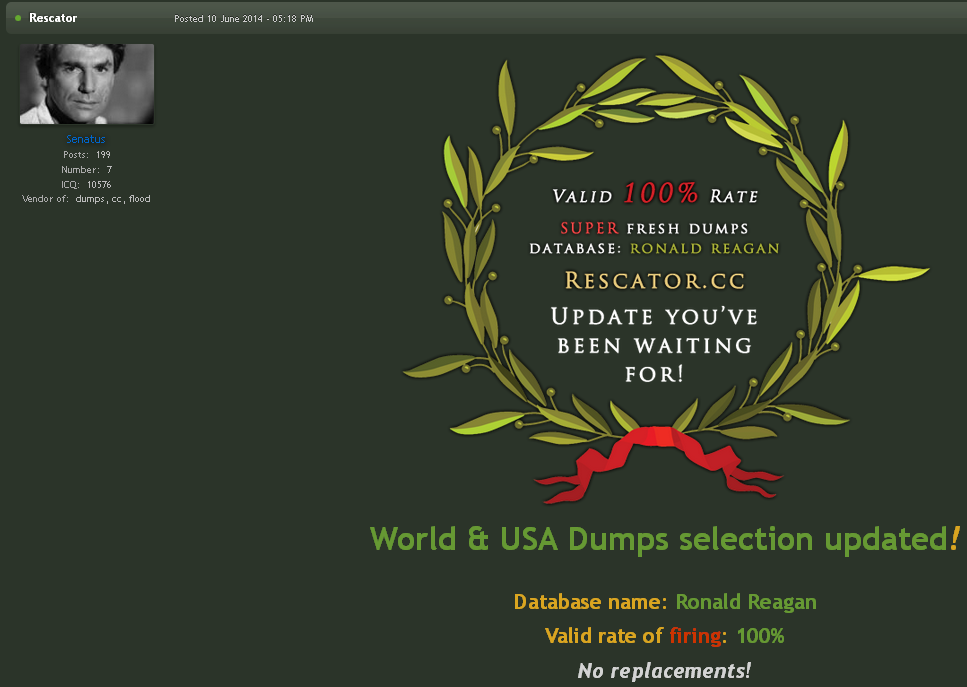
On Dec. 18, 2013, KrebsOnSecurity broke the news that U.S. retail giant Target was battling a wide-ranging computer intrusion that compromised more than 40 million customer payment cards over the previous month. The malware used in the Target breach included the text string “Rescator,” which also was the handle chosen by the cybercriminal who was selling all of the cards stolen from Target customers. Ten years later, KrebsOnSecurity has uncovered new clues about the real-life identity of Rescator.
Rescator, advertising a new batch of cards stolen in a 2014 breach at P.F. Chang’s.
Shortly after breaking the Target story, KrebsOnSecurity reported that Rescator appeared to be a hacker from Ukraine. Efforts to confirm my reporting with that individual ended when they declined to answer questions, and after I declined to accept a bribe of $10,000 not to run my story.
That reporting was based on clues from an early Russian cybercrime forum in which a hacker named Rescator — using the same profile image that Rescator was known to use on other forums — claimed to have originally been known as “Helkern,” the nickname chosen by the administrator of a cybercrime forum called Darklife.
KrebsOnSecurity began revisiting the research into Rescator’s real-life identity in 2018, after the U.S. Department of Justice unsealed an indictment that named a different Ukrainian man as Helkern.
It may be helpful to first recap why Rescator is thought to be so closely tied to the Target breach. For starters, the text string “Rescator” was found in some of the malware used in the Target breach. Investigators would later determine that a variant of the malware used in the Target breach was used in 2014 to steal 56 million payment cards from Home Depot customers. And once again, cards stolen in the Home Depot breach were sold exclusively at Rescator’s shops.
On Nov. 25, 2013, two days before Target said the breach officially began, Rescator could be seen in instant messages hiring another forum member to verify 400,000 payment cards that Rescator claimed were freshly stolen.
By the first week of December, 2013, Rescator’s online store — rescator[.]la — was selling more than six million payment card records stolen from Target customers. Prior to the Target breach, Rescator had mostly sold much smaller batches of stolen card and identity data, and the website allowed cybercriminals to automate the sending of fraudulent wire transfers to money mules based in Lviv, Ukraine.
Finally, there is some honor among thieves, and in the marketplace for stolen payment card data it is considered poor form to advertise a batch of cards as “yours” if you are merely reselling cards sold to you by a third-party card vendor or thief. When serious stolen payment card shop vendors wish to communicate that a batch of cards is uniquely their handiwork or that of their immediate crew, they refer to it as “our base.” And Rescator was quite clear in his advertisements that these millions of cards were obtained firsthand.
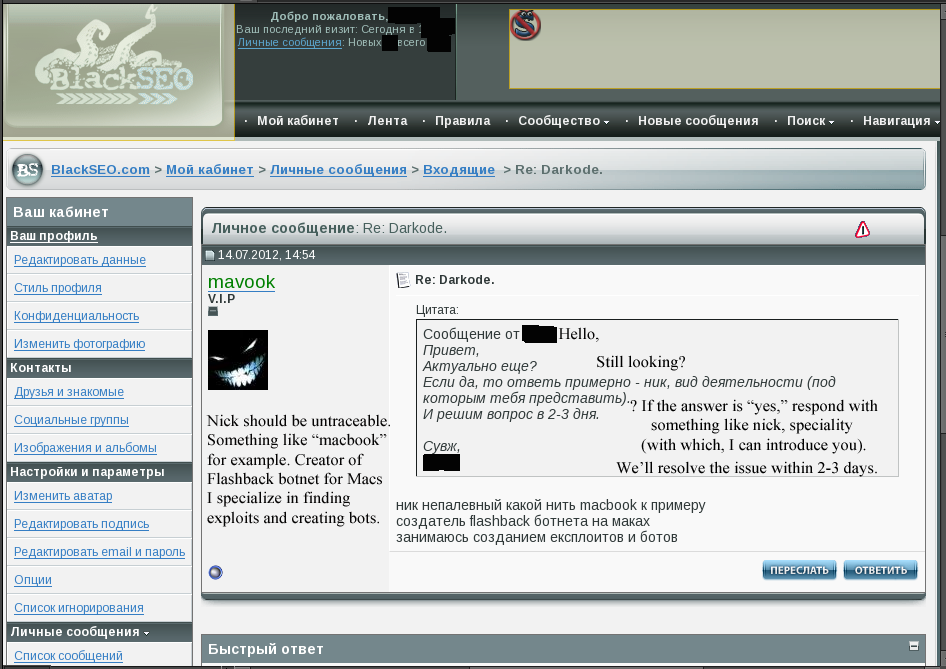
That story about the Flashback author was possible because a source had obtained a Web browser authentication cookie for a founding member of a Russian cybercrime forum called BlackSEO. Anyone in possession of that cookie could then browse the invite-only BlackSEO forum and read the user’s private messages without having to log in.
BlackSEO.com VIP member “Mavook” tells forum admin Ika in a private message that he is the Flashback author.
The legitimate owner of that BlackSEO user cookie went by the nickname Ika, and Ika’s private messages on the forum showed he was close friends with the Flashback author. At the time, Ika also was the administrator of Pustota[.]pw — a closely-guarded Russian forum that counted among its members some of the world’s most successful and established spammers and malware writers.
For many years, Ika held a key position at one of Russia’s largest Internet service providers, and his (mostly glowing) reputation as a reliable provider of web hosting to the Russian cybercrime community gave him an encyclopedic knowledge about nearly every major player in that scene at the time.
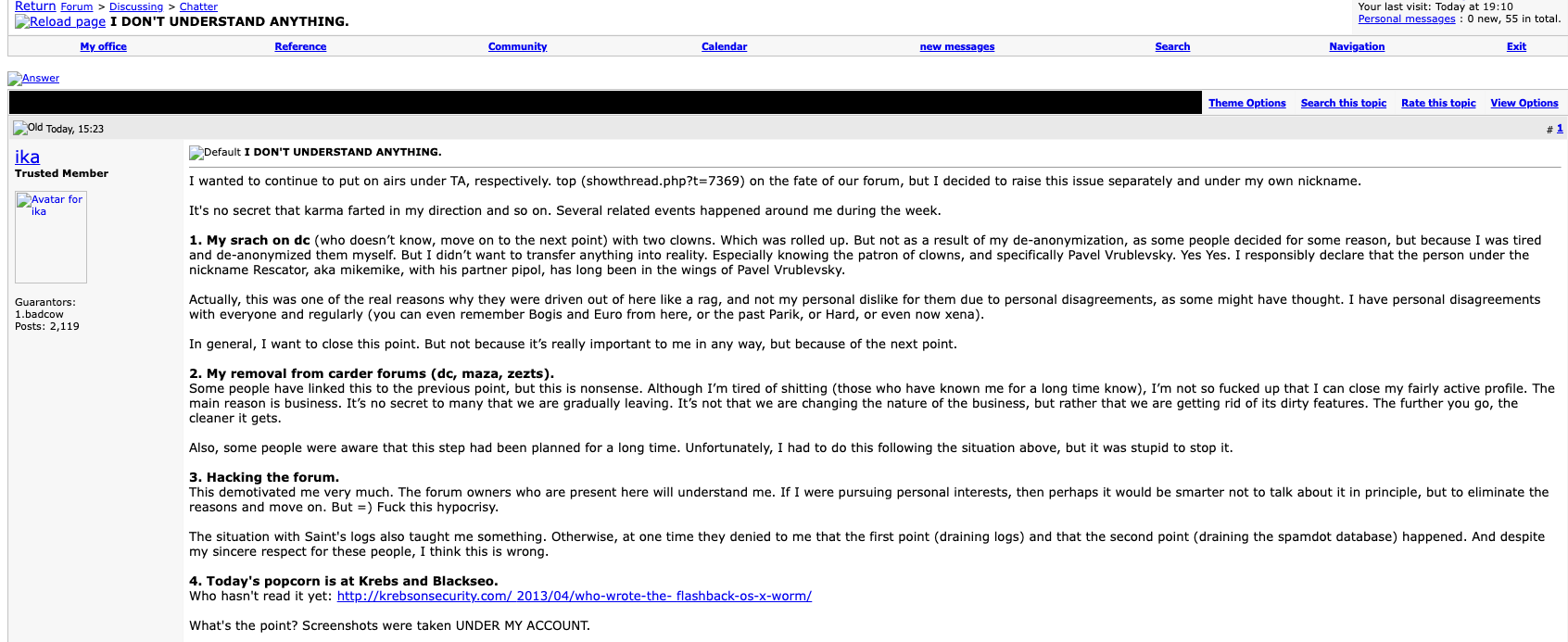
The story on the Flashback author featured redacted screenshots that were taken from Ika’s BlackSEO account (see image above). The day after that story ran, Ika posted a farewell address to his mates, expressing shock and bewilderment over the apparent compromise of his BlackSEO account.
In a lengthy post on April 4, 2013 titled “I DON’T UNDERSTAND ANYTHING,” Ika told Pustota forum members he was so spooked by recent events that he was closing the forum and quitting the cybercrime business entirely. Ika recounted how the Flashback story had come the same week that rival cybercriminals tried to “dox” him (their dox named the wrong individual, but included some of Ika’s more guarded identities).
“It’s no secret that karma farted in my direction,” Ika said at the beginning of his post. Unbeknownst to Ika at the time, his Pustota forum also had been completely hacked that week, and a copy of its database shared with this author.
A Google translated version of the farewell post from Ika, the administrator of Pustota, a Russian language cybercrime forum focused on botnets and spam. Click to enlarge.
Ika said the two individuals who tried to dox him did so on an even more guarded Russian language forum — DirectConnection[.]ws, perhaps the most exclusive Russian cybercrime community ever created. New applicants of this forum had to pay a non-refundable deposit, and receive vouches by three established cybercriminals already on the forum. Even if one managed to steal (or guess) a user’s DirectConnection password, the login page could not be reached unless the visitor also possessed a special browser certificate that the forum administrator gave only to approved members.
In no uncertain terms, Ika declared that Rescator went by the nickname MikeMike on DirectConnection:
“I did not want to bring any of this to real life. Especially since I knew the patron of the clowns – specifically Pavel Vrublevsky. Yes, I do state with confidence that the man with the nickname Rescator a.k.a. MikeMike with his partner Pipol have been Pavel Vrublevsky’s puppets for a long time.”
Pavel Vrublevsky is a convicted cybercriminal who became famous as the CEO of the Russian e-payments company ChronoPay, which specialized in facilitating online payments for a variety of “high-risk” businesses, including gambling, pirated Mp3 files, rogue antivirus software and “male enhancement” pills.
As detailed in my 2014 book Spam Nation, Vrublevsky not-so-secretly ran a pharmacy affiliate spam program called Rx-Promotion, which paid spammers and virus writers to blast out tens of billions of junk emails advertising generic Viagra and controlled pharmaceuticals like pain relief medications. Much of my reporting on Vrublevsky’s cybercrime empire came from several years worth of internal ChronoPay emails and documents that were leaked online in 2010 and 2011.
Pavel Vrublevsky’s former Facebook profile photo.
ZAXVATMIRA
In 2014, KrebsOnSecurity learned from a trusted source close to the Target breach investigation that the user MikeMike on DirectConnection — the same account that Ika said belonged to Rescator — used the email address “zaxvatmira@gmail.com.”
At the time, KrebsOnSecurity could not connect that email address to anything or anyone. However, a recent search on zaxvatmira@gmail.com at the breach tracking service Constella Intelligence returns just one result: An account created in November 2010 at the site searchengines[.]ru under the handle “r-fac1.”
A search on “r-fac1” at cyber intelligence firm Intel 471 revealed that this user’s introductory post on searchengines[.]ru advertised musictransferonline[.]com, an affiliate program that paid people to drive traffic to sites that sold pirated music files for pennies apiece.
According to leaked ChronoPay emails from 2010, this domain was registered and paid for by ChronoPay. Those missives also show that in August 2010 Vrublevsky authorized a payment of ~$1,200 for a multi-user license of an Intranet service called MegaPlan.
ChronoPay used the MegaPlan service to help manage the sprawling projects that Vrublevsky referred to internally as their “black” payment processing operations, including pirated pills, porn, Mp3s, and fake antivirus products. ChronoPay employees used their MegaPlan accounts to track payment disputes, order volumes, and advertising partnerships for these high-risk programs.
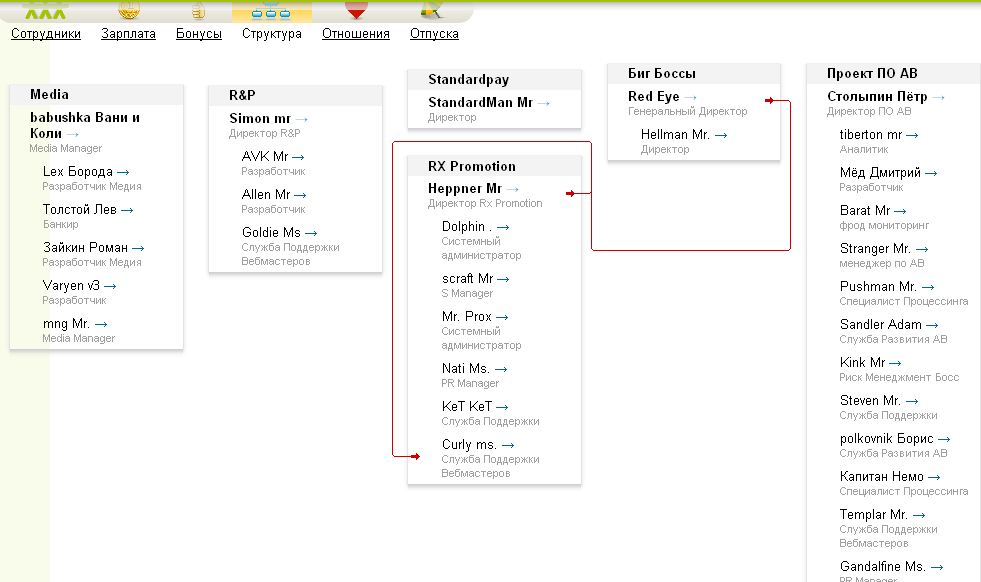
Borrowing a page from the Quentin Tarantino movie Reservoir Dogs, the employees adopted nicknames like “Mr. Kink,” “Mr. Heppner,” and “Ms. Nati.” However, in a classic failure of operational security, many of these employees had their MegaPlan account messages automatically forwarded to their real ChronoPay email accounts.
A screen shot of the org chart from ChronoPay’s MegaPlan Intranet system.
When ChronoPay’s internal emails were leaked in 2010, the username and password for its MegaPlan subscription were still working and valid. An internal user directory for that subscription included the personal (non-ChronoPay) email address tied to each employee Megaplan nickname. That directory listing said the email address zaxvatmira@gmail.com was assigned to the head of the Media/Mp3 division for ChronoPay, pictured at the top left of the organizational chart above as “Babushka Vani and Koli.”
[Author’s note: I initially overlooked the presence of the email address zaxvatmira@gmail.com in my notes because it did not show up in text searches of my saved emails, files or messages. I rediscovered it recently when a text search for zaxvatmira@gmail.com on my Mac found the address in a screenshot of the ChronoPay MegaPlan interface.]
The nickname two rungs down from “Babushka” in the ChronoPay org chart is “Lev Tolstoy,” which the MegaPlan service showed was picked by someone who used the email address v.zhabukin@freefrog-co-ru.
ChronoPay’s emails show that this Freefrog email address belongs to a Vasily Borisovich Zhabykin from Moscow. The Russian business tracking website rusprofile[.]ru reports that Zhabykin is or was the supervisor or owner of three Russian organizations, including one called JSC Hot Spot.
[Author’s note: The word “babushka” means “grandma” in Russian, and it could be that this nickname is a nod to the ChronoPay CEO’s wife, Vera. The leaked ChronoPay emails show that Vera Vrublevsky managed a group of hackers working with their media division, and was at least nominally in charge of MP3 projects for ChronoPay. Indeed, in messages exposed by the leaked ChronoPay email cache, Zhabykin stated that he was “directly subordinate” to Mrs. Vrublevsky].
CYBERCRIME HOTSPOT
JSC Hot Spot is interesting because its co-founder is another ChronoPay employee: 37-year-old Mikhail “Mike” Shefel. A Facebook profile for Mr. Shefel says he is or was vice president of payment systems at ChronoPay. However, the last update on that profile is from 2018, when Shefel appears to have legally changed his last name.
Archive.org shows that Hot Spot’s website — myhotspot[.]ru — sold a variety of consulting services, including IT security assessments, code and system audits, and email marketing. The earliest recorded archive of the Hot Spot website listed three clients on its homepage, including ChronoPay and Freefrog.
ChronoPay internal emails show that Freefrog was one of its investment projects that facilitated the sale of pirated Mp3 files. Rusprofile[.]ru reports that Freefrog’s official company name — JSC Freefrog — is incorporated by a thinly-documented entity based in the Seychelles called Impex Consulting Ltd., and it is unclear who its true owners are.
However, a search at DomainTools.com on the phone number listed on the homepage of myhotspot[.]ru (74957809554) reveals that number is associated with eight domain names.
Six of those domains are some variation of FreeFrog. Another domain registered to that phone number is bothunter[.]me, which included a copyright credit to “Hot Spot 2011.” At the annual Russian Internet Week IT convention in Moscow in 2012, Mr. Shefel gave a short presentation about bothunter, which he described as a service he designed to identify inauthentic (bot) accounts on Russian social media networks.
Interestingly, one of r-fac1’s first posts to Searchengines[.]ru a year earlier saw this user requesting help from other members who had access to large numbers of hacked social media accounts. R-fac1 told forum members that he was only looking to use those accounts to post harmless links and comments to the followers of the hacked profiles, and his post suggested he was testing something.
“Good afternoon,” r-fac1 wrote on Dec. 20, 2010. “I’m looking for people with their own not-recently-registered accounts on forums, (except for search) Social networks, Twitter, blogs, their websites. Tasks, depending on your accounts, post text and a link, sometimes just a link. Most often the topic is chatter, relaxation, discussion. Posting my links in your profiles, on your walls. A separate offer for people with a large set of contacts in instant messengers to try to use viral marketing.”
Neither Mr. Shefel nor Mr. Zhabykin responded to requests for comment.
WHERE ARE THEY NOW?
Mr. Zhabykin soon moved on to bigger ventures, co-founding a cryptocurrency exchange based in Moscow’s financial center called Suex. In September 2021, Suex earned the distinction of becoming the first crypto firm to be sanctioned by the U.S. Department of the Treasury, which effectively blocked Suex from the global financial system. The Treasury alleged Suex helped to process millions in criminal transactions, including the proceeds of numerous ransomware attacks.
“I don’t understand how I got mixed up in this,” Zhabykin toldThe New York Times in 2021. Zhabykin said Suex, which is registered in the Czech Republic, was mostly a failure and had conducted only a half dozen or so transactions since 2019.
The Russian business tracking service Rusprofile says Zhabykin also is the owner of a company based in the United Kingdom called RideWithLocal; the company’s website says it specializes in arranging excursions for extreme sports, including snowboarding, skiing, surfing and parasailing. Images from the RideWithLocal Facebook page show helicopters dropping snowboarders and skiers atop some fairly steep mountains.
A screenshot from the Facebook page of RideWithLocal.
Constella Intelligence found a cached copy of a now-deleted LinkedIn profile for Mr. Zhabykin, who described himself as a “sporttech/fintech specialist and mentor.”
“I create products and services worldwide, focusing on innovation and global challenges,” his LinkedIn profile said. “I’ve started my career in 2002 and since then I worked in Moscow, different regions of Russia, including Siberia and in Finland, Brazil, United Kingdom, Sri Lanka. Over the last 15 years I contributed to many amazing products in the following industries: sports, ecology, sport tech, fin tech, electronic payments, big data, telecommunications, pulp and paper industry, wood processing and travel. My specialities are Product development, Mentorship, Strategy and Business development.”
Rusprofile reports that Mikhail Borisovich Shefel is associated with at least eight current or now-defunct companies in Russia, including Dengi IM (Money IM), Internet Capital, Internet Lawyer, Internet 2, Zao Hot Spot, and (my personal favorite) an entity incorporated in 2021 called “All the Money in the World.”
Constella Intelligence found several official documents for Mr. Shefel that came from hacked Russian phone, automobile and residence records. They indicate Mr. Shefel is the registrant of a black Porsche Cayenne (Plate:X537SR197) and a Mercedes (Plate:P003PX90). Those vehicle records show Mr. Shefel was born on May 28, 1986.
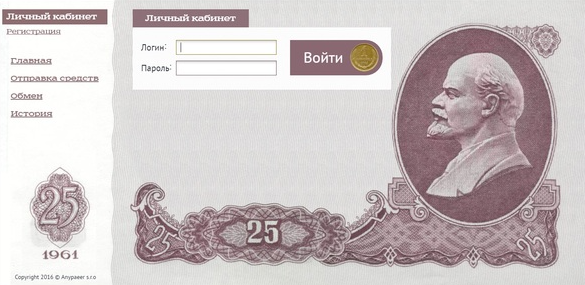
Rusprofile reveals that at some point near the end of 2018, Shefel changed his last name to Lenin. DomainTools reports that in 2018, Mr. Shefel’s company Internet 2 LLC registered the domain name Lenin[.]me. This now-defunct service sold physical USSR-era Ruble notes that bear the image of Vladimir Lenin, the founding father of the Soviet Union.
Meanwhile, Pavel Vrublevsky remains imprisoned in Russia, awaiting trial on fraud charges levied against the payment company CEO in March 2022. Authorities allege Vrublevsky operated several fraudulent SMS-based payment schemes. They also accused Vrublevsky of facilitating money laundering for Hydra, the largest Russian darknet market. Hydra trafficked in illegal drugs and financial services, including cryptocurrency tumbling for money laundering, exchange services between cryptocurrency and Russian rubles, and the sale of falsified documents and hacking services.
In 2013, Vrublevsky was sentenced to 2.5 years in a Russian penal colony for convincing one of his top spammers and botmasters to launch a distributed denial-of-service (DDoS) attack against a ChronoPay competitor that shut down the ticketing system for the state-owned Aeroflot airline.
Following his release, Vrublevsky began working on a new digital payments platform based in Hong Kong called HPay Ltd (a.k.a. Hong Kong Processing Corporation). HPay appears to have had a great number of clients that were running schemes which bamboozled people with fake lotteries and prize contests.
KrebsOnSecurity sought comment on this research from the Federal Bureau of Investigation (FBI) and the U.S. Secret Service, both of which have been involved in the Target breach investigation over the years. The Secret Service declined to confirm or dispute any of the findings, but said it is still interested in hearing from anyone who might have more information.
“The U.S. Secret Service does not comment on any open investigation and won’t confirm or deny the accuracy in any reporting related to a criminal manner,” the agency said in a written statement. “However, If you have any information relating to the subjects referenced in this article, please contact the U.S. Secret Service at mostwanted@usss.dhs.gov. The Secret Service pays a reward for information leading to the arrest of cybercriminals.”
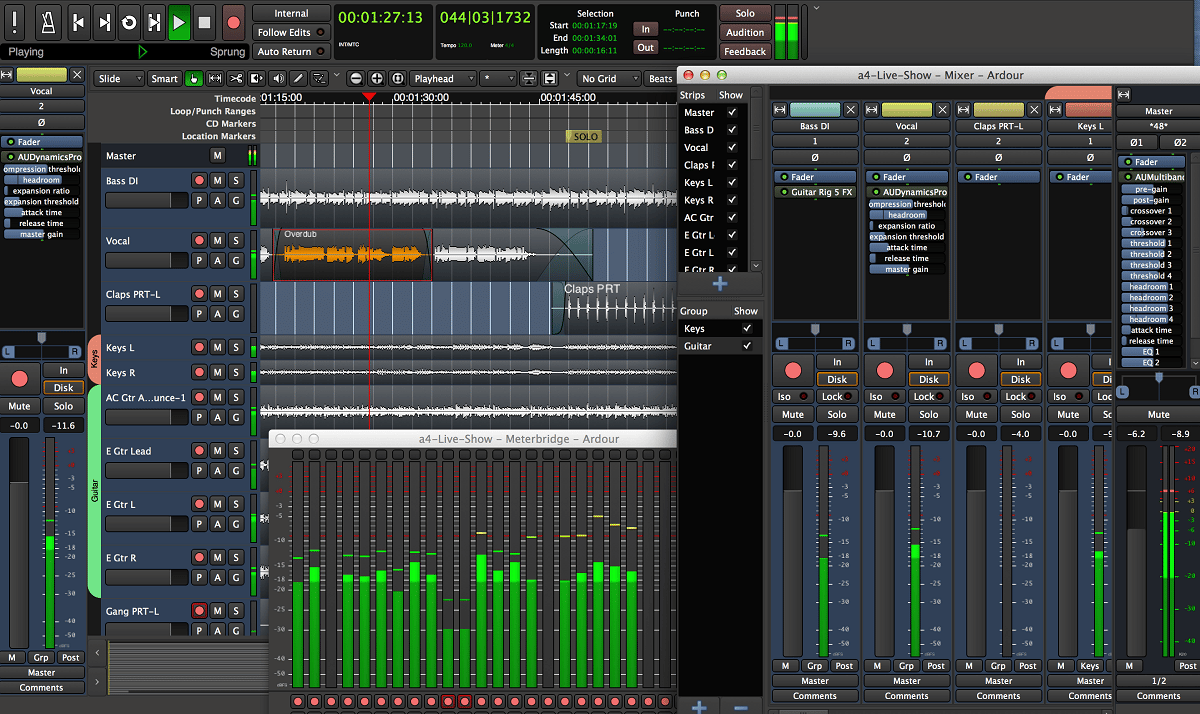
Ardour es un software libre de grabación multipista de audio y MIDI a disco duro. Es multiplataforma: actualmente se puede instalar en sistemas operativos GNU/Linux, OS X, FreeBSD y Windows
La nueva versión de Ardour 8.2 ya está disponible y en este lanzamiento se destaca que se completa el soporte para todos los dispositivos Novation LaunchPad actuales, así como también la correcciones de errores, pequeñas características nuevas y mejoras.
Para quienes desconocen de Ardour, deben saber que es una estación de trabajo de audio digital multiplataforma que puede usar para la grabación multipista de audio y MIDI, editar y mezclar audio.
Principales novedades de Ardour 8.2
En esta nueva versión que se presenta de Ardour se destaca la implementacion de la nueva función «Note tupling» la cual está inspirada en una función del nuevo Ableton Live 12. Note tuplin, permite al usuario mientras MIDI, seleccionar una o más notas y al presionar «s» divide cada nota en dos partes iguales. Está función puede seguir siendo utilizada por lo que la división aumentará en 3, 4, 5 , etc. ). Para cancelar la división, puede presionar «Shift+s», y para fusionar – «j».
Otra de las novedades que se destaca de Ardour 8.2 es «No-strobe option» la cual es una nueva función que permite desactivar todos aquellos elementos que puedan emitir luces parpadeantes. Está función fue añadida con la finalidad de proteger a usuarios con epilepsia. Cabe mencionar que si está función está habilitada, los relojes no funcionan, ningún botón parpadea y los medidores no se mueven.
Por la parte de las mejoras de soporte, se destaca el soporte añadido para Solid State Logic UF8 (un dispositivo USB MIDI / Mackie Control Protocol) , así como también soporte para los dispositivos Novation LaunchPad X y LaunchPad Mini . Esto completa el soporte de Ardour para toda la gama de dispositivos Novation LaunchPad mk3.
De los demás cambios que se destaca de esta nueva versión:
La frecuencia de muestreo predeterminada se ha cambiado a 48 kHz.
Al importar mapas de tempo desde archivos MIDI estándar, el mapa de tempo se inserta en la posición correcta (no siempre en cero).
Al editar notas MIDI, ya se muestra la longitud de la nota con un cursor detallado.
Se añadió el botón Silenciar a la vista de la grabadora.
Ya es posible borrar la información de escaneo del complemento LV2.
Se mejoro la visualización de líneas rectas para la velocidad de las notas.
Se optimizaron las operaciones del mapa de tempo para casos triviales (y abrumadoramente comunes) de 1 tempo y 1 metro.
Finalmente si estás interesado en poder conocer más al respecto, puedes consultar los detalles en el siguardourardouriente enlace.
¿Cómo instalar Ardour en Linux?
Dentro de los repositorios de las distribuciones podemos encontrar el paquete de la aplicación con el detalle de que posiblemente no sea la versión más actual y además de que esta es solamente una versión de prueba.
Dicho esto, si quieres probar la aplicación te dejo los comandos de instalación.
Para poder instalar Ardour en Debian, Ubuntu y derivados:
sudo apt install ardour
Si estás utilizando Arch Linux o algún derivado, puedes instalar la aplicación con este comando:
sudo pacman -S ardour
Para el caso de Fedora, CentOS y derivados podemos instalar con:
sudo dnf install ardour
Para el caso openSUSE:
sudo zypper install ardour
Y ya con esto tendrás instalada la aplicación en tu sistema.
¿Cómo compilar Ardour en Linux?
Para comenzar el proceso de construcción, primero deberán instalar las numerosas dependencias del programa. Ardour es una gran suite de edición de audio y utiliza una gran cantidad de códecs y otras herramientas. Para instalar las dependencias, deberán dirigirse al sitio web oficial, leer la documentación y conocer cuáles son.
Hecho lo anterior procedemos a obtener el código fuente, abrimos una terminal y ejecutamos:
git clone git: //git.ardour.org/ardour/ardour.git

cd ardour
A continuación, deberán ejecutar el script «waf».
Primero necesitaremos ejecutarlo para escanear el sistema para crear nuevos archivos de configuración (makefiles, etc.).
Al ejecutar el script waf también los ayudará a determinar si tienen todas las dependencias correctas instaladas.
La secuencia de comandos se negará a configurar sin estos archivos, por lo que, si tiene problemas para encontrarlos, primeramente ejecutaremos este comando:
./waf configure
Con esto verificará que las dependencias estén instaladas y todo está listo para funcionar. Para iniciar el proceso de construcción, ejecuten waf:
./waf
El paquete de edición de audio de Ardour es muy grande y llevará bastante tiempo compilarlo. Por lo que en este momento pueden aprovechar para hacer otras cosas.
Hecha la compilación, ahora cambiaremos de directorio y lo hacemos con:
cd gtk2_ardour
Inicien Ardour con «ardev».
./ardev
En este momento ya tenemos la posibilidad de poder instalar la aplicación, solamente debemos de ejecutar:
./waf install
Y listo ya con ello podrán comenzar a disfrutar de este estupendo editor de audio profesional.
The embattled self-driving car subsidiary of General Motors faces an uncertain future after California regulators shut down its robot taxi service in the state.
Se dio a conocer el lanzamiento de la nueva versión de Nextcloud Hub 7 la cual continúa avanzando en la dirección que se dirigió con Hub 6. La nueva versión ofrece capacidades avanzadas de búsqueda entre aplicaciones, funcionalidad fuera de la oficina en toda la plataforma y amplía el protocolo de inicio de sesión.
Para quienes desconocen de Nextcloud Hub, deben saber que está diseñado como una plataforma que permite implementar una infraestructura que se asemeja a Google Docs y Microsoft 365, con la cual la colaboración de los miembros es totalmente controlada, pues no está vinculada a servicios de nube externos.
Combina varias aplicaciones complementarias sobre la plataforma en la nube de Nextcloud en un solo entorno, lo que permite trabajar junto con documentos, archivos e información de Office para planificar tareas y eventos. La plataforma también incluye complementos para acceso a correo electrónico, mensajería, videoconferencias y chats.
Principales novedades de Nextcloud Hub 7
Una de las características más importantes de esta nueva versión de Nextcloud Hub 7, es la «Búsqueda unificada» la cual brinda la capacidad (a través del ícono de lupa en la esquina superior derecha de la barra de herramientas) de buscar aplicaciones y contenido relacionado, aplicar filtros, obtener una vista previa de los resultados, buscar en fuentes externas, en todos los documentos, chats, correo electrónico, archivos, libreta de direcciones, notas, comentarios, agenda, etc.
Otro de los cambios que se destaca es la nueva «configuración de fuera de la oficina» entre aplicaciones que se refleja en el chat (al enviar una respuesta automática en su sistema de mensajería), en el correo electrónico (al enviar correos electrónicos de respuesta de disponibilidad), el calendario y el estado del usuario en Nextcloud. Esta característica simplifica la asignación de responsabilidades a un colega, permitiendo compartir archivos, tareas, eventos y correos electrónicos al acceder al perfil o a los recursos del personal ausente. Se desplegará una notificación emergente que brinda información sobre su indisponibilidad, así como los detalles de contacto del empleado sustituto asignado. Estas mejoras no solo facilitan la gestión del ausentismo, sino que también optimizan la colaboración y el intercambio de información durante períodos de ausencia, mejorando la eficiencia en el entorno laboral.
Nextcloud Hub 7 también continúa aumentando las capacidades de inteligencia artificial en Nextcloud Assistant, pues se agregó la capacidad de generar imágenes basadas en descripciones de texto utilizando el modelo de Stable Diffusion, también se incluye una “vista previa técnica” de Context Chat, que no necesariamente está lista para el horario de máxima audiencia, que permite que la IA generativa responda preguntas sobre los propios documentos, chats y correos electrónicos de los usuarios.
Ademas de ello, en Nextcloud Talk se introduce el acceso telefónico a las capacidades de acceso telefónico existentes, rastrea el consentimiento de grabación de video y ofrece un chat de «nota personal», se ha agregado la capacidad de mostrar video desde la cámara web del presentador en una pequeña ventana en modo imagen en imagen, se agregó soporte para enviar invitaciones mediante llamadas telefónicas y se proporciona la posibilidad de configurar reacciones animadas durante una videollamada.
Por otra parte, en Nextcloud Files se implementaron mejoras de rendimiento, pues fue reescrito por completo y se ha cambiado para utilizar la biblioteca Vue.js, cuenta con carga y almacenamiento en caché mejorados de miniaturas, se ha simplificado la integración con otras aplicaciones, se ha mejorado la selección y se han agregado acciones adicionales a los elementos seleccionados.
De los demás cambios que se destacan:
Nextcloud Photos: ahora admite el uso de metadatos EXIF y añade compatibilidad con Live Photo en iOS.
Se ha mejorado la distribución e implementación de aplicaciones para aplicaciones basadas en Docker, con soporte para aplicaciones escritas en otros lenguajes (Go, Python o Rust, etc.) junto con una nueva revisión de la tienda de aplicaciones.
Nextcloud AI Assistant presenta soporte para el modelo de lenguaje grande alemán Aleph Alpha, y los administradores ahora pueden limitar el uso de integraciones de IA.
Se han ampliado las herramientas para Groupware: pues se soporte para determinar el estado y cambiar automáticamente el estado a «ocupado» cuando ocurren ciertos eventos en el calendario del programador.
Finalmente si estás interesado en poder conocer más al respecto, puedes consultar los detalles en el siguiente enlace.








 en la esquina superior derecha de la barra de herramientas) de buscar aplicaciones y contenido relacionado, aplicar filtros, obtener una vista previa de los resultados, buscar en fuentes externas, en todos los documentos, chats, correo electrónico, archivos, libreta de direcciones, notas, comentarios, agenda, etc.
 Pacosite's Blog