After surviving a crash landing, an astronaut and his passenger must outlast the perils of prehistoric Earth to reach their only hope for escape.
from New On Netflix USA https://ift.tt/ouGc1Yv
via IFTTT

After surviving a crash landing, an astronaut and his passenger must outlast the perils of prehistoric Earth to reach their only hope for escape.
from New On Netflix USA https://ift.tt/ouGc1Yv
via IFTTT
A dream job tutoring a billionaire’s son becomes a terrifying nightmare for Ethan when his obsessed student stalks him and his girlfriend.
from New On Netflix USA https://ift.tt/ILojiW7
via IFTTT
With fierce competition between third-party sellers, it can be tough to find genuinely good products. These tips can help.
from Gear Latest https://ift.tt/YhWiqdz
via IFTTT
This dual-display laptop might be the beginning of the end of the physical keyboard era.
from Gear Latest https://ift.tt/hm9qvY1
via IFTTT
Want to reconnect with people and grow your clout on Threads? Here are a few tips to help you get started.
from Gear Latest https://ift.tt/oOhMBPH
via IFTTT

WineHQ ha lanzado hace unas horas una nueva versión de desarrollo de su software para ejecutar aplicaciones de Windows en otros sistemas que no tengan nada que ver con las ventanas. Esta semana nos han entregado WINE 8.12, y entre sus novedades más destacadas hay una que no guarda relación con los programas ejecutados, sino con dónde se van a ejecutar. Wayland está ganando cada vez más terreno y están teniéndolo en cuenta.
Del lanzamiento de WINE 8.12 sólo han destacado tres puntos, dos si descontamos el habitual de varias correcciones de errores: se ha introducido soporte inicial para pintar ventanas en el driver Wayland, y mejoras de rendimiento del flujo de comandos en WineD3D. Más abajo, en donde detallan todo lo que han hecho, vemos una lista con 31 bugs corregidos, la que tenéis a continuación, y un total de 345 cambios.
Traducción cortesía de DeepL.
WINE 8.12 ha llegado dos semanas después de la v8.11, y ya se puede descargar desde el siguiente botón. En la página de descargas hay información sobre cómo instalar esta y otras versiones en sistemas operativos como Debian y Ubuntu, pero también se puede instalar en Android y macOS.
from Linux Adictos https://ift.tt/Kr1YI9R
via IFTTT

Todos tenemos nuestra distribución Linux preferidas. A algunos nos gustan las que nos permiten tener el ordenador listo para usar lo más pronto posible. Otros prefieren dedicar tiempo a elegir cada mínimo detalle de la configuración. La pregunta es ¿Son realmente difíciles las distros Linux difíciles?
Por supuesto, que el concepto de difícil o fácil es opinable. He escuchado a músicos de orquesta sinfónica (que tienen sobre sus espaldas varios años de estudio) decir que no pueden hacer cosas que sus colegas de Tango o Jazz (en muchos casos amateurs) hacen. Eso tiene que ver con la forma en la que se aprende y práctica
En otras palabras, si creciste con la generación de la interfaz gráfica, instalar desde la terminal puede resultar un choque cultural, pero para quienes nos iniciamos con la Commodore 64 tipear comandos es como volver a casa.
La RAE define a la palabra difícil como un adjetivo para algo que presenta obstáculos. Si buscamos la definición de esta última palabra nos informa que es un impedimento, dificultad o inconveniente.
Debemos tener en cuenta que las causas de la dificultad varían. Tenemos, por ejemplo:
En octubre del 2006 compré un ordenador con placa madre Foxconn. Los memoriosos recordarán que Foxconn odiaba a Linux y en una época era imposible hacer funcionar ninguna distribución. Yo no lo sabía.
Para mi suerte, los desarrolladores del núcleo habían logrado solucionar los problemas de compatibilidad y justo salió Ubuntu 6.10. Solo tuve que iniciar sesión la primera vez con el monitor apagado y escribir un comando que ajustara la resolución del gestor de arranque.
En los años que llevo en Linux eso e instalar el controlador para que una cámara de fotos sin pedigrí funcione como cámara web fueron lo que más me costó. Solo tardé un par de horas de búsqueda en Google.
En mi opinión, si tienes el tiempo, la paciencia y las ganas, no se puede decir que sean realmente difíciles las distribuciones Linux difíciles. Lo que hay son distribuciones Linux que exigirán más de las tres cosas que otras.
Hace unos meses alguien me preguntó por qué uso distribuciones basadas en Ubuntu en lugar de usar Arch Linux. Le contesté que es por el mismo motivo que compro mi comida en el Carrefour que está a seis cuadras de donde vivo en lugar de salir a cazarla. TIempo y esfuerzo.
Alguno de ustedes podría decirme que tratándose de una distribución de actualización continua (Rolling release) a la larga Arch Linux terminaría ahorrándome más tiempo que una distribución que saca una nueva versión cada seis meses. Puede ser en el caso de usuarios normales, pero yo vivo probando programas de diferentes orígenes y descargando archivos que necesito temporalmente. Reinstalar dos veces por año tiene todo el sentido para mí.
Por el contrario, para quienes necesitan una configuración a medida, quieren controlar cada paso de la instalación o simplemente saber cómo funciona cada parte del sistema, elegir Gentoo o Arch Linux será una mejor opción. Ambas cuentan con una completa documentación.
from Linux Adictos https://ift.tt/rN0s6xm
via IFTTT

By Ryan Mac and Lauren Hirsch
The lawsuit targeted Wachtell, Lipton, Rosen & Katz, a well-known Wall Street law firm, for “unjust enrichment” related to Mr. Musk’s $44 billion purchase of Twitter.
Published: July 7, 2023 at 02:43PM
from NYT Technology https://ift.tt/XKo3BIz
via IFTTT
When the marital infidelity website AshleyMadison.com learned in July 2015 that hackers were threatening to publish data stolen from 37 million users, the company’s then-CEO Noel Biderman was quick to point the finger at an unnamed former contractor. But as a new documentary series on Hulu reveals [SPOILER ALERT!], there was just one problem with that theory: Their top suspect had killed himself more than a year before the hackers began publishing stolen user data.
The new documentary, The Ashley Madison Affair, begins airing today on Hulu in the United States and on Disney+ in the United Kingdom. The series features interviews with security experts and journalists, Ashley Madison executives, victims of the breach and jilted spouses.
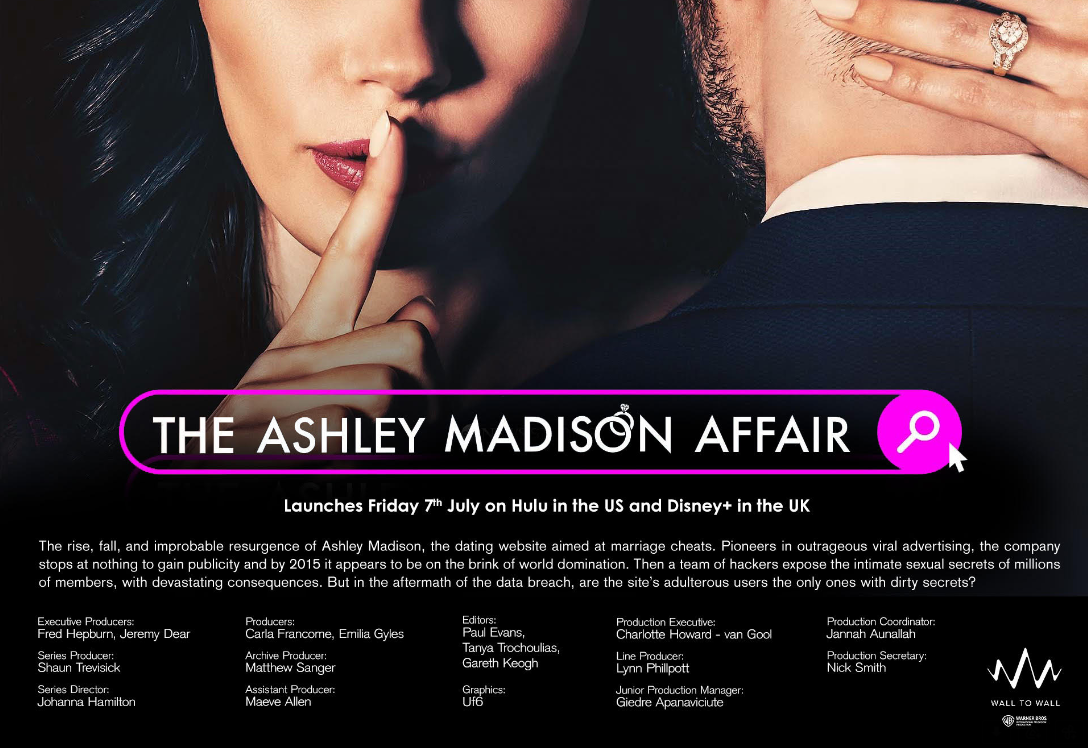
The series also touches on shocking new details unearthed by KrebsOnSecurity and Jeremy Bullock, a data scientist who worked with the show’s producers at the Warner Bros. production company Wall to Wall Media. Bullock had spent many hours poring over the hundreds of thousands of emails that the Ashley Madison hackers stole from Biderman and published online in 2015.
Wall to Wall reached out in July 2022 about collaborating with Bullock after KrebsOnSecurity published A Retrospective on the 2015 Ashley Madison Breach. That piece explored how Biderman — who is Jewish — had become the target of concerted harassment campaigns by anti-Semitic and far-right groups online in the months leading up to the hack.
Whoever hacked Ashley Madison had access to all employee emails, but they only released Biderman’s messages — three years worth. Apropos of my retrospective report, Bullock found that a great many messages in Biderman’s inbox were belligerent and anti-Semitic messages from a former Ashley Madison employee named William Brewster Harrison.
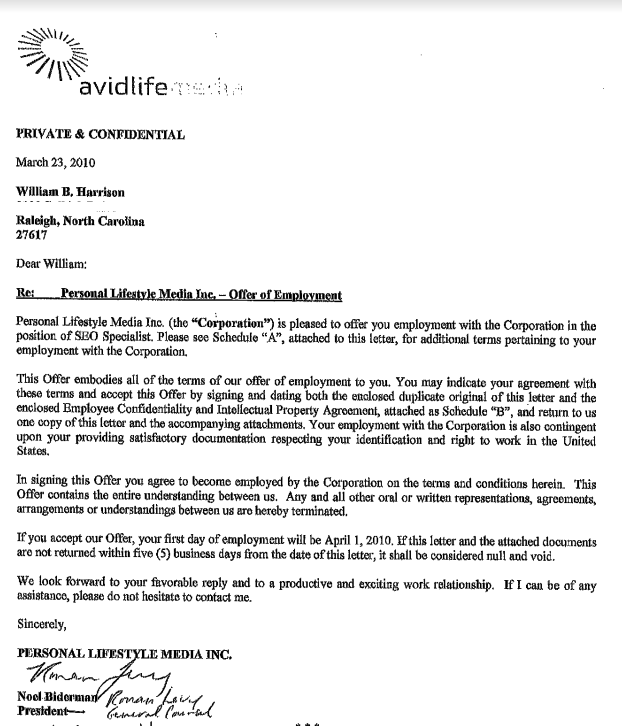
William Harrison’s employment contract with Ashley Madison parent Avid Life Media.
The messages show that Harrison was hired in March 2010 to help promote Ashley Madison online, but the messages also reveal Harrison was heavily involved in helping to create and cultivate phony female accounts on the service.
There is evidence to suggest that in 2010 Harrison was directed to harass the owner of Ashleymadisonsucks.com into closing the site or selling the domain to Ashley Madison.
Ashley Madison’s parent company — Toronto-based Avid Life Media — filed a trademark infringement complaint in 2010 that succeeded in revealing a man named Dennis Bradshaw as the owner. But after being informed that Bradshaw was not subject to Canadian trademark laws, Avid Life offered to buy AshleyMadisonSucks.com for $10,000.
When Bradshaw refused to sell the domain, he and his then-girlfriend were subject to an unrelenting campaign of online harassment and blackmail. It now appears those attacks were perpetrated by Harrison, who sent emails from different accounts at the free email service Vistomail pretending to be Bradshaw, his then-girlfriend and their friends.
[As the documentary points out, the domain AshleyMadisonSucks.com was eventually transferred to Ashley Madison, which then shrewdly used it for advertising and to help debunk theories about why its service was supposedly untrustworthy].
Harrison even went after Bradshaw’s lawyer and wife, listing them both on a website he created called Contact-a-CEO[.]com, which Harrison used to besmirch the name of major companies — including several past employers — all entities he believed had slighted him or his family in some way. The site also claimed to include the names, addresses and phone numbers of top CEOs.
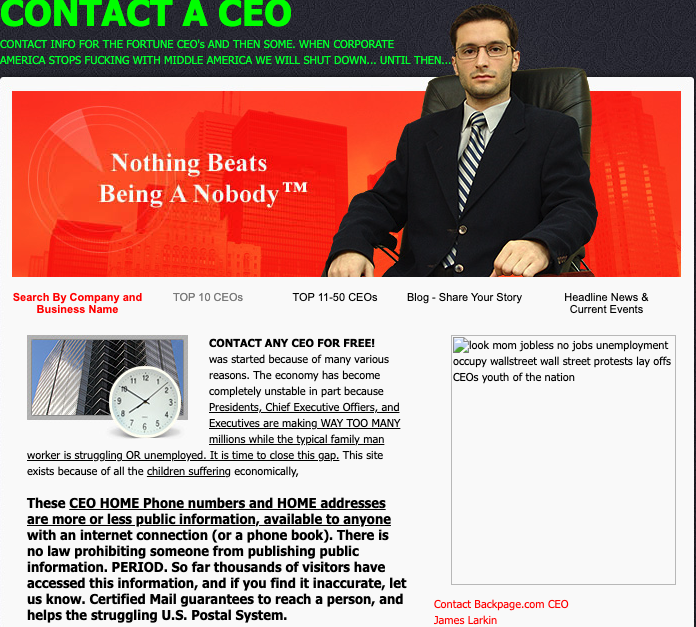
A cached copy of Harrison’s website, contact-the-ceo.com.
An exhaustive analysis of domains registered to the various Vistomail pseudonyms used by Harrison show he also ran Bash-a-Business[.]com, which Harrison dedicated to “all those sorry ass corporate executives out there profiting from your hard work, organs, lives, ideas, intelligence, and wallets.” Copies of the site at archive.org show it was the work of someone calling themselves “The Chaos Creator.”
Will Harrison was terminated as an Ashley Madison in November 2011, and by early 2012 he’d turned his considerable harassment skills squarely against the company. Ashley Madison’s long-suspected army of fake female accounts came to the fore in August 2012 after the former sex worker turned activist and blogger Maggie McNeill published screenshots apparently taken from Ashley Madison’s internal systems suggesting that a large percentage of the female accounts on the service were computer-operated bots.
Ashley Madison’s executives understood that only a handful of employees at the time would have had access to the systems needed to produce the screenshots McNeill published online. In one exchange on Aug. 16, 2012, Ashley Madison’s director of IT was asked to produce a list of all company employees with all-powerful administrator access.
“Who or what is asdfdfsda@asdf.com?,” Biderman asked, after being sent a list of nine email addresses.
“It appears to be the email address Will used for his profiles,” the IT director replied.
“And his access was never shut off until today?,” asked the company’s general counsel Mike Daks.
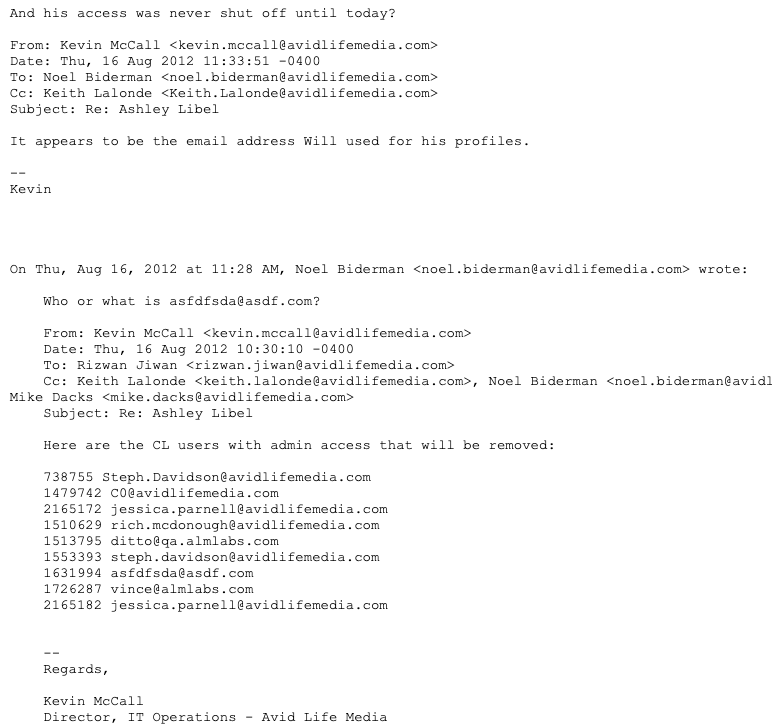
A Biderman email from 2012.
What prompted the data scientist Bullock to reach out were gobs of anti-Semitic diatribes from Harrison, who had taken to labeling Biderman and others “greedy Jew bastards.”
“So good luck, I’m sure we’ll talk again soon, but for now, Ive got better things in the oven,” Harrison wrote to Biderman after his employment contract with Ashley Madison was terminated. “Just remember I outsmarted you last time and I will outsmart and out maneuver you this time too, by keeping myself far far away from the action and just enjoying the sideline view, cheering for the opposition.”
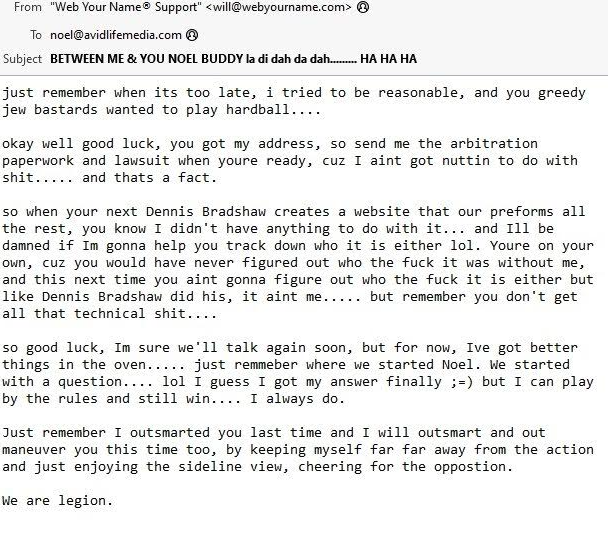
A 2012 email from William Harrison to former Ashley Madison CEO Noel Biderman.
Harrison signed his threatening missive with the salutation, “We are legion,” suggesting that whatever comeuppance he had in store for Ashley Madison would come from a variety of directions and anonymous hackers.
The leaked Biderman emails show that Harrison made good on his threats, and that in the months that followed Harrison began targeting Biderman and other Ashley Madison executives with menacing anonymous emails and spoofed phone calls laced with profanity and anti-Semitic language.
But on Mar. 5, 2014, Harrison committed suicide by shooting himself in the head with a handgun. This fact was apparently unknown to Biderman and other Ashley Madison executives more than a year later when their July 2015 hack was first revealed.
Does Harrison’s untimely suicide rule him out as a suspect in the 2015 hack? Who is The Chaos Creator, and what else transpired between Harrison and Ashley Madison prior to his death? We’ll explore these questions in Part II of this story, to be published early next week.
from Krebs on Security https://ift.tt/6pNLBP3
via IFTTT
Originally a banking trojan, Emotet later evolved into a full-blown botnet and went on to become one of the most dangerous cyberthreats worldwide
The post Emotet: sold or on vacation? – Week in security with Tony Anscombe appeared first on WeLiveSecurity
from WeLiveSecurity https://ift.tt/1VjZWAq
via IFTTT
 Pacosite's Blog