Tails 5.14 llega con migración automática a LUKS2 mejoras y mas

Tails_Linux

The Amnesic Incognito Live System o Tails es una distribución Linux diseñada para preservar la privacidad y el anonimato

Se ha formado el lanzamiento de Tails 5.14 (The Amnesic Incognito Live System), versión que aún llega basa en Debian 11.7, pero que llega implementando cambios para el almacenamiento persistente, actualizaciones, correcciones de errores y más.

Para aquellos que desconocen de Tails, deben saber que esta es una distribución que está basada en la base del paquete Debian y diseñada para proporcionar acceso anónimo a la red, con la finalidad de preservar la privacidad y el anonimato del usuario en la red.

La salida anónima de Tails es proporcionada por Tor en todas las conexiones, ya que el tráfico a través de la red Tor, están bloqueadas por defecto con un filtro de paquetes, con lo cual el usuario no deja rastro en la red a no ser que quiera lo contrario. El cifrado se usa para almacenar datos de usuario en el modo guardar datos de usuario entre inicios, además de que presenta una serie de aplicaciones preconfiguradas pensadas en la seguridad y anonimato del usuario, tales como un navegador web, el cliente de correo, un cliente de mensaje instantáneos entre otras más.

Principales novedades de Tails 5.14

En esta nueva versión de Tails 5.14 podremos encontrar que la distribucion todavía llega basada en Debian 11.7 (Bullseye) y con el Kernel de Linux 6.1.25-1

se destaca que se ha proporcionado la conversión automática de particiones LUKS1 persistentes y encriptadas existentes al formato LUKS2, que utiliza algoritmos criptográficos más confiables. La función de generación de claves se ha cambiado de PBKDF2 a Argon2id.

Con este cambio los desarrolladores recomiendan a los usuarios que también cambien la frase de contraseña de su almacenamiento persistente y otros volúmenes cifrados con LUKS, ya que los parámetros de cifrado utilizados anteriormente en LUKS1 podrían verse comprometidos con el uso de equipos especiales si hubiera acceso físico al dispositivo.

Otro de los cambios que se destaca, es que ahora el instalador ofrece la posibilidad de crear una copia de seguridad completa del almacenamiento persistente, ademas de que tambien se destaca que Tails 5.14 incluye otras mejoras para el almacenamiento persistente, tales como un interruptor en la pantalla de bienvenida para crear un almacenamiento persistente en lugar de un botón.

Tambien se destaca que se devolvieron las descripciones de ciertas funciones avanzadas de almacenamiento persistente, así como descripciones de varias funciones y una mención de Kleopatra en la función GnuPG.

Por otra parte, se destaca que se proporcionó la detección automática de una conexión de red a través del portal cautivo al configurar una conexión automática a Tor. Ademas que este, ha sido actualizado a la versión 12.0.7 que está sincronizada con el código base Firefox 102.12 ESR, que corrige 11 vulnerabilidades, de las cuales se destacan los problemas con certificados TLS no válidos. Ademas de las correcciones, Tor Browser 12.0.7 actualizó la versión 11.4.22 de NoScript y OpenSSL a la version 1.1.1u

Por último y no menos importante, se menciona que ahora Tails presenta un apartado de donación, ya que mucha gente usa Tails para asegurar su billetera Bitcoin y los desarrolladores no tomaron a mal el integrar una forma de donar de Electrum a Tails.

Finalmente si estás interesado en poder conocer más al respecto, puedes consultar los detalles en el siguiente enlace.

Descargar Tails 5.14

Si quieres probar o instalar esta nueva versión de esta distribución de Linux en tu equipo, puedes obtener la imagen del sistema la cual ya está disponible desde su página web oficial en su sección de descargas, en enlace es este.

La imagen que se obtiene desde la sección de descargas es una imagen ISO de 1 GB capaz de funcionar en modo en vivo.

¿Cómo actualizar a la nueva versión de Tails 5.14?

Para aquellos usuarios que tengan instalada una versión anterior de Tails y quieren realizar la actualización a esta nueva versión, pueden realizar directamente siguiendo las instrucciones de este enlace.

Para ello podrán hacer uso de su dispositivo USB que utilizaron para instalar Tails, pueden consultar la información para llevar este movimiento en su ordenador en el siguiente enlace. 

from Linux Adictos https://ift.tt/DrxvXYF
via IFTTT

CISA Order Highlights Persistent Risk at Network Edge

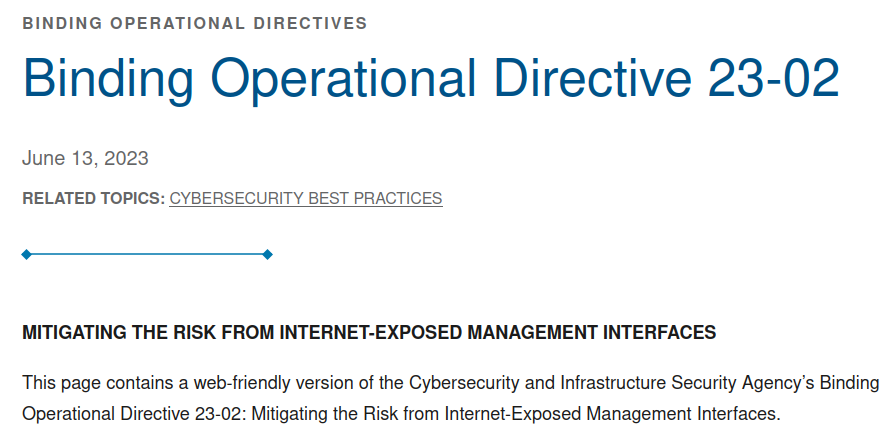
The U.S. government agency in charge of improving the nation’s cybersecurity posture is ordering all federal civilian agencies to take new measures to restrict access to Internet-exposed networking equipment. The directive comes amid a surge in attacks targeting previously unknown vulnerabilities in widely used security and networking appliances.

Under a new order from the Cybersecurity and Infrastructure Security Agency (CISA), federal agencies will have 14 days to respond to any reports from CISA about misconfigured or Internet-exposed networking equipment. The directive applies to any networking devices — such as firewalls, routers and load balancers — that allow remote authentication or administration.

The order requires federal departments to limit access so that only authorized users on an agency’s local or internal network can reach the management interfaces of these devices. CISA’s mandate follows a slew of recent attacks wherein attackers exploited zero-day flaws in popular networking products to conduct ransomware and cyber espionage attacks on victim organizations.

Earlier today, incident response firm Mandiant revealed that since at least October 2022, Chinese cyber spies have been exploiting a zero-day vulnerability in many email security gateway (ESG) appliances sold by California-based Barracuda Networks to hoover up email from organizations using these devices.

Barracuda was alerted to the exploitation of a zero-day in its products in mid-May, and two days later the company pushed a security update to address the flaw in all affected devices. But last week, Barracuda took the highly unusual step of offering to replace compromised ESGs, evidently in response to malware that altered the systems in such a fundamental way that they could no longer be secured remotely with software updates.

According to Mandiant, a previously unidentified Chinese hacking group was responsible for exploiting the Barracuda flaw, and appeared to be searching through victim organization email records for accounts “belonging to individuals working for a government with political or strategic interest to [China] while this victim government was participating in high-level, diplomatic meetings with other countries.”

When security experts began raising the alarm about a possible zero-day in Barracuda’s products, the Chinese hacking group altered their tactics, techniques and procedures (TTPs) in response to Barracuda’s efforts to contain and remediate the incident, Mandiant found.

Mandiant said the attackers will continue to change their tactics and malware, “especially as network defenders continue to take action against this adversary and their activity is further exposed by the infosec community.”

Meanwhile, this week we learned more details about the ongoing exploitation of a zero-day flaw in a broad range of virtual private networking (VPN) products made by Fortinet — devices many organizations rely on to facilitate remote network access for employees.

On June 11, Fortinet released a half-dozen security updates for its FortiOS firmware, including a weakness that researchers said allows an attacker to run malware on virtually any Fortinet SSL VPN appliance. The researchers found that just being able to reach the management interface for a vulnerable Fortinet SSL VPN appliance was enough to completely compromise the devices.

“This is reachable pre-authentication, on every SSL VPN appliance,” French vulnerability researcher Charles Fol tweeted. “Patch your #Fortigate.”

In details published on June 12, Fortinet confirmed that one of the vulnerabilities (CVE-2023-27997) is being actively exploited. The company said it discovered the weakness in an internal code audit that began in January 2023 — when it learned that Chinese hackers were exploiting a different zero-day flaw in its products.

Shodan.io, the search engine made for finding Internet of Things devices, reports that there are currently more than a half-million vulnerable Fortinet devices reachable via the public Internet.

The new cybersecurity directive from CISA orders agencies to remove any networking device management interfaces from the internet by making them only accessible from an internal enterprise network (CISA recommends an isolated management network). CISA also says agencies should “deploy capabilities, as part of a Zero Trust Architecture, that enforce access control to the interface through a policy enforcement point separate from the interface itself (preferred action).”

Security experts say CISA’s directive highlights the reality that cyberspies and ransomware gangs are making it increasingly risky for organizations to expose any devices to the public Internet, because these groups have strong incentives to probe such devices for previously unknown security vulnerabilities.

The most glaring example of this dynamic can be seen in the frequency with which ransomware groups have discovered and pounced on zero-day flaws in widely-used file-transfer protocol (FTP) applications. One ransomware gang in particular — Cl0p — has repeatedly exploited zero day bugs in various FTP appliances to extort tens of millions of dollars from hundreds of ransomware victims.

On February 2, KrebsOnSecurity broke the news that attackers were exploiting a zero-day vulnerability in the GoAnywhere FTP appliance by Fortra. By the time security updates were available to fix the vulnerability, Cl0p had already used it to steal data from more than a hundred organizations running Fortra’s FTP appliance.

According to CISA, on May 27, Cl0p began exploiting a previously unknown flaw in MOVEit Transfer, a popular Internet-facing file transfer application. MOVEit parent Progress Software has since released security updates to address the weakness, but Cl0p claims to have already used it to compromise hundreds of victim organizations. TechCrunch has been tracking the fallout from victim organizations, which range from banks and insurance providers to universities and healthcare entities.

The always on-point weekly security news podcast Risky Business has recently been urging organizations to jettison any and all FTP appliances, noting that Cl0p (or another crime gang) is likely to visit the same treatment on other FTP appliance vendors.

But that sound advice doesn’t exactly scale for mid-tier networking devices like Barracuda ESGs or Fortinet SSL VPNs, which are particularly prominent in small to mid-sized organizations.

“It’s not like FTP services, you can’t tell an enterprise [to] turn off the VPN [because] the productivity hit of disconnecting the VPN is terminal, it’s a non-starter,” Risky Business co-host Adam Boileau said on this week’s show. “So how to mitigate the impact of having to use a domain-joined network appliance at the edge of your network that is going to get zero-day in it? There’s no good answer.”

Risky Business founder Patrick Gray said the COVID-19 pandemic breathed new life into entire classes of networking appliances that rely on code which was never designed with today’s threat models in mind.

“In the years leading up to the pandemic, the push towards identity-aware proxies and zero trust everything and moving away from this type of equipment was gradual, but it was happening,” Gray said. “And then COVID-19 hit and everybody had to go work from home, and there really was one option to get going quickly — which was to deploy VPN concentrators with enterprise features.”

Gray said the security industry had been focused on building the next generation of remote access tools that are more security-hardened, but when the pandemic hit organizations scrambled to cobble together whatever they could.

“The only stuff available in the market was all this old crap that is not QA’d properly, and every time you shake them CVEs fall out,” Gray remarked, calling the pandemic, “a shot in the arm” to companies like Fortinet and Barracuda.

“They sold so many VPNs through the pandemic and this is the hangover,” Gray said. “COVID-19 extended the life of these companies and technologies, and that’s unfortunate.”

from Krebs on Security https://ift.tt/DVXb2wh
via IFTTT