Lots to learn, clearly explained in plain English… listen now! (Full transcript inside.)
from Naked Security https://ift.tt/ZtjT2XO
via IFTTT

Lots to learn, clearly explained in plain English… listen now! (Full transcript inside.)
from Naked Security https://ift.tt/ZtjT2XO
via IFTTT
Code-signing certificates are supposed to help authenticate the identity of software publishers, and provide cryptographic assurance that a signed piece of software has not been altered or tampered with. Both of these qualities make stolen or ill-gotten code-signing certificates attractive to cybercriminal groups, who prize their ability to add stealth and longevity to malicious software. This post is a deep dive on “Megatraffer,” a veteran Russian hacker who has practically cornered the underground market for malware focused code-signing certificates since 2015.
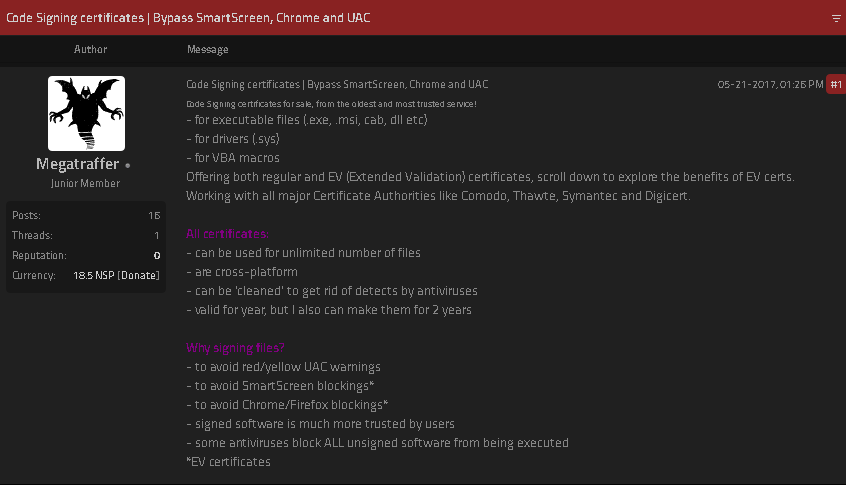
One of Megatraffer’s ads on an English-language cybercrime forum.
A review of Megatraffer’s posts on Russian crime forums shows this user began peddling individual stolen code-signing certs in 2015 on the Russian-language forum Exploit, and soon expanded to selling certificates for cryptographically signing applications and files designed to run in Microsoft Windows, Java, Adobe AIR, Mac and Microsoft Office.
Megatraffer explained that malware purveyors need a certificate because many antivirus products will be far more interested in unsigned software, and because signed files downloaded from the Internet don’t tend to get blocked by security features built into modern web browsers. Additionally, newer versions of Microsoft Windows will complain with a bright yellow or red alert message if users try to install a program that is not signed.
“Why do I need a certificate?” Megatraffer asked rhetorically in their Jan. 2016 sales thread on Exploit. “Antivirus software trusts signed programs more. For some types of software, a digital signature is mandatory.”
At the time, Megatraffer was selling unique code-signing certificates for $700 apiece, and charging more than twice that amount ($1,900) for an “extended validation” or EV code-signing cert, which is supposed to only come with additional identity vetting of the certificate holder. According to Megatraffer, EV certificates were a “must-have” if you wanted to sign malicious software or hardware drivers that would reliably work in newer Windows operating systems.
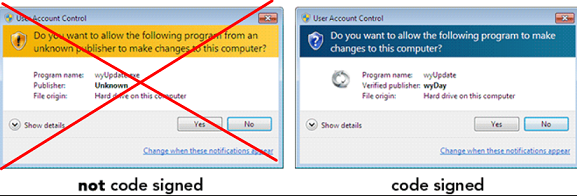
Part of Megatraffer’s ad. Image: Ke-la.com.
Megatraffer has continued to offer their code-signing services across more than a half-dozen other Russian-language cybercrime forums, mostly in the form of sporadically available EV and non-EV code-signing certificates from major vendors like Thawte and Comodo.
More recently, it appears Megatraffer has been working with ransomware groups to help improve the stealth of their malware. Shortly after Russia invaded Ukraine in February 2022, someone leaked several years of internal chat logs from the Conti ransomware gang, and those logs show Megatraffer was working with the group to help code-sign their malware between July and October 2020.
According to cyber intelligence firm Intel 471, Megatraffer has been active on more than a half-dozen crime forums from September 2009 to the present day. And on most of these identities, Megatraffer has used the email address 774748@gmail.com. That same email address also is tied to two forum accounts for a user with the handle “O.R.Z.”
Constella Intelligence, a company that tracks exposed databases, finds that 774748@gmail.com was used in connection with just a handful of passwords, but most frequently the password “featar24“. Pivoting off of that password reveals a handful of email addresses, including akafitis@gmail.com.
Intel 471 shows akafitis@gmail.com was used to register another O.R.Z. user account — this one on Verified[.]ru in 2008. Prior to that, akafitis@gmail.com was used as the email address for the account “Fitis,” which was active on Exploit between September 2006 and May 2007. Constella found the password “featar24” also was used in conjunction with the email address spampage@yandex.ru, which is tied to yet another O.R.Z. account on Carder[.]su from 2008.
The email address akafitis@gmail.com was used to create a Livejournal blog profile named Fitis that has a large bear as its avatar. In November 2009, Fitis wrote, “I am the perfect criminal. My fingerprints change beyond recognition every few days. At least my laptop is sure of it.”
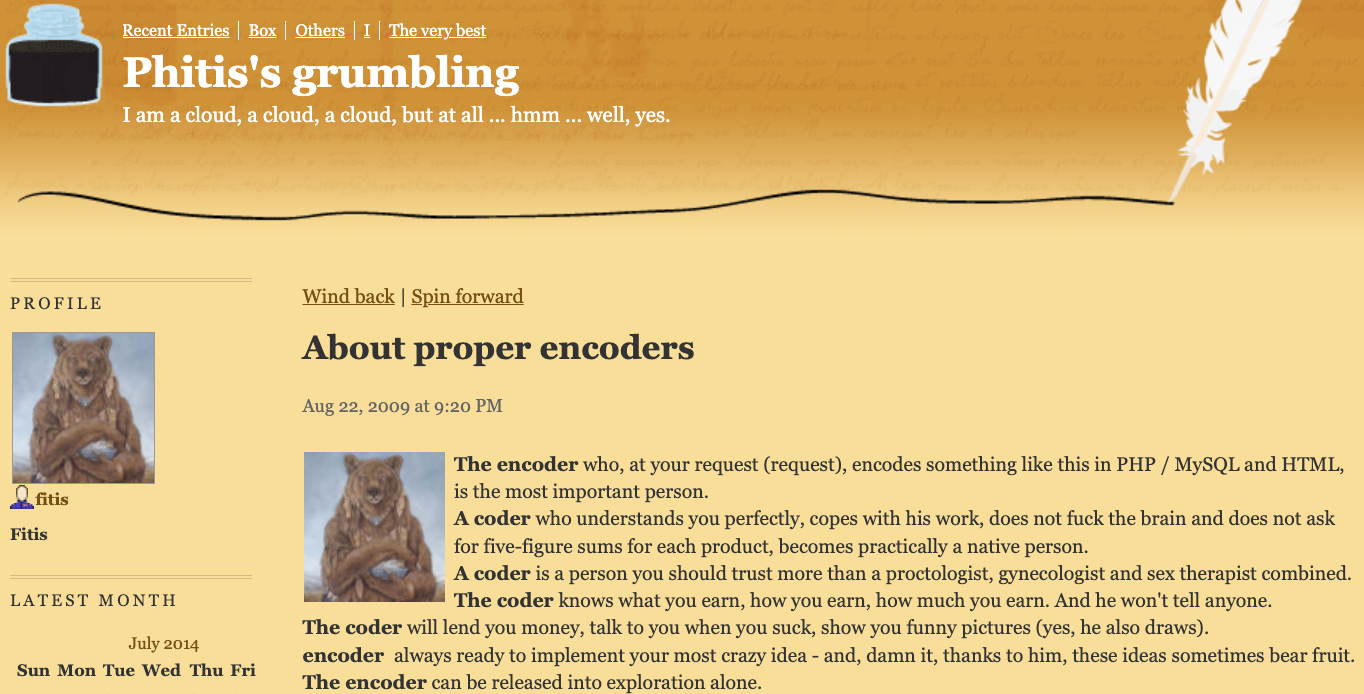
Fitis’s Livejournal account. Image: Archive.org.
Fitis’s real-life identity was exposed in 2010 after two of the biggest sponsors of pharmaceutical spam went to war with each other, and large volumes of internal documents, emails and chat records seized from both spam empires were leaked to this author. That protracted and public conflict formed the backdrop of my 2014 book — “Spam Nation: The Inside Story of Organized Cybercrime, from Global Epidemic to Your Front Door.”
One of the leaked documents included a Microsoft Excel spreadsheet containing the real names, addresses, phone numbers, emails, street addresses and WebMoney addresses for dozens of top earners in Spamit — at the time the most successful pharmaceutical spam affiliate program in the Russian hacking scene and one that employed most of the top Russian botmasters.
That document shows Fitis was one of Spamit’s most prolific recruiters, bringing more than 75 affiliates to the Spamit program over several years prior to its implosion in 2010 (and earning commissions on any future sales from all 75 affiliates).
The document also says Fitis got paid using a WebMoney account that was created when its owner presented a valid Russian passport for a Konstantin Evgenievich Fetisov, born Nov. 16, 1982 and residing in Moscow. Russian motor vehicle records show two different vehicles are registered to this person at the same Moscow address.
The most interesting domain name registered to the email address spampage@yahoo.com, fittingly enough, is fitis[.]ru, which DomainTools.com says was registered in 2005 to a Konstantin E. Fetisov from Moscow.
The Wayback Machine at archive.org has a handful of mostly blank pages indexed for fitis[.]ru in its early years, but for a brief period in 2007 it appears this website was inadvertently exposing all of its file directories to the Internet.
One of the exposed files — Glavmed.html — is a general invitation to the infamous Glavmed pharmacy affiliate program, a now-defunct scheme that paid tens of millions of dollars to affiliates who advertised online pill shops mainly by hacking websites and manipulating search engine results. Glavmed was operated by the same Russian cybercriminals who ran the Spamit program.
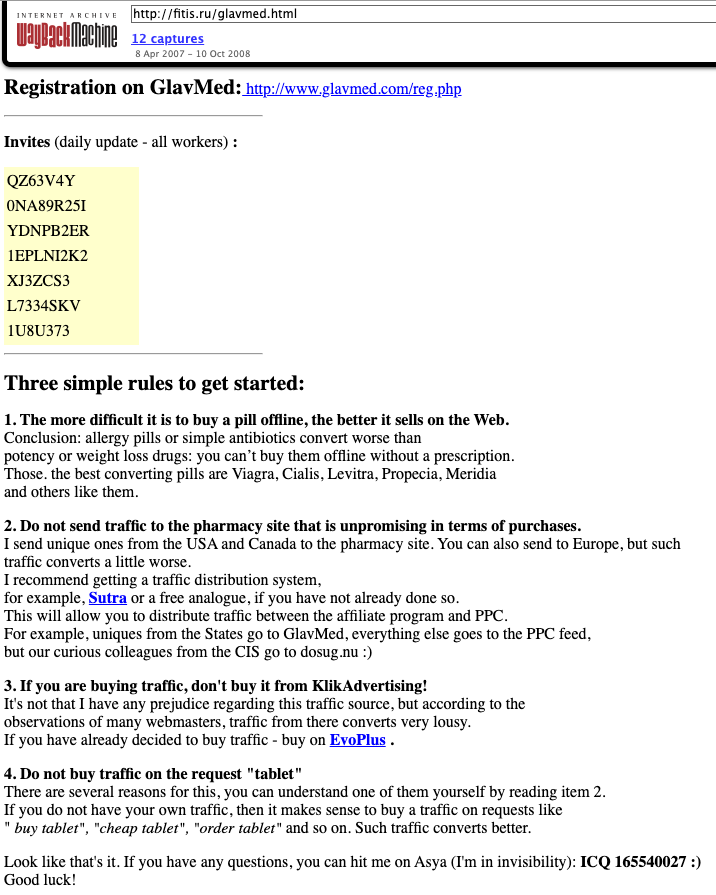
A Google translated ad circa 2007 recruiting for the pharmacy affiliate program Glavmed, which told interested applicants to contact the ICQ number used by Fitis, a.k.a. MegaTraffer. Image: Archive.org.
Archive.org shows the fitis[.]ru webpage with the Glavmed invitation was continuously updated with new invite codes. In their message to would-be Glavmed affiliates, the program administrator asked applicants to contact them at the ICQ number 165540027, which Intel 471 found was an instant messenger address previously used by Fitis on Exploit.
The exposed files in the archived version of fitis[.]ru include source code for malicious software, lists of compromised websites used for pharmacy spam, and a handful of what are apparently personal files and photos. Among the photos is a 2007 image labeled merely “fitis.jpg,” which shows a bespectacled, bearded young man with a ponytail standing next to what appears to be a newly-married couple at a wedding ceremony.
Mr. Fetisov did not respond to requests for comment.
As a veteran organizer of affiliate programs, Fitis did not waste much time building a new moneymaking collective after Spamit closed up shop. New York City-based cyber intelligence firm Flashpoint found that Megatraffer’s ICQ was the contact number for Himba[.]ru, a cost-per-acquisition (CPA) program launched in 2012 that paid handsomely for completed application forms tied to a variety of financial instruments, including consumer credit cards, insurance policies, and loans.
“Megatraffer’s entrenched presence on cybercrime forums strongly suggests that malicious means are used to source at least a portion of traffic delivered to HIMBA’s advertisers,” Flashpoint observed in a threat report on the actor.
Intel 471 finds that Himba was an active affiliate program until around May 2019, when it stopping paying its associates.
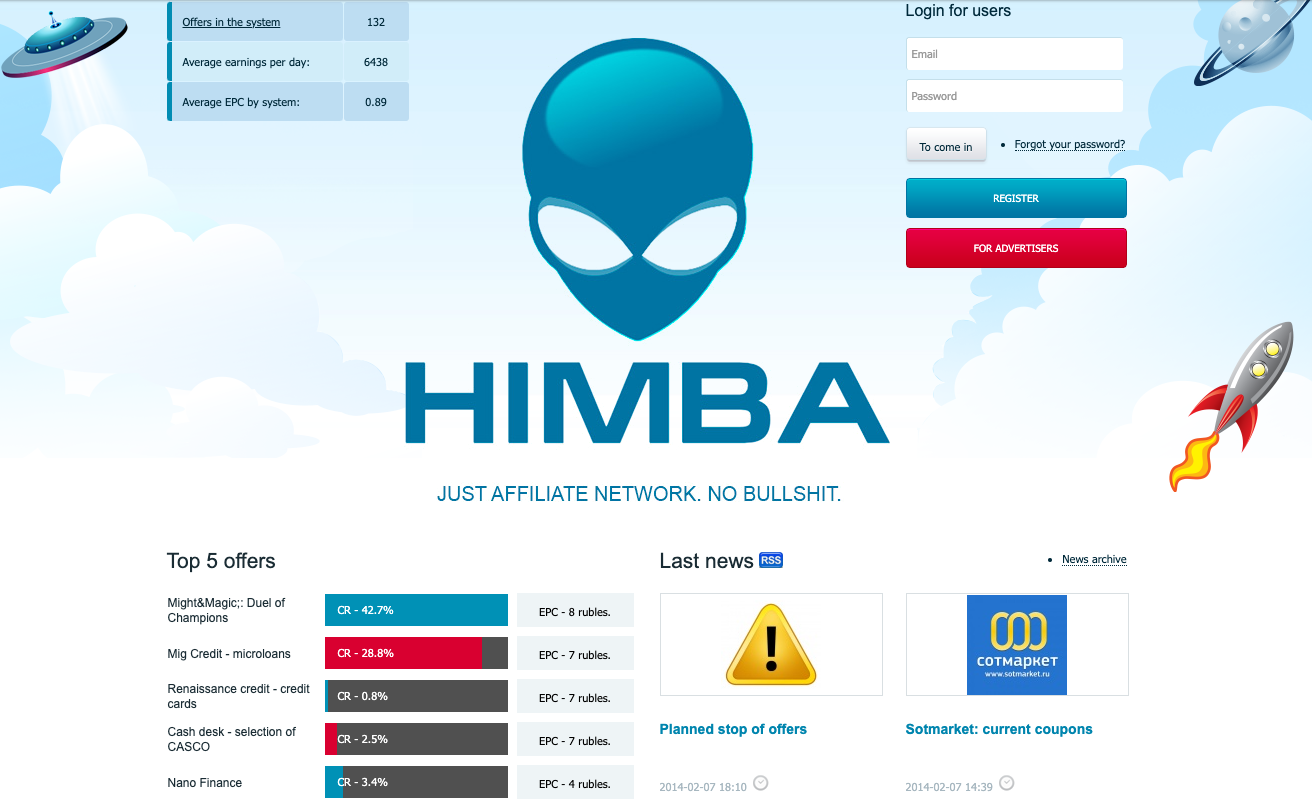
Fitis’s Himba affiliate program, circa February 2014. Image: Archive.org.
Flashpoint notes that in September 2015, Megatraffer posted a job ad on Exploit seeking experienced coders to work on browser plugins, installers and “loaders” — basically remote access trojans (RATs) that establish communication between the attacker and a compromised system.
“The actor specified that he is looking for full-time, onsite help either in his Moscow or Kiev locations,” Flashpoint wrote.
from Krebs on Security https://ift.tt/blGyuYB
via IFTTT
The $500 Meta Quest 3 made its debut today, mere days before Apple is rumored to show off its virtual reality headset.
from Gear Latest https://ift.tt/Kj2Owk5
via IFTTT
[Streaming Again] A TV news reporter (Jim Carrey) rants at God (Morgan Freeman) and is given divine powers for a week to see if he can do a better job at running things.
from New On Netflix USA https://ift.tt/Q9wGzhE
via IFTTT
[Streaming Again] Peter Pan, now grown up and a workaholic, must return to Neverland to save his kids from the clutches of vengeful pirate Captain Hook.
from New On Netflix USA https://ift.tt/ZiXjQGM
via IFTTT
[Streaming Again] A devoted zookeeper’s animal friends rally together and offer their best advice to help him win back the woman who broke his heart.
from New On Netflix USA https://ift.tt/kXVJyme
via IFTTT

(adsbygoogle = window.adsbygoogle || []).push({});
Desde ayer venimos haciendo una reseña de los tipos de herramientas de seguridad informática y las opciones disponibles para Linux. En este post vamos a contestar a uno de los mitos más difundidos respondiendo a la pregunta ¿Realmente se necesitan antivirus en Linux?
Los virus son una forma de malware muy extendida que dificulta o impide el funcionamiento de sistemas informáticos y gracias a su capacidad de autoreplicarse extenderse de manera rápida a otros equipos.
(adsbygoogle = window.adsbygoogle || []).push({});
La función de los programas antivirus es proteger a los sistemas informáticos de virus y otro software malicioso que pueda afectar al sistema operativo, aplicaciones y archivos importantes. Uso la expresión software malicioso ya que en general este tipo de aplicaciones no solo se ocupa de los virus sino también de los gusanos, ransomware, spyware y adware.
Este tipo de programas busca no solo detectar y alertar el software malicioso sino también eliminarlo monitoreando las diferentes actividades del ordenador para encontrar patrones conocidos de malware o comportamientos poco habituales.
Para la detección de patrones se utilizan bases de datos de los malwares ya conocidos En el caso del comportamiento, toda actividad no justificada se tomará como indicio y se informará al usuario.
(adsbygoogle = window.adsbygoogle || []).push({});
De acuerdo con las configuraciones establecidas por el usuario, al detectar un programa potencialmente sospechoso, el antivirus elegirá algunas de las siguientes alternativas:
Además de las actividades del ordenador, el programa antivirus supervisa en tiempo real los sitios de Internet por los que navegamos, los archivos que descargamos y los adjuntos que recibimos por correo electrónico.
Debido a que todos los días aparece nuevo software malicioso es importante mantenerlo actualizado para que la base de datos en la que se basa su funcionamiento esté al día.
Permítanme hacer una analogía con el sexo. Si tienes una pareja estable que sabes que no te engaña y la posibilidad de un embarazo no es algo que te preocupe, la posibilidad de que te contagies de una enfermedad de transmisión sexual sin usar condón es muy baja, pero no desaparece totalmente.
(adsbygoogle = window.adsbygoogle || []).push({});
Tu pareja puede ser infectada con sangre contaminada por una transfusión, una jeringa o un corte accidental.
Si no tienes parejas estables y sueles preferir tener sexo con personas promiscuas es como jugar a la ruleta rusa con todas las balas en el cargador.
Volviendo al tema que nos ocupa, Usar Linux es como tener sexo con una pareja estable. Su sistema cuidadosamente medido de otorgar privilegios de acceso a las diferentes partes del sistema es una barrera para que el software malicioso destruya componentes sensibles.
Sin embargo, a menos que te desconectes completamente de la red y no instales nada nuevo manualmente, no estás a salvo de que un archivo que te enviaron por mail o una actualización no autorizada mediante un ataque a los repositorios de tu distribución Linux, sea el punto de entrada del software malicioso.
Y, recuerda que al ser parte de una red eres solidariamente responsable de la seguridad general. Aunque no te afecte el virus puedes ser el portador asintomático que lo extienda.
En general, en lo que se refiere a sistemas domésticos, la decisión depende de cada usuario. Donde sí debe instalarse obligatoriamente un antivirus es en los servidores corporativos. Sobre todo, en el caso de que se utilicen para el envío o recepción de correo electrónico o como plataforma para compartir archivos.
En los últimos años fueron apareciendo antivirus comerciales (Las malas lenguas dicen que esa fue la causa y no la consecuencia del aumento de malware para Linux) Sin embargo, también existen alternativas de código abierto que puedes encontrar en los repositorios y que comentaremos en el próximo artículo.
Mientras tanto, me gustaría saber. ¿Utilizan algún antivirus en Linux?
from Linux Adictos https://ift.tt/9GLin1b
via IFTTT
[Streaming Again] New York cop Tom O’Meara and his family welcome a young Irishman into their home, unaware that he’s on the run — and on a mission to avenge his father.
from New On Netflix USA https://ift.tt/rul9VGm
via IFTTT
[Streaming Again] Grumpy meteorologist Phil Connors lives the same day over and over after he arrives in the town of Punxsutawney for the annual Groundhog Day festivities.
from New On Netflix USA https://ift.tt/3VLIgZh
via IFTTT
[Streaming Again] A young surfer enters his first contest, hoping a win will earn him respect. But an encounter with a laid-back local forces him to rethink his values.
from New On Netflix USA https://ift.tt/ac6KEjG
via IFTTT
 Pacosite's Blog