Pacosite's Blog

Comunicaciones, Linux, Tecnología e Internet

Pacosite's Blog

Descubrieron que pueden introducir paquetes maliciosos en AUR mediante dominios caducados

vulnerabilidad

Si se explotan, estas fallas pueden permitir a los atacantes obtener acceso no autorizado a información confidencial o, en general, causar problemas

Hace poco dieron a conocer mediante una publicación de blog los resultados de un experimento, en el cual demuestran como se puede tomar el control de los paquetes en el repositorio AUR.

Para quienes desconocen de AUR (Arch User Repository), deben saber que este es un repositorio de software para Arch Linux. Se diferencia de los repositorios oficiales de Arch Linux, ya que en este sus paquetes son proporcionados por sus usuarios y Arch Linux no los admite oficialmente.

AUR es utilizado por desarrolladores externos para distribuir sus paquetes sin estar incluidos en los repositorios principales de la distribución Arch Linux.

En este, se realizó una investigación debido a la falta de soporte, que es más una característica que un error, ya que permite que AUR contenga paquetes que son difíciles de soportar (por ejemplo, debido a problemas de licencia) o que solo son utilizados por un puñado de usuarios.

Sin embargo, la falta de soporte también significa menos control de calidad, lo que permite a los malos actores introducir paquetes maliciosos. Para advertir a los usuarios de este riesgo, AUR tiene un gran descargo de responsabilidad en la página principal (una leyenda que muchos ignoran o simplemente desconocen):

ESCARGO DE RESPONSABILIDAD: Los paquetes AUR son contenido producido por el usuario. Cualquier uso de los archivos proporcionados es bajo su propio riesgo.

Sobre el experimento realizado, los investigadores prepararon un script que comprueba la caducidad del registro de los dominios que aparecen en los archivos PKGBUILD y SRCINFO. La ejecución de este script identificó 14 dominios caducados utilizados en 20 paquetes de carga de archivos.

Con ello, pudieron identificar que hay varias formas de introducir un paquete malicioso (o cambios maliciosos en un paquete legítimo) en AUR. Por ejemplo, convirtiéndose en el mantenedor de paquetes huérfanos (es decir, paquetes que ya no son compatibles con sus mantenedores anteriores) o escribiendo nombres de paquetes populares.

Otra opción es encontrar paquetes que utilicen URL con dominios caducados durante su proceso de creación, registrar el dominio y alojar archivos maliciosos. ¿Cuántos de los paquetes son vulnerables a tal ataque? ¡Vamos a averiguar!

Se menciona que el proceso no es tan simple como se pudiera tener en cuenta, ya no basta simplemente con registrar un dominio, ya que esto no es suficiente para falsificar el paquete, pues el contenido descargado se compara con la suma de verificación ya cargada en AUR. Sin embargo, los mantenedores de alrededor del 35% de los paquetes en AUR parecen usar el parámetro «SKIP» en el archivo PKGBUILD para omitir la verificación de la suma de control (por ejemplo, especifique sha256sums=(‘SKIP’)). De los 20 paquetes con dominios vencidos, en 4 se utilizó el parámetro SKIP.

Para demostrar la posibilidad de cometer un ataque, los investigadores compraron el dominio de uno de los paquetes que no verifican las sumas de verificación y colocaron un archivo con el código y un script de instalación modificado.

Desafortunadamente, no existe una forma estandarizada de verificar si un dominio está disponible. Las respuestas de WHOIS de los TLD más populares contienen algo como «No coincide con el dominio» para los dominios disponibles, pero esto no es cierto para todos los TLD. Un buen primer paso es filtrar cualquier dominio que tenga un Aconjunto de registros DNS, ya que esos dominios (lo más probable) todavía estarán en uso. Para realizar rápidamente muchas solicitudes de DNS, usamos blechschmidt/massdns . Esta es una gran herramienta que nos permite resolver miles de dominios en segundos

En lugar del contenido real, se ha agregado al script una advertencia sobre la ejecución de código de terceros. Un intento de instalar el paquete condujo a la descarga de archivos falsificados y, dado que no se verificó la suma de verificación, a la instalación y ejecución exitosas del código agregado por los experimentadores.

Finalmente se menciona que el secuestro de paquetes AUR no es un concepto nuevo, ya que el secuestro de paquetes AUR siempre ha sido posible (de múltiples maneras) y es un riesgo conocido.

Si estás interesado en poder conocer más al respecto, puedes consultar los detalles en el siguiente enlace.

from Linux Adictos https://ift.tt/29MItDJ
via IFTTT

Hacker Charged With Extorting Online Psychotherapy Service

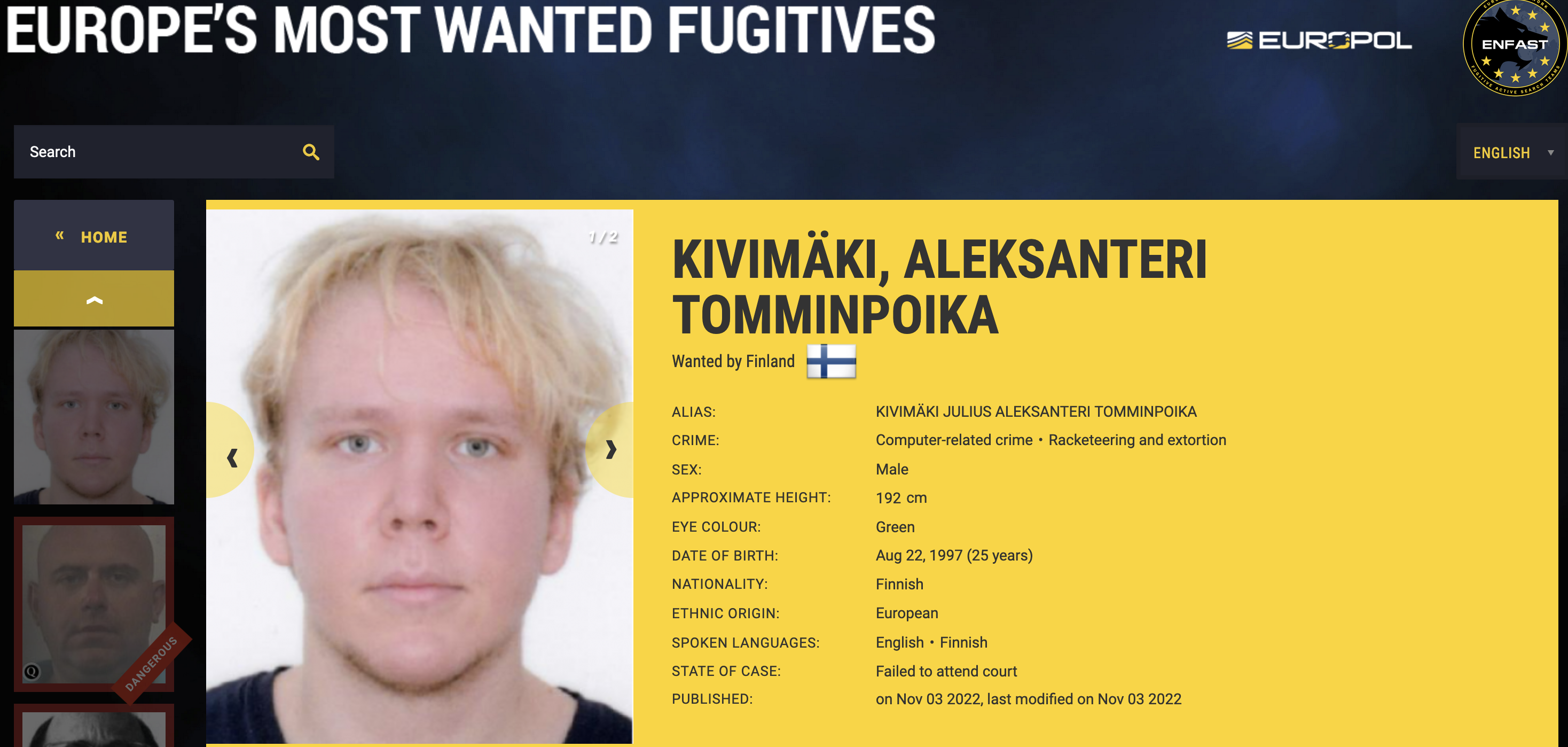
A 25-year-old Finnish man has been charged with extorting a once popular and now-bankrupt online psychotherapy company and its patients. Finnish authorities rarely name suspects in an investigation, but they were willing to make an exception for Julius “Zeekill” Kivimaki, a notorious hacker who — at the tender age of 17 — had been convicted of more than 50,000 cybercrimes, including data breaches, payment fraud, operating botnets, and calling in bomb threats.

In late October 2022, Kivimaki was charged (and arrested in absentia, according to the Finns) with attempting to extort money from the Vastaamo Psychotherapy Center.  On October 21, 2020, Vastaamo became the target of blackmail when a tormentor identified as “ransom_man” demanded payment of 40 bitcoins (~450,000 euros at the time) in return for a promise not to publish highly sensitive therapy session notes Vastaamo had exposed online.

In a series of posts over the ensuing days on a Finnish-language dark net discussion board, ransom_man said Vastaamo appeared unwilling to negotiate a payment, and that he would start publishing 100 patient profiles every 24 hours “to provide further incentive for the company to continue communicating with us.”

“We’re not asking for much, approximately 450,000 euros which is less than 10 euros per patient and only a small fraction of the around 20 million yearly revenues of this company,” ransom_man wrote.

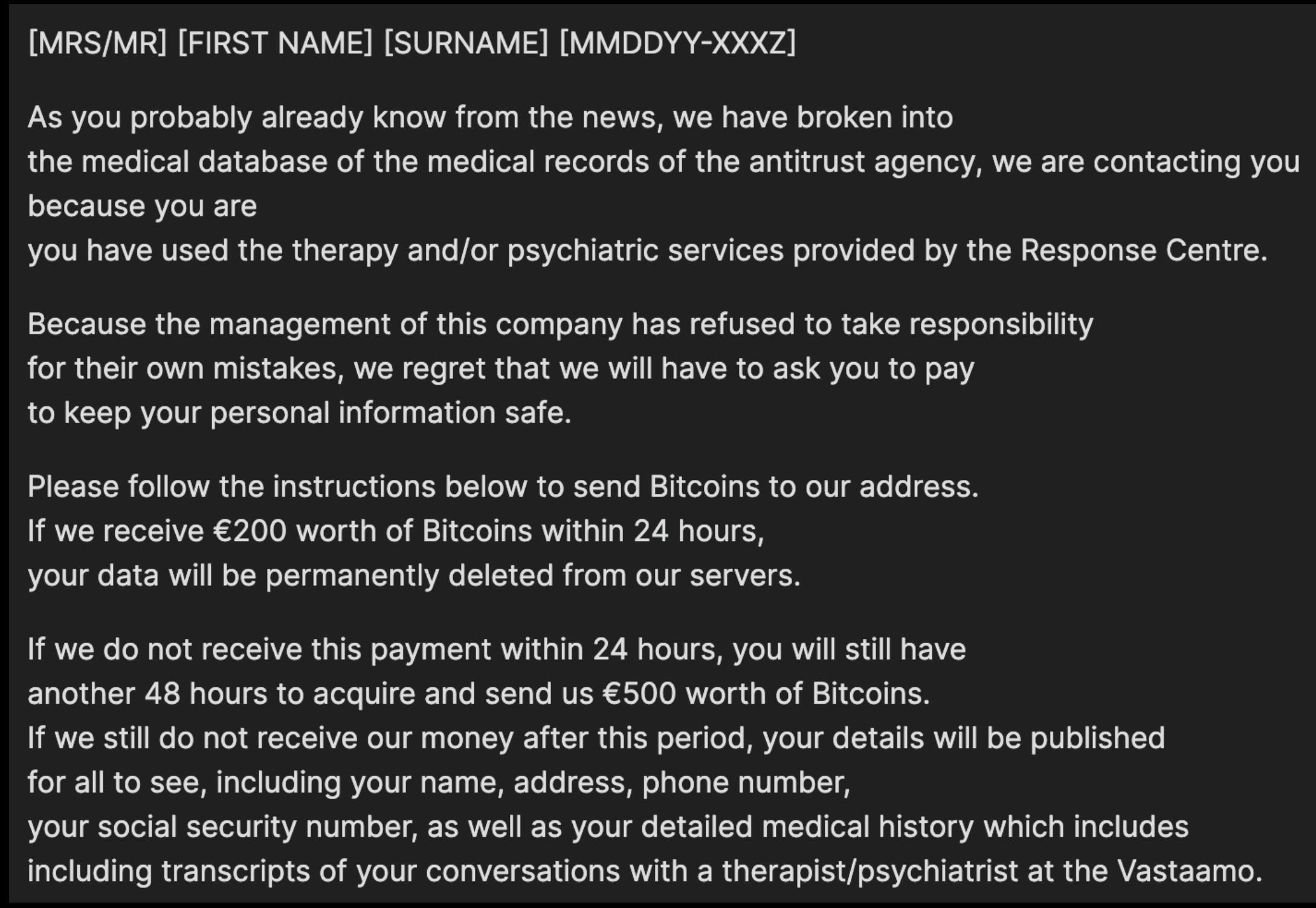
When Vastaamo declined to pay, ransom_man shifted to extorting individual patients. According to Finnish police, some 22,000 victims reported extortion attempts targeting them personally, targeted emails that threatened to publish their therapy notes online unless paid a 500 euro ransom.

The extortion message targeted Vastaamo patients.

On Oct. 23, 2020, ransom_man uploaded to the dark web a large compressed file that included all of the stolen Vastaamo patient records. But investigators found the file also contained an entire copy of ransom_man’s home folder, a likely mistake that exposed a number of clues that they say point to Kivimaki.

Ransom_man quickly deleted the large file (accompanied by a “whoops” notation), but not before it had been downloaded a number of times. The entire archive has since been made into a searchable website on the Dark Web.

Among those who grabbed a copy of the database was Atti Kurritu, a former criminal investigator at the Helsinki Police Department. In 2013, Kurritu worked on investigation involving Kivimaki’s use of the Zbot botnet, among other activities Kivimaki engaged in as a member of the hacker group Hack the Planet.

“It was a huge opsec [operational security] fail, because they had a lot of stuff in there — including the user’s private SSH folder, and a lot of known hosts that we could take a very good look at,” Kurritu told KrebsOnSecurity, declining to discuss specifics of the evidence investigators seized. “There were also other projects and databases.”

Kurritu said he and others who worked on the investigation into Kivimaki’s previous cybercrimes couldn’t shake the suspicion that the infamous cybercriminal was also behind the Vastaamo extortion.

“I couldn’t find anything that would link that data directly to one individual, but there were enough indicators in there that put the name in my head and I couldn’t shake it,” Kurritu said. “I told the police this back in 2020, and when they named him as the prime suspect I was not surprised.”

A handful of individually extorted victims paid a ransom, but when news broke that the entire Vastaamo database had been leaked online, the extortion threats no longer held their sting. However, someone would soon set up a site on the dark web where anyone could search this sensitive data.

Kivimaki stopped using his middle name Julius in favor of his given first name Aleksanteri when he moved abroad several years ago. A Twitter account by that name was verified by Kivimaki’s attorney as his, and through that account he denied being involved in the Vastaamo extortion.

“I believe [the Finnish authorities] brought this to the public in order to influence the decision-making of my old case from my teenage years, which was just processed in the Court of Appeal, both cases are investigated by the same persons,” Kivimaki tweeted on Oct. 28.

Kivimaki is appealing a 2020 district court decision sentencing him to “one year of conditional imprisonment for two counts of fraud committed as a young person, and one of gross fraud, interference with telecommunications as a young person, aggravated data breach as a young person and incitement to fraud as a young person,” according to the Finnish tabloid Ilta-Sanomat.

“Now in the Court of Appeal, the prosecutor is demanding a harsher punishment for the man, i.e. unconditional imprisonment,” reads the Ilta-Sanomat story. “The prosecutor notes in his complaint that the young man has been committing cybercrimes from Espoo since he was 15 years old, and the actions have had to be painstakingly investigated through international legal aid.”

As described in this Wired story last year, Vastaamo filled an urgent demand for psychological counseling, and it won accolades from Finnish health authorities and others for its services.

“Vastaamo was a private company, but it seemed to operate in the same spirit of tech-enabled ease and accessibility: You booked a therapist with a few clicks, wait times were tolerable, and Finland’s Social Insurance Institution reimbursed a big chunk of the session fee (provided you had a diagnosed mental disorder),” William Ralston wrote for Wired. “The company was run by Ville Tapio, a 39-year-old coder and entrepreneur with sharp eyebrows, slicked-back brown hair, and a heavy jawline. He’d cofounded the company with his parents. They pitched ­Vastaamo as a humble family-run enterprise committed to improving the mental health of all Finns.”

But for all the good it brought, the healthcare records management system that Ville Tapio built from scratch reportedly relied on little more than a MySQL database that was left dangerously exposed to the web for 16 months, guarded by nothing more than an administrator account with a blank password.

The Finnish daily Iltalehti said Tapio was relieved of his duties as CEO of Vastaamo in October 2020, and that in September, prosecutors brought charges against Tapio for a data protection offense in connection with Vastaamo’s information leak.

“According to Vastaamo, the data breach in Vastaamo’s customer databases took place in November 2018,” Iltalehti reported last month. “According to Vastaamo, Tapio concealed information about the data breach for more than a year and a half.”

from Krebs on Security https://ift.tt/7DXhBCE
via IFTTT

Cyberspace ‘a battleground’ as reports of cybercrime in Australia jump 13%

Fraud, online shopping and banking among most commonly reported crimes, but ransomware ‘most destructive’, ASD says

The number of reports of cybercrime in Australia had shot up by 13% to 76,000 in a year, or one every seven minutes, even before a series of high-profile privacy breaches hit the headlines.

These threats are imposing an increasingly heavy cost on businesses, with the average loss per cybercrime rising by 14% to $39,000 for a small business and $62,000 for a large business.

Sign up for our free morning and afternoon email newsletters from Guardian Australia for your daily news roundup

Continue reading…

from Data and computer security | The Guardian https://ift.tt/5bQlYIi
via IFTTT