When a lawyer uncovers a ruthless leader’s criminal network that sexually exploits and threatens young women, he embarks on a bloody pursuit of justice.
from New On Netflix USA https://ift.tt/c5wfX0G
via IFTTT

When a lawyer uncovers a ruthless leader’s criminal network that sexually exploits and threatens young women, he embarks on a bloody pursuit of justice.
from New On Netflix USA https://ift.tt/c5wfX0G
via IFTTT
When a lawyer uncovers a ruthless leader’s criminal network that sexually exploits and threatens young women, he embarks on a bloody pursuit of justice.
from New On Netflix USA https://ift.tt/B7pQ2XV
via IFTTT
When a lawyer uncovers a ruthless leader’s criminal network that sexually exploits and threatens young women, he embarks on a bloody pursuit of justice.
from New On Netflix USA https://ift.tt/n6v4G8K
via IFTTT
Three types of automated DevOps tools can increase the rate of deployment success, reduce errors, raise ROI, and improve data security.
from Dark Reading https://ift.tt/qj8LAvD
via IFTTT
Americas at risk of further COVID-19 wave as cases surge in other regions, PAHO Director warns
Cristina Mitchell
6 Apr 2022
from PAHO/WHO | Pan American Health Organization https://ift.tt/OXUwdET
via IFTTT
ESET researchers analyzed three malicious applications targeting customers of eight Malaysian banks
The post Fake e‑shops on the prowl for banking credentials using Android malware appeared first on WeLiveSecurity
from WeLiveSecurity https://ift.tt/r87aFKI
via IFTTT

(adsbygoogle = window.adsbygoogle || []).push({});
Se dio a conocer el lanzamiento de la nueva versión de la distribución de linux «Porteus Kiosk 5.4.0» en la cual se han realizado diversas actualizaciones entre las cuales se destaca la inclusión del Kernel 5.15.28, mejoras de soporte para la aceleración de decodificación por hardware y más.
La distribución se destaca por ser un contenedor básico que incluye solo el conjunto mínimo de componentes necesarios para ejecutar un navegador web (se admiten Firefox y Chrome). Eso se reduce en sus capacidades para evitar actividad no deseada en el sistema (por ejemplo, no se permite cambiar la configuración, la descarga/instalación de aplicaciones está bloqueada, solo el acceso a páginas seleccionadas).
(adsbygoogle = window.adsbygoogle || []).push({});
Además, se ofrecen compilaciones especializadas en la nube para un trabajo cómodo con aplicaciones web (Google Apps, Jolicloud, OwnCloud, Dropbox) y ThinClient para trabajar como un cliente ligero (Citrix, RDP, NX, VNC y SSH) y un servidor para la administración de redes de kioscos.
La configuración se realiza a través de un asistente especial, que se combina con el instalador y permite preparar una versión personalizada del kit de distribución para colocarlo en un USB Flash o disco duro. Por ejemplo, puede establecer una página predeterminada, definir una lista blanca de sitios permitidos, establecer una contraseña para el inicio de sesión de un invitado, definir un tiempo de espera de inactividad para cerrar la sesión, cambiar la imagen de fondo, personalizar la apariencia del navegador, agregar complementos adicionales, habilitar la red inalámbrica soporte, configurar el cambio de distribución del teclado, etc. d.
En el arranque, los componentes del sistema se verifican mediante sumas de comprobación y la imagen del sistema se monta en modo de solo lectura. Las actualizaciones se instalan automáticamente mediante el mecanismo de generación y reemplazo atómico de toda la imagen del sistema.
(adsbygoogle = window.adsbygoogle || []).push({});
En esta nueva versión de Porteus Kiosk 5.4.0 la base del sistema y las versiones del software que componen a este sistema, están sincronizadas con el repositorio de Gentoo a partir del 20 de marzo.
Dentro de los paquetes del sistema se destaca que se incluyen los paquetes actualizados del Kernel de Linux 5.15.28, Chrome 98.0.4758.102 y Firefox 91.7.1.
Por la parte de los cambios que se realizaron en esta nueva versión, se destaca que se habilitó la decodificación de video acelerada por hardware al mostrar videos y páginas web durante el bloqueo de pantalla.
Ademas de que tambien se destaca que se implementó la capacidad de generar dinámicamente una configuración externa que se puede cargar pasando el parámetro «kiosk_config=URL», por ejemplo, ‘kiosk_config=https://ift.tt/ZdYt3PT’.
(adsbygoogle = window.adsbygoogle || []).push({});
Por otra parte, se menciona que Firefox tiene el complemento OpenH264 habilitado de forma predeterminada, lo que puede ser útil cuando se transmite video usando WebRTC.
De los demás cambios que se destacan de esta nueva versión:
Si quieres conocer más al respecto sobre esta nueva versión lanzada, puedes consultar la lista de cambios y el sitio web del proyecto.
Para quienes estén interesados en poder probar esta distribución, podrán obtener la imagen del sistema desde su sitio web oficial en el cual en su sección de descargas se proporcionan los enlaces correspondientes (la imagen de arranque de la distribución ocupa 140 MB).
De igual forma podrán encontrar mayor información en el sitio sobre la configuración, instalación e incluso información para modificar la imagen del sistema, en su sección de documentación.
from Linux Adictos https://ift.tt/ia9DSOs
via IFTTT
Many organizations are already struggling to combat cybersecurity threats from ransomware purveyors and state-sponsored hacking groups, both of which tend to take days or weeks to pivot from an opportunistic malware infection to a full blown data breach. But few organizations have a playbook for responding to the kinds of virtual “smash and grab” attacks we’ve seen recently from LAPSUS$, a juvenile data extortion group whose short-lived, low-tech and remarkably effective tactics have put some of the world’s biggest corporations on edge.

Since surfacing in late 2021, LAPSUS$ has gained access to the networks or contractors for some of the world’s largest technology companies, including Microsoft, NVIDIA, Okta and Samsung. LAPSUS$ typically threatens to release sensitive data unless paid a ransom, but with most victims the hackers ended up publishing any information they stole (mainly computer source code).
Microsoft blogged about its attack at the hands of LAPSUS$, and about the group targeting its customers. It found LAPSUS$ used a variety of old-fashioned techniques that seldom show up in any corporate breach post-mortems, such as:
-targeting employees at their personal email addresses and phone numbers;
-offering to pay $20,000 a week to employees who give up remote access credentials;
-social engineering help desk and customer support employees at targeted companies;
-bribing/tricking employees at mobile phone stores to hijack a target’s phone number;
-intruding on their victims’ crisis communications calls post-breach.
If these tactics sound like something you might sooner expect from spooky, state-sponsored “Advanced Persistent Threat” or APT groups, consider that the core LAPSUS$ members are thought to range in age from 15 to 21. Also, LAPSUS$ operates on a shoestring budget and is anything but stealthy: According to Microsoft, LAPSUS$ doesn’t seem to cover its tracks or hide its activity. In fact, the group often announces its hacks on social media.

This unusual combination makes LAPSUS$ something of an aberration that is probably more aptly referred to as “Advanced Persistent Teenagers,” said one CXO at a large organization that recently had a run-in with LAPSUS$.
“There is a lot of speculation about how good they are, tactics et cetera, but I think it’s more than that,” said the CXO, who spoke about the incident on condition of anonymity. “They put together an approach that industry thought suboptimal and unlikely. So it’s their golden hour.”
LAPSUS$ seems to have conjured some worst-case scenarios in the minds of many security experts, who worry what will happen when more organized cybercriminal groups start adopting these techniques.
“LAPSUS$ has shown that with only $25,000, a group of teenagers could get into organizations with mature cybersecurity practices,” said Amit Yoran, CEO of security firm Tenable and a former federal cybersecurity czar, testifying last week before the House Homeland Security Committee. “With much deeper pockets, focus, and mission, targeting critical infrastructure. That should be a sobering, if not terrifying, call to action.”
My CXO source said LAPSUS$ succeeds because they simply refuse to give up, and just keep trying until someone lets them in.
“They would just keep jamming a few individuals to get [remote] access, read some onboarding documents, enroll a new 2FA [two-factor authentication method] and exfiltrate code or secrets, like a smash-and-grab,” the CXO said. “These guys were not leet, just damn persistent.”
The smash-and-grab attacks by LAPSUS$ obscure some of the group’s less public activities, which according to Microsoft include targeting individual user accounts at cryptocurrency exchanges to drain crypto holdings.
In some ways, the attacks from LAPSUS$ recall the July 2020 intrusion at Twitter, wherein the accounts for Apple, Bill Gates, Jeff Bezos, Kanye West, Uber and others were made to tweet messages inviting the world to participate in a cryptocurrency scam that promised to double any amount sent to specific wallets. The flash scam netted the perpetrators more than $100,000 in the ensuing hours.
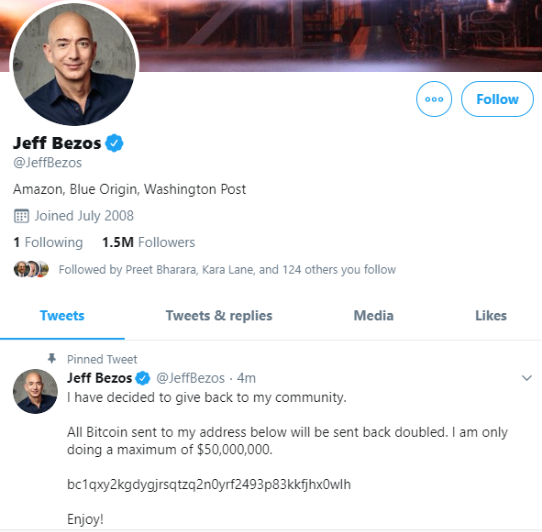
The group of teenagers who hacked Twitter hailed from a community that traded in hacked social media accounts. This community places a special premium on accounts with short “OG” usernames, and some of its most successful and notorious members were known to use all of the methods Microsoft attributed to LAPSUS$ in the service of hijacking prized OG accounts.
The Twitter hackers largely pulled it off by brute force, writes Wired on the July 15, 2020 hack.
“Someone was trying to phish employee credentials, and they were good at it,” Wired reported. “They were calling up consumer service and tech support personnel, instructing them to reset their passwords. Many employees passed the messages onto the security team and went back to business. But a few gullible ones—maybe four, maybe six, maybe eight—were more accommodating. They went to a dummy site controlled by the hackers and entered their credentials in a way that served up their usernames and passwords as well as multifactor authentication codes.”
Twitter revealed that a key tactic of the group was “phone spear phishing” (a.k.a. “voice phishing” a.k.a. “vishing”). This involved calling up Twitter staffers using false identities, and tricking them into giving up credentials for an internal company tool that let the hackers reset passwords and multi-factor authentication setups for targeted users.
In August 2020, KrebsOnSecurity warned that crooks were using voice phishing to target new hires at major companies, impersonating IT employees and asking them to update their VPN client or log in at a phishing website that mimicked their employer’s VPN login page.
Two days after that story ran, the FBI and the Cybersecurity & Infrastructure Security Agency (CISA) issued their own warning on vishing, saying the attackers typically compiled dossiers on employees at specific companies by mass-scraping public profiles on social media platforms, recruiter and marketing tools, publicly available background check services, and open-source research. The joint FBI/CISA alert continued:
“Actors first began using unattributed Voice over Internet Protocol (VoIP) numbers to call targeted employees on their personal cellphones, and later began incorporating spoofed numbers of other offices and employees in the victim company. The actors used social engineering techniques and, in some cases, posed as members of the victim company’s IT help desk, using their knowledge of the employee’s personally identifiable information—including name, position, duration at company, and home address—to gain the trust of the targeted employee.”
“The actors then convinced the targeted employee that a new VPN link would be sent and required their login, including any 2FA [2-factor authentication] or OTP [one-time passwords]. The actor logged the information provided by the employee and used it in real-time to gain access to corporate tools using the employee’s account.”
Like LAPSUS$, these vishers just kept up their social engineering attacks until they succeeded. As KrebsOnSecurity wrote about the vishers back in 2020:
“It matters little to the attackers if the first few social engineering attempts fail. Most targeted employees are working from home or can be reached on a mobile device. If at first the attackers don’t succeed, they simply try again with a different employee.”
“And with each passing attempt, the phishers can glean important details from employees about the target’s operations, such as company-specific lingo used to describe its various online assets, or its corporate hierarchy.”
“Thus, each unsuccessful attempt actually teaches the fraudsters how to refine their social engineering approach with the next mark within the targeted organization.”
The primary danger with smash-and-grab groups like LAPSUS$ is not just their persistence but their ability to extract the maximum amount of sensitive information from their victims using compromised user accounts that typically have a short lifespan. After all, in many attacks, the stolen credentials are useful only so long as the impersonated employee isn’t also trying to use them.
This dynamic puts tremendous pressure on cyber incident response teams, which suddenly are faced with insiders who are trying frantically to steal everything of perceived value within a short window of time. On top of that, LAPSUS$ has a habit of posting screenshots on social media touting its access to internal corporate tools. These images and claims quickly go viral and create a public relations nightmare for the victim organization.
Single sign-on provider Okta experienced this firsthand last month, when LAPSUS$ posted screenshots that appeared to show Okta’s Slack channels and another with a Cloudflare interface. Cloudflare responded by resetting its employees’ Okta credentials.
Okta quickly came under fire for posting only a brief statement that said the screenshots LAPSUS$ shared were connected to a January 2022 incident involving the compromise of “a third-party customer support engineer working for one of our subprocessors,” and that “the matter was investigated and contained by the subprocessor.”
This assurance apparently did not sit well with many Okta customers, especially after LAPSUS$ began posting statements that disputed some of Okta’s claims. On March 25, Okta issued an apology for its handling of the January breach at a third-party support provider, which ultimately affected hundreds of its customers.
My CXO source said the lesson from LAPSUS$ is that even short-lived intrusions can have a long-term negative impact on victim organizations — especially when victims are not immediately forthcoming about the details of a security incident that affects customers.
“It does force us to think about insider access differently,” the CXO told KrebsOnSecurity. “Nation states have typically wanted longer, more strategic access; ransomware groups want large lateral movement. LAPSUS$ doesn’t care, it’s more about, ‘What can these 2-3 accounts get me in the next 6 hours?’ We haven’t optimized to defend that.”
Any organizations wondering what they can do to harden their systems against attacks from groups like LAPSUS$ should consult Microsoft’s recent blog post on the group’s activities, tactics and tools. Microsoft’s guidance includes recommendations that can help prevent account takeovers or at least mitigate the impact from stolen employee credentials.
from Krebs on Security https://ift.tt/adkYFcU
via IFTTT

By BY DANIEL VICTOR
A report on direct messages sent to five women found that “abuse and harmful content is allowed to thrive” on Instagram. The platform’s parent company, Meta, said it disagreed with the report’s conclusions.
Published: April 6, 2022 at 12:41PM
from NYT Technology https://ift.tt/vKF6yxs
via IFTTT
ESET researchers analyzed three malicious applications targeting customers of eight Malaysian banks
The post Fake e‑shops on the prowl for banking credentials using Android malware appeared first on WeLiveSecurity
from WeLiveSecurity https://ift.tt/r87aFKI
via IFTTT
 Pacosite's Blog