A young woman haunted by her past joins a mysterious professor and his group of gifted students who investigate paranormal activity — and fight demons.
from New On Netflix USA https://ift.tt/6LADtOv
via IFTTT

A young woman haunted by her past joins a mysterious professor and his group of gifted students who investigate paranormal activity — and fight demons.
from New On Netflix USA https://ift.tt/6LADtOv
via IFTTT
This reality series follows a crew of famed, affluent stars as they work and play, flirt and feud in Johannesburg, South Africa.
from New On Netflix USA https://ift.tt/AsjNy7w
via IFTTT
 Hace un año, Fedora anunció que iba a cambiar el diseño de su logotipo. A veces, los cambios son difíciles de encajar, y más si esos cambios son en la interfaz de un software y terminan por dificultar dar con algunas opciones. Lo que hizo Fedora en su día fue más bien estilizar su logotipo, simplificarlo, dándole una imagen más moderna pero sin alejarse mucho de lo que ya tenían. Canonical ha decidido hacer lo mismo para Ubuntu, pero en este caso parece que se nota algo más, y lo hace por tres motivos.
(adsbygoogle = window.adsbygoogle || []).push({});
Lo más importante es el círculo de amigos, lo que es el logotipo en sí. En 2004 se creó un logotipo en el que los círculos representaban cabezas y las líneas curvas representaban brazos. Al diseño se le conoce como CoF, por las siglas en inglés de «Circle of Friends», y cuando se actualizó hace cerca de una década se mantuvo el diseño, cambiando sólo que pasaría a ser blanco sobre un círculo naranja. Ya en 2022, el logotipo cambiará de forma, lo que por sí mismo no es un cambio tan drástico, pero sí cuando lo sumamos todo.

(adsbygoogle = window.adsbygoogle || []).push({});
Si vamos ahora mismo a la página web oficial del proyecto, arriba a la izquierda, debajo del nombre de Canonical, vemos cómo sería todo junto, con nombre y logotipo. Aparece la palabra «ubuntu», en minúsculas, con el logotipo arriba a la derecha. El fondo es naranja, y texto y logotipo son blancos. Tal y como vemos en el siguiente vídeo, las cosas cambiarán mucho dentro de más o menos un mes.
El logotipo aparece en un rectángulo, más concretamente en su parte inferior, y la palabra «Ubuntu» aparece a su derecha. La inicial pasará a ser mayúscula, algo que en lo personal me resulta tan raro que incluso me he llegado a plantear referirme al sistema operativo en minúsculas porque así lo escribe Canonical en la actualidad. Si no lo he hecho es sencillamente porque, aunque sí escribimos otros como «elementary OS» o «postmarketOS», «ubuntu» no queda tan bien, probablemente porque no tiene ninguna otra mayúscula como los «OS» anteriores.
Canonical contrató al mismo diseñador que hizo el cambio de la versión 1 a la versión 2 del CoF, pero en esta ocasión creo que el cambio es mucho más grande. Ya veremos cómo aparece la página web oficial el próximo 21 de abril, cuando se lance Ubuntu 22.04 LTS Jammy Jellyfish, pero yo ya puedo decir que, como mínimo, esa «U» no debería estar así. Cuestión de gustos, pero los comentarios al vídeo de YouTube parecen ser unánimes: Canonical, no. Puedes hacerlo mejor, y estás a tiempo de dar marcha atrás.
(adsbygoogle = window.adsbygoogle || []).push({});
from Linux Adictos https://ift.tt/9eGSzwK
via IFTTT
This week, we talk about the limitations of using facial recognition technology to identify suspected criminals.
from Gear Latest https://ift.tt/QRJS4lM
via IFTTT
En Veracruz hoy la condición actual es Clear y una temperatura de 23C.

La máxima temperatura será de 27C y la mínima de 23C.
Durante el día la condición se pronostica como Partly Cloudy/Wind

Sunrise March 18, 2022 at 06:29AM
Sunset March 18, 2022 at 06:34PM
Viento con dirección South y velocidad de 11 Km/h
With a high of 81F and a low of 73F.
via IFTTT
The wireless, noise-canceling EAH-A800 boast a premium feel, great sound, and more battery than you’ll likely ever need. But they’re not perfect.
from Gear Latest https://ift.tt/RvLrfIu
via IFTTT
Paying a ransom might appear to be the best option, but it comes with its own costs.
from Dark Reading https://ift.tt/Lw6GFcE
via IFTTT
Researchers are tracking a number of open-source “protestware” projects on GitHub that have recently altered their code to display “Stand with Ukraine” messages for users, or basic facts about the carnage in Ukraine. The group also is tracking several code packages that were recently modified to erase files on computers that appear to be coming from Russian or Belarusian Internet addresses.

The upstart tracking effort is being crowdsourced via Telegram, but the output of the Russian research group is centralized in a Google Spreadsheet that is open to the public. Most of the GitHub code repositories tracked by this group include relatively harmless components that will either display a simple message in support of Ukraine, or show statistics about the war in Ukraine — such as casualty numbers — and links to more information on the Deep Web.
For example, the popular library ES5-ext hadn’t updated its code in nearly two years. But on March 7, the code project added a component “postinstall.js,” which checks to see if the user’s computer is tied to a Russian Internet address. If so, the code broadcasts a “Call for peace:”
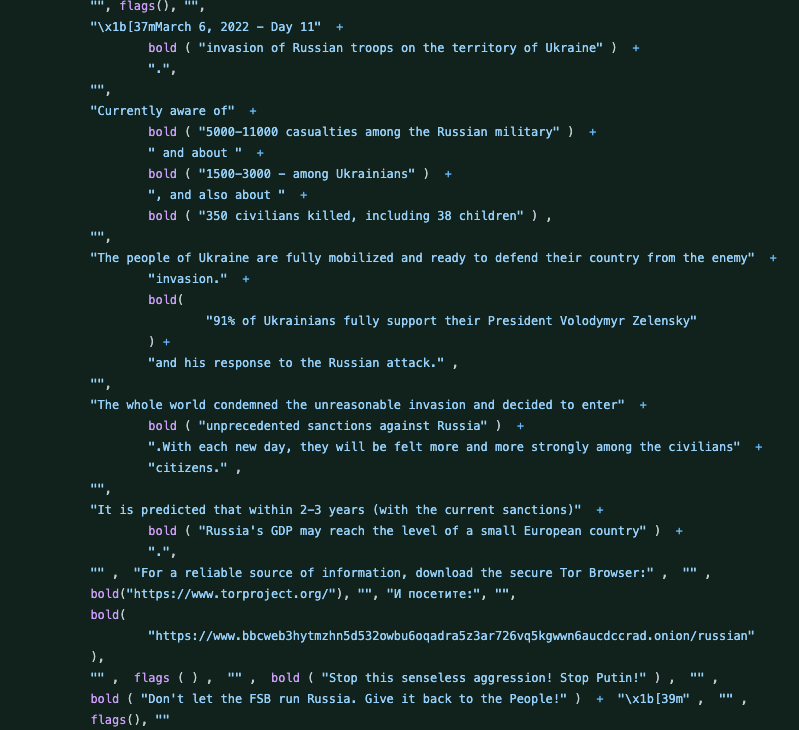
A message that appears for Russian users of the popular es5-ext code library on GitHub. The message has been Google-Translated from Russian to English.
A more concerning example can be found at the GitHub page for “vue-cli,” a popular Javascript framework for building web-based user interfaces. On March 15, users discovered a new component had been added that was designed to wipe all files from any systems visiting from a Russian or Belarusian Internet address (the malicious code has since been removed):
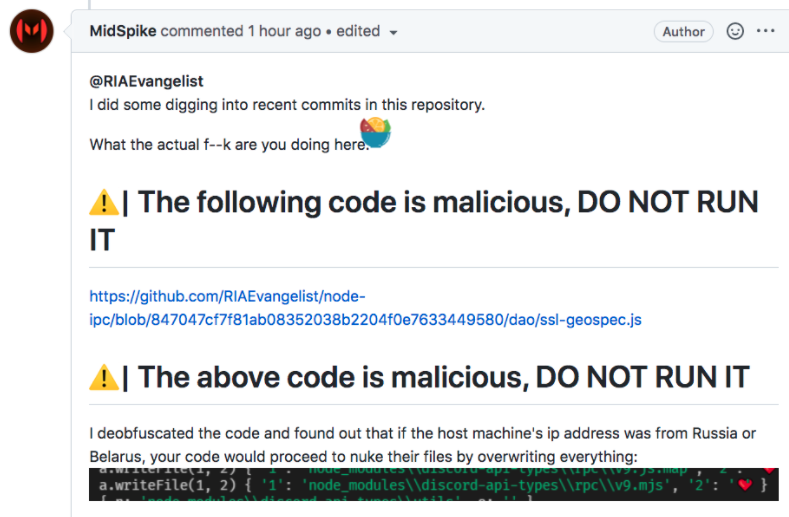
Readers complaining that an update to the popular Vue-Cli package sought to wipe files if the user was coming from a Russian IP address.
“Man, I love politics in my APIs,” GitHub user “MSchleckser” commented wryly on Mar. 15.
The crowdsourced effort also blacklisted a code library called “PeaceNotWar” maintained by GitHub user RIAEvangelist.
“This code serves as a non-destructive example of why controlling your node modules is important,” RIAEvangelist wrote. “It also serves as a non-violent protest against Russia’s aggression that threatens the world right now. This module will add a message of peace on your users’ desktops, and it will only do it if it does not already exist just to be polite. To include this module in your code, just run npm i peacenotwar in your code’s directory or module root.”
Alex Holden is a native Ukrainian who runs the Minneapolis-based cyber intelligence firm Hold Security. Holden said the real trouble starts when protestware is included in code packages that get automatically fetched by a myriad of third-party software products. Holden said some of the code projects tracked by the Russian research group are maintained by Ukrainian software developers.
“Ukrainian and sadly non-Ukrainian developers are modifying their public software to trigger malware or pro-Ukraine ads when deployed on Russian computers,” Holden said. “And we see this effort, which is the Russians trying to defend against that.”
Commenting on the malicious code added to the “Vue-cli” application, GitHub user “nm17” said a continued expansion of protestware would erode public trust in open-source software.
“The Pandora’s box is now opened, and from this point on, people who use opensource will experience xenophobia more than ever before, EVERYONE included,” NM17 wrote. “The trust factor of open source, which was based on good will of the developers is now practically gone, and now, more and more people are realizing that one day, their library/application can possibly be exploited to do/say whatever some random dev on the internet thought ‘was the right thing they to do.’ Not a single good came out of this ‘protest.’”
from Krebs on Security https://ift.tt/CWMBgnT
via IFTTT
ThreatMapper 1.3.0 features secret scanning and the ability to enumerate a software bill of materials (SBOM) at runtime to help secure serverless, Kubernetes, container and multi-cloud environments.
from Dark Reading https://ift.tt/P2Fd7eT
via IFTTT
Telemetry from industrial systems security firm Dragos has spotted the malware command-and-control servers communicating with several automotive manufacturer systems.
from Dark Reading https://ift.tt/UhCuT2y
via IFTTT
 Pacosite's Blog