Proven best practices create integrity and trustworthiness.
from Dark Reading https://ift.tt/Agc6Pwo
via IFTTT

Proven best practices create integrity and trustworthiness.
from Dark Reading https://ift.tt/Agc6Pwo
via IFTTT
Pavel Vrublevsky, founder of the Russian payment technology firm ChronoPay and the antagonist in my 2014 book “Spam Nation,” was arrested in Moscow this month and charged with fraud. Russian authorities allege Vrublevsky operated several fraudulent SMS-based payment schemes, and facilitated money laundering for Hydra, the largest Russian darknet market. But according to information obtained by KrebsOnSecurity, it is equally likely Vrublevsky was arrested thanks to his propensity for carefully documenting the links between Russia’s state security services and the cybercriminal underground.

An undated photo of Vrublevsky at his ChronoPay office in Moscow.
ChronoPay specializes in providing access to the global credit card networks for “high risk” merchants — businesses involved in selling services online that tend to generate an unusually large number of chargebacks and reports of fraud, and hence have a higher risk of failure.
When I first began writing about Vrublevsky in 2009 as a reporter for The Washington Post, ChronoPay and its sister firm Red & Partners (RNP) were earning millions setting up payment infrastructure for fake antivirus peddlers and spammers pimping male enhancement drugs.
Using the hacker alias “RedEye,” the ChronoPay CEO oversaw a burgeoning pharmacy spam affiliate program called Rx-Promotion, which paid some of Russia’s most talented spammers and virus writers to bombard the world with junk email promoting Rx-Promotion’s pill shops. RedEye also was the administrator of Crutop, a Russian language forum and affiliate program that catered to thousands of adult webmasters.
In 2013, Vrublevsky was sentenced to 2.5 years in a Russian penal colony for convincing one of his top affiliates to launch a distributed denial-of-service (DDoS) attack against a competitor that shut down the ticketing system for the state-owned Aeroflot airline.
Following his release from jail, Vrublevsky began working on a new digital payments platform based in Hong Kong called HPay Ltd (a.k.a. Hong Kong Processing Corporation). HPay appears to have had a great number of clients that were running schemes which bamboozled people with fake lotteries and prize contests.
According to Russian prosecutors, the scam went like this: Consumers would receive an SMS with links to sites that falsely claimed a number of well-known companies were sponsoring drawings and lotteries for people who enrolled or agreed to answer surveys. All who responded were told they were winners, but also that they had to pay a commission to pick up the prize. That scheme allegedly stole 500 million rubles (~ USD $4.5 million) from over 100,000 consumers.
There are scant public records that show a connection between ChronoPay and HPay, apart from the fact that the latter’s website — hpay[.]io — was originally hosted on the same server (185.111.218.63) along with a handful of other domains, including Vrublevsky’s personal website rnp[.]com.
But then earlier this month, KrebsOnSecurity received a large amount of information that was stolen from ChronoPay recently when hackers managed to compromise the company’s Confluence server. Confluence is a web-based corporate wiki platform, and ChronoPay used their Confluence installation to document in exquisite detail how it creatively distributes the risk associated with high-risk processing by routing transactions through a myriad of shell companies and third-party processors.
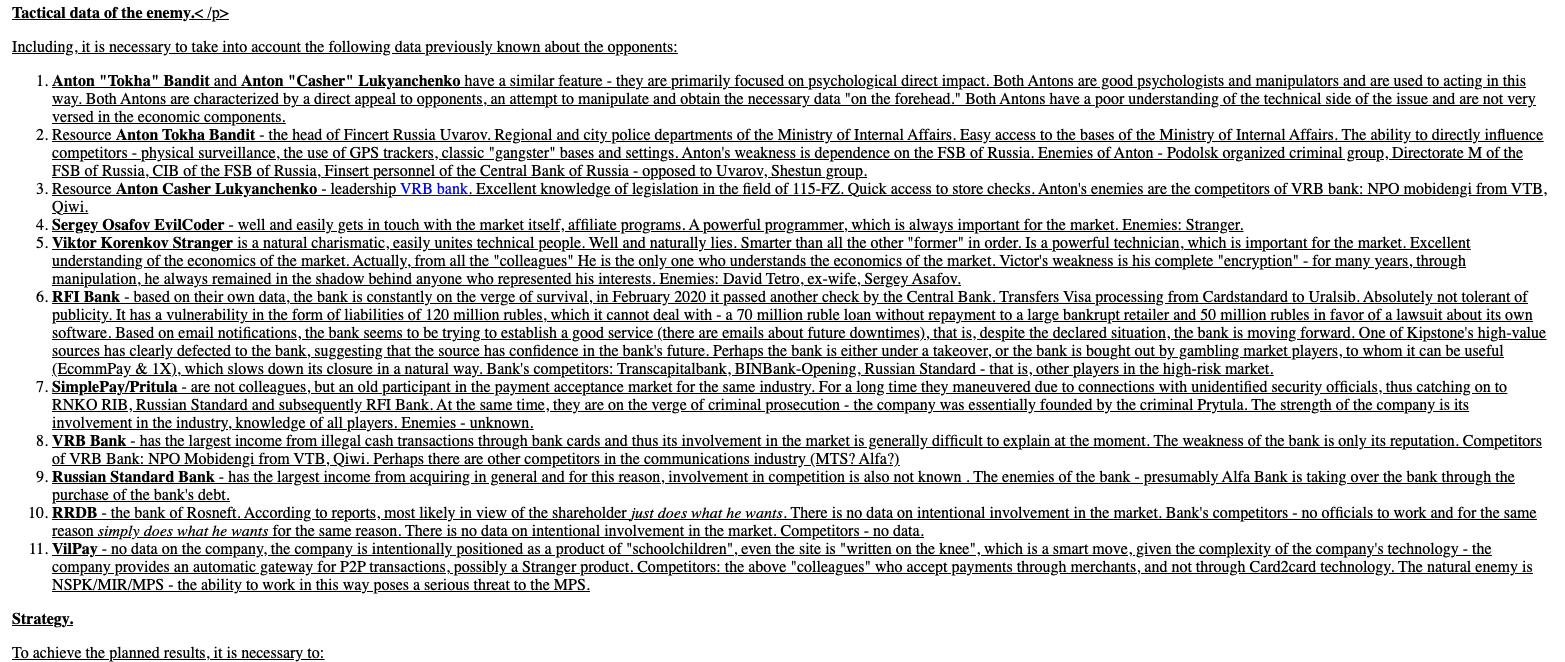
A Google-translated snippet of the hacked ChronoPay Confluence installation. Click to enlarge.
Incredibly, Vrublevsky himself appears to have used ChronoPay’s Confluence wiki to document his entire 20+ years of personal and professional history in the high-risk payments space, including the company’s most recent forays with HPay. The latest document in the hacked archive is dated April 2021.
These diary entries, interspersed between highly technical how-tos, are all written in Russian and in the third person. But they are unmistakably Vrublevsky’s words: Some of the elaborate stories in the wiki were identical to theories that Vrublevsky himself espoused to me throughout hundreds of hours of phone interviews. Also, in some of the entries the narrator switches from “he” to “I” when describing the actions of Vrublevsky.
Vrublevsky’s memoire/wiki invokes the nicknames and real names of Russian hackers who worked with the protection of corrupt officials in the Russian Federal Security Service (FSB), the successor agency to the Soviet KGB. In several diary entries, Vrublevsky writes about various cybercriminals and Russian law enforcement officials involved in processing credit card payments tied to online gambling sites.
Russian banks are prohibited from processing payments for online gambling, and as a result many online gaming sites catering to Russian speakers have chosen to process credit card payments through Ukrainian financial institutions.
That’s according to Vladislav “BadB” Horohorin, the convicted cybercriminal who shared the ChronoPay Confluence data with KrebsOnSecurity. In February 2017, Horohorin was released after serving four years in a U.S. prison for his role in the 2009 theft of more than $9 million from RBS Worldpay.
Horohorin said Vrublevsky has been using his knowledge of the card processing networks to extort people in the online gambling industry who may run afoul of Russian laws.
“Russia has strict regulations against processing for the gambling business,” Horohorin said. “While Russian banks can’t do it, Ukrainian ones can, so we have Ukrainian banks processing gambling and casinos, which mostly Russian gamblers use. What Pavel does is he blackmails those Ukrainian banks using his connections and knowledge. Some pay, some don’t. But some people are not very tolerant of that kind of abuse.”
A native of Donetsk, Ukraine, Horohorin told KrebsOnSecurity he hacked and shared the ChronoPay Confluence installation because Vrublevsky had threatened a family member. Horohorin believes Vrublevsky secretly operated the “bad bank” channel on Telegram, which calls attention to online gambling operations that are violating Visa and MasterCard regulations (violations that can bring the violator hundreds of thousands of dollars in fines).
“Pavel scrupulously wrote his diary for a long time, and there is a lot of information on the people he knows,” Horohorin told KrebsOnSecurity. “My understanding is he wrote this in order to blackmail people later. There is a lot of interesting stuff, a lot of names and a lot of very intimate info about Russian card processing market, as well as Pavel’s own escapades.”
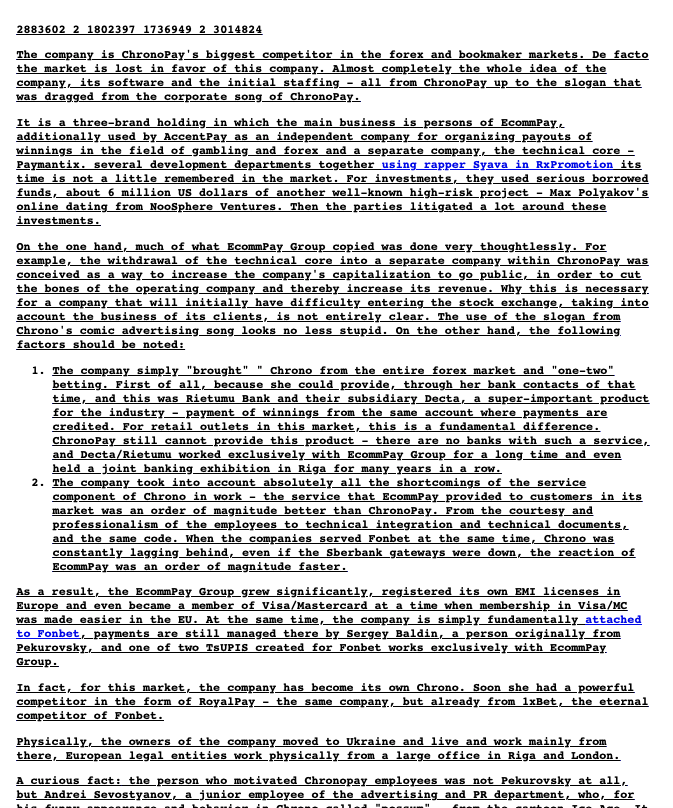
ChronoPay’s hacked Confluence server contains many diary entries about major players in the Russian online gambling and bookmaking industries.
Among the escapades recounted in the ChronoPay founder’s diaries are multiple stories involving the self-proclaimed “King of Fraud!” Aleksandr “Nastra” Zhukov, a Russian national who ran an advertising fraud network dubbed “Methbot” that stole $7 million from publishers through bots made to look like humans watching videos online.
The journal explains that Zhukov lived with a ChronoPay employee and had a great deal of interaction with ChronoPay’s high-risk department, so much so that Zhukov at one point gave Vrublevsky a $100,000 jeweled watch as a gift. Zukhov was arrested in Bulgaria in 2018 and extradited to the United States. Following a jury trial in New York that ended last year, Zhukov was sentenced to 10 years in prison.
According to the Russian news outlet Kommersant, Vrublevsky and company operated “Inferno Pay,” a payments portal that worked with Hydra, the largest Russian darknet market for illicit goods, including drug trafficking, malware, and counterfeit money and documents.

Inferno Pay, a cryptocurrency and payment API allegedly operated by the ChronoPay CEO.
“The services of Inferno Pay, whose commission came to 30% of the transaction, were actively used by online casinos,” Kommersant wrote on Mar. 12.
The drama surrounding Vrublevsky’s most recent arrest is reminiscent of events leading up to his imprisonment nearly a decade ago, when several years’ worth of ChronoPay internal emails were leaked online.
Kommersant said Russian authorities also searched the dwelling of Dmitry Artimovich, a former ChronoPay director who along with his brother Igor was responsible for running the Festi botnet, the same spam botnet that was used for years to pump out junk emails promoting Vrublevsky’s pharmacy affiliate websites. Festi also was the botnet used in the DDoS attack that sent Vrubelvsky to prison for two years in 2013.
Artimovich says he had a falling out with Vrublevsky roughly five years ago, and he’s been suing the company ever since. In a message to KrebsOnSecurity, Artimovich said while Vrublevsky was involved in a lot of shady activities, he doubts Vrublevksy’s arrest was really about SMS payment scams as the government claims.
“I do not think that it was a reason for his arrest,” Artimovich said. “Our law enforcement usually don’t give a shit about sites like this. And I don’t think that Vrublevsky made much money there. I believe he angered some high-ranking person. Because the scale of the case is much larger than Aeroflot. Police made search of 22 people. Illegal seizure of money, computers.”

The Hydra darknet market. Image: bitcoin.com
from Krebs on Security https://ift.tt/T4wA1RQ
via IFTTT
Advancements to the most deployed ZTNA solution strengthen the Zscaler Zero Trust Exchange with new private app protection, deception, and privileged remote access capabilities.
from Dark Reading https://ift.tt/8EznyYp
via IFTTT

By BY SHIRA OVIDE
Recreating the human face could give virtual interactions the sense of intimacy they’re missing.
Published: March 22, 2022 at 10:19AM
from NYT Technology https://ift.tt/DxJvl7q
via IFTTT

(adsbygoogle = window.adsbygoogle || []).push({});
En las próximas semanas habrá dos lanzamientos importantes en el mundo Linux: Fedora 36 y Ubuntu 22.04. Acercándonos a estas fechas, cada vez se irán publicando más noticias sobre estos sistemas operativos, como que Jammy Jellyfish usará GNOME 42 o el nuevo logotipo que usará el sistema de Canonical a partir de abril. Hoy tenemos que volver a hablar del sistema cuyo logo es un círculo de amigos, más concretamente para las instalaciones en equipos que usen hardware de NVIDIA.
En la actualidad, Ubuntu ya usa Wayland por defecto, pero no si se está usando el driver propietario de NVIDIA. Algo pasa con este hardware y Linux, ya que en algunos sistemas o escritorios es fácil leer comentarios de usuarios asegurando que les ha dejado de funcionar y otro software como WayDroid no funciona con tarjetas NVIDIA. Por lo menos en lo que respecta a Ubuntu, parece que las cosas están mejorando, ya que ahora mismo ya funciona por defecto en Wayland en equipos con su driver propietario.
(adsbygoogle = window.adsbygoogle || []).push({});
Canonical decidió pasarse a Wayland con el lanzamiento de Hirsute Hippo (21.04), pero sólo para equipos con tarjetas AMD Radeon o Intel. Si se quería usar el driver propietario de NVIDIA, el sistema iniciaba en X.Org. NVIDIA ha estado trabajando para corregir sus problemas con Wayland, y ha mejorado el soporte para GBM, entre otras cosas.
Hay que dejar claro que sólo funcionará en la serie NVIDIA 510 o posterior; no funcionará si se usa el driver propietario en una versión anterior. Es esa versión ya que se lleva mucho mejor con Wayland y Mutter, por lo que ya se activará por defecto cuando Ubuntu 22.04 sea lanzado el mes que viene. De hecho, ya lo está en la Daily Build.
Ubuntu 22.04 llegará el próximo 21 de abril con novedades como esta u otras como la posibilidad de cambiar el color de acento y el nuevo logotipo.
(adsbygoogle = window.adsbygoogle || []).push({});
from Linux Adictos https://ift.tt/f28hd13
via IFTTT

Do you struggle to nod off or stay asleep through the night? These WIRED-tested tools can help.
from Gear Latest https://ift.tt/Nr8spWo
via IFTTT
If every application, device, and bot need access and authentication at some point, the need for managing and controlling the confidential data that allows those functions gets staggeringly large.
from Dark Reading https://ift.tt/AB1Syg3
via IFTTT
[New Episodes] Male celebs play make-believe as high schoolers, welcoming star transfer students every week and engaging in battles of witty humor and slapstick.
from New On Netflix USA https://ift.tt/LRKmaEp
via IFTTT
[Streaming Again] Matters of the heart introduce chaos into the once-idyllic bachelor existence of three young men who share an apartment.
from New On Netflix USA https://ift.tt/J6IWsF3
via IFTTT
 Pacosite's Blog