Yesterday’s piece told the tale of Hieu Minh Ngo, a hacker the U.S. Secret Service described as someone who caused more material financial harm to more Americans than any other convicted cybercriminal. Ngo was recently deported back to his home country after serving more than seven years in prison for running multiple identity theft services. He now says he wants to use his experience to convince other cybercriminals to use their skills for good. Here’s a look at what happened after he got busted.

Hieu Minh Ngo, 29, in a recent photo.
Part I of this series ended with Ngo in handcuffs after disembarking a flight from his native Vietnam to Guam, where he believed he was going to meet another cybercriminal who’d promised to hook him up with the mother of all consumer data caches.
Ngo had been making more than $125,000 a month reselling ill-gotten access to some of the biggest data brokers on the planet. But the Secret Service discovered his various accounts at these data brokers and had them shut down one by one. Ngo became obsessed with restarting his business and maintaining his previous income. By this time, his ID theft services had earned roughly USD $3 million.
As this was going on, Secret Service agents used an intermediary to trick Ngo into thinking he’d trodden on the turf of another cybercriminal. From Part I:
The Secret Service contacted Ngo through an intermediary in the United Kingdom — a known, convicted cybercriminal who agreed to play along. The U.K.-based collaborator told Ngo he had personally shut down Ngo’s access to Experian because he had been there first and Ngo was interfering with his business.
“The U.K. guy told Ngo, ‘Hey, you’re treading on my turf, and I decided to lock you out. But as long as you’re paying a vig through me, your access won’t go away’,” the Secret Service’s Matt O’Neill recalled.
After several months of conversing with his apparent U.K.-based tormentor, Ngo agreed to meet him in Guam to finalize the deal. But immediately after stepping off of the plane in Guam, he was apprehended by Secret Service agents.
“One of the names of his identity theft services was findget[.]me,” O’Neill said. “We took that seriously, and we did like he asked.”
In an interview with KrebsOnSecurity, Ngo said he spent about two months in a Guam jail awaiting transfer to the United States. A month passed before he was allowed a 10 minute phone call to his family and explain what he’d gotten himself into.
“This was a very tough time,” Ngo said. “They were so sad and they were crying a lot.”
First stop on his prosecution tour was New Jersey, where he ultimately pleaded guilty to hacking into MicroBilt, the first of several data brokers whose consumer databases would power different iterations of his identity theft service over the years.
Next came New Hampshire, where another guilty plea forced him to testify in three different trials against identity thieves who had used his services for years. Among them was Lance Ealy, a serial ID thief from Dayton, Ohio who used Ngo’s service to purchase more than 350 “fullz” — a term used to describe a package of everything one would need to steal someone’s identity, including their Social Security number, mother’s maiden name, birth date, address, phone number, email address, bank account information and passwords.
Ealy used Ngo’s service primarily to conduct tax refund fraud with the U.S. Internal Revenue Service (IRS), claiming huge refunds in the names of ID theft victims who first learned of the fraud when they went to file their taxes and found someone else had beat them to it.
Ngo’s cooperation with the government ultimately led to 20 arrests, with a dozen of those defendants lured into the open by O’Neill and other Secret Service agents posing as Ngo.
The Secret Service had difficulty pinning down the exact amount of financial damage inflicted by Ngo’s various ID theft services over the years, primarily because those services only kept records of what customers searched for — not which records they purchased.
But based on the records they did have, the government estimated that Ngo’s service enabled approximately $1.1 billion in new account fraud at banks and retailers throughout the United States, and roughly $64 million in tax refund fraud with the states and the IRS.
“We interviewed a number of Ngo’s customers, who were pretty open about why they were using his services,” O’Neill said. “Many of them told us the same thing: Buying identities was so much better for them than stolen payment card data, because card data could be used once or twice before it was no good to them anymore. But identities could be used over and over again for years.”
O’Neill said he still marvels at the fact that Ngo’s name is practically unknown when compared to the world’s most infamous credit card thieves, some of whom were responsible for stealing hundreds of millions of cards from big box retail merchants.
“I don’t know of anyone who has come close to causing more material harm than Ngo did to the average American,” O’Neill said. “But most people have probably never heard of him.”
Ngo said he wasn’t surprised that his services were responsible for so much financial damage. But he was utterly unprepared to hear about the human toll. Throughout the court proceedings, Ngo sat through story after dreadful story of how his work had ruined the financial lives of people harmed by his services.
“When I was running the service, I didn’t really care because I didn’t know my customers and I didn’t know much about what they were doing with it,” Ngo said. “But during my case, the federal court received like 13,000 letters from victims who complained they lost their houses, jobs, or could no longer afford to buy a home or maintain their financial life because of me. That made me feel really bad, and I realized I’d been a terrible person.”
Even as he bounced from one federal detention facility to the next, Ngo always seemed to encounter ID theft victims wherever he went, including prison guards, healthcare workers and counselors.
“When I was in jail at Beaumont, Texas I talked to one of the correctional officers there who shared with me a story about her friend who lost her identity and then lost everything after that,” Ngo recalled. “Her whole life fell apart. I don’t know if that lady was one of my victims, but that story made me feel sick. I know now that was I was doing was just evil.”
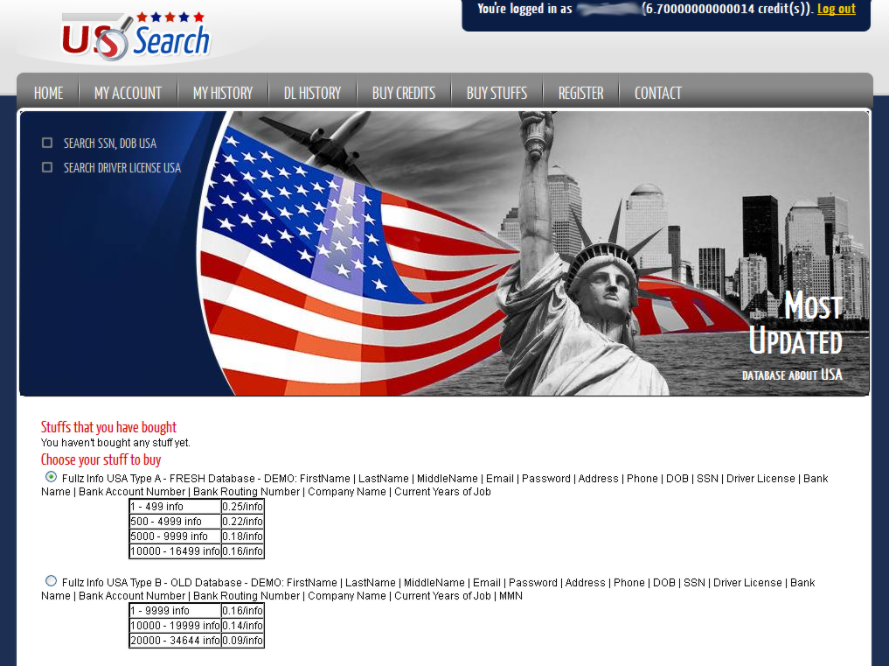
Ngo’s former ID theft service usearching[.]info.
The Vietnamese hacker was released from prison a few months ago, and is now finishing up a mandatory three-week COVID-19 quarantine in a government-run facility near Ho Chi Minh city. In the final months of his detention, Ngo started reading everything he could get his hands on about computer and Internet security, and even authored a lengthy guide written for the average Internet user with advice about how to avoid getting hacked or becoming the victim of identity theft.
Ngo said while he would like to one day get a job working in some cybersecurity role, he’s in no hurry to do so. He’s already had at least one job offer in Vietnam, but he turned it down. He says he’s not ready to work yet, but is looking forward to spending time with his family — and specifically with his dad, who was recently diagnosed with Stage 4 cancer.
Longer term, Ngo says, he wants to mentor young people and help guide them on the right path, and away from cybercrime. He’s been brutally honest about his crimes and the destruction he’s caused. His LinkedIn profile states up front that he’s a convicted cybercriminal.
“I hope my work can help to change the minds of somebody, and if at least one person can change and turn to do good, I’m happy,” Ngo said. “It’s time for me to do something right, to give back to the world, because I know I can do something like this.”
Still, the recidivism rate among cybercriminals tends to be extremely high, and it would be easy for him to slip back into his old ways. After all, few people know as well as he does how best to exploit access to identity data.
O’Neill said he believes Ngo probably will keep his nose clean. But he added that Ngo’s service if it existed today probably would be even more successful and lucrative given the sheer number of scammers involved in using stolen identity data to defraud states and the federal government out of pandemic assistance loans and unemployment insurance benefits.
“It doesn’t appear he’s looking to get back into that life of crime,” O’Neill said. “But I firmly believe the people doing fraudulent small business loans and unemployment claims cut their teeth on his website. He was definitely the new coin of the realm.”
Ngo maintains he has zero interest in doing anything that might send him back to prison.
“Prison is a difficult place, but it gave me time to think about my life and my choices,” he said. “I am committing myself to do good and be better every day. I now know that money is just a part of life. It’s not everything and it can’t bring you true happiness. I hope those cybercriminals out there can learn from my experience. I hope they stop what they are doing and instead use their skills to help make the world better.”
from Krebs on Security https://ift.tt/2ExH2Pt
via IFTTT


 Pacosite's Blog