CodeMeter 6.60 – ‘CodeMeter.exe’ Unquoted Service Path
from Exploit-DB.com RSS Feed https://ift.tt/3fBsFWO
via IFTTT

CodeMeter 6.60 – ‘CodeMeter.exe’ Unquoted Service Path
from Exploit-DB.com RSS Feed https://ift.tt/3fBsFWO
via IFTTT
Un estudio de 2016 dictaminó que de más de 2,000 nombres, un quinto arrojaba errores
from Tendencias – Digital Trends Español https://ift.tt/2DCHewi
via IFTTT
A group of thieves thought to be responsible for collecting millions in fraudulent small business loans and unemployment insurance benefits from COVID-19 economic relief efforts gathered personal data on people and businesses they were impersonating by leveraging several compromised accounts at a little-known U.S. consumer data broker, KrebsOnSecurity has learned.

In June, KrebsOnSecurity was contacted by a cybersecurity researcher who discovered that a group of scammers was sharing highly detailed personal and financial records on Americans via a free web-based email service that allows anyone who knows an account’s username to view all email sent to that account — without the need of a password.
The source, who asked not to be identified in this story, said he’s been monitoring the group’s communications for several weeks and sharing the information with state and federal authorities in a bid to disrupt their fraudulent activity.
The source said the group appears to consist of several hundred individuals who collectively have stolen tens of millions of dollars from U.S. state and federal treasuries via phony loan applications with the U.S. Small Business Administration (SBA) and through fraudulent unemployment insurance claims made against several states.
KrebsOnSecurity reviewed dozens of emails the fraud group exchanged, and noticed that a great many consumer records they shared carried a notation indicating they were cut and pasted from the output of queries made at Interactive Data LLC, a Florida-based data analytics company.
Interactive Data, also known as IDIdata.com, markets access to a “massive data repository” on U.S. consumers to a range of clients, including law enforcement officials, debt recovery professionals, and anti-fraud and compliance personnel at a variety of organizations.
The consumer dossiers obtained from IDI and shared by the fraudsters include a staggering amount of sensitive data, including:
-full Social Security number and date of birth;
-current and all known previous physical addresses;
-all known current and past mobile and home phone numbers;
-the names of any relatives and known associates;
-all known associated email addresses
-IP addresses and dates tied to the consumer’s online activities;
-vehicle registration, and property ownership information
-available lines of credit and amounts, and dates they were opened
-bankruptcies, liens, judgments, foreclosures and business affiliations
Reached via phone, IDI Holdings CEO Derek Dubner acknowledged that a review of the consumer records sampled from the fraud group’s shared communications indicates “a handful” of authorized IDI customer accounts had been compromised.
“We identified a handful of legitimate businesses who are customers that may have experienced a breach,” Dubner said.
Dubner said all customers are required to use multi-factor authentication, and that everyone applying for access to its services undergoes a rigorous vetting process.
“We absolutely credential businesses and have several ways do that and exceed the gold standard, which is following some of the credit bureau guidelines,” he said. “We validate the identity of those applying [for access], check with the applicant’s state licensor and individual licenses.”
Citing an ongoing law enforcement investigation into the matter, Dubner declined to say if the company knew for how long the handful of customer accounts were compromised, or how many consumer records were looked up via those stolen accounts.
“We are communicating with law enforcement about it,” he said. “There isn’t much more I can share because we don’t want to impede the investigation.”
The source told KrebsOnSecurity he’s identified more than 2,000 people whose SSNs, DoBs and other data were used by the fraud gang to file for unemployment insurance benefits and SBA loans, and that a single payday can land the thieves $20,000 or more. In addition, he said, it seems clear that the fraudsters are recycling stolen identities to file phony unemployment insurance claims in multiple states.
Hacked or ill-gotten accounts at consumer data brokers have fueled ID theft and identity theft services of various sorts for years. In 2013, KrebsOnSecurity broke the news that the U.S. Secret Service had arrested a 24-year-old man named Hieu Minh Ngo for running an identity theft service out of his home in Vietnam.
Ngo’s service, variously named superget[.]info and findget[.]me, gave customers access to personal and financial data on more than 200 million Americans. He gained that access by posing as a private investigator to a data broker subsidiary acquired by Experian, one of the three major credit bureaus in the United States.
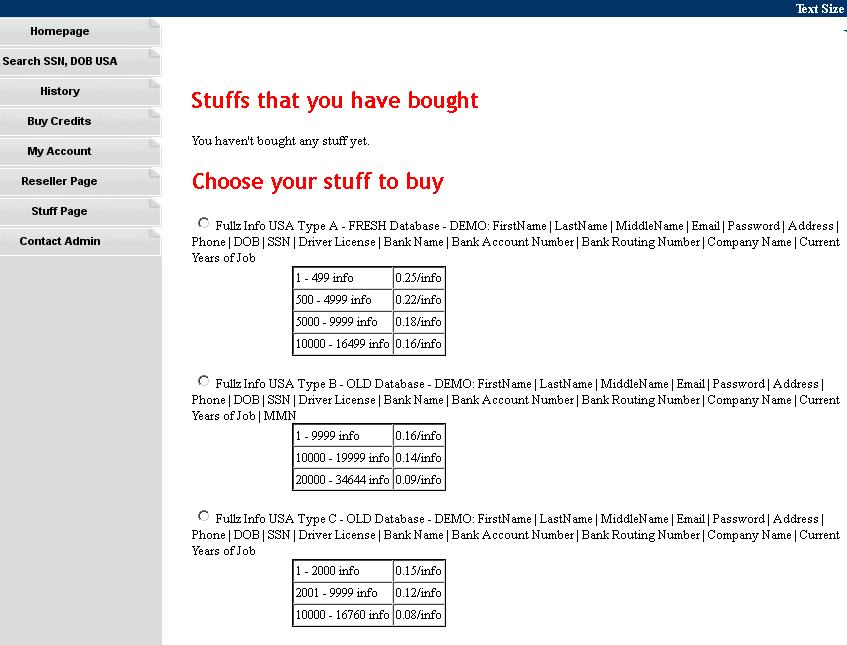
Ngo’s ID theft service superget.info
Experian was hauled before Congress to account for the lapse, and assured lawmakers there was no evidence that consumers had been harmed by Ngo’s access. But as follow-up reporting showed, Ngo’s service was frequented by ID thieves who specialized in filing fraudulent tax refund requests with the Internal Revenue Service, and was relied upon heavily by an identity theft ring operating in the New York-New Jersey region.
Also in 2013, KrebsOnSecurity broke the news that ssndob[.]ms, then a major identity theft service in the cybercrime underground, had infiltrated computers at some of America’s large consumer and business data aggregators, including LexisNexis Inc., Dun & Bradstreet, and Kroll Background America Inc.
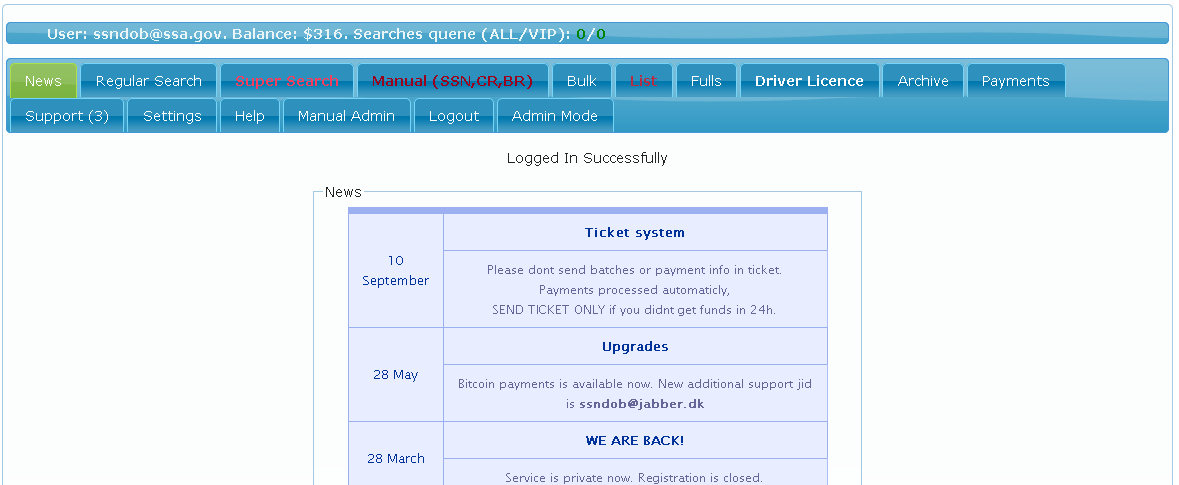
The now defunct SSNDOB identity theft service.
In 2006, The Washington Post reported that a group of five men used stolen or illegally created accounts at LexisNexis subsidiaries to lookup SSNs and other personal information more than 310,000 individuals. And in 2004, it emerged that identity thieves masquerading as customers of data broker Choicepoint had stolen the personal and financial records of more than 145,000 Americans.
Those compromises were noteworthy because the consumer information warehoused by these data brokers can be used to find the answers to so-called knowledge-based authentication (KBA) questions used by companies seeking to validate the financial history of people applying for new lines of credit.
In that sense, thieves involved in ID theft may be better off targeting data brokers like IDI and their customers than the major credit bureaus, said Nicholas Weaver, a researcher at the International Computer Science Institute and lecturer at UC Berkeley.
“This means you have access not only to the consumer’s SSN and other static information, but everything you need for knowledge-based authentication because these are the types of companies that are providing KBA data.”
The fraud group communications reviewed by this author suggest they are cashing out primarily through financial instruments like prepaid cards and a small number of online-only banks that allow consumers to establish accounts and move money just by providing a name and associated date of birth and SSN.
While most of these instruments place daily or monthly limits on the amount of money users can deposit into and withdraw from the accounts, some of the more popular instruments for ID thieves appear to be those that allow spending, sending or withdrawal of between $5,000 to $7,000 per transaction, with high limits on the overall number or dollar value of transactions allowed in a given time period.
KrebsOnSecurity is investigating the extent to which a small number of these financial instruments may be massively over-represented in the incidence of unemployment insurance benefit fraud at the state level, and in SBA loan fraud at the federal level. Anyone in the financial sector or state agencies with information about these apparent trends may confidentially contact this author at krebsonsecurity @ gmail dot com, or via the encrypted message service Wickr at “krebswickr“.
The looting of state unemployment insurance programs by identity thieves has been well documented of late, but far less public attention has centered on fraud targeting Economic Injury Disaster Loan (EIDL) and advance grant programs run by the U.S. Small Business Administration in response to the COVID-19 crisis.
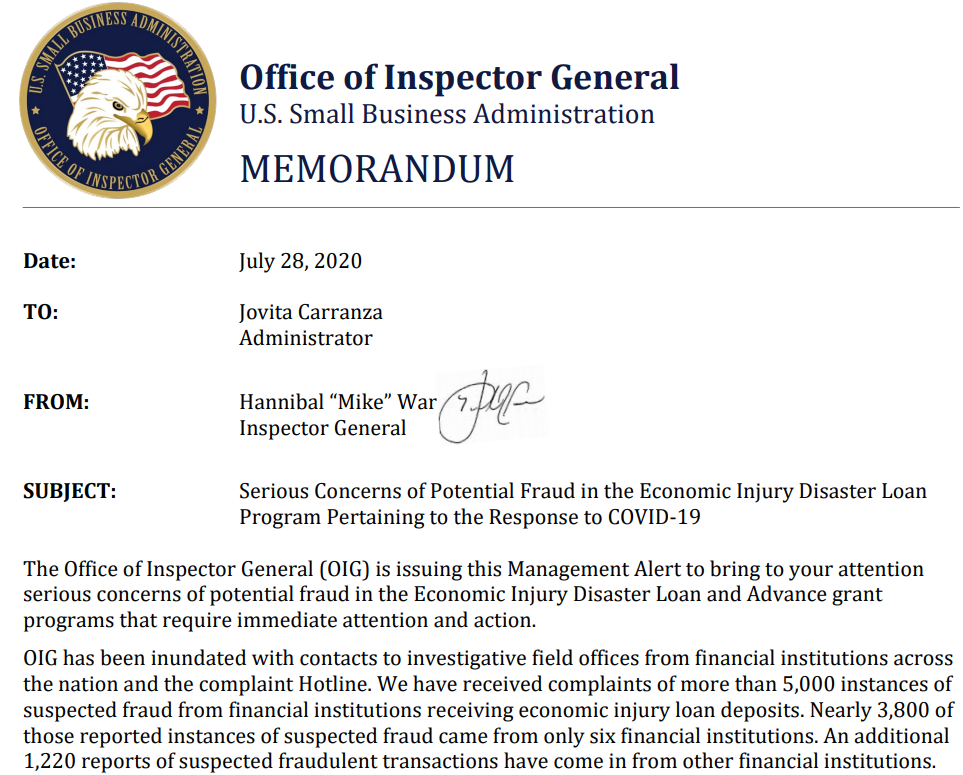
Late last month, the SBA Office of Inspector General (OIG) released a scathing report (PDF) saying it has been inundated with complaints from financial institutions reporting suspected fraudulent EIDL transactions, and that it has so far identified $250 million in loans given to “potentially ineligible recipients.” The OIG said many of the complaints were about credit inquiries for individuals who had never applied for an economic injury loan or grant.
The figures released by the SBA OIG suggest the financial impact of the fraud may be severely under-reported at the moment. For example, the OIG said nearly 3,800 of the 5,000 complaints it received came from just six financial institutions (out of several thousand across the United States). One credit union reportedly told the U.S. Justice Department that 59 out of 60 SBA deposits it received appeared to be fraudulent.
from Krebs on Security https://ift.tt/3gBu5BY
via IFTTT
Sin duda lo necesitaban los chicos de LG. Después de acumular unos cuantos ejercicios en negativo bueno es recuperar la senda de las críticas positivas, y para ello siempre es bueno un golpe de timón como el que ha supuesto este LG VELVET 5G convertido ya en la gran sorpresa Android de 2020.
Un soplo de aire fresco para el catálogo de la firma surcoreana, y una vuelta a los orígenes para hacer bien lo que LG siempre ha sabido hacer bien, que es construir smartphones de la mejor calidad escuchando al mercado para adaptarse a sus necesidades.

El cambio de paradigma de LG empieza por el terciopelo, pero sin terciopelo
Así pues, el nuevo LG VELVET 5G no lleva terciopelo en su trasera como podríamos pensar mirando a su denominación, pero es que tampoco lo necesita, porque LG ha buscado el cambio radical sin alardes, con un diseño diferenciador, curvo y muy estético, que esconde además un hardware compensado con todo lo que puedes pedirle a un móvil en la actualidad.
Y todo ello rebajando precios para llegar a todos… ¡Pero no nos quedemos aquí, conozcámoslo más en profundidad, y veamos qué nos propone el cambio radical de LG!
El terciopelo marca ya el punto de inflexión para una LG que esta vez quería ser diferente, y que sin duda ha conseguido dar esa vuelta de tuerca refrescando su gama de smartphones con un diseño novedoso, hardware más compensado y precios mucho más atractivos que sientan las bases tanto de este nuevo LG VELVET 5G como del futuro de la compañía en la industria
Te recomendamos | El LG Velvet al fin es oficial con diseño totalmente renovado, pantalla curva y Snapdragon 765 con 5G
| Características, especificaciones y ‘datasheet’ al completo | |
|---|---|
| Dimensiones | 167,2 x 74,1 x 7,85 (mm) | 180 (g) |
| Pantalla | P-OLED 6,8 pulgadas Cinema FullVision Display |
| Resolución y formato | FHD+ (2.460 x 1.080 píxeles), 20,5:9, 395 ppp |
| Procesador | Qualcomm Snapdragon 765G SDM765, octa-core @ 2,4GHz y GPU Adreno 620 |
| RAM | 6 GB |
| Almacenamiento interno | 128 GB, ampliables con microSD |
| Sistema operativo | Android 10 con LG UX 9 |
| Cámara trasera | Triple con 48 MP (angular) f/1.8, 8 MP (gran angular) f/2.2, 5 MP (depth) f/2.4, autoenfoque PDAF, flash LED, auto-HDR, EIS, video 4K@30fps |
| Cámara frontal | 16 MP (estándar) f/1.9, auto-HDR, modo belleza, vídeo FHD@30fps |
| Conectividad | 5G SA/NSA, LTE doble SIM, Wi-Fi 802.11 a/b/g/n/ac, Bluetooth 5.1 LE, aGPS con GLONASS, BDS y GALILEO, NFC, Audio-jack de 3,5 mm, USB v2.0 Tipo-C |
| Batería | 4.300 mAh (no extraíble), carga rápida 25W, carga rápida inalámbrica 9W, USB Power Delivery 3.0 |
| Otros | Resistencia IP68 + MIL-STD-810G, lector dactilar integrado (óptico), altavoces estéreo, compatible con LG Dual Screen y Stylus |

Diseño icónico, pantalla FullVision y múltiples colores para gustar a todos
Lo mejor del LG Velvet 5G os lo encontraréis a primera vista, y es que este smartphone es uno de los más bonitos que vas a poder comprarte de aquí al final de año sobre todo en su rango de precios.
De hecho, LG ha vuelto a la mesa de diseño para repensar cómo quieren sus usuarios que sean sus smartphones, y este nuevo lenguaje estético denominado ‘3D Arc’ ha convencido a propios y extraños con su finura y su elegancia, apostando por las curvas y los buenos materiales.
No en vano, este sándwich de vidrio y metal presume de construcción de gama alta, con certificaciones de resistencia IP68 ante líquidos y polvo y MIL-STD-810G ante caídas y golpes, sumando un tacto muy premium y una sensación en mano absolutamente impresionante.
El frontal se ha optimizado al máximo con un pequeño notch en forma de gota de agua, cuidando la simetría arriba y abajo a excepción de esta muesca, y colocando además en su trasera las cámaras en una serie perfectamente estudiada de agujeros que a la vista le sienta increíble.
El acabado general es muy limpio y armonioso, elegante, discreto y más funcional que llamativo, dando protagonismo al vidrio templado y al chasis de aluminio pulido con esquinas redondeadas, en colores verde, blanco, gris y un degradado muy atractivo de tonos amarillos a rojos.

Conectividad 5G, hardware compensado y ‘dual screen’ si queremos productividad
Y finalmente LG se bajó del barco. La compañía surcoreana había avisado hace tiempo de que la carrera de especificaciones y precios se había desmesurado, y por primera vez les vemos utilizar la coherencia para alegrar nuestros corazones con un hardware diferente, más económico y que prima la funcionalidad y la experiencia por encima de la potencia.
De hecho, es que la culpa de los altísimos precios que manejan los flagship de los gigantes de la industria está en parte en el chipset Snapdragon 865 de Qualcomm y en su módem 5G, además de en unos módulos de cámara que sin duda se nos han ido de las manos.
En este caso LG apuesta por la optimización y compensa su plataforma de hardware con el SoC Qualcomm Snapdragon 765G, una CPU móvil de corte medio pero también fabricada en 7 nanómetros y con procesador de ocho núcleos, que ofrece prestaciones adecuadas y un precio más comedido sumando al conjunto el módem 5G SA/NSA y una GPU Adreno 620.
Le acompañan 6 GB de memoria RAM LPDDR4x y otros 128 GB de almacenamiento interno que también es ampliable, donde se instalará Android 10 con la personalización LG UX 9 con un buen montón de novedades.
No falta la conectividad completa esperada en este tipo de dispositivos, con doble SIM compartiendo el segundo slot con la ampliación de memoria, WiFi de doble banda, Bluetooth 5.1 LE, aGPS compatible con GLONASS, BDS y GALILEO además de NFC, que junto al lector dactilar óptico integrado nos permitirá pagar con el móvil.
Redondeando el conjunto tendremos un conector de auriculares estándar, de 3,5 milímetros, junto a otro puerto USB de tipo-C con funcionalidad On-The-Go para conectar periféricos, y una batería de 4.300 mAh para animarlo todo que es compatible con Quick Charge 4.0+ y carga inalámbrica.

El mejor sonido para el mejor multimedia, seña de identidad de LG
No sólo de potencia iba a vivir el móvil más importante de LG en este 2020, y es que el fabricante surcoreano nos propone además disfrutar del mejor multimedia con un panel P-OLED de 6,8 pulgadas que ofrece resolución FHD+ y una respuesta vistosa y nítida en cualquier situación.
Además, se ha optado por montar un sistema de triple cámara inmejorablemente integrado en el diseño, con protuberancias mínimas y sensores de 48 MP (angular), 8 MP (gran angular) y 5 MP (profundidad).
Este sistema se completa con IA, autoenfoque PDAF, auto-HDR, flash LED y una curiosa funcionalidad en vídeo, pues es capaz de grabar en 4K hasta 30 fotogramas por segundo con EIS y un modo ‘ASMR’ que aumenta la sensibilidad de los micrófonos del dispositivo para captar incluso los sonidos más delicados.
Cuenta con tecnología Quad Binning, que combina cuatro píxeles en uno para crear imágenes más luminosas utilizando el sensor principal, y dispone de un altavoz estéreo doble para asegurar el mejor sonido posible firmado por un sistema Artificial Intelligence Sound que analiza el contenido y establece la mejor y más adecuada calidad del audio.
En el frontal cuenta con otra cámara de 16 megapíxeles, con auto-HDR y un modo de belleza ya habitual en casi todos los teléfonos.

Sin duda, el VELVET de LG es uno de los móviles más elegantes y mejor acabados del mercado
El integrante más completo y atractivo del catálogo LG en este 2020 está ya disponible en España, a un precio recomendado de lanzamiento de 699 euros en color Aurora Gray y próximamente en Aurora Green y con una única configuración de memoria.
Además, también está disponible ya el accesorio/funda LG Dual Screen que amplía sus posibilidades con una segunda pantalla, así como un stylus inteligente para aquellos que quieran aprovechar su smartphone en tareas más productivas.
Contenido ofrecido por | LG Mobile
Entra en Andro4all para leer el artículo completo
Puedes unirte a nosotros en Twitter, Facebook o en Google+
¡Suscríbete a nuestro canal de YouTube!
Publicado recientemente en Andro4all
La entrada Sin terciopelo, pero el LG VELVET 5G es sin duda la sorpresa Android del año se publicó primero en Andro4all.
from Andro4all https://ift.tt/3kjS37f
via IFTTT
Tal y como estaba previsto en base al calendario oficial de la actualización, Android 11 Beta 3 ya está disponible.
Se trata de la tercera y última beta del a nueva versión del sistema, antes de la llegada de la edición definitiva, cuyo despliegue está programado para el próximo mes de septiembre.
Con esta actualización, Google introduce cambios funcionales menores, y se limita a mejorar fallos y solucionar errores presentes en la beta 2. No obstante, la compañía ha aprovechado para renovar el huevo de pascua del sistema operativo.

Android 11 es la segunda versión de la historia sin un nombre de postre o dulce
La beta 3 de Android 11 llega solo unos días después de la presentación del nuevo Google Pixel 4a, el terminal de gama media de Google para este 2020, que equipa la versión 10 de Android y será uno de los primeros del mercado en actualizar a la nueva versión.
Google explica que, dado que en la beta número 2 se alcanzó la fase de estabilidad de la plataforma, todos los cambios estéticos y funcionales son definitivos. No obstante, unos días atrás uno de los miembros del equipo de desarrollo de Android anunciaba la llegada de alguna que otra sorpresa con la versión definitiva.
Puede que una de esas sorpresas fuera el nuevo “easter egg” o huevo de pascua que Google al fin ha introducido en esta tercera beta de Android 11. Como cuentan en 9to5Google, en esta ocasión Google ha revivido el minijuego “Neko cat” introducido como huevo de pascua en Android 7.
Ahora, eso sí, para acceder a él será necesario pulsar varias veces sobre el número de versión del sistema dentro de la sección de “Información” en los Ajustes del Sistema, y deslizar el control giratorio para hacer aparecer el logo de Android 11.

Será entonces cuando, en el nuevo menú de apagado del sistema, será posible añadir el minijuego dentro de la sección de dispositivos. Ahí, aparecerá el menú “Ver otras aplicaciones”, donde es posible añadir un nuevo “Control de gato”.
El minijuego en cuestión consiste en alimentar un gato virtual con comida y agua y jugar con él para hacer que aparezca. Habrá que dejar el dispositivo bloqueado durante varios minutos para que aparezca. Una vez lo haga, recibiremos una notificación.
Además de eso, como ya era posible en Android 7, es posible renombrar cada uno de los gatos virtuales a los que hayamos conseguido invocar, compartir imágenes de ellos y más. Un dato curioso es el hecho de que esta función se aprovecha del motor háptico de los Pixel 4 para emitir una vibración que simula el ronroneo de un gato real.
Android 11 Beta 3 se puede descargar a través de la página oficial del programa, aunque los poseedores de un móvil compatible –cualquier Pixel desde el Pixel 2 hasta los Pixel 4– pueden adherirse al programa Android beta para recibir la nueva versión automáticamente en sus terminales.
También es posible realizar la instalación manualmente siguiendo los pasos de nuestra guía.
Entra en Andro4all para leer el artículo completo
Puedes unirte a nosotros en Twitter, Facebook o en Google+
¡Suscríbete a nuestro canal de YouTube!
Publicado recientemente en Andro4all
La entrada Android 11 Beta 3 ya está disponible y llega con un nuevo “easter egg” se publicó primero en Andro4all.
from Andro4all https://ift.tt/2EYt49o
via IFTTT
Tohid Shekari, phD candidate at Georgia Tech, talks about the session that he and Georgia Tech professor Raheem Beyah gave about a stealthy and adaptable way to use IoT botnets for financial gain or market downfall.
from Dark Reading: https://ift.tt/3a2ADHl
via IFTTT
SPONSORED CONTENT: Stealthier and more patient than some predecessors, WastedLocker lingers surreptitiously for as long as it needs to for maximum payoff, says Jon DiMaggio with Broadcom’s Symantec division. He explains how Windows servers are at a different risk level than their open-source counterparts, and how WastedLocker identifies “valuable” targets.
from Dark Reading: https://ift.tt/3fGROzK
via IFTTT
Researchers Peleg Hader and Tomer Bar of SafeBreach share details of the three vulnerabilities they found in Windows Print Spooler that could allow an attacker to sneak into the network through an old printer service mechanism.
from Dark Reading: https://ift.tt/31oq0uN
via IFTTT
Marco Balduzzi senior research scientist with Trend Micro, tells us how the often-overlooked ICS protocol gateways contain serious vulnerabilities that allow attackers to hack OT systems remotely.
from Dark Reading: https://ift.tt/33D60an
via IFTTT
La idea es que la gente pueda asegurarse de ver qué organismos son controlados estatalmente
The post Twitter crea etiqueta especial para los gobiernos y medios estatales appeared first on Digital Trends Español.
from Redes sociales | Digital Trends Español https://ift.tt/31v7h0s
via IFTTT
 Pacosite's Blog