140 euros de descuento para este robot aspirador de Rowenta, un referente en limpieza

Hoy en día contamos con una gran variedad de productos que nos permiten hacer nuestro hogar un poco más inteligente. Puede que altavoces como los de Amazon y bombillas regulables sean los primeros ejemplos que te vengan a la cabeza, pero existen otros que pueden ser incluso más útiles. Hablamos de los robots aspiradores. En El Corte Inglés encontramos uno de estos robots con un atractivo descuento. Puedes llevarte a

Entra en Andro4all para leer el artículo completo

Puedes unirte a nosotros en Twitter, Facebook o en Google+

¡Suscríbete a nuestro canal de YouTube!

Publicado recientemente en Andro4all

La entrada 140 euros de descuento para este robot aspirador de Rowenta, un referente en limpieza se publicó primero en Andro4all.

from Andro4all https://ift.tt/3bP1bM9
via IFTTT

‘Zoom is malware’: why experts worry about the video conferencing platform

The company has seen a 535% rise in daily traffic in the past month, but security researchers say the app is a ‘privacy disaster’

As coronavirus lockdowns have moved many in-person activities online, the use of video conferencing platform Zoom has quickly escalated. So, too, have concerns about its security.

In the last month, there was a 535% rise in daily traffic to the Zoom.us download page, according to an analysis from web analytics firm SimilarWeb. Its app for iPhone has been the most downloaded app in the country for weeks, according to the mobile app market research firm Sensor Tower. Even politicians and other high-profile figures, including the British prime minister, Boris Johnson, and the former US federal reserve chair Alan Greenspan, use it for conferencing as they work from home.

Related: Coronavirus and app downloads: what you need to know about protecting your privacy

Continue reading…

from Data and computer security | The Guardian https://ift.tt/2R5TWHx
via IFTTT

‘War Dialing’ Tool Exposes Zoom’s Password Problems

As the Coronavirus pandemic continues to force people to work from home, countless companies are now holding daily meetings using videoconferencing services from Zoom. But without the protection of a password, there’s a decent chance your next Zoom meeting could be “Zoom bombed” — attended or disrupted by someone who doesn’t belong. And according to data gathered by a new automated Zoom meeting discovery tool dubbed “zWarDial,” a crazy number of meetings at major corporations are not being protected by a password.
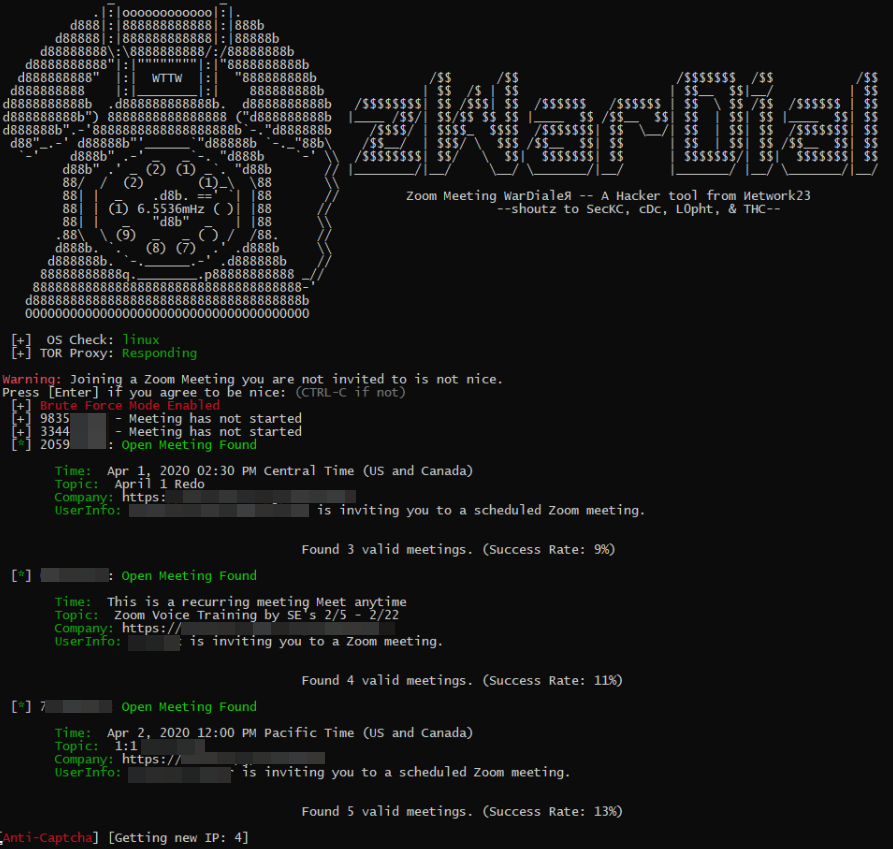
zWarDial, an automated tool for finding non-password protected Zoom meetings. According to its makers, zWarDial can find on average 110 meetings per hour, and has a success rate of around 14 percent.

Each Zoom conference call is assigned a Meeting ID that consists of 9 to 11 digits. Naturally, hackers have figured out they can simply guess or automate the guessing of random IDs within that space of digits.

Security experts at Check Point Research did exactly that last summer, and found they were able to predict approximately four percent of randomly generated Meeting IDs. The Check Point researchers said enabling passwords on each meeting was the only thing that prevented them from randomly finding a meeting.

Zoom responded by saying it was enabling passwords by default in all future scheduled meetings. Zoom also said it would block repeated attempts to scan for meeting IDs, and that it would no longer automatically indicate if a meeting ID was valid or invalid.

Nevertheless, the incidence of Zoombombing has skyrocketed over the past few weeks, even prompting an alert by the FBI on how to secure meetings against eavesdroppers and mischief-makers. This suggests that many Zoom users have disabled passwords by default and/or that Zoom’s new security feature simply isn’t working as intended for all users.

New data and acknowledgments by Zoom itself suggest the latter may be more likely.

Earlier this week, KrebsOnSecurity heard from Trent Lo, a security professional who founded SecKC, Kansas City’s longest-running monthly security meetup. Lo and fellow SecKC members recently created zWarDial, which borrows part of its name from the old phone-based war dialing programs that called random or sequential numbers in a given telephone number prefix to search for computer modems.

Lo said zWarDial evades Zoom’s attempts to block automated meeting scans by routing the searches through multiple proxies in Tor, a free and open-source software that lets users browse the Web anonymously.

“Zoom recently said they fixed this but I’m using a totally different URL and passing a cookie along with that URL,” Lo said, describing part of how his tool works on the back end. “This gives me the [Zoom meeting] room information without having to log in.”

Lo said a single instance of zWarDial can find approximately 100 meetings per hour, but that multiple instances of the tool running in parallel could probably discover most of the open Zoom meetings on any given day. Each instance, he said, has a success rate of approximately 14 percent, meaning for each random meeting number it tries, the program has a 14 percent chance of finding an open meeting.

Only meetings that are protected by a password are undetectable by zWarDial, Lo said.

“Having a password enabled on the meeting is the only thing that defeats it,” he said.

Lo shared the output of one day’s worth of zWarDial scanning, which revealed information about nearly 2,400 upcoming or recurring Zoom meetings. That information included the link needed to join each meeting; the date and time of the meeting; the name of the meeting organizer; and any information supplied by the meeting organizer about the topic of the meeting.

The results were staggering, and revealed details about Zoom meetings scheduled by some of the world’s largest companies, including major banks, international consulting firms, ride-hailing services, government contractors, and investment ratings firms.

KrebsOnSecurity is not naming the companies involved, but was able to verify dozens of them by matching the name of the meeting organizer with corporate profiles on LinkedIn.

By far the largest group of companies exposing their Zoom meetings are in the technology sector, and include a number of security and cloud technology vendors. These include at least one tech company that’s taken to social media warning people about the need to password protect Zoom meetings!
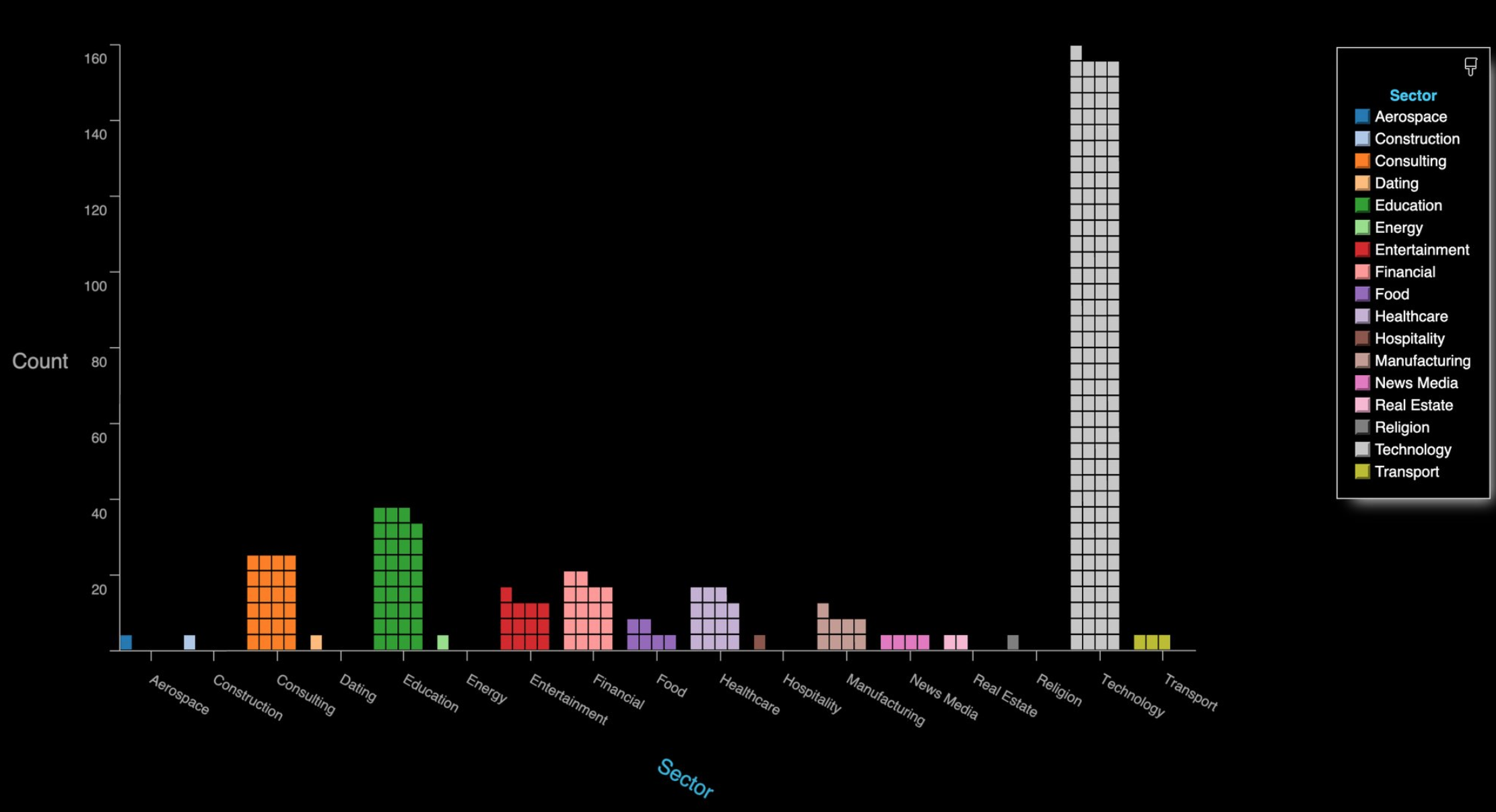
The distribution of Zoom meetings found by zWarDial, indexed by industry. As depicted above, zWarDial found roughly 2,400 exposed meetings in less than 24 hours. Image: SecKC.

A GREMLIN IN THE DEFAULTS?

Given the preponderance of Zoom meetings exposed by security and technology companies that ostensibly should know better, KrebsOnSecurity asked Zoom whether its approach of adding passwords by default to all new meetings was actually working as intended.

In reply, Zoom said it was investigating the possibility that its password-by-default approach may fail under certain circumstances.

“Zoom strongly encourages users to implement passwords for all of their meetings to ensure uninvited users are not able to join,” the company said in a written statement shared with this author.

“Passwords for new meetings have been enabled by default since late last year, unless account owners or admins opted out,” the statement continues. “We are looking into unique edge cases to determine whether, under certain circumstances, users unaffiliated with an account owner or administrator may not have had passwords switched on by default at the time that change was made.

The acknowledgment comes amid a series of security and privacy stumbles for Zoom, which has seen its user base grow exponentially in recent weeks. Zoom founder and chief executive Eric Yuan said in a recent blog post that the maximum number of daily meeting participants — both paid and free — has grown from around 10 million in December to 200 million in March.

That rapid growth has also brought additional scrutiny from security and privacy experts, who’ve found plenty of real and potential problems with the service of late. TechCrunch’s Zack Whittaker has a fairly comprehensive breakdown of them here; not included in that list is a story he broke earlier this week on a pair of zero-day vulnerabilities in Zoom that were publicly detailed by a former NSA expert.

Zoom CEO Yuan acknowledged that his company has struggled to keep up with steeply growing demand for its service and with the additional scrutiny that comes with it, saying in a blog post that for the next 90 days all new feature development was being frozen so the company’s engineers could focus on security issues.

Dave Kennedy, a security expert and founder of the security consultancy TrustedSec, penned a lengthy thread on Twitter saying while Zoom certainly has had its share of security and privacy goofs, some in the security community are unnecessarily exacerbating an already tough situation for Zoom and its tens of millions of users who rely on it for day-to-day meetings.

“What we have here is a company that is relatively easy to use for the masses (comes with its challenges on personal meeting IDs) and is relatively secure,” Kennedy wrote. “Yet the industry is making it out to be ‘this is malware’ and you can’t use this. This is extreme. We need to look at the risk specific applications pose and help voice a message of how people can leverage technology and be safe. Dropping zero-days to the media hurts our credibility, sensationalizes fear, and hurts others.”

“If there are ways for a company to improve, we should notify them and if they don’t fix their issues, we should call them out,” he continued. “We should not be putting fear into everyone, and leveraging the media as a method to create that fear.”

Zoom’s advice on securing meetings is here. SecKC’s Lo said organizations using Zoom should avoid posting the Zoom meeting links on social media, and always require a meeting password when possible.

“This should be enabled by default as a new customer or a trial user,” he said. “Legacy organizations will need to check their administration settings to make sure this is enabled. You can also enable ‘Embed password in meeting link for one-click join.’ This prevents an actor from accessing your meeting without losing the usability of sharing a link to join.”

In addition, Zoom users can disable “Allow participants to join the meeting before the host arrives.”

“If you have to have this feature enabled at least enable “notify host when participants join the meeting before them,” Lo advised. “This will notify you that someone might be using your meeting without your knowledge. If you must keep your meeting unprotected you should enable ‘Mask phone number in the participant list.’ Using the waiting list feature will prevent unwanted participants from accessing your meeting but it will still expose your meeting details if used without a password.”
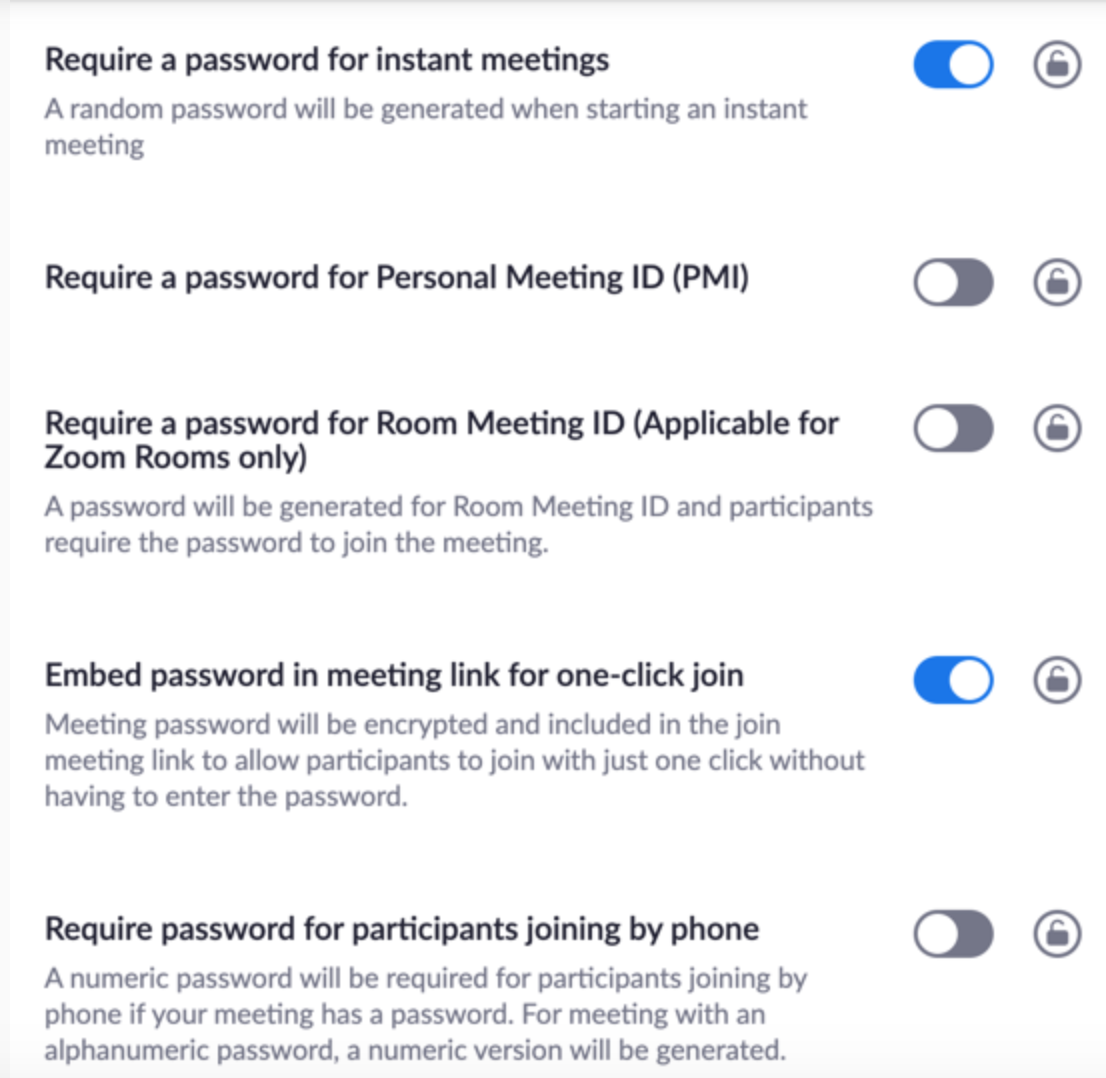
Some of the security settings available to Zoom users. These and others can be found at https://ift.tt/3bHBBZp

from Krebs on Security https://ift.tt/2w7RwB7
via IFTTT

Los cuestionamientos a Zoom son cada vez más numerosos

Los cuestionamientos a Zoom

Zoom es una solución de video conferencia que se hizo muy popular a partir del distanciamiento social impuesto por la pandemia del COVID-19. Dado que su versión gratuita permite superar las limitaciones de videollamadas grupales de WhatsApp, se hizo muy popular entre los usuarios domésticos.

Los cuestionamientos a Zoom

Esa repentina popularidad llevó a que los expertos en seguridad informática (y algún que otro ciberdelincuente) pusieran interés en sus características de privacidad y seguridad.

La oficina de la fiscal general de Nueva York, Letitia James, envió a la empresa un requerimiento para que informe qué nuevas medidas de seguridad se han puesto en marcha la compañía para manejar el aumento de tráfico en su red y para detectar a los delincuentes informáticos.

Para la fiscalia, la firma responsable del servicio fue lenta en abordar los fallos de seguridad como las vulnerabilidades “que podrían permitir a terceros malintencionados, entre otras cosas, obtener acceso subrepticio a las cámaras web de los consumidores”.

Todo empezó con los aumentos de ataques ahora conocidos como “Zoombombing.

Esa palabreja se refiere a la explotación de la función de compartir la pantalla del Zoom para secuestrar reuniones e interrumpir sesiones educativas o publicar mensajes de supremacía blanca en un seminario web sobre antisemitismo,

Los fiscales manifiestan su preocupación de que:

las actuales prácticas de seguridad de Zoom no sean suficientes para adaptarse al reciente y repentino aumento tanto del volumen como de la sensibilidad de los datos que pasan por su red.

Aunque reconocen que las vulnerabilidades detectadas se han corregido, le preguntan a Zoom si ha emprendido un examen más amplio de sus prácticas de seguridad.

Compartiendo datos con Facebook

Hace unos días se descubrió que el cliente Zoom para iOS enviaba datos a Facebook. Esto pasaba aunque el usuario no tuviera cuenta en esa red social.

Posiblemente no sea algo deliberado. Muchas aplicaciones utilizan los kits de desarrollo de software (SDK) de Facebook como medio para implementar características en sus aplicaciones más fácilmente.

Al descargar y abrir la aplicación, Zoom se conectaba a la Graph API de Facebook. La Graph API es la principal forma en que los desarrolladores obtienen datos dentro o fuera de Facebook.

La aplicación Zoom notificaba a Facebook cuando el usuario abría la aplicación, detalles del dispositivo del usuario como el modelo, la zona horaria y la ciudad desde la que se está conectando, qué compañía telefónica está utilizando y un identificador de anunciante único creado por el dispositivo del usuario que las compañías pueden utilizar para dirigirse a un usuario con anuncios.

El pasado viernes, se actualizó la aplicación. En la nueva versión se reemplazó el uso del SDK por una autenticación en Facebook usando el navegador.

Otros problemas de privacidad

Zoom también tiene otros problemas potenciales de privacidad. Los anfitriones de las llamadas de Zoom pueden ver si los participantes tienen la ventana de Zoom abierta o no, lo que significa que pueden monitorear si es probable que la gente esté prestando atención. Los administradores también pueden ver la dirección IP, los datos de localización y la información del dispositivo. Si un usuario graba cualquier llamada a través de Zoom, los administradores pueden acceder a los contenidos de esa llamada grabada, incluidos los archivos de vídeo, audio, transcripción y chat, así como al acceso a los privilegios de compartir, analizar y gestionar la nube. Los administradores también tienen la posibilidad de unirse a cualquier llamada en cualquier momento a instancias de su organización de Zoom, sin consentimiento o aviso previo para los asistentes a la llamada.

Si usas una Mac y tienes instalado Zoom, deberías tener cuidado en lo que haces delante de la cámara. Jonathan Leitschuh, un analista de seguridad, publicó dos links desde los que se puede desde un sitio web encender la cámara web de los usuarios de Mac sin su consentimiento y conocimiento.

Pero, las cosas no están mejor para los usuarios de Windows. Según el experto en seguridad cibernética @_g0dmode, Zoom para Windows es vulnerable a una vulnerabilidad clásica de “inyección de ruta UNC” que podría permitir a los atacantes remotos robar las credenciales de inicio de sesión de Windows de las víctimas e incluso ejecutar comandos arbitrarios en sus sistemas.

Estos ataques son posibles porque Zoom para Windows soporta rutas UNC remotas que convierten las URIs potencialmente inseguras en hipervínculos cuando se reciben a través de mensajes de chat a un destinatario en un chat personal o de grupo.

Lo grave de todo esto es que hablamos de un servicio que lleva 9 años en el mercado y de una aplicación que es de las más descargadas en ambas tiendas de aplicaciones.

Hace unos días, en Linux Adictos repasamos algunas soluciones de video conferencia de código abierto que puedes utilizar.

from Linux Adictos https://ift.tt/2w81Xo9
via IFTTT

140 euros de descuento para este robot aspirador de Rowenta, un referente en limpieza

Hoy en día contamos con una gran variedad de productos que nos permiten hacer nuestro hogar un poco más inteligente. Puede que altavoces como los de Amazon y bombillas regulables sean los primeros ejemplos que te vengan a la cabeza, pero existen otros que pueden ser incluso más útiles. Hablamos de los robots aspiradores. En El Corte Inglés encontramos uno de estos robots con un atractivo descuento. Puedes llevarte a

Entra en Andro4all para leer el artículo completo

Puedes unirte a nosotros en Twitter, Facebook o en Google+

¡Suscríbete a nuestro canal de YouTube!

Publicado recientemente en Andro4all

La entrada 140 euros de descuento para este robot aspirador de Rowenta, un referente en limpieza se publicó primero en Andro4all.

from Andro4all https://ift.tt/3bP1bM9
via IFTTT

Las tres mejores webs para hacer puzzles online

Sabemos que te aburres. No quiero generalizar, ya que yo, por ejemplo, aún trabajo en esta época, pero es una realidad que la amplia mayoría de ciudadanos se encuentran enclaustrados en casa desde hace semanas, parece que aún serán más, y las ideas empiezan a escasear. No debería ser así, porque tenemos más medios que nunca y estamos más comunicados que en ninguna otra época, pero la mente suele necesitar

Entra en Andro4all para leer el artículo completo

Puedes unirte a nosotros en Twitter, Facebook o en Google+

¡Suscríbete a nuestro canal de YouTube!

Publicado recientemente en Andro4all

La entrada Las tres mejores webs para hacer puzzles online se publicó primero en Andro4all.

from Andro4all https://ift.tt/2wbPyzI
via IFTTT

12 trucos para tus videollamadas con Zoom que deberías conocer

A pesar de ciertos problemas de privacidad que han llevado a la compañía a detener el desarrollo de nuevas funciones para centrarse en mejorar la seguridad de la plataforma, Zoom se ha convertido en la aplicación de videollamadas más utilizada durante el período de confinamiento en el que se encuentra sumida una buena parte de la población a nivel global a causa de la pandemia de COVID-19. Son muchas las

Entra en Andro4all para leer el artículo completo

Puedes unirte a nosotros en Twitter, Facebook o en Google+

¡Suscríbete a nuestro canal de YouTube!

Publicado recientemente en Andro4all

La entrada 12 trucos para tus videollamadas con Zoom que deberías conocer se publicó primero en Andro4all.

from Andro4all https://ift.tt/2JuJ5Tx
via IFTTT