Payroll Provider Gives Extortionists a Payday

Payroll software provider Apex Human Capital Management suffered a ransomware attack this week that severed payroll management services for hundreds of the company’s customers for nearly three days. Faced with the threat of an extended outage, Apex chose to pay the ransom demand and begin the process of restoring service to customers.

Roswell, Ga. based Apex HCM is a cloud-based payroll software company that serves some 350 payroll service bureaus that in turn provide payroll services to small and mid-sized businesses. At 4 a.m. on Tuesday, Feb. 19, Apex was alerted that its systems had been infected with a destructive strain of ransomware that encrypts computer files and demands payment for a digital key needed to unscramble the data.
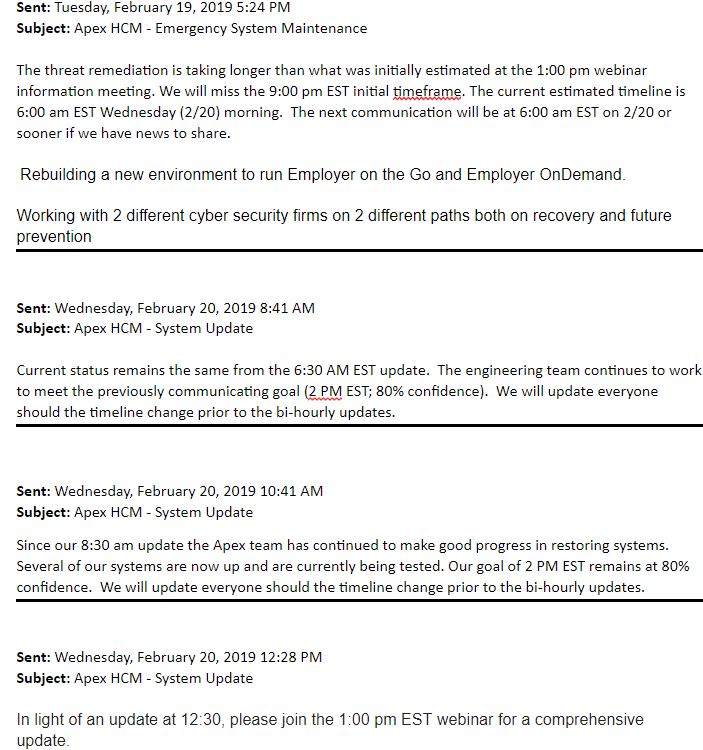
The company quickly took all of its systems offline, and began notifying customers that it was trying to remediate a security threat. Over a series of bi-hourly updates, Apex kept estimating that it expected to restore service in a few hours, only to have to walk back those estimates almost every other time a new customer update went out.

Contacted Wednesday by an Apex client who was nervous about being unable to make this week’s payroll for his clients, KrebsOnSecurity reached out to Apex for comment. Ian Oxman, the company’s chief marketing officer, said the ransomware never touched customer data, but instead encrypted and disrupted everything in the company’s computer systems and at its off-site disaster recovery systems.

“We had just recently completed a pretty state-of-the-art disaster recovery plan off-site out and of state that was mirroring our live system,” Oxman said. “But when the ransomware bomb went off, not only did it go through and infect our own network, it was then immediately picked up in our disaster recovery site, which made switching over to that site unusable.”

Oxman said Apex hired two outside security firms, and by Feb. 20 the consensus among all three was that paying the ransom was the fastest way to get back online. The company declined to specify how much was paid or what strain of ransomware was responsible for the attack.

“We paid the ransom, and it sucked,” Oxman said. “In respect for our clients who needed to get their businesses up and running that was going to be obviously the quicker path.”

Unfortunately for Apex, paying up didn’t completely solve its problems. For one thing, Oxman said, the decryption key they were given after paying the ransom didn’t work exactly as promised. Instead of restoring all files and folders to their pre-encrypted state, the decryption process broke countless file directories and rendered many executable files inoperable — causing even more delays.

“When they encrypt the data, that happens really fast,” he said. “When they gave us the keys to decrypt it, things didn’t go quite as cleanly.”

One of Apex’s older business units — ACA OnDemand — is still offline, but the company is now offering to move customers on that platform over to newer (and more expensive) software-as-a-service systems, and to train those customers on how to use them.

Experts say attacks like the one against Apex HCM are playing out across the world every day, and have turned into a billion-dollar business for cyber thieves. The biggest group of victims are professional services firms, according to a study by NTT Security.

Ransomware victims perhaps in the toughest spot include those offering cloud data hosting and software-as-service, as these businesses are completely unable to serve their customers while a ransomware infestation is active.

The FBI and multiple security firms have advised victims not to pay any ransom demands, as doing so just encourages the attackers and in any case may not result in actually regaining access to encrypted files.

In practice, however, many cybersecurity consulting firms are quietly urging their customers that paying up is the fastest route back to business-as-usual. It’s not hard to see why: Having customer data ransomed or stolen can spell the end of cloud-based business, but just being down for more than a few days can often be just as devastating. As a result, the temptation to simply pay up may become stronger with each passing day — even if the only thing being ransomed is a bunch of desktops and servers.

On Christmas Eve 2018, cloud data hosting firm Dataresolution.net was hit with the Ryuk strain of ransomware. More than a week later on Jan. 2, 2019, this blog reported that the company — which had chosen not to pay the ransom and instead restore everything from backups — was still struggling to bring its systems back online.

One dataresolution.net client said the company didn’t succeed in rebuilding its server or turning over his company’s database stored there until Jan. 9 — 16 days after the ransomware outbreak.

“From my understanding it was another two weeks until all of the clients were rebuilt,” said the customer, who works as an IT manager at a benefits management firm that used dataresolution.net and its now transitioning away from the company. “The vendor never provided any analysis on how it occurred and how they would prevent it from occurring again.  Other than different antivirus and not allowing RDP connections to the internet they don’t seem to have put any additional safeguards in place. They did not proactively offer any compensation for the outage. I am in the process of documenting the business financial impact to request a ‘credit’ at the same time as planning on bringing the system in house.”

For its part, Apex is still trying to determine how the ransomware got into its systems.

“That’s where this forensic analysis is still going on,” Oxman said. “For us, the emergency response team literally worked 48 hours straight getting our systems back up, and secondary to that is now trying to figure out what the hell happened and how do we prevent this from happening again. We had just completed a security audit and we were feeling pretty good. Obviously, these cyber hackers found a way in, but I’m sure that’s how every company feels that gets hit.”

Here are a few tips for preventing and dealing with ransomware attacks:

-Patch, early and often: Many ransomware attacks leverage known security flaws in servers and desktops.

-Disable RDP: Short for Remote Desktop Protocol, this feature of Windows allows a system to be remotely administered over the Internet. A ridiculous number of businesses — particularly healthcare providers — get hit with ransomware because they leave RDP open to the Internet and secured with easy-to-guess passwords. And there are a number of criminal services that sell access to brute-forced RDP installations.

-Filter all email: Invest in security systems that can block executable files at the email gateway.

-Isolate mission-critical systems and data: This can be harder than it sounds. It may be worth hiring a competent security firm to make sure this is done right.

-Backup key files and databases: Bear in mind that ransomware can encrypt any network or cloud-based files or folders that are mapped and have been assigned a drive letter. Backing up to a secondary system that is not assigned a drive letter or is disconnected when it’s not backing up data is key. The old “3-2-1” backup rule comes into play here: Wherever possible, keep three backups of your data, on two different storage types, with at least one backup offsite.

-Disable macros in Microsoft Office: Block external content in Office files. Educate users that ransomware very often succeeds only when a user opens Office file attachment sent via email and manually enables Macros.

-Enable controlled folder access: Create rules to disallow the running of executable files in Windows from local user profile folders (App Data, Local App Data, ProgramData, Temp, etc.)

Sites like nomoreransom.org distribute free tools and tutorials that can help some ransomware victims recover files without paying a ransom demand, but those tools often only work with specific versions of a particular ransomware strain.

from Krebs on Security https://ift.tt/2SioBzn
via IFTTT

Tu móvil, una app y este lápiz 3D es todo lo que necesitas para tus primeras creaciones en 3D

El mundo de los smartphones está lleno de aplicaciones de todo tipo, como aquella que te premia por avisar a tu familia del peligro de los airbags o la que es capaz de identificar hasta 250 tipos de arañas. Ahora, gracias a tu móvil, una aplicación y un lápiz 3D ya puedes crear cosas en 3D. 3Doodler App es una aplicación exclusiva para lápices 3D, para que los usuarios lo

Entra en Andro4all para leer el artículo completo

Puedes unirte a nosotros en Twitter, Facebook o en Google+

¡Suscríbete a nuestro canal de YouTube!

Publicado recientemente en Andro4all

from Andro4all https://ift.tt/2TZANqe
via IFTTT

tar: comandos que deberías conocer

Hay una herramienta bien conocida en el mundo Unix, y esa es tar, ya que los tarballs se manejan a diario, especialmente para desempaquetar paquetes de código fuente y compilarlos. Como ya sabes, si nos lees, los tarballs son archivos empaquetados con la herramienta tar y con algún tipo de compresión, que puede ser de diferentes tipos según el algoritmo de comrpesión empleado. Por ello, se hace uso de otras herramientas de compresión/descompresión.

Lo bueno de los tarballs es que conservan los permisos y demás atributos de los ficheros y directorios empaquetados, por eso son especialmente importante para conservar los permisos adecuados de los ficheros fuente, scripts y demás que debemos ejecutar para la compilació e instalación. De hecho, cuando “desempaquetamos” mal uno de estos paquetes, usando por ejemplo algunas herramientas gráficas de descompresión, esos permisos se van al traste y puede que no funcione correctamente lo que pretendemos…

Hoy te vamos a presentar algunas órdenes sencillas y básicas con tar que deberías conocer para poder trabajar bien con los paquetes. Para más información, puedes consultar otros de mis artículos como:

Pues bien, manos a la obra:

  • Empaquetar un fichero o directorio:
tar -cvf nombre_tarball.tar /ruta/directorio/ 
  • Para compresión .gz (si quieres otro tipo de compresión, puedes cambiar la z por j para .bz2, etc.):
tar cvzf nombre_tarball.tar.gz /ruta/directorio/
  • Para desempaquetar, con la x, sea cual sea la compresión:
tar -xvf nombre_tarball.tar.gz
  • Solo listar el contenido del tarball, sin ejercer ninguna operación de descompresión o desempaquetado sobre él:
tar -tvf nombre_tarball.tar.gz
  • Agregar ficheros y directorios a un tarball existente:
tar -rvf nombre_tarball.tar.gz nuevo.txt
  • Verificar un tarball:
tar -tvfW nombre_tarball.tar
  • Comprobar el tamaño:
tar -czf - nombre_tarball.tar.gz | wc -c

Los ejemplos los he puesto con compresión .gz normalmente, pero no tiene por qué ser así. Valdía igual para .bz2, .xz, etc. Tan solo recuerda a la hora de comprimir, usar la letra adecuada para cada tipo de compresión…


El artículo tar: comandos que deberías conocer ha sido originalmente publicado en Linux Adictos.

from Linux Adictos https://ift.tt/2NmAtzv
via IFTTT

Nubia se adelantaría al Samsung Galaxy Fold y al Huawei Mate X con un wearable flexible que ya está promocionando

Ya lo hemos comentado más de una vez, este Mobile World Congress 2019 pertenece a los móviles plegables con pantalla flexible, un grandísimo avance con respecto a la edición del pasado año, en la que que tuvimos que conformarnos únicamente con el ZTE Axon M (el cual, solo un año más tarde palidece al compararlo con el Galaxy Fold). Volviendo a lo que nos interesa, con el Samsung Galaxy Fold

Entra en Andro4all para leer el artículo completo

Puedes unirte a nosotros en Twitter, Facebook o en Google+

¡Suscríbete a nuestro canal de YouTube!

Publicado recientemente en Andro4all

from Andro4all https://ift.tt/2U93eCo
via IFTTT

Google celebra los Oscar con un spot solo apto para cinéfilos, ¿puedes reconocer todas las películas que aparecen?

Los Premios Oscar prácticamente ya están aquí y Google no ha querido perder la ocasión de hacer su particular homenaje al séptimo arte mediante un spot la mar de creativo que han subido a su canal oficial de Youtube. El año pasado ya vimos a Samsung colarse en la ceremonia de entrega de los Oscar para promocionar los Galaxy S9, ahora parece que es Google quien saca partido a este

Entra en Andro4all para leer el artículo completo

Puedes unirte a nosotros en Twitter, Facebook o en Google+

¡Suscríbete a nuestro canal de YouTube!

Publicado recientemente en Andro4all

from Andro4all https://ift.tt/2U5H4AC
via IFTTT

¿Prefieres los marcos al agujero en pantalla? Samsung ha pensado en ti y ha incluido un ajuste especial en los S10

Con los Samsung Galaxy S10 y S10+ ya encima de la mesa siendo escrutados al milímetro por cientos de medios y periodistas, no dejan de surgir nuevos y fascinantes detalles que prueban el buen hacer y el cuidado que Samsung ha puesto en la experiencia de usuario de sus últimos terminales. Esta vez han sido los chicos de Sammobile quienes han descubierto (gracias a los avisos de otros usuarios), una

Entra en Andro4all para leer el artículo completo

Puedes unirte a nosotros en Twitter, Facebook o en Google+

¡Suscríbete a nuestro canal de YouTube!

Publicado recientemente en Andro4all

from Andro4all https://ift.tt/2Td1NW6
via IFTTT

Mobile World Congress: historia del evento de móviles más importante de cada año

Este lunes arranca oficialmente el Mobile World Congress 2019 de Barcelona, y con él, una nueva entrega de la feria de telefonía más importante del año. Las principales marcas aprovecharán la inmejorable oportunidad que les brinda este evento para anunciar sus nuevas apuestas para el segmento telefónico, y presentar nuevos modelos de smartphones así como las tecnologías que darán vida a su catálogo a lo largo del año. Pero antes

Entra en Andro4all para leer el artículo completo

Puedes unirte a nosotros en Twitter, Facebook o en Google+

¡Suscríbete a nuestro canal de YouTube!

Publicado recientemente en Andro4all

from Andro4all https://ift.tt/2tBCVsB
via IFTTT

Las técnicas de mitigación de software a Spectre no son suficientes

Recientemente un grupo de investigadores que trabajan para Google han argumentado que será difícil evitar los errores relacionados con Spectre en el futuro, a menos que las CPU se revisen a fondo.

Según ellos, las técnicas de mitigación basadas en software por sí solas no serán suficientes para evitar la explotación de dichas vulnerabilidades de hardware, las soluciones de software de mitigación que consideran en su mayor parte como incompletas.

Sobre Spectrum

Debemos recordar que es gracias a Google que sabemos que las vulnerabilidades críticas que afectan a los chips modernos y probablemente a toda la industria de los semiconductores, afectan principalmente a las CPU Intel x86 de 64 bits.

Pero estos fallos de seguridad también afectan a los procesadores basados ​​en la arquitectura ARM (Samsung, Qualcomm, MediaTek, Apple, Huawei, etc.) así como la arquitectura de la CPU desarrollada por IBM y en menor medida a los procesadores AMD.

Spectre corresponde a las dos primeras variantes: 1 (bypass de comprobación de límites) y 2 (inyección de derivación de ramificación) estas vulnerabilidades críticas fueron descubiertas por la empresa de Mountain View y expuestas a los tipos específicos de ataques relacionados.

Spectre básicamente rompe la barrera entre las aplicaciones y permite que un atacante obtenga discretamente información confidencial sobre las aplicaciones en ejecución, incluso si están protegidas.

Destapar un hoyo para tapar otro

Los investigadores de Google han descubierto que el tiempo de espera de la memoria caché de los datos del procesador moderno puede abusarse para recuperar ilegalmente información de una computadora.

Esta función es utilizada por la mayoría de los procesadores modernos para optimizar el rendimiento, pero también puede causar serios problemas de seguridad.

Los investigadores de Google pudieron demostrar que los atacantes pueden aprovechar esta característica (también conocida como ejecución especulativa) para explotar los procesos a nivel de usuario al pasar por alto la MMU y leer el contenido de la memoria del kernel.

Una computadora que normalmente debería haber sido inaccesible para ellos. Este problema es material, es decir, que se refiere a los chips no reconfigurables no sería posible usar un parche a través de microcódigo para corregir todas las variantes de las diversas vulnerabilidades de seguridad reveladas durante los últimos 14 meses, especialmente para las vulnerabilidades de Spectre.


Para resolver este problema de manera efectiva, sería necesario utilizar una técnica de aislamiento de la tabla de correspondencia o diseñar nuevos procesadores con una arquitectura revisada en consecuencia.

En un documento distribuido por ArXiv, los investigadores de la filial de Alphabet ahora se aseguran de que todos los procesadores que admiten la ejecución especulativa sigan siendo susceptibles a varios ataques de canal lateral, a pesar de las medidas de mitigación que podrían descubrirse en el futuro.

Se deben corregir esos fallos a toda costa

Según ellos, para corregir verdaderamente todos los errores actuales y futuros relacionados con Spectre y la amenaza que representan, los diseñadores de CPU deben esforzarse por ofrecer nuevas arquitecturas para sus microprocesadores.

Intel dijo que incluirá correcciones de hardware para errores de hardware específicos y conocidos en sus futuros chips.

El problema, según los investigadores de Google, es que los errores relacionados con Spectre se consideran una clase completa y que, además, las vulnerabilidades relacionadas con la ejecución especulativa favorecen significativamente a los ataques de canal lateral.

Los investigadores de Google propusieron varias soluciones posibles, entre las cuales va incluida la desactivación total de la funcionalidad de ejecución especulativa, así como la atenuación precisa de la demora y finalmente el “enmascaramiento”.

Los investigadores de Google también señalaron que estas medidas de mitigación no están exentas de problemas y que es probable que se apliquen sanciones de desempeño si se implementan.

Finalmente ellos concluyeron diciendo que es posible que Spectre sea demasiado bueno para su nombre, ya que parece estar destinado a acosarnos durante mucho tiempo.

Lo que subraya el hecho de que durante mucho tiempo nos hemos centrado en el rendimiento y la complejidad a expensas de la seguridad.

El artículo Las técnicas de mitigación de software a Spectre no son suficientes ha sido originalmente publicado en Linux Adictos.

from Linux Adictos https://ift.tt/2BKLpC7
via IFTTT