Godaddy.com, the world’s largest domain name registrar, recently addressed an authentication weakness that cybercriminals were using to blast out spam through legitimate, dormant domains. But several more recent malware spam campaigns suggest GoDaddy’s fix hasn’t gone far enough, and that scammers likely still have a sizable arsenal of hijacked GoDaddy domains at their disposal.
On January 22, KrebsOnSecurity published research showing that crooks behind a series of massive sextortion and bomb threat spam campaigns throughout 2018 — an adversary that’s been dubbed “Spammy Bear” — achieved an unusual amount of inbox delivery by exploiting a weakness at GoDaddy which allowed anyone to add a domain to their GoDaddy account without validating that they actually owned the domain.
Spammy Bear targeted dormant but otherwise legitimate domains that had one thing in common: They all at one time used GoDaddy’s hosted Domain Name System (DNS) service. Researcher Ron Guilmette discovered that Spammy Bear was able to hijack thousands of these dormant domains for spam simply by registering free accounts at GoDaddy and telling the company’s automated DNS service to allow the sending of email with those domains from an Internet address controlled by the spammers.
Very soon after that story ran, GoDaddy said it had put in place a fix for the problem, and had scrubbed more than 4,000 domain names used in the spam campaigns that were identified in my Jan. 22 story. But on or around February 1, a new spam campaign that leveraged similarly hijacked domains at GoDaddy began distributing Gand Crab, a potent strain of ransomware.
As noted in a post last week at the blog MyOnlineSecurity, the Gand Crab campaign used a variety of lures, including fake DHL shipping notices and phony AT&T e-fax alerts. The domains documented by MyOnlineSecurity all had their DNS records altered between Jan. 31 and Feb. 1 to allow the sending of email from Internet addresses tied to two ISPs identified in my original Jan. 22 report on the GoDaddy weakness.
“What makes these malware laden emails much more likely to be delivered is the fact that the sending domains all have a good reputation,” MyOnlineSecurity observed. “There are dozens, if not hundreds of domains involved in this particular campaign. Almost all the domains have been registered for many years, some for more than 10 years.”
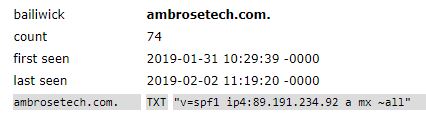
A “passive DNS” lookup shows the DNS changes made by the spammers on Jan. 31 for one of the domains used in the Gand Crab spam campaign documented by MyOnlineSecurity. Image: Farsight Security.
In a statement provided to KrebsOnSecurity, GoDaddy said the company was confident the steps it took to address the problem were working as intended, and that GoDaddy had simply overlooked the domains abused in the recent GandCrab spam campaign.
“The domains used in the Gand Crab campaign were modified before then, but we missed them in our initial sweep,” GoDaddy spokesperson Dan Race said. “While we are otherwise confident of the mitigation steps we took to prevent the dangling DNS issue, we are working to identify any other domains that need to be fixed.”
“We do not believe it is possible for a person to hijack the DNS of one or more domains using the same tactics as used in the Spammy Bear and Gand Crab campaigns,” Race continued. “However, we are assessing if there are other methods that may be used to achieve the same results, and we continue our normal monitoring for account takeover. We have also set up a reporting alias at dns-spam-concerns@godaddy.com to make it easier to report any suspicious activity or any details that might help our efforts to stop this kind of abuse.”
That email address is likely to receive quite a few tips in the short run. Virusbulletin editor Martijn Grooten this week published his analysis on a January 29 malware email campaign that came disguised as a shipping notice from UPS. Grooten said the spam intercepted from that campaign included links to an Internet address that was previously used to distribute GandCrab, and that virtually all of the domains seen sending the fake UPS notices used one of two pairs of DNS servers managed by GoDaddy.
“The majority of domains, which we think had probably had their DNS compromised, still point to the same IP address though,” Grooten wrote. That IP address is currently home to a Web site that sells stolen credit card data.
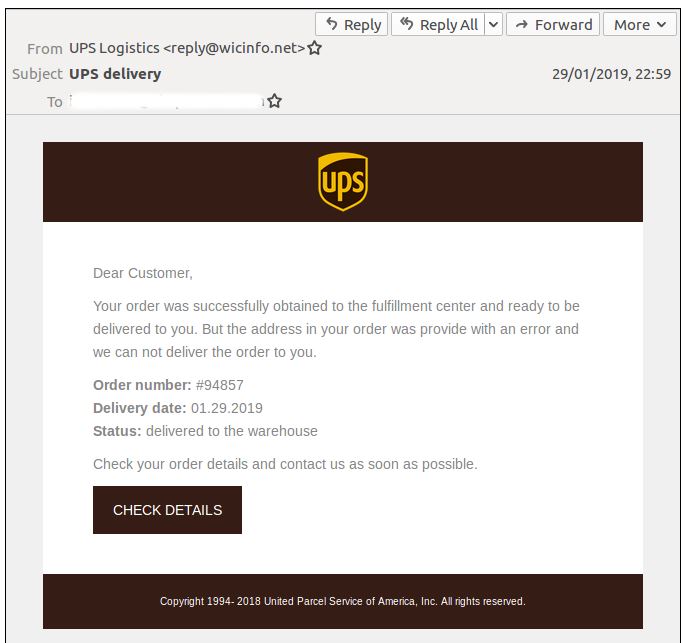
The fake UPS message used in a Jan. 29 Gand Crab malware spam campaign. Source: Virusbulletin.
Grooten told KrebsOnSecurity he suspects criminals may have succeeded at actually compromising several of GoDaddy’s hosted DNS servers. For one thing, he said, the same pair (sometimes two pairs) of name servers keep appearing in the same campaign.
“In quite a few campaigns we saw domains used that were alphabetically close, [and] there are other domains used that had moved away from GoDaddy before these campaigns, yet were still used,” Grooten said. “It’s also interesting to note that hundreds — and perhaps thousands — of domains had their DNS changed within a short period of time. Such a thing is hard to do if you have to log into individual accounts.”
GoDaddy did not respond to requests for comment about the possibility of a breach explaining the continuing abuse of its DNS services.
First emerging in early 2018, Gand Crab has been dubbed “the most popular multi-million dollar ransomware of the year.” Last week, KrebsOnSecurity was contacted by a company hit with Gand Crab in late January after an employee was taken in by what appears to be the same campaign detailed by Virusbulletin.
Charlene Price is co-owner of A.S. Price Mechanical, a small metal fabrication business in Gilbert, South Carolina. Price said an employee was tricked into infecting one of their hard drives with Gand Crab, which encrypted the drive and demanded $2,000 in bitcoin for a key needed to unlock the files.
While Price and her husband consulted with tech experts and debated what to do next, the extortionists doubled the ransom demand to $4,000.
Sites like nomoreransom.org distribute free tools and tutorials that can help some ransomware victims recover their files without paying a ransom demand, but those tools often only work with specific versions of a particular ransomware strain. Price said the tool nomoreransom.org made available for Gand Crab infections was unable to decrypt the files on her scrambled hard drive.
“It’s not fair or right and this is unjust,” Price said. “We have accepted the fact, for now, that we are just locked out our company’s information. We know nothing about this type of issue other than we have to pay it or just start again.”
from Krebs on Security http://bit.ly/2D6zxui
via IFTTT



 Pacosite's Blog