Timeshare Owner? The Mexican Drug Cartels Want You

The FBI is warning timeshare owners to be wary of a prevalent telemarketing scam involving a violent Mexican drug cartel that tries to trick elderly people into believing someone wants to buy their property. This is the story of a couple who recently lost more than $50,000 to an ongoing timeshare scam that spans at least two dozen phony escrow, title and realty firms.

One of the phony real estate companies trying to scam elderly people out of money over fake offers to buy their timeshares.

One evening in late 2022, someone phoned Mr. & Mrs. Dimitruk, a retired couple from Ontario, Canada and asked whether they’d ever considered selling their timeshare in Florida. The person on the phone referenced their timeshare address and said they had an interested buyer in Mexico. Would they possibly be interested in selling it?

The Dimitruks had purchased the timeshare years ago, but it wasn’t fully paid off — they still owed roughly $5,000 before they could legally sell it. That wouldn’t be an issue for this buyer, the man on the phone assured them.

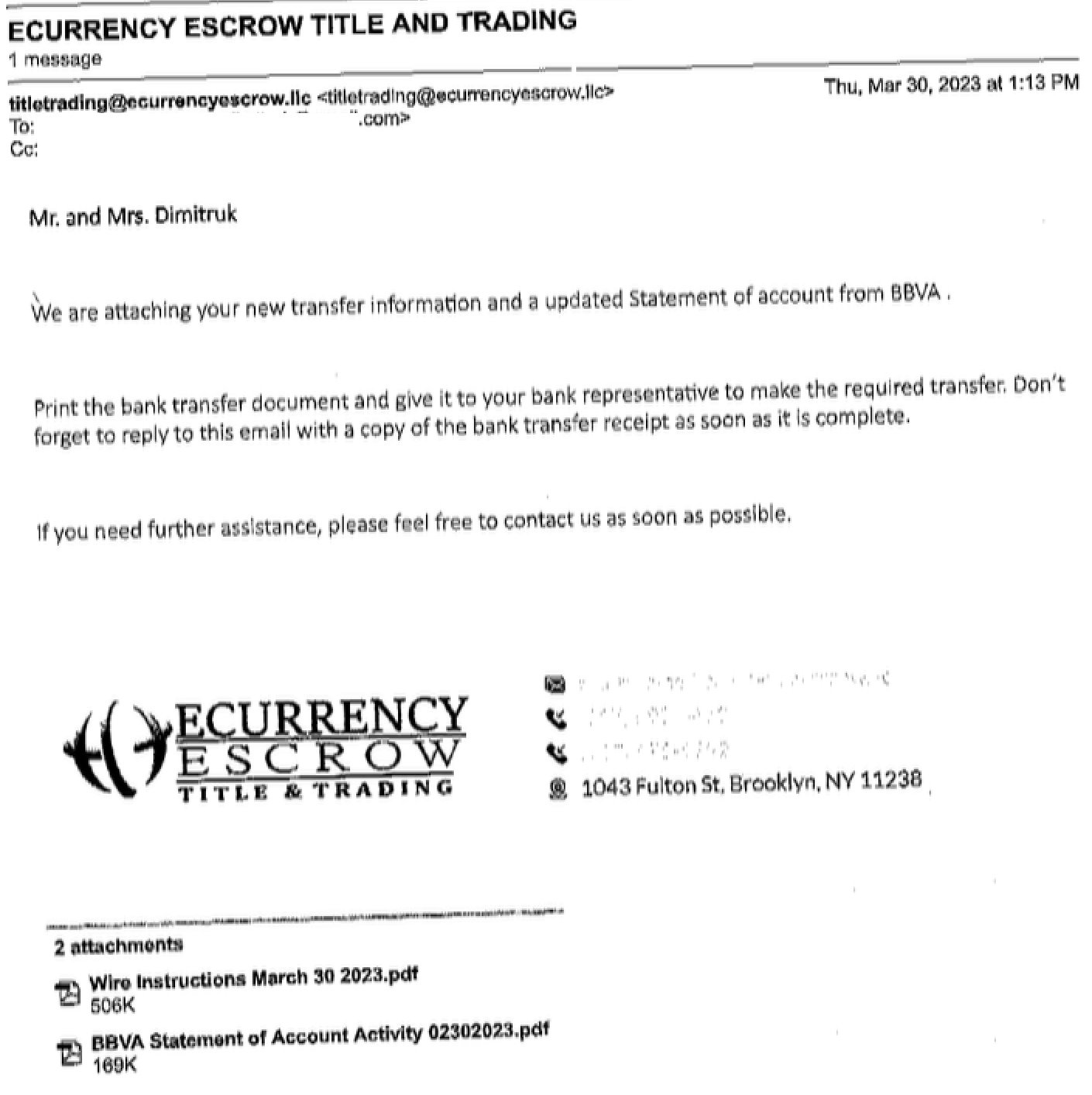
With a few days, their contact at a escrow company in New York called ecurrencyescrow[.]llc faxed them forms to fill out and send back to start the process of selling their timeshare to the potential buyer, who had offered an amount that was above what the property was likely worth.

After certain forms were signed and faxed, the Dimitruks were asked to send a small wire transfer of more than $3,000 to handle “administrative” and “processing” fees, supposedly so that the sale would not be held up by any bureaucratic red tape down in Mexico.

These document exchanges went on for almost a year, during which time the real estate brokers made additional financial demands, such as tax payments on the sale, and various administrative fees. Ms. Dimitruk even sent them a $5,000 wire to pay off her remaining balance on the timeshare they thought they were selling.

In a phone interview with KrebsOnSecurity, Mr. Dimitruk said they lost over $50,000.

“They kept calling me after that saying, ‘Hey your money is waiting for you here’,” said William Dimitruk, a 73-year-old retired long-haul truck driver. “They said ‘We’re going to get in trouble if the money isn’t returned to you,’ and gave me a toll-free number to call them at.”

In the last call he had with the scammers, the man on the other end of the line confessed that some bad people had worked for them previously, but that those employees had been fired.

“Near the end of the call he said, ‘You’ve been dealing with some bad people and we fired all those bad guys,’” Dimitruk recalled. “So they were like, yeah it’s all good. You can go ahead and pay us more and we’ll send you your money.”

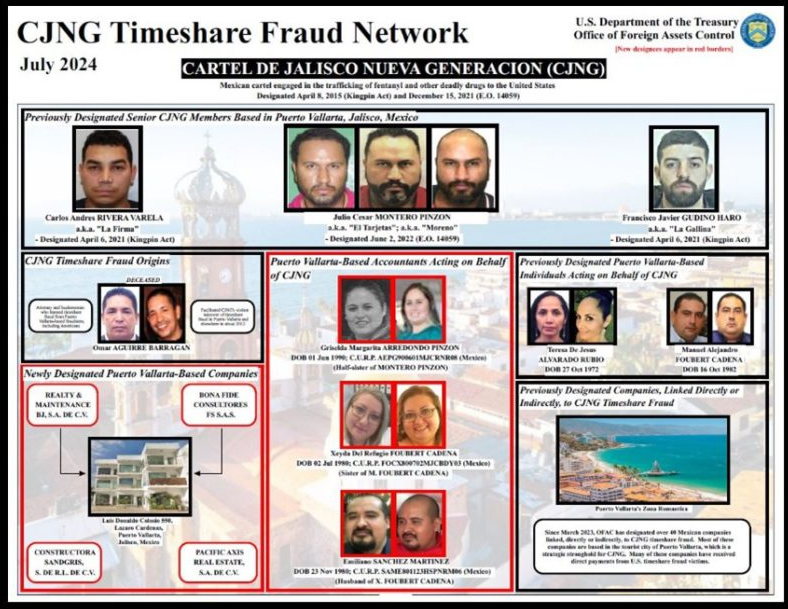
According to the FBI, there are indeed some very bad people behind these scams. The FBI warns the timeshare fraud schemes have been linked to the Jalisco New Generation drug cartel in Mexico.

In July 2024, the FBI and the Treasury Department’s Financial Crimes Enforcement Network (FinCEN) warned the Jalisco cartel is running boiler room-like call centers that target elderly people who own timeshares:

“Mexico-based [transnational criminal organizations] such as the Jalisco New Generation Cartel are increasingly targeting U.S. owners of timeshares in Mexico through complex and often yearslong telemarketing, impersonation, and advance fee schemes. They use the illicit proceeds to diversify their revenue streams and finance other criminal activities, including the manufacturing and trafficking of illicit fentanyl and other synthetic drugs into the United States.”

A July 2024 CBS News story about these scams notes that U.S. and Mexican officials last year confirmed that as many as eight young workers were confirmed dead after they apparently tried to quit jobs at a call center operated by the Jalisco cartel.

Source: US Department of the Treasury’s Office of Foreign Assets Control.

The phony escrow company the Dimitruks dealt with — ecurrencyescrow[.]llc — is no longer online. But the documents sent by their contact there referenced a few other still-active domains, including realestateassetsllc[.]com

The original registration records of both of these domains reference another domain — datasur[.]host — that is associated with dozens of other real estate and escrow-themed domains going back at least four years. Some of these domains are no longer active, while others have been previously suspended at different hosting providers.

061nyr[.]net
061-newyorkrealty[.]net
1nydevelopersgroupllc[.]com
1oceanrealtyllc[.]com
advancedclosingservicesllc[.]com
americancorporatetitle[.]com
asesorialegalsiglo[.]com
atencion-tributaria.[]com
carolinasctinc[.]net
closingandsettlementservices[.]com
closingandsettlementsllc[.]com
closingsettlementllc[.]com
crefaescrowslimited[.]net
ecurrencyescrow[.]llc
empirerllc[.]com
fiduciarocitibanamex[.]com
fondosmx[.]org
freightescrowcollc[.]com
goldmansachs-investment[.]com
hgvccorp[.]com
infodivisionfinanciera[.]com
internationaladvisorllc[.]com
jadehillrealtyllc[.]com
lewisandassociaterealty[.]com
nyreputable[.]org
privateinvestment.com[.]co
realestateassetsllc[.]com
realestateisinc[.]com
settlementandmanagement[.]com
stllcservices[.]com
stllcservices[.]net
thebluehorizonrealtyinc[.]com
walshrealtyny[.]net
windsorre[.]com

By loading ecurrencyescrowllc[.]com into the Wayback Machine at archive.org, we can see text at the top of the page that reads, “Visit our resource library for videos and tools designed to make managing your escrow disbursements a breeze.”

Searching on that bit of text at publicwww.com shows the same text appears on the website of an escrow company called Escshieldsecurity Network (escshieldsecurity[.]com). This entity claims to have been around since 2009, but the domain itself is less than two years old, and there is no contact information associated with the site. The Pennsylvania Secretary of State also has no record of a business by this name at its stated address.

Incredibly, Escshieldsecurity pitches itself as a solution to timeshare closing scams.

“By 2015, cyber thieves had realized the amount of funds involved and had targeted the real estate, title and settlement industry,” the company’s website states. “As funding became more complex and risky, agents and underwriters had little time or resources to keep up. The industry needed a simple solution that allowed it to keep pace with new funding security needs.”

The domains associated with this scam will often reference legitimate companies and licensed professionals in the real estate and closing businesses, but those real professionals often have no idea they’re being impersonated until someone starts asking around. The truth is, the original reader tip that caused KrebsOnSecurity to investigate this scheme came from one such professional whose name and reputation was being used to scam others.

It is unclear whether the Dimitruks were robbed by people working for the Jalisco cartel, but it is clear that whoever is responsible for managing many of the above-mentioned domains — including the DNS provider datasur[.]host — recently compromised their computer with information-stealing malware.

That’s according to data collected by the breach tracking service Constella Intelligence [Constella is currently an advertiser on KrebsOnSecurity]. Constella found that someone using the email address exposed in the DNS records for datasur[.]host — jyanes1920@gmail.com — also was relieved of credentials for managing most of the domains referenced above at a Mexican hosting provider.

It’s not unusual for victims of such scams to keep mum about their misfortune. Sometimes, it’s shame and embarrassment that prevents victims from filing a report with the local authorities. But in this case, victims who learn they’ve been robbed by a violent drug cartel have even more reason to remain silent.

William Dimitruk acknowledged that he and his wife haven’t yet filed a police report. But after acknowledging it could help prevent harm to other would-be victims, Mr. Dimitruk said he would consider it.

There is another reason victims of scams like this should notify authorities: Occasionally, the feds will bust up one of these scam operations and seize funds that were stolen from victims. But those investigations can take years, and it can be even more years before the government starts trying to figure out who got scammed and how to remunerate victims. All too often, the real impediment to returning some of those losses is that the feds have no idea who the victims are.

If you are the victim of a timeshare scam like this, please consider filing a report with the FBI’s Internet Crime Complaint Center (IC3), at ic3.gov. Other places where victims may wish to file a complaint:

Federal Trade Commission – https://www.ftccomplaintassistant.gov
International Consumer Protection and Enforcement Network – https://www.econsumer.gov/en
Profeco – Mexican Attorney General – https://consulmex.sre.gob.mx/montreal/index.php/en/foreigners/services-foreigners/318-consumer-protection

from Krebs on Security https://ift.tt/InYJRxa
via IFTTT

This Windows PowerShell Phish Has Scary Potential

Many GitHub users this week received a novel phishing email warning of critical security holes in their code. Those who clicked the link for details were asked to distinguish themselves from bots by pressing a combination of keyboard keys that causes Microsoft Windows to download password-stealing malware. While it’s unlikely that many programmers fell for this scam, it’s notable because less targeted versions of it are likely to be far more successful against the average Windows user.

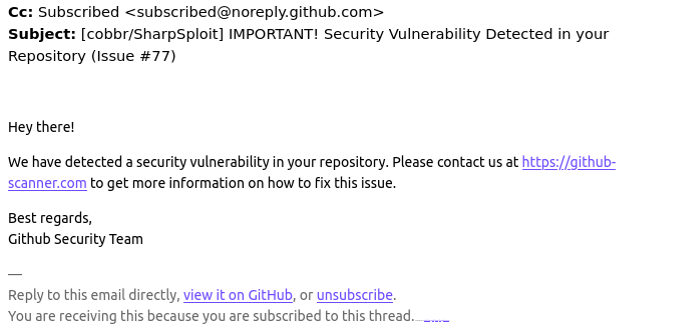
A reader named Chris shared an email he received this week that spoofed GitHub’s security team and warned: “Hey there! We have detected a security vulnerability in your repository. Please contact us at https://github-scanner%5B.%5Dcom to get more information on how to fix this issue.”

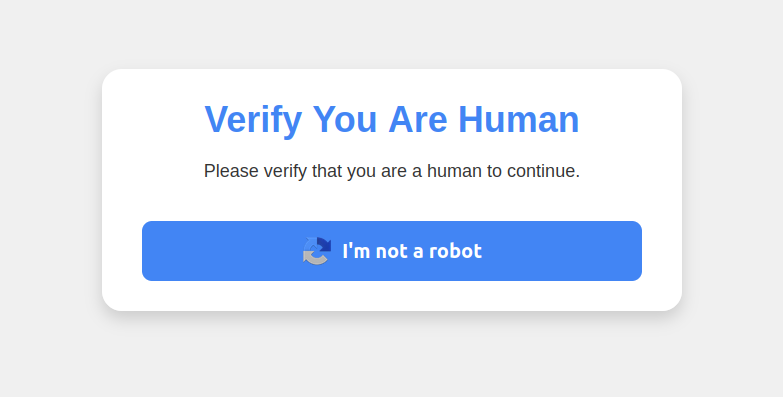
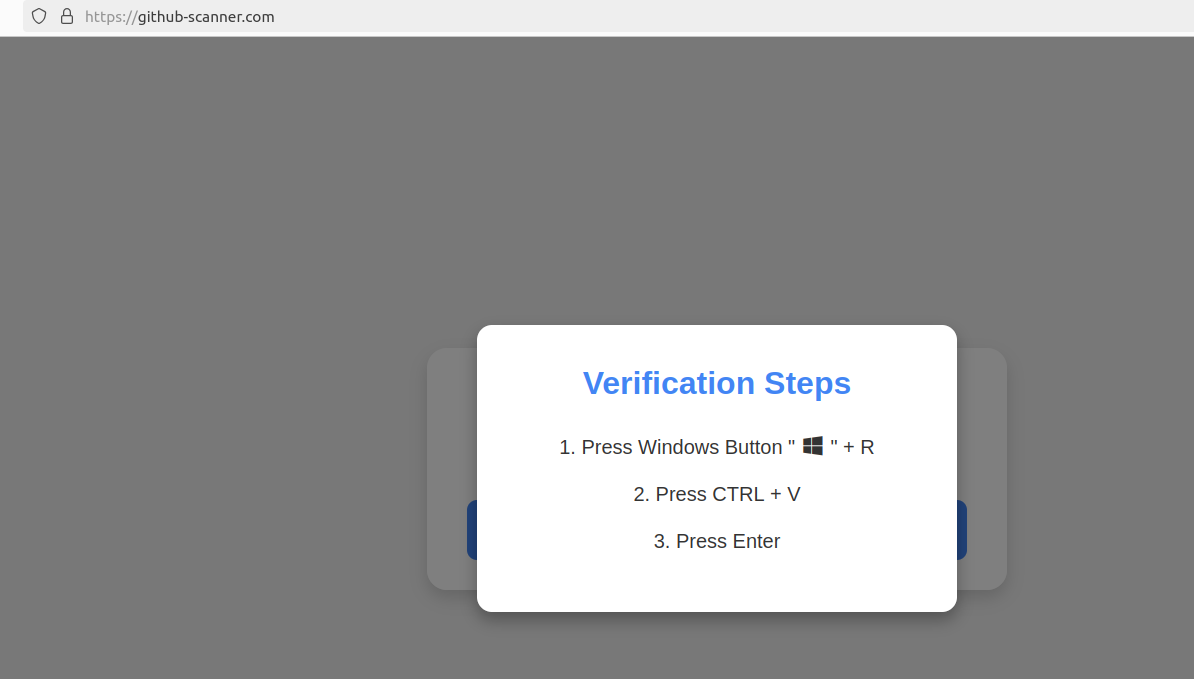
Visiting that link generates a web page that asks the visitor to “Verify You Are Human” by solving an unusual CAPTCHA.

This malware attack pretends to be a CAPTCHA intended to separate humans from bots.

Clicking the “I’m not a robot” button generates a pop-up message asking the user to take three sequential steps to prove their humanity. Step 1 involves simultaneously pressing the keyboard key with the Windows icon and the letter “R,” which opens a Windows “Run” prompt that will execute any specified program that is already installed on the system.

Executing this series of keypresses prompts the built-in Windows Powershell to download password-stealing malware.

Step 2 asks the user to press the “Control” key and the letter “V” at the same time, which pastes malicious code from the site’s virtual clipboard.

Step 3 — pressing the “Enter” key — causes Windows to launch a PowerShell command, and then fetch and execute a malicious file from github-scanner[.]com called “l6e.exe.”

PowerShell is a powerful, cross-platform automation tool built into Windows that is designed to make it simpler for administrators to automate tasks on a PC or across multiple computers on the same network.

According to an analysis at the malware scanning service Virustotal.com, the malicious file downloaded by the pasted text is called Lumma Stealer, and it’s designed to snarf any credentials stored on the victim’s PC.

This phishing campaign may not have fooled many programmers, who no doubt natively understand that pressing the Windows and “R” keys will open up a “Run” prompt, or that Ctrl-V will dump the contents of the clipboard.

But I bet the same approach would work just fine to trick some of my less tech-savvy friends and relatives into running malware on their PCs. I’d also bet none of these people have ever heard of PowerShell, let alone had occasion to intentionally launch a PowerShell terminal.

Given those realities, it would be nice if there were a simple way to disable or at least heavily restrict PowerShell for normal end users for whom it could become more of a liability.

However, Microsoft strongly advises against nixing PowerShell because some core system processes and tasks may not function properly without it. What’s more, doing so requires tinkering with sensitive settings in the Windows registry, which can be a dicey undertaking even for the learned.

Still, it wouldn’t hurt to share this article with the Windows users in your life who fit the less-savvy profile. Because this particular scam has a great deal of room for growth and creativity.

from Krebs on Security https://ift.tt/mD2MjSG
via IFTTT

Scam ‘Funeral Streaming’ Groups Thrive on Facebook

Scammers are flooding Facebook with groups that purport to offer video streaming of funeral services for the recently deceased. Friends and family who follow the links for the streaming services are then asked to cough up their credit card information. Recently, these scammers have branched out into offering fake streaming services for nearly any kind of event advertised on Facebook. Here’s a closer look at the size of this scheme, and some findings about who may be responsible.

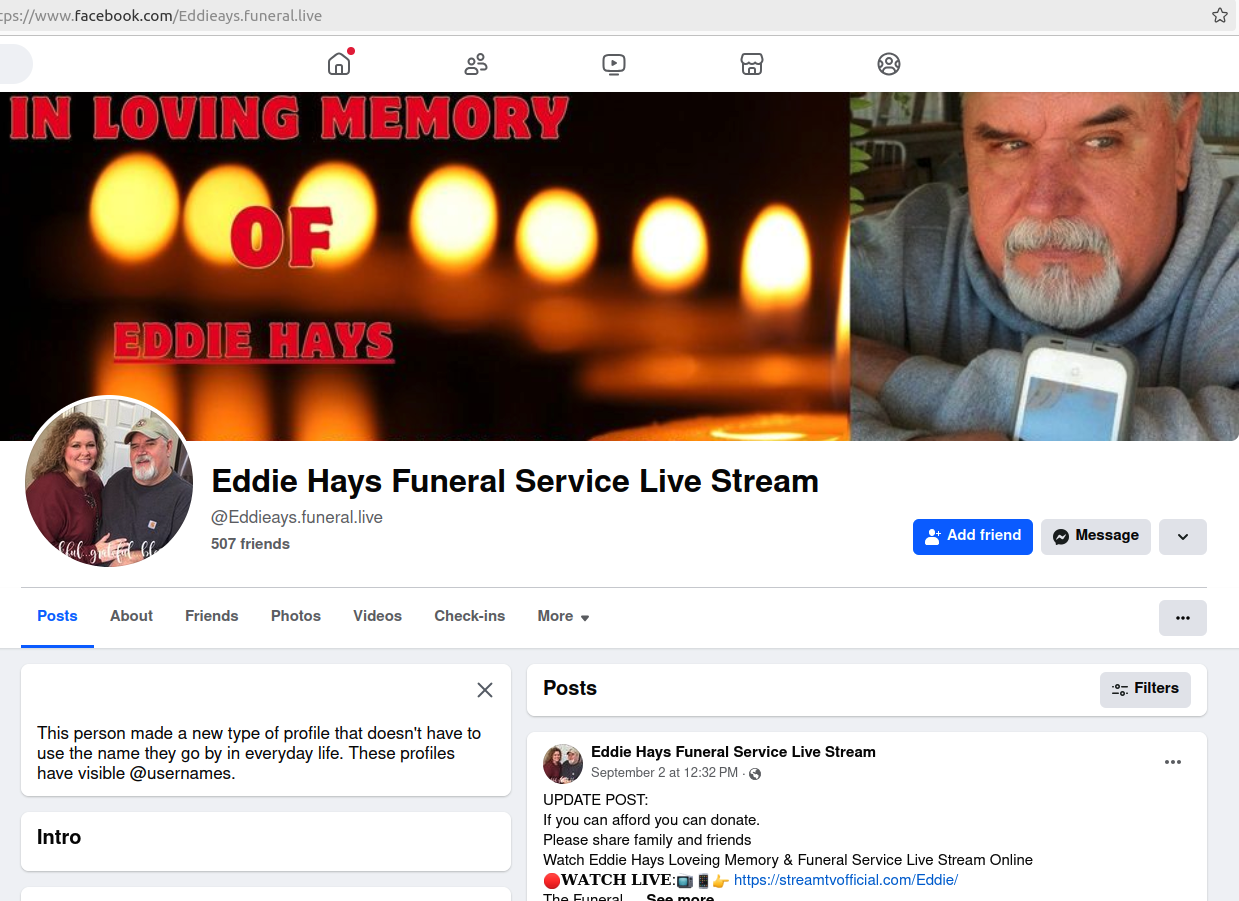
One of the many scam funeral group pages on Facebook. Clicking to view the “live stream” of the funeral takes one to a newly registered website that requests credit card information.

KrebsOnSecurity recently heard from a reader named George who said a friend had just passed away, and he noticed that a Facebook group had been created in that friend’s memory. The page listed the correct time and date of the funeral service, which it claimed could be streamed over the Internet by following a link that led to a page requesting credit card information.

“After I posted about the site, a buddy of mine indicated [the same thing] happened to her when her friend passed away two weeks ago,” George said.

Searching Facebook/Meta for a few simple keywords like “funeral” and “stream” reveals countless funeral group pages on Facebook, some of them for services in the past and others erected for an upcoming funeral.

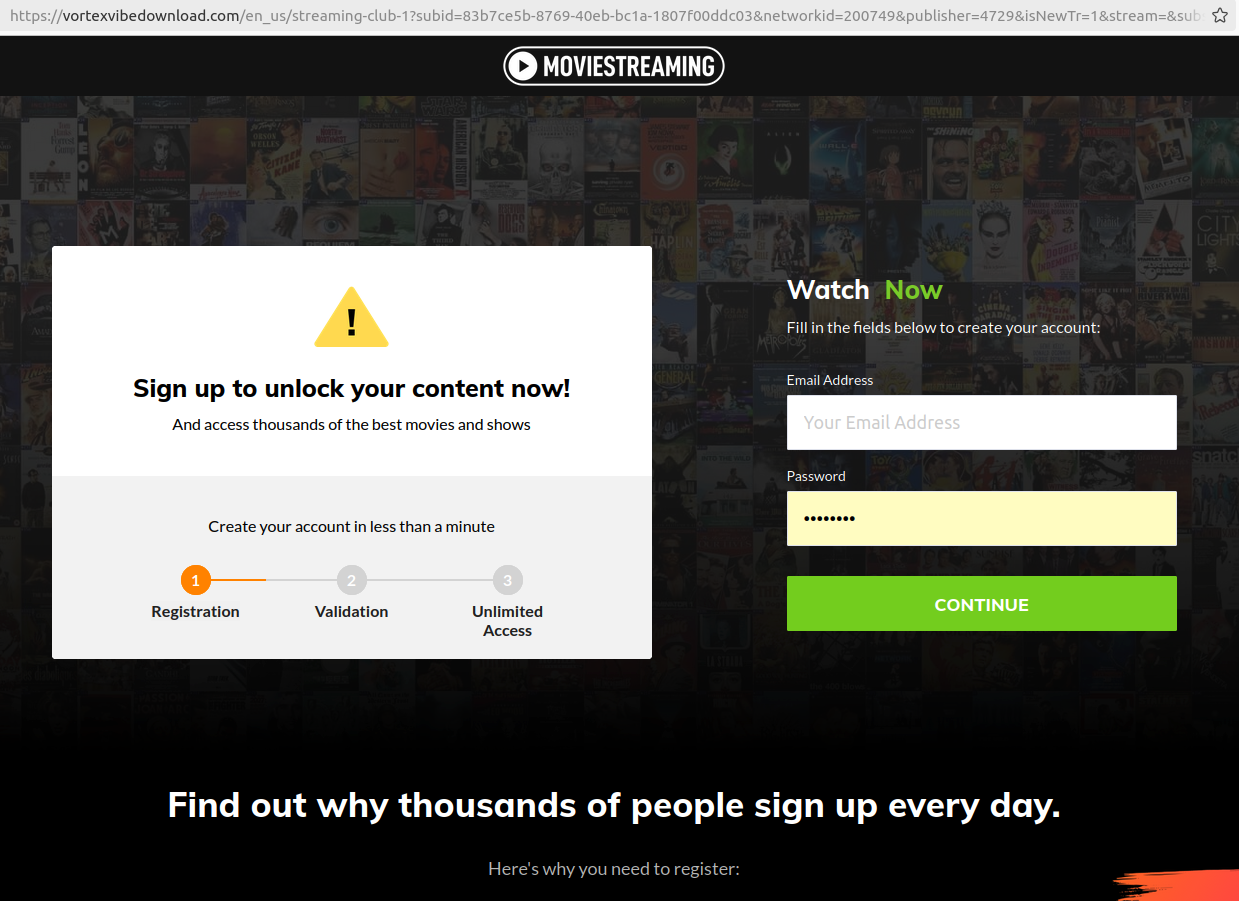
All of these groups include images of the deceased as their profile photo, and seek to funnel users to a handful of newly-registered video streaming websites that require a credit card payment before one can continue. Even more galling, some of these pages request donations in the name of the deceased.

It’s not clear how many Facebook users fall for this scam, but it’s worth noting that many of these fake funeral groups attract subscribers from at least some of the deceased’s followers, suggesting those users have subscribed to the groups in anticipation of the service being streamed. It’s also unclear how many people end up missing a friend or loved one’s funeral because they mistakenly thought it was being streamed online.

One of many look-alike landing pages for video streaming services linked to scam Facebook funeral groups.

George said their friend’s funeral service page on Facebook included a link to the supposed live-streamed service at livestreamnow[.]xyz, a domain registered in November 2023.

According to DomainTools.com, the organization that registered this domain is called “apkdownloadweb,” is based in Rajshahi, Bangladesh, and uses the DNS servers of a Web hosting company in Bangladesh called webhostbd[.]net.

A search on “apkdownloadweb” in DomainTools shows three domains registered to this entity, including live24sports[.]xyz and onlinestreaming[.]xyz. Both of those domains also used webhostbd[.]net for DNS. Apkdownloadweb has a Facebook page, which shows a number of “live video” teasers for sports events that have already happened, and says its domain is apkdownloadweb[.]com.

Livestreamnow[.]xyz is currently hosted at a Bangladeshi web hosting provider named cloudswebserver[.]com, but historical DNS records show this website also used DNS servers from webhostbd[.]net.

The Internet address of livestreamnow[.]xyz is 148.251.54.196, at the hosting giant Hetzner in Germany. DomainTools shows this same Internet address is home to nearly 6,000 other domains (.CSV), including hundreds that reference video streaming terms, like watchliveon24[.]com and foxsportsplus[.]com.

There are thousands of domains at this IP address that include or end in the letters “bd,” the country code top-level domain for Bangladesh. Although many domains correspond to websites for electronics stores or blogs about IT topics, just as many contain a fair amount of placeholder content (think “lorem ipsum” text on the “contact” page). In other words, the sites appear legitimate at first glance, but upon closer inspection it is clear they are not currently used by active businesses.

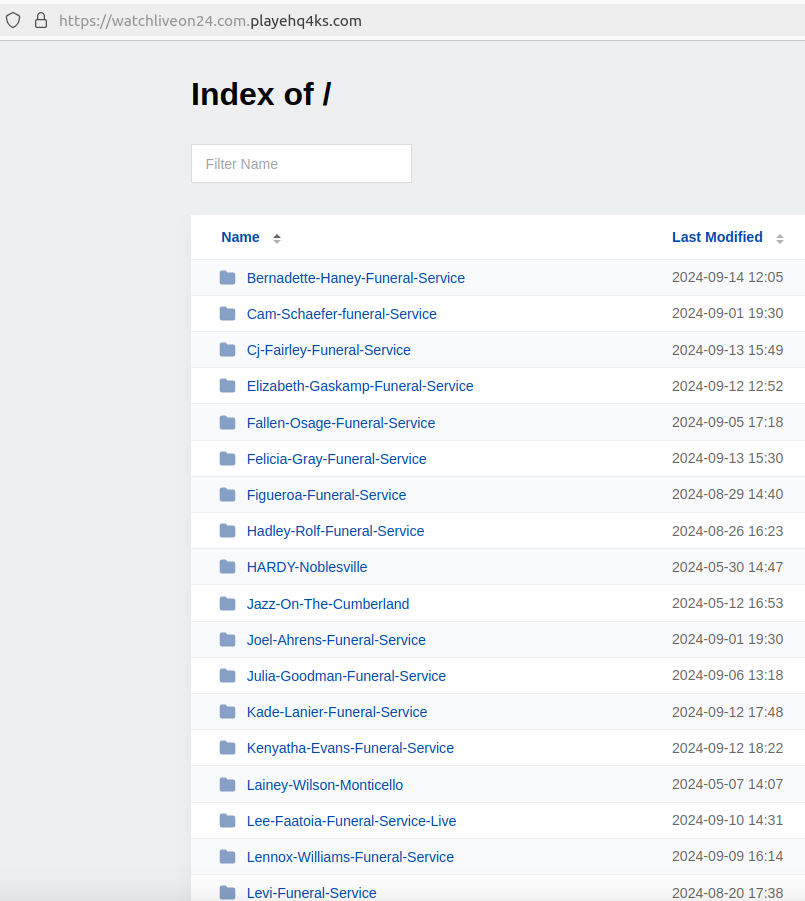
The passive DNS records for 148.251.54.196 show a surprising number of results that are basically two domain names mushed together. For example, there is watchliveon24[.]com.playehq4ks[.]com, which displays links to multiple funeral service streaming groups on Facebook.

Another combined domain on the same Internet address — livestreaming24[.]xyz.allsportslivenow[.]com — lists dozens of links to Facebook groups for funerals, but also for virtually all types of events that are announced or posted about by Facebook users, including graduations, concerts, award ceremonies, weddings, and rodeos.

Even community events promoted by state and local police departments on Facebook are fair game for these scammers. A Facebook page maintained by the police force in Plympton, Mass. for a town social event this summer called Plympton Night Out was quickly made into two different Facebook groups that informed visitors they could stream the festivities at either espnstreamlive[.]co or skysports[.]live.

WHO’S BEHIND THE FAKEBOOK FUNERALS?

Recall that the registrant of livestreamnow[.]xyz — the bogus streaming site linked in the Facebook group for George’s late friend — was an organization called “Apkdownloadweb.” That entity’s domain — apkdownloadweb[.]com — is registered to a Mazidul Islam in Rajshahi, Bangladesh (this domain is also using Webhostbd[.]net DNS servers).

Mazidul Islam’s LinkedIn page says he is the organizer of a now defunct IT blog called gadgetsbiz[.]com, which DomainTools finds was registered to a Mehedi Hasan from Rajshahi, Bangladesh.

To bring this full circle, DomainTools finds the domain name for the DNS provider on all of the above-mentioned sites  — webhostbd[.]net — was originally registered to a Md Mehedi, and to the email address webhostbd.net@gmail.com (“MD” is a common abbreviation for Muhammad/Mohammod/Muhammed).

A search on that email address at Constella finds a breached record from the data broker Apollo.io saying its owner’s full name is Mohammod Mehedi Hasan. Unfortunately, this is not a particularly unique name in that region of the world.

But as luck would have it, sometime last year the administrator of apkdownloadweb.com managed to infect their Windows PC with password-stealing malware. We know this because the raw logs of data stolen from this administrator’s PC were indexed by the breach tracking service Constella Intelligence [full disclosure: As of this month, Constella is an advertiser on this website].

These so-called “stealer logs” are mostly generated by opportunistic infections from information-stealing trojans that are sold on cybercrime markets. A typical set of logs for a compromised PC will include any usernames and passwords stored in any browser on the system, as well as a list of recent URLs visited and files downloaded.

Malware purveyors will often deploy infostealer malware by bundling it with “cracked” or pirated software titles. Indeed, the stealer logs for the administrator of apkdownloadweb[.]com show this user’s PC became infected immediately after they downloaded a booby-trapped mobile application development toolkit.

Those stolen credentials indicate Apkdownloadweb[.]com is maintained by a 20-something native of Dhaka, Bangladesh named Mohammod Abdullah Khondokar.

The “browser history” folder from the admin of Apkdownloadweb shows Khondokar recently left a comment on the Facebook page of Mohammod Mehedi Hasan, and Khondokar’s Facebook profile says the two are friends.

Neither MD Hasan nor MD Abdullah Khondokar responded to requests for comment. KrebsOnSecurity also sought comment from Meta.

from Krebs on Security https://ift.tt/OpgkJMy
via IFTTT

The Dark Nexus Between Harm Groups and ‘The Com’

A cyberattack that shut down two of the top casinos in Las Vegas last year quickly became one of the most riveting security stories of 2023: It was the first known case of native English-speaking hackers in the United States and Britain teaming up with ransomware gangs based in Russia. But that made-for-Hollywood narrative has eclipsed a far more hideous trend: Many of these young, Western cybercriminals are also members of fast-growing online groups that exist solely to bully, stalk, harass and extort vulnerable teens into physically harming themselves and others.

Image: Shutterstock.

In September 2023, a Russian ransomware group known as ALPHV/Black Cat claimed credit for an intrusion at the MGM Resorts hotel chain that quickly brought MGM’s casinos in Las Vegas to a standstill. While MGM was still trying to evict the intruders from its systems, an individual who claimed to have firsthand knowledge of the hack contacted multiple media outlets to offer interviews about how it all went down.

One account of the hack came from a 17-year-old in the United Kingdom, who told reporters the intrusion began when one of the English-speaking hackers phoned a tech support person at MGM and tricked them into resetting the password for an employee account.

The security firm CrowdStrike dubbed the group “Scattered Spider,” a recognition that the MGM hackers came from different hacker cliques scattered across an ocean of Telegram and Discord servers dedicated to financially-oriented cybercrime.

Collectively, this archipelago of crime-focused chat communities is known as “The Com,” and it functions as a kind of distributed cybercriminal social network that facilitates instant collaboration.

But mostly, The Com is a place where cybercriminals go to boast about their exploits and standing within the community, or to knock others down a peg or two. Top Com members are constantly sniping over who pulled off the most impressive heists, or who has accumulated the biggest pile of stolen virtual currencies.

And as often as they extort victim companies for financial gain, members of The Com are constantly trying to wrest stolen money from their cybercriminal rivals — often in ways that spill over into physical violence in the real world.

CrowdStrike would go on to produce and sell Scattered Spider action figures, and it featured a life-sized Scattered Spider sculpture at this year’s RSA Security Conference in San Francisco.

But marketing security products and services based on specific cybercriminal groups can be tricky, particularly if it turns out that robbing and extorting victims is by no means the most abhorrent activity those groups engage in on a daily basis.

KrebsOnSecurity examined the Telegram user ID number of the account that offered media interviews about the MGM hack — which corresponds to the screen name “@Holy” — and found the same account was used across a number of cybercrime channels that are entirely focused on extorting young people into harming themselves or others, and recording the harm on video.

In one post on a Telegram channel dedicated to youth extortion, this same user can be seen asking if anyone knows the current Telegram handles for several core members of 764, an extremist group known for victimizing children through coordinated online campaigns of extortion, doxing, swatting and harassment.

HOLY NAZI

Holy was known to possess multiple prized Telegram usernames, including @bomb, @halo, and @cute, as well as one of the highest-priced Telegram usernames ever put up for sale: @nazi. A source close to the investigation said @Holy also was a moderator on “Harm Nation,” an offshoot of 764.

People affiliated with harm groups like 764 will often recruit new members by lurking on gaming platforms, social media sites and mobile applications that are popular with young people, including Discord, Minecraft, Roblox, Steam, Telegram, and Twitch.

“This type of offence usually starts with a direct message through gaming platforms and can move to more private chatrooms on other virtual platforms, typically one with video enabled features, where the conversation quickly becomes sexualized or violent,” warns a recent alert from the Royal Canadian Mounted Police (RCMP) about the rise of sextortion groups on social media channels.

“One of the tactics being used by these actors is sextortion, however, they are not using it to extract money or for sexual gratification,” the RCMP continued. “Instead they use it to further manipulate and control victims to produce more harmful and violent content as part of their ideological objectives and radicalization pathway.”

The 764 network is among the most populated harm communities, but there are plenty more. Some of the largest such known groups include CVLT, Court, Kaskar, Leak Society, 7997, 8884, 2992, 6996, 555, Slit Town, 545, 404, NMK, 303, and H3ll.

In March, a consortium of reporters from Wired, Der Spiegel, Recorder and The Washington Post examined millions of messages across more than 50 Discord and Telegram chat groups.

“The abuse perpetrated by members of com groups is extreme,” Wired’s Ali Winston wrote. “They have coerced children into sexual abuse or self-harm, causing them to deeply lacerate their bodies to carve ‘cutsigns’ of an abuser’s online alias into their skin.” The story continues:

“Victims have flushed their heads in toilets, attacked their siblings, killed their pets, and in some extreme instances, attempted or died by suicide. Court records from the United States and European nations reveal participants in this network have also been accused of robberies, in-person sexual abuse of minors, kidnapping, weapons violations, swatting, and murder.”

“Some members of the network extort children for sexual pleasure, some for power and control. Some do it merely for the kick that comes from manipulation. Others sell the explicit CSAM content produced by extortion on the dark web.”

KrebsOnSecurity has learned Holy’s real name is Owen David Flowers, and that he is the previously unnamed 17-year-old who was arrested in July 2024 by the U.K.’s West Midlands Police as part of a joint investigation with the FBI into the MGM hack.

Early in their cybercriminal career (as a 15-year-old), @Holy went by the handle “Vsphere,” and was a proud member of the LAPSUS$ cybercrime group. Throughout 2022, LAPSUS$ would hack and social engineer their way into some of the world’s biggest technology companies, including EA Games, Microsoft, NVIDIA, Okta, Samsung, and T-Mobile.

JUDISCHE/WAIFU

Another timely example of the overlap between harm communities and top members of The Com can be found in a group of criminals who recently stole obscene amounts of customer records from users of the cloud data provider Snowflake.

At the end of 2023, malicious hackers figured out that many major companies have uploaded massive amounts of valuable and sensitive customer data to Snowflake servers, all the while protecting those Snowflake accounts with little more than a username and password (no multi-factor authentication required). The group then searched darknet markets for stolen Snowflake account credentials, and began raiding the data storage repositories used by some of the world’s largest corporations.

Among those that had data exposed in Snowflake was AT&T, which disclosed in July that cybercriminals had stolen personal information and phone and text message records for roughly 110 million people — nearly all its customers.

A report on the extortion group from the incident response firm Mandiant notes that Snowflake victim companies were privately approached by the hackers, who demanded a ransom in exchange for a promise not to sell or leak the stolen data. All told, more than 160 organizations were extorted, including TicketMaster, Lending Tree, Advance Auto Parts and Neiman Marcus.

On May 2, 2024, a user by the name “Judische” claimed on the fraud-focused Telegram channel Star Chat that they had hacked Santander Bank, one of the first known Snowflake victims. Judische would repeat that claim in Star Chat on May 13 — the day before Santander publicly disclosed a data breach — and would periodically blurt out the names of other Snowflake victims before their data even went up for sale on the cybercrime forums.

A careful review of Judische’s account history and postings on Telegram shows this user is more widely known under the nickname “Waifu,” an early moniker that corresponds to one of the more accomplished SIM-swappers in The Com over the years.

In a SIM-swapping attack, the fraudsters will phish or purchase credentials for mobile phone company employees, and use those credentials to redirect a target’s mobile calls and text messages to a device the attackers control.

Several channels on Telegram maintain a frequently updated leaderboard of the 100 richest SIM-swappers, as well as the hacker handles associated with specific cybercrime groups (Waifu is ranked #24). That leaderboard has long included Waifu on a roster of hackers for a group that called itself “Beige.”

Beige members were implicated in two stories published here in 2020. The first was an August 2020 piece called Voice Phishers Targeting Corporate VPNs, which warned that the COVID-19 epidemic had brought a wave of voice phishing or “vishing” attacks that targeted work-from-home employees via their mobile devices, and tricked many of those people into giving up credentials needed to access their employer’s network remotely.

Beige group members also have claimed credit for a breach at the domain registrar GoDaddy. In November 2020, intruders thought to be associated with the Beige Group tricked a GoDaddy employee into installing malicious software, and with that access they were able to redirect the web and email traffic for multiple cryptocurrency trading platforms.

The Telegram channels that Judische and his related accounts frequented over the years show this user divides their time between posting in SIM-swapping and cybercrime cashout channels, and harassing and stalking others in harm communities like Leak Society and Court.

Mandiant has attributed the Snowflake compromises to a group it calls “UNC5537,” with members based in North America and Turkey. KrebsOnSecurity has learned Judische is a 26-year-old software engineer in Ontario, Canada.

Sources close to the investigation into the Snowflake incident tell KrebsOnSecurity the UNC5537 member in Turkey is John Erin Binns, an elusive American man indicted by the U.S. Department of Justice (DOJ) for a 2021 breach at T-Mobile that exposed the personal information of at least 76.6 million customers.

Binns is currently in custody in a Turkish prison and fighting his extradition. Meanwhile, he has been suing almost every federal agency and agent that contributed investigative resources to his case.

In June 2024, a Mandiant employee told Bloomberg that UNC5537 members have made death threats against cybersecurity experts investigating the hackers, and that in one case the group used artificial intelligence to create fake nude photos of a researcher to harass them.

ViLE

In June 2024, two American men pleaded guilty to hacking into a U.S. Drug Enforcement Agency (DEA) online portal that tapped into 16 different federal law enforcement databasesSagar “Weep” Singh, a 20-year-old from Rhode Island, and Nicholas “Convict” Ceraolo, 25, of Queens, NY, were both active in SIM-swapping communities.

Singh and Ceraolo hacked into a number of foreign police department email accounts, and used them to make phony “emergency data requests” to social media platforms seeking account information about specific users they were stalking. According to the government, in each case the men impersonating the foreign police departments told those platforms the request was urgent because the account holders had been trading in child pornography or engaging in child extortion.

Eventually, the two men formed part of a group of cybercriminals known to its members as “ViLE,” who specialize in obtaining personal information about third-party victims, which they then used to harass, threaten or extort the victims, a practice known as “doxing.”

The U.S. government says Singh and Ceraolo worked closely with a third man — referenced in the indictment as co-conspirator #1 or “CC-1” — to administer a doxing forum where victims could pay to have their personal information removed.

The government doesn’t name CC-1 or the doxing forum, but CC-1’s hacker handle is “Kayte” (a.k.a. “KT“) which corresponds to the nickname of a 23-year-old man who lives with his parents in Coffs Harbor, Australia. For several years (with a brief interruption), KT has been the administrator of a truly vile doxing community known as the Doxbin.

A screenshot of the website for the cybercriminal group “ViLE.” Image: USDOJ.

People whose names and personal information appear on the Doxbin can quickly find themselves the target of extended harassment campaigns, account hacking, SIM-swapping and even swatting — which involves falsely reporting a violent incident at a target’s address to trick local police into responding with potentially deadly force.

A handful of Com members targeted by federal authorities have gone so far as to perpetrate swatting, doxing, and other harassment against the same federal agents who are trying to unravel their alleged crimes. This has led some investigators working cases involving the Com to begin redacting their names from affidavits and indictments filed in federal court.

In January 2024, KrebsOnSecurity broke the news that prosecutors in Florida had charged a 19-year-old alleged Scattered Spider member named Noah Michael Urban with wire fraud and identity theft. That story recounted how Urban’s alleged hacker identities “King Bob” and “Sosa” inhabited a world in which rival cryptocurrency theft rings frequently settled disputes through so-called “violence-as-a-service” offerings — hiring strangers online to perpetrate firebombings, beatings and kidnappings against their rivals.

Urban’s indictment is currently sealed. But a copy of the document obtained by KrebsOnSecurity shows the name of the federal agent who testified to it has been blacked out.
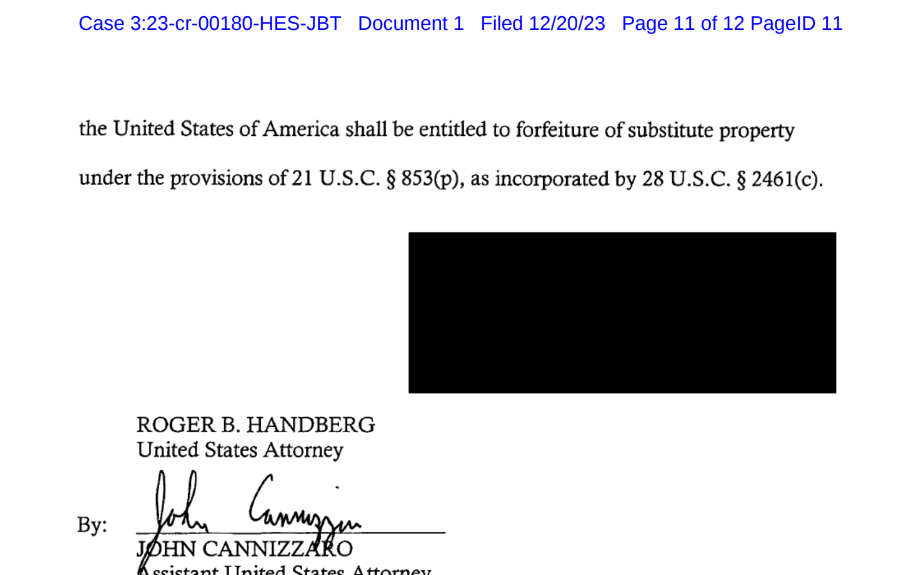
The final page of Noah Michael Urban’s indictment shows the investigating agent redacted their name from charging documents.

HACKING RINGS, STALKING VICTIMS

In June 2022, this blog told the story of two men charged with hacking into the Ring home security cameras of a dozen random people and then methodically swatting each of them. Adding insult to injury, the men used the compromised security cameras to record live footage of local police swarming those homes.
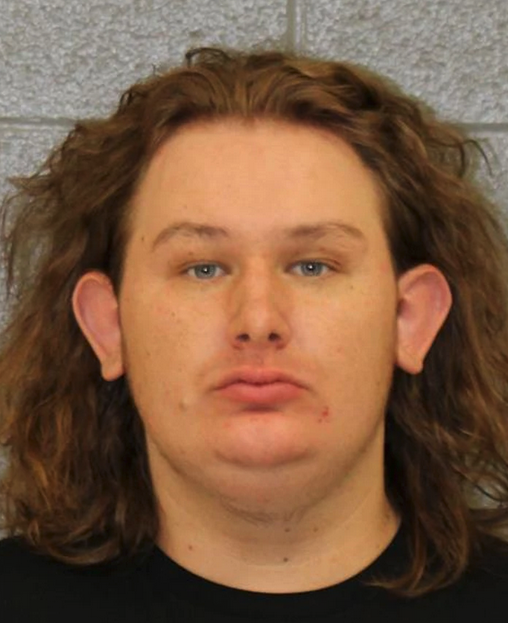
McCarty, in a mugshot.

James Thomas Andrew McCarty, Charlotte, N.C., and Kya Christian Nelson, of Racine, Wisc., conspired to hack into Yahoo email accounts belonging to victims in the United States. The two would check how many of those Yahoo accounts were associated with Ring accounts, and then target people who used the same password for both accounts.

The Telegram and Discord aliases allegedly used by McCarty — “Aspertaine” and “Couch,” among others — correspond to an identity that was active in certain channels dedicated to SIM-swapping.

What KrebsOnSecurity didn’t report at the time is that both ChumLul and Aspertaine were active members of CVLT, wherein those identities clearly participated in harassing and exploiting young teens online.

In June 2024, McCarty was sentenced to seven years in prison after pleading guilty to making hoax calls that elicited police SWAT responses. Nelson also pleaded guilty and received a seven-year prison sentence.

POMPOMPURIN

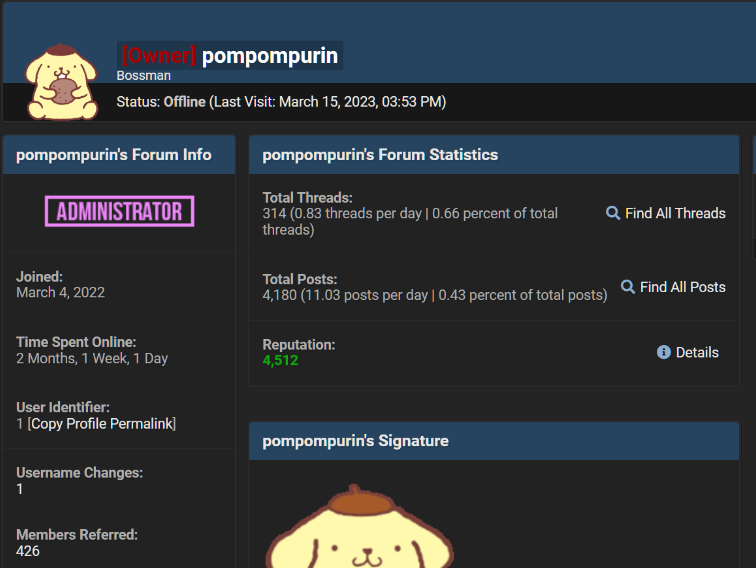
In March 2023, U.S. federal agents in New York announced they’d arrested “Pompompurin,” the alleged administrator of Breachforums, an English-language cybercrime forum where hacked corporate databases frequently appear for sale. In cases where the victim organization isn’t extorted in advance by hackers, being listed on Breachforums has often been the way many victims first learned of an intrusion.

Pompompurin had been a nemesis to the FBI for several years. In November 2021, KrebsOnSecurity broke the news that thousands of fake emails about a cybercrime investigation were blasted out from the FBI’s email systems and Internet addresses.

Pompompurin took credit for that stunt, and said he was able to send the FBI email blast by exploiting a flaw in an FBI portal designed to share information with state and local law enforcement authorities. The FBI later acknowledged that a software misconfiguration allowed someone to send the fake emails.

In December, 2022, KrebsOnSecurity detailed how hackers active on BreachForums had infiltrated the FBI’s InfraGard program, a vetted network designed to build cyber and physical threat information sharing partnerships with experts in the private sector. The hackers impersonated the CEO of a major financial company, applied for InfraGard membership in the CEO’s name, and were granted admission to the community.

The feds named Pompompurin as 21-year-old Peeksill resident Conor Brian Fitzpatrick, who was originally charged with one count of conspiracy to solicit individuals to sell unauthorized access devices (stolen usernames and passwords). But after FBI agents raided and searched the home where Fitzpatrick lived with his parents, prosecutors tacked on charges for possession of child pornography.
DOMESTIC TERRORISM?

Recent actions by the DOJ indicate the government is well aware of the significant overlap between leading members of The Com and harm communities. But the government also is growing more sensitive to the criticism that it can often take months or years to gather enough evidence to criminally charge some of these suspects, during which time the perpetrators can abuse and recruit countless new victims.

Late last year, however, the DOJ signaled a new tactic in pursuing leaders of harm communities like 764: Charging them with domestic terrorism.

In December 2023, the government charged (PDF) a Hawaiian man with possessing and sharing sexually explicit videos and images of prepubescent children being abused. Prosecutors allege Kalana Limkin, 18, of Hilo, Hawaii, admitted he was an associate of CVLT and 764, and that he was the founder of a splinter harm group called Cultist. Limkin’s Telegram profile shows he also was active on the harm community Slit Town.

The relevant citation from Limkin’s complaint reads:

“Members of the group ‘764’ have conspired and continue to conspire in both online and in-person venues to engage in violent actions in furtherance of a Racially Motivated Violent Extremist ideology, wholly or in part through activities that violate federal criminal law meeting the statutory definition of Domestic Terrorism, defined in Title 18, United States Code, § 2331.”

Experts say charging harm groups under anti-terrorism statutes potentially gives the government access to more expedient investigative powers than it would normally have in a run-of-the-mill criminal hacking case.

“What it ultimately gets you is additional tools you can use in the investigation, possibly warrants and things like that,” said Mark Rasch, a former U.S. federal cybercrime prosecutor and now general counsel for the New York-based cybersecurity firm Unit 221B. “It can also get you additional remedies at the end of the case, like greater sanctions, more jail time, fines and forfeiture.”

But Rasch said this tactic can backfire on prosecutors who overplay their hand and go after someone who ends up challenging the charges in court.

“If you’re going to charge a hacker or pedophile with a crime like terrorism, that’s going to make it harder to get a conviction,” Rasch said. “It adds to the prosecutorial burden and increases the likelihood of getting an acquittal.”

Rasch said it’s unclear where it is appropriate to draw the line in the use of terrorism statutes to disrupt harm groups online, noting that there certainly are circumstances where individuals can commit violations of domestic anti-terrorism statutes through their Internet activity alone.

“The Internet is a platform like any other, where virtually any kind of crime that can be committed in the real world can also be committed online,” he said. “That doesn’t mean all misuse of computers fits within the statutory definition of terrorism.”

The RCMP’s warning on sexual extortion of minors over the Internet lists a number of potential warning signs that teens may exhibit if they become immeshed in these harm groups. The FBI urges anyone who believes their child or someone they know is being exploited to contact their local FBI field office, call 1-800-CALL-FBI, or report it online at tips.fbi.gov.

from Krebs on Security https://ift.tt/qOtUl6b
via IFTTT

Bug Left Some Windows PCs Dangerously Unpatched

Microsoft Corp. today released updates to fix at least 79 security vulnerabilities in its Windows operating systems and related software, including multiple flaws that are already showing up in active attacks. Microsoft also corrected a critical bug that has caused some Windows 10 PCs to remain dangerously unpatched against actively exploited vulnerabilities for several months this year.

By far the most curious security weakness Microsoft disclosed today has the snappy name of CVE-2024-43491, which Microsoft says is a vulnerability that led to the rolling back of fixes for some vulnerabilities affecting “optional components” on certain Windows 10 systems produced in 2015. Those include Windows 10 systems that installed the monthly security update for Windows released in March 2024, or other updates released until August 2024.

Satnam Narang, senior staff research engineer at Tenable, said that while the phrase “exploitation detected” in a Microsoft advisory normally implies the flaw is being exploited by cybercriminals, it appears labeled this way with CVE-2024-43491 because the rollback of fixes reintroduced vulnerabilities that were previously know to be exploited.

“To correct this issue, users need to apply both the September 2024 Servicing Stack Update and the September 2024 Windows Security Updates,” Narang said.

Kev Breen, senior director of threat research at Immersive Labs, said the root cause of CVE-2024-43491 is that on specific versions of Windows 10, the build version numbers that are checked by the update service were not properly handled in the code.

“The notes from Microsoft say that the ‘build version numbers crossed into a range that triggered a code defect’,” Breen said. “The short version is that some versions of Windows 10 with optional components enabled was left in a vulnerable state.”

Zero Day #1 this month is CVE-2024-38226, and it concerns a weakness in Microsoft Publisher, a standalone application included in some versions of Microsoft Office. This flaw lets attackers bypass Microsoft’s “Mark of the Web,” a Windows security feature that marks files downloaded from the Internet as potentially unsafe.

Zero Day #2 is CVE-2024-38217, also a Mark of the Web bypass affecting Office. Both zero-day flaws rely on the target opening a booby-trapped Office file.

Security firm Rapid7 notes that CVE-2024-38217 has been publicly disclosed via an extensive write-up, with exploit code also available on GitHub.

According to Microsoft, CVE-2024-38014, an “elevation of privilege” bug in the Windows Installer, is also being actively exploited.

June’s coverage of Microsoft Patch Tuesday was titled “Recall Edition,” because the big news then was that Microsoft was facing a torrent of criticism from privacy and security experts over “Recall,” a new artificial intelligence (AI) feature of Redmond’s flagship Copilot+ PCs that constantly takes screenshots of whatever users are doing on their computers.

At the time, Microsoft responded by suggesting Recall would no longer be enabled by default. But last week, the software giant clarified that what it really meant was that the ability to disable Recall was a bug/feature in the preview version of Copilot+ that will not be available to Windows customers going forward. Translation: New versions of Windows are shipping with Recall deeply embedded in the operating system.

It’s pretty rich that Microsoft, which already collects an insane amount of information from its customers on a near constant basis, is calling the Recall removal feature a bug, while treating Recall as a desirable feature. Because from where I sit, Recall is a feature nobody asked for that turns Windows into a bug (of the surveillance variety).

When Redmond first responded to critics about Recall, they noted that Recall snapshots never leave the user’s system, and that even if attackers managed to hack a Copilot+ PC they would not be able to exfiltrate on-device Recall data.

But that claim rang hollow after former Microsoft threat analyst Kevin Beaumont detailed on his blog how any user on the system (even a non-administrator) can export Recall data, which is just stored in an SQLite database locally.

As it is apt to do on Microsoft Patch Tuesday, Adobe has released updates to fix security vulnerabilities in a range of products, including Reader and Acrobat, After Effects, Premiere Pro, Illustrator, ColdFusion, Adobe Audition, and Photoshop. Adobe says it is not aware of any exploits in the wild for any of the issues addressed in its updates.

Seeking a more detailed breakdown of the patches released by Microsoft today? Check out the SANS Internet Storm Center’s thorough list. People responsible for administering many systems in an enterprise environment would do well to keep an eye on AskWoody.com, which often has the skinny on any wonky Windows patches that may be causing problems for some users.

As always, if you experience any issues applying this month’s patch batch, consider dropping a note in the comments here about it.


from Krebs on Security https://ift.tt/6iL8rFs
via IFTTT

Sextortion Scams Now Include Photos of Your Home

An old but persistent email scam known as “sextortion” has a new personalized touch: The missives, which claim that malware has captured webcam footage of recipients pleasuring themselves, now include a photo of the target’s home in a bid to make threats about publishing the videos more frightening and convincing.

This week, several readers reported receiving sextortion emails that addressed them by name and included images of their street or front yard that were apparently lifted from an online mapping application such as Google Maps.

The message purports to have been sent from a hacker who’s compromised your computer and used your webcam to record a video of you while you were watching porn. The missive threatens to release the video to all of your contacts unless you pay a Bitcoin ransom. In this case, the ransom demand is just shy of $2,000, payable via Bitcoin by scanning a QR code embedded in the email.

Following a salutation that includes the recipient’s full name, the start of the message reads, “Is visiting [recipient’s street address] a more convenient way to contact if you don’t take action. Nice location btw.” Below that is the photo of the recipient’s street address.

A semi-redacted screenshot of a newish sextortion scam that includes a photo of the target’s front yard.

The message tells people they have 24 hours to pay up, or else their embarrassing videos will be released to all of their contacts, friends and family members.

“Don’t even think about replying to this, it’s pointless,” the message concludes. “I don’t make mistakes, [recipient’s name]. If I notice that you’ve shared or discussed this email with someone else, your shitty video will instantly start getting sent to your contacts.”

The remaining sections of the two-page sextortion message (which arrives as a PDF attachment) are fairly formulaic and include thematic elements seen in most previous sextortion waves. Those include claims that the extortionist has installed malware on your computer (in this case the scammer claims the spyware is called “Pegasus,” and that they are watching everything you do on your machine.

Previous innovations in sextortion customization involved sending emails that included at least one password they had previously used at an account online that was tied to their email address.

Sextortion — even semi-automated scams like this one with no actual physical leverage to backstop the extortion demand — is a serious crime that can lead to devastating consequences for victims. Sextortion occurs when someone threatens to distribute your private and sensitive material if you don’t provide them with images of a sexual nature, sexual favors, or money.

According to the FBI, here are some things you can do to avoid becoming a victim:

-Never send compromising images of yourself to anyone, no matter who they are — or who they say they are.
-Don’t open attachments from people you don’t know, and be wary of opening attachments even from those you do know.
-Turn off [and/or cover] any web cameras when you are not using them.

The FBI says in many sextortion cases, the perpetrator is an adult pretending to be a teenager, and you are just one of the many victims being targeted by the same person. If you believe you’re a victim of sextortion, or know someone else who is, the FBI wants to hear from you: Contact your local FBI office (or toll-free at 1-800-CALL-FBI).

from Krebs on Security https://ift.tt/O6JwKYG
via IFTTT

Owners of 1-Time Passcode Theft Service Plead Guilty

Three men in the United Kingdom have pleaded guilty to operating otp[.]agency, a once popular online service that helped attackers intercept the one-time passcodes (OTPs) that many websites require as a second authentication factor in addition to passwords.

Launched in November 2019, OTP Agency was a service for intercepting one-time passwords needed to log in to various websites. Scammers who had already stolen someone’s bank account credentials could enter the target’s phone number and name, and the service would initiate an automated phone call to the target that warned them about unauthorized activity on their account.

The call would prompt the target to enter a one-time passcode generated by their phone’s mobile app, and the code was then relayed to the scammer’s user panel at the OTP Agency website.

A statement published Aug. 30 by the U.K.’s National Crime Agency (NCA) said three men pleaded guilty to running OTP Agency: Callum Picari, 22, from Hornchurch, Essex; Vijayasidhurshan Vijayanathan, 21, from Aylesbury, Buckinghamshire; and Aza Siddeeque, 19, from Milton Keynes, Buckinghamshire.

KrebsOnSecurity profiled OTP Agency in a February 2021 story about arrests tied to another phishing-related service based in the U.K. Someone claiming to represent OTP Agency then posted several comments on the piece, wherein they claimed the story was libelous and that they were a legitimate anti-fraud service. However, the service’s Telegram channel clearly showed its proprietors had built OTP Agency with one purpose in mind: To help their customers take over online accounts.

Within hours of that publication, OTP Agency shuttered its website and announced it was closing up shop and purging its user database. The NCA said the February 2021 story prompted a panicked message exchange between Picari and Vijayanathan:

Picari said: bro we are in big trouble… U will get me bagged… Bro delete the chat

Vijayanathan: Are you sure

Picari: So much evidence in there

Vijayanathan: Are you 100% sure

Picari: It’s so incriminating…Take a look and search ‘fraud’…Just think of all the evidence…that we cba to find…in the OTP chat…they will find

Vijayanathan: Exactly so if we just shut EVERYTHING down

Picari: They went to our first ever msg…We look incriminating…if we shut down…I say delete the chat…Our chat is Fraud 100%

Vijayanathan : Everyone with a brain will tell you stop it here and move on

Picari: Just because we close it doesn’t mean we didn’t do it…But deleting our chat…Will f*^k their investigations…There’s nothing fraudulent on the site

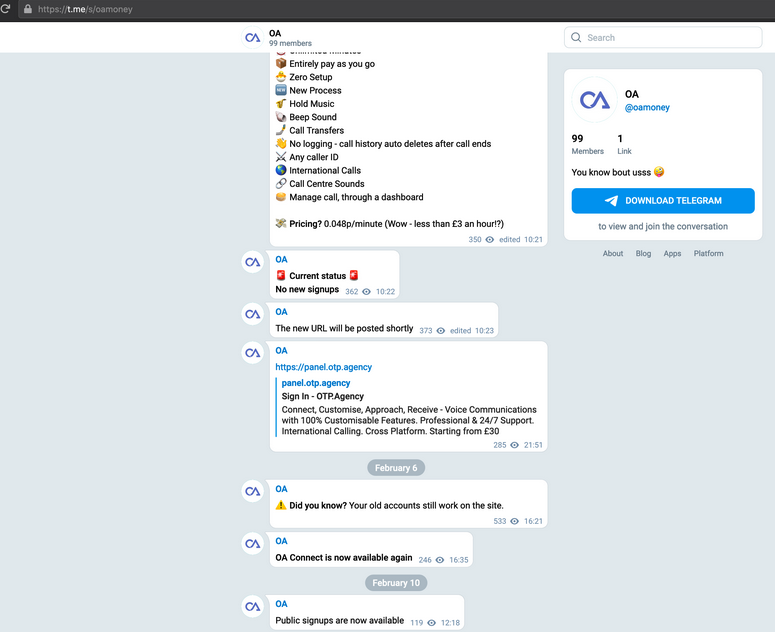
Despite deleting its Telegram channel, OTP Agency evidently found it difficult to walk away from its customers (and/or the money). Instead of shutting down as Vijayanathan wisely advised, just a few days later OTP Agency was communicating with customers on a new Telegram channel, offering a new login page and assuring existing customers that their usernames, passwords and balances would remain the same.

OTP Agency, immediately after their initial shutdown, telling customers their existing logins will still work.

But that revival would be short-lived. The NCA said the site was taken offline less than a month later when the trio were arrested. NCA investigators said more than 12,500 people were targeted by OTP Agency users during the 18 month the service was active.

Picari was the owner, developer and main beneficiary of the service, and his personal information and ownership of OTP Agency was revealed in February 2020 in a “dox” posted to the now-defunct English-language cybercrime forum Raidforums. The NCA said it began investigating the service in June 2020.

The OTP Agency operators who pleaded guilty to running the service; Aza Siddeeque, Callum Picari, and Vijayasidhurshan Vijayanathan.

OTP Agency might be gone, but several other similar OTP interception services are still in operation and accepting new customers, including a long-running service KrebsOnSecurity profiled in September 2021 called SMSRanger. More on SMSRanger in an upcoming post.

Text messages, emails and phone calls warning recipients about potential fraud are some of the most common scam lures. If someone (or something) calls saying they’re from your bank, or asks you to provide any personal or financial information, do not respond.  Just hang up, full stop.

If the call has you worried about the security and integrity of your account, check the account status online, or call your financial institution — ideally using a phone number that came from the bank’s Web site or from the back of your payment card.

Further reading: When in Doubt, Hang Up, Look Up, and Call Back

from Krebs on Security https://ift.tt/RFnGgav
via IFTTT

When Get-Out-The-Vote Efforts Look Like Phishing

Multiple media reports this week warned Americans to be on guard against a new phishing scam that arrives in a text message informing recipients they are not yet registered to vote. A bit of digging reveals the missives were sent by a California political consulting firm as part of a well-meaning but potentially counterproductive get-out-the-vote effort that had all the hallmarks of a phishing campaign.

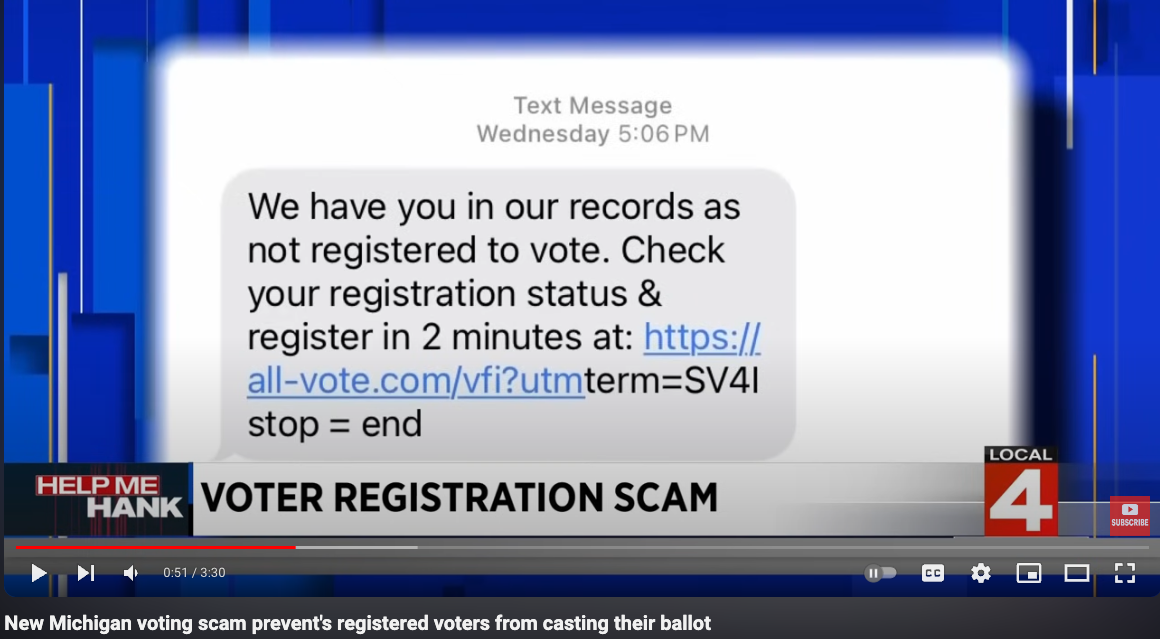
Image: WDIV Detroit on Youtube.

On Aug. 27, the local Channel 4 affiliate WDIV in Detroit warned about a new SMS message wave that they said could prevent registered voters from casting their ballot. The story didn’t explain how or why the scam could block eligible voters from casting ballots, but it did show one of the related text messages, which linked to the site all-vote.com.

“We have you in our records as not registered to vote,” the unbidden SMS advised. “Check your registration status & register in 2 minutes.”

Similar warnings came from an ABC station in Arizona, and from an NBC affiliate in Pennsylvania, where election officials just issued an alert to be on the lookout for scam messages coming from all-vote.com. Some people interviewed who received the messages said they figured it was a scam because they knew for a fact they were registered to vote in their state. WDIV even interviewed a seventh-grader from Canada who said he also got the SMS saying he wasn’t registered to vote.

Someone trying to determine whether all-vote.com was legitimate might visit the main URL first (as opposed to just clicking the link in the SMS) to find out more about the organization. But visiting all-vote.com directly presents one with a login page to an online service called bl.ink. DomainTools.com finds all-vote.com was registered on July 10, 2024. Red flag #1.

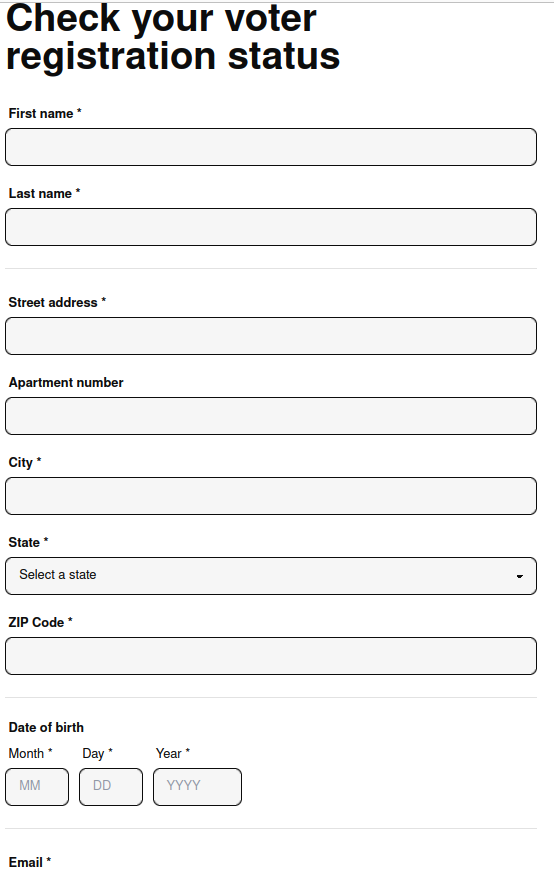
The information requested from people who visited votewin.org via the SMS campaign.

Another version of this SMS campaign told recipients to check their voter status at a site called votewin.org, which DomainTools says was registered July 9, 2024. There is little information about who runs votewin.org on its website, and the contact page leads to generic contact form. Red Flag #2.

What’s more, Votewin.org asks visitors to supply their name, address, email address, date of birth, mobile phone number, while pre-checking options to sign the visitor up for more notifications. Big Red Flag #3.

Votewin.org’s Terms of Service referenced a California-based voter engagement platform called VoteAmerica LLC. The same voter registration query form advertised in the SMS messages is available if one clicks the “check your registration status” link on voteamerica.org.

VoteAmerica founder Debra Cleaver told KrebsOnSecurity the entity responsible for the SMS campaigns telling people they weren’t registered is Movement Labs, a political consulting firm in San Francisco.

Cleaver said her office had received several inquiries about the messages, which violate a key tenet of election outreach: Never tell the recipient what their voter status may be.

“That’s one of the worst practices,” Cleaver said. “You never tell someone what the voter file says because voter files are not reliable, and are often out of date.”

Reached via email, Movement Labs founder Yoni Landau said the SMS campaigns targeted “underrepresented groups in the electorate, young people, folks who are moving, low income households and the like, who are unregistered in our databases, with the intent to help them register to vote.”

Landau said filling out the form on Votewin.org merely checks to see if the visitor is registered to vote in their state, and then attempts to help them register if not.

“We understand that many people are jarred by the messages – we tested hundreds of variations of messages and found that these had the largest impact on someone’s likelihood to register,” he said. “I’m deeply sorry for anyone that may have gotten the message in error, who is registered to vote, and we’re looking into our content now to see if there are any variations that might be less certain but still as effective in generating new legal registrations.”

Cleaver said Movement Labs’ SMS campaign may have been incompetent, but it wasn’t malicious.

“When you work in voter mobilization, it’s not enough to want to do good, you actually need to be good,” she said. “At the end of the day the end result of incompetence and maliciousness is the same: increased chaos, reduced voter turnout, and long-term harm to our democracy.”

from Krebs on Security https://ift.tt/DoRIltP
via IFTTT

New 0-Day Attacks Linked to China’s ‘Volt Typhoon’

Malicious hackers are exploiting a zero-day vulnerability in Versa Director, a software product used by many Internet and IT service providers. Researchers believe the activity is linked to Volt Typhoon, a Chinese cyber espionage group focused on infiltrating critical U.S. networks and laying the groundwork for the ability to disrupt communications between the United States and Asia during any future armed conflict with China.

Image: Shutterstock.com

Versa Director systems are primarily used by Internet service providers (ISPs), as well as managed service providers (MSPs) that cater to the IT needs of many small to mid-sized businesses simultaneously. In a security advisory published Aug. 26, Versa urged customers to deploy a patch for the vulnerability (CVE-2024-39717), which the company said is fixed in Versa Director 22.1.4 or later.

Versa said the weakness allows attackers to upload a file of their choosing to vulnerable systems. The advisory placed much of the blame on Versa customers who “failed to implement system hardening and firewall guidelines…leaving a management port exposed on the internet that provided the threat actors with initial access.”

Versa’s advisory doesn’t say how it learned of the zero-day flaw, but its vulnerability listing at mitre.org acknowledges “there are reports of others based on backbone telemetry observations of a 3rd party provider, however these are unconfirmed to date.”

Those third-party reports came in late June 2024 from Michael Horka, senior lead information security engineer at Black Lotus Labs, the security research arm of Lumen Technologies, which operates one of the global Internet’s largest backbones.

In an interview with KrebsOnSecurity, Horka said Black Lotus Labs identified a web-based backdoor on Versa Director systems belonging to four U.S. victims and one non-U.S. victim in the ISP and MSP sectors, with the earliest known exploit activity occurring at a U.S. ISP on June 12, 2024.

“This makes Versa Director a lucrative target for advanced persistent threat (APT) actors who would want to view or control network infrastructure at scale, or pivot into additional (or downstream) networks of interest,” Horka wrote in a blog post published today.

Black Lotus Labs said it assessed with “medium” confidence that Volt Typhoon was responsible for the compromises, noting the intrusions bear the hallmarks of the Chinese state-sponsored espionage group — including zero-day attacks targeting IT infrastructure providers, and Java-based backdoors that run in memory only.

In May 2023, the National Security Agency (NSA), the Federal Bureau of Investigation (FBI), and the Cybersecurity Infrastructure Security Agency (CISA) issued a joint warning (PDF) about Volt Typhoon, also known as “Bronze Silhouette” and “Insidious Taurus,” which described how the group uses small office/home office (SOHO) network devices to hide their activity.

In early December 2023, Black Lotus Labs published its findings on “KV-botnet,” thousands of compromised SOHO routers that were chained together to form a covert data transfer network supporting various Chinese state-sponsored hacking groups, including Volt Typhoon.

In January 2024, the U.S. Department of Justice disclosed the FBI had executed a court-authorized takedown of the KV-botnet shortly before Black Lotus Labs released its December report.

In February 2024, CISA again joined the FBI and NSA in warning Volt Typhoon had compromised the IT environments of multiple critical infrastructure organizations — primarily in communications, energy, transportation systems, and water and wastewater sectors — in the continental and non-continental United States and its territories, including Guam.

“Volt Typhoon’s choice of targets and pattern of behavior is not consistent with traditional cyber espionage or intelligence gathering operations, and the U.S. authoring agencies assess with high confidence that Volt Typhoon actors are pre-positioning themselves on IT networks to enable lateral movement to OT [operational technology] assets to disrupt functions,” that alert warned.

In a speech at Vanderbilt University in April, FBI Director Christopher Wray said China is developing the “ability to physically wreak havoc on our critical infrastructure at a time of its choosing,” and that China’s plan is to “land blows against civilian infrastructure to try to induce panic.”

Ryan English, an information security engineer at Lumen, said it’s disappointing his employer didn’t at least garner an honorable mention in Versa’s security advisory. But he said he’s glad there are now a lot fewer Versa systems exposed to this attack.

“Lumen has for the last nine weeks been very intimate with their leadership with the goal in mind of helping them mitigate this,” English said. “We’ve given them everything we could along the way, so it kind of sucks being referenced just as a third party.”

from Krebs on Security https://ift.tt/xBInjvT
via IFTTT

Local Networks Go Global When Domain Names Collide

The proliferation of new top-level domains (TLDs) has exacerbated a well-known security weakness: Many organizations set up their internal Microsoft authentication systems years ago using domain names in TLDs that didn’t exist at the time. Meaning, they are continuously sending their Windows usernames and passwords to domain names they do not control and which are freely available for anyone to register. Here’s a look at one security researcher’s efforts to map and shrink the size of this insidious problem.

At issue is a well-known security and privacy threat called “namespace collision,” a situation where domain names intended to be used exclusively on an internal company network end up overlapping with domains that can resolve normally on the open Internet.

Windows computers on a private corporate network validate other things on that network using a Microsoft innovation called Active Directory, which is the umbrella term for a broad range of identity-related services in Windows environments. A core part of the way these things find each other involves a Windows feature called “DNS name devolution,” a kind of network shorthand that makes it easier to find other computers or servers without having to specify a full, legitimate domain name for those resources.

Consider the hypothetical private network internalnetwork.example.com: When an employee on this network wishes to access a shared drive called “drive1,” there’s no need to type “drive1.internalnetwork.example.com” into Windows Explorer; entering “\\drive1\” alone will suffice, and Windows takes care of the rest.

But problems can arise when an organization has built their Active Directory network on top of a domain they don’t own or control. While that may sound like a bonkers way to design a corporate authentication system, keep in mind that many organizations built their networks long before the introduction of hundreds of new top-level domains (TLDs), like .network, .inc, and .llc.

For example, a company in 1995 builds their Microsoft Active Directory service around the domain company.llc, perhaps reasoning that since .llc wasn’t even a routable TLD, the domain would simply fail to resolve if the organization’s Windows computers were ever used outside of its local network.

Alas, in 2018, the .llc TLD was born and began selling domains. From then on, anyone who registered company.llc would be able to passively intercept that organization’s Microsoft Windows credentials, or actively modify those connections in some way — such as redirecting them somewhere malicious.

Philippe Caturegli, founder of the security consultancy Seralys, is one of several researchers seeking to chart the size of the namespace collision problem. As a professional penetration tester, Caturegli has long exploited these collisions to attack specific targets that were paying to have their cyber defenses probed. But over the past year, Caturegli has been gradually mapping this vulnerability across the Internet by looking for clues that appear in self-signed security certificates (e.g. SSL/TLS certs).

Caturegli has been scanning the open Internet for self-signed certificates referencing domains in a variety of TLDs likely to appeal to businesses, including .ad, .associates, .center, .cloud, .consulting, .dev, .digital, .domains, .email, .global, .gmbh, .group, .holdings, .host, .inc, .institute, .international, .it, .llc, .ltd, .management, .ms, .name, .network, .security, .services, .site, .srl, .support, .systems, .tech, .university, .win and .zone, among others.

Seralys found certificates referencing more than 9,000 distinct domains across those TLDs. Their analysis determined many TLDs had far more exposed domains than others, and that about 20 percent of the domains they found ending .ad, .cloud and .group remain unregistered.

“The scale of the issue seems bigger than I initially anticipated,” Caturegli said in an interview with KrebsOnSecurity. “And while doing my research, I have also identified government entities (foreign and domestic), critical infrastructures, etc. that have such misconfigured assets.”

REAL-TIME CRIME

Some of the above-listed TLDs are not new and correspond to country-code TLDs, like .it for Italy, and .ad, the country-code TLD for the tiny nation of Andorra. Caturegli said many organizations no doubt viewed a domain ending in .ad as a convenient shorthand for an internal Active Directory setup, while being unaware or unworried that someone could actually register such a domain and intercept all of their Windows credentials and any unencrypted traffic.

When Caturegli discovered an encryption certificate being actively used for the domain memrtcc.ad, the domain was still available for registration. He then learned the .ad registry requires prospective customers to show a valid trademark for a domain before it can be registered.

Undeterred, Caturegli found a domain registrar that would sell him the domain for $160, and handle the trademark registration for another $500 (on subsequent .ad registrations, he located a company in Andorra that could process the trademark application for half that amount).

Caturegli said that immediately after setting up a DNS server for memrtcc.ad, he began receiving a flood of communications from hundreds of Microsoft Windows computers trying to authenticate to the domain. Each request contained a username and a hashed Windows password, and upon searching the usernames online Caturegli concluded they all belonged to police officers in Memphis, Tenn.

“It looks like all of the police cars there have a laptop in the cars, and they’re all attached to this memrtcc.ad domain that I now own,” Caturegli said, noting wryly that “memrtcc” stands for “Memphis Real-Time Crime Center.”

Caturegli said setting up an email server record for memrtcc.ad caused him to begin receiving automated messages from the police department’s IT help desk, including trouble tickets regarding the city’s Okta authentication system.

Mike Barlow, information security manager for the City of Memphis, confirmed the Memphis Police’s systems were sharing their Microsoft Windows credentials with the domain, and that the city was working with Caturegli to have the domain transferred to them.

“We are working with the Memphis Police Department to at least somewhat mitigate the issue in the meantime,” Barlow said.

Domain administrators have long been encouraged to use .local for internal domain names, because this TLD is reserved for use by local networks and cannot be routed over the open Internet. However, Caturegli said many organizations seem to have missed that memo and gotten things backwards — setting up their internal Active Directory structure around the perfectly routable domain local.ad.

Caturegli said he knows this because he “defensively” registered local.ad, which he said is currently used by multiple large organizations for Active Directory setups — including a European mobile phone provider, and the City of Newcastle in the United Kingdom.

ONE WPAD TO RULE THEM ALL

Caturegli said he has now defensively registered a number of domains ending in .ad, such internal.ad and schema.ad. But perhaps the most dangerous domain in his stable is wpad.ad. WPAD stands for Web Proxy Auto-Discovery Protocol, which is an ancient, on-by-default feature built into every version of Microsoft Windows that was designed to make it simpler for Windows computers to automatically find and download any proxy settings required by the local network.

Trouble is, any organization that chose a .ad domain they don’t own for their Active Directory setup will have a whole bunch of Microsoft systems constantly trying to reach out to wpad.ad if those machines have proxy automated detection enabled.

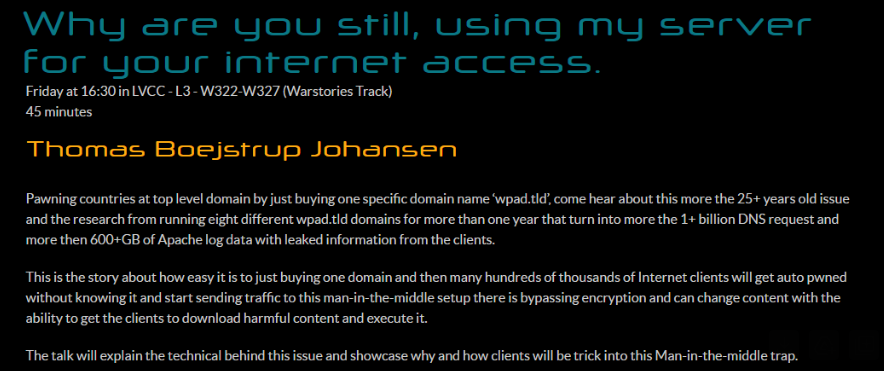
Security researchers have been beating up on WPAD for more than two decades now, warning time and again how it can be abused for nefarious ends. At this year’s DEF CON security conference in Las Vegas, for example, a researcher showed what happened after they registered the domain wpad.dk: Immediately after switching on the domain, they received a flood of WPAD requests from Microsoft Windows systems in Denmark that had namespace collisions in their Active Directory environments.

Image: Defcon.org.

For his part, Caturegli set up a server to resolve and record the Internet address of any Microsoft Sharepoint systems trying to reach wpad.ad, and saw that over one week it received more than 140,000 hits from Sharepoint hosts around the world attempting to connect.

The fundamental problem with WPAD is the same with Active Directory: Both are technologies originally designed to be used in closed, static, trusted office environments, and neither was built with today’s mobile devices or workforce in mind.

Probably one big reason organizations with potential namespace collision problems don’t fix them is that rebuilding one’s Active Directory infrastructure around a new domain name can be incredibly disruptive, costly, and risky, while the potential threat is considered comparatively low.

But Caturegli said ransomware gangs and other cybercrime groups could siphon huge volumes of Microsoft Windows credentials from quite a few companies with just a small up-front investment.

“It’s an easy way to gain that initial access without even having to launch an actual attack,” he said. “You just wait for the misconfigured workstation to connect to you and send you their credentials.”

If we ever learn that cybercrime groups are using namespace collisions to launch ransomware attacks, nobody can say they weren’t warned. Mike O’Connor, an early domain name investor who registered a number of choice domains such as bar.com, place.com and television.com, warned loudly and often back in 2013 that then-pending plans to add more than 1,000 new TLDs would massively expand the number of namespace collisions. O’Connor was so concerned about the problem that he offered $50,000, $25,000 and $10,000 prizes for researchers who could propose the best solutions for mitigating it.

Mr. O’Connor’s most famous domain is corp.com, because for several decades he watched in horror as hundreds of thousands of Microsoft PCs continuously blasted his domain with credentials from organizations that had set up their Active Directory environment around the domain corp.com.

It turned out that Microsoft had actually used corp.com as an example of how one might set up Active Directory in some editions of Windows NT. Worse, some of the traffic going to corp.com was coming from Microsoft’s internal networks, indicating some part of Microsoft’s own internal infrastructure was misconfigured. When O’Connor said he was ready to sell corp.com to the highest bidder in 2020, Microsoft agreed to buy the domain for an undisclosed amount.

“I kind of imagine this problem to be something like a town [that] knowingly built a water supply out of lead pipes, or vendors of those projects who knew but didn’t tell their customers,” O’Connor told KrebsOnSecurity. “This is not an inadvertent thing like Y2K where everybody was surprised by what happened. People knew and didn’t care.”

from Krebs on Security https://ift.tt/fEBVGRs
via IFTTT